
How to solve simple equations
Answer in short
To solve an equation, get the unknown alone on one side. Do the same operation to both sides so it stays balanced: undo additions and subtractions first, then multiplications and divisions. For 5x − 4 = 7, add 4 to get 5x = 11, then divide by 5: x = 11/5. Then put the answer back to check.
Stuck on a question? Take a photo and Lagnever AI explains it step by step. Try it for 7 days for ₹2. Get it on Google Play
What is an equation?
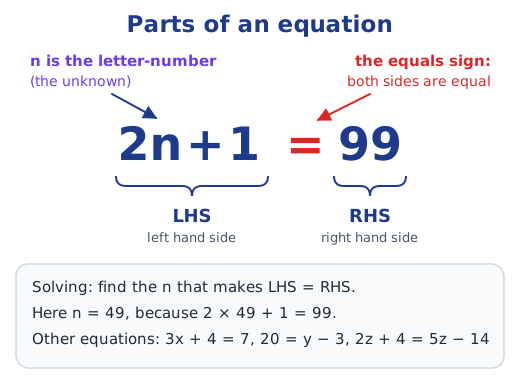
An equation is a statement that two expressions are equal, such as 2n + 1 = 99 or 2z + 4 = 5z − 14. The part before the equals sign is the left hand side (LHS) and the part after it is the right hand side (RHS). The letter stands for an unknown number. Solving the equation means finding the value of the letter that makes LHS and RHS equal; that value is the solution.
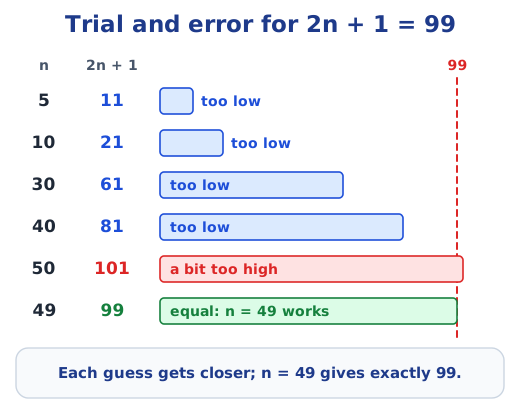
Trial and error
One way is to try values. For 2n + 1 = 99, n = 5 gives only 11 and n = 30 gives 61. n = 40 gives 81, closer, and n = 50 gives 101, just too much. Then n = 49 gives exactly 99. No other value works, because each step up in n adds 2 to the LHS. Guessing works here, but for 5x − 4 = 7 the answer is not even a whole number, so we need a method that always works.
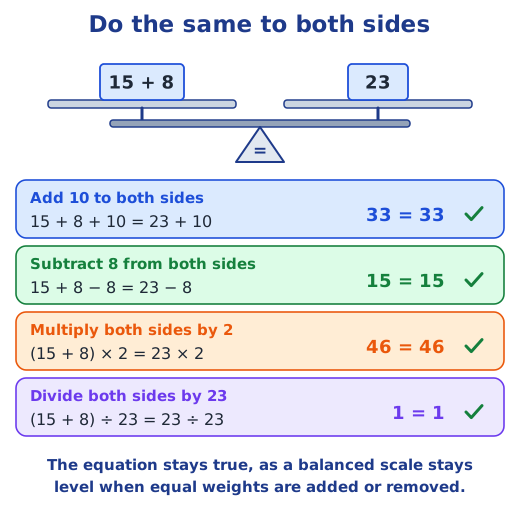
Keep the balance
Think of a pan balance. If both pans hold equal weights, taking the same weight off each pan, or adding the same weight to each, keeps it level. An equation behaves the same way. Start with 15 + 8 = 23: add 10 to both sides and you get 33 = 33; multiply both sides by 2 and you get 46 = 46. Whatever you do to one side, do the same to the other, and the equation stays true. (Only division by zero is not allowed.)
Solving step by step
The plan is to leave the unknown alone on one side. For 5x − 4 = 7, the − 4 is in the way, so add 4 to both sides: 5x = 11. Now the factor 5 is in the way, so divide both sides by 5: x = 11/5, or 2.2. Undo additions and subtractions first, then multiplications and divisions.
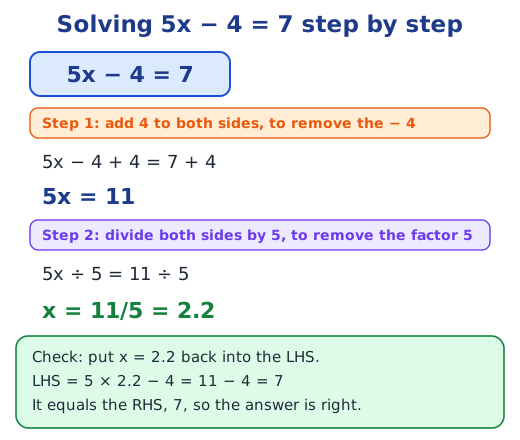
Always check. Put x = 2.2 back: 5 × 2.2 − 4 = 11 − 4 = 7, which is the RHS, so the answer is right. In the same way, 11y + (−5) = 61 gives 11y = 66 and y = 6, and 6 × 11 − 5 = 61 confirms it.
Unknowns on both sides
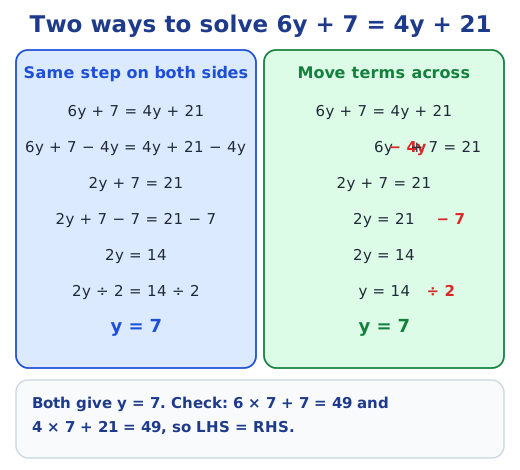
In 6y + 7 = 4y + 21, the unknown appears on both sides. Subtract 4y from both sides first: 2y + 7 = 21. Then subtract 7: 2y = 14. Then divide by 2: y = 7. Brackets are opened first: 4(m + 6) − 8 = 2m − 4 becomes 4m + 16 = 2m − 4, so 2m = −20 and m = −10.
A faster way: moving terms across
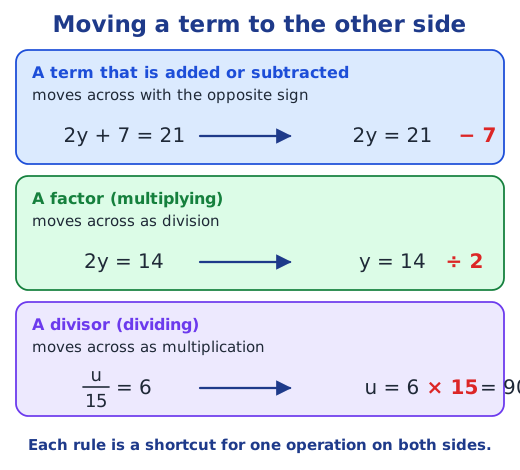
Look at what each step does. Subtracting 7 from both sides of 2y + 7 = 21 simply makes the + 7 disappear on the left and appear as − 7 on the right: 2y = 21 − 7. So we can write that step at once. Three rules follow:
- A term that is added or subtracted moves across with the opposite sign (its additive inverse).
- A factor that multiplies one side moves across as division: 2y = 14 gives y = 14 ÷ 2.
- A divisor moves across as multiplication: u ÷ 15 = 6 gives u = 6 × 15 = 90.
Mind the mistake
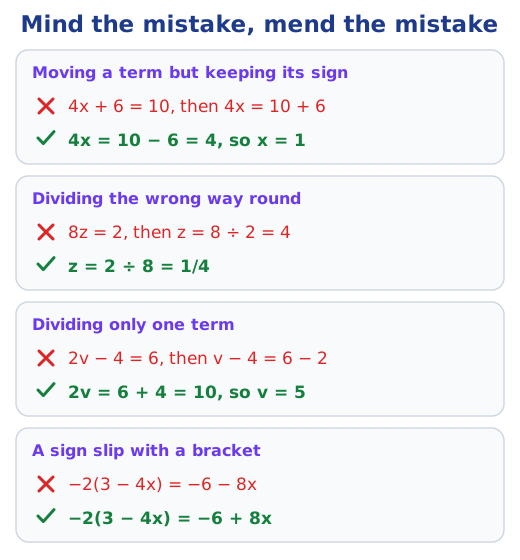
Most errors come from moving a term but keeping its sign, dividing only one term of a side, dividing the wrong way round (8z = 2 gives z = 2/8, not 4), and sign slips with brackets: −2(3 − 4x) is −6 + 8x. An equation can also have no solution: x + 4 = x + 5 can never be true.
Why it matters
These few steps solve every equation in the chapter and many later ones. Use them on stories in word problems on equations, and see how Indian mathematicians solved equations in bijaganita: algebra in ancient India. Answers to the textbook questions are in the NCERT solutions for Part 2 Chapter 7; see all of Part 2 Chapter 7 notes.
Practice
-
What is the first step to solve 5x − 4 = 7?
Show answer
Answer: (b) Add 4 to both sides
-
If u ÷ 15 = 6, what is u?
Show answer
Answer: (b) 90
-
Solve 4(m + 6) − 8 = 2m − 4.
Show answer
Answer: (b) m = −10
-
Solve 6y + 7 = 4y + 21 and check your answer.
Show answer
Answer: Subtract 4y from both sides: 2y + 7 = 21. Subtract 7 from both sides: 2y = 14, so y = 7. Check: 6 × 7 + 7 = 49 and 4 × 7 + 21 = 49, so the two sides match.
-
Frame an equation that has no solution.
Show answer
Answer: x + 4 = x + 5. Four more than a number can never equal five more than the same number: subtracting x from both sides leaves 4 = 5, which is false, so no value of x works.
Questions students ask
What does solving an equation mean?
It means finding the value of the letter-number that makes the left hand side equal to the right hand side. For 2n + 1 = 99 that value is 49, because 2 × 49 + 1 = 99. This value is the solution of the equation.
Why do we do the same thing to both sides of an equation?
Because the two sides are equal to begin with. Adding, subtracting, multiplying or dividing both by the same number gives two new values that are still equal, just as a balanced scale stays level when equal weights are added to or taken off both pans.
Is moving a term across the same as doing one step on both sides?
Yes. Writing 2y + 7 = 21 as 2y = 21 − 7 is a short way of subtracting 7 from both sides, and writing 2y = 14 as y = 14 ÷ 2 is a short way of dividing both sides by 2. The result is the same either way.
Stuck on a question?
Take a photo and Lagnever AI explains it step by step. Try it for 7 days for ₹2.
Get it on Google Play Open in browser
For parents: after the trial, the plan renews monthly by UPI or card autopay. You can cancel anytime in the app.