
Bijaganita: algebra in ancient India
Answer in short
Bijaganita is the old Indian name for algebra, the mathematics of finding unknown numbers with symbols. Bija means seed: the answer hides in the unknown as a tree hides in a seed. Aryabhata and Brahmagupta gave methods for equations, Bhaskaracharya wrote a book called Bijaganita, and the ideas reached Europe through Al-Khwarizmi, whose al-jabr gave us the word algebra.
Stuck on a question? Take a photo and Lagnever AI explains it step by step. Try it for 7 days for ₹2. Get it on Google Play
What does bijaganita mean?
Writing numbers with symbols and solving equations was a big part of mathematics in ancient India. This branch was called bijaganita, which we now call algebra. Bija means seed. A seed holds a whole tree inside it, and an unknown number holds the answer to a problem; solving the problem is like letting the tree grow, one step at a time.
Brahmagupta and the unknowns
In Chapter 18 of his book Brahmasphutasiddhanta (628 CE), Brahmagupta showed how unknown numbers written as symbols can be added, subtracted and multiplied, much as we use x and y today. It is one of the earliest known works on algebra anywhere. The mathematician David Mumford, a winner of the Fields Medal, called Brahmagupta the central figure in creating algebra as we know it.
How the ideas travelled
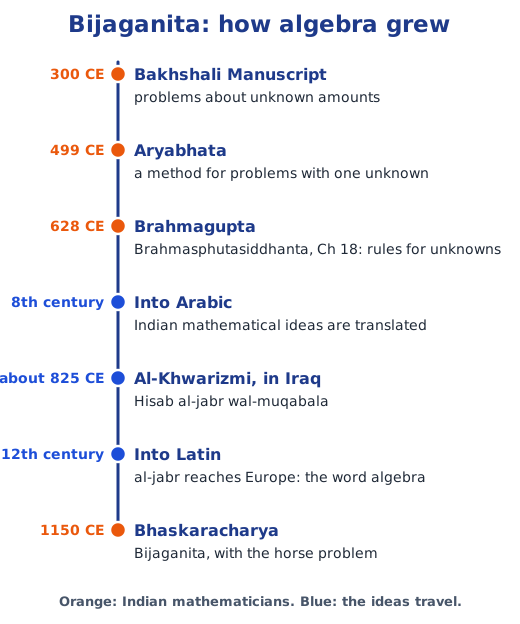
During the 8th century, works of Indian mathematics were put into Arabic, and they shaped the thinking of Al-Khwarizmi, who lived in what is now Iraq. Around 825 CE he wrote Hisab al-jabr wal-muqabala, meaning “the calculation of restoring and balancing”. In the 12th century his book was translated into Latin and became popular in Europe, and al-jabr turned into the word algebra that we still use.
The old Indian notation
From Brahmagupta’s time, Indian mathematicians used short syllables for unknowns. ya was short for yavat-tavat, “as much as”, and was used for the first unknown. ka and ni came from the colour names kalaka (black) and nilaka (blue), and pi and lo were used too. (Extra: these two are usually explained as pitaka, yellow, and lohita, red.) A known number was marked ru, from rupa, form.
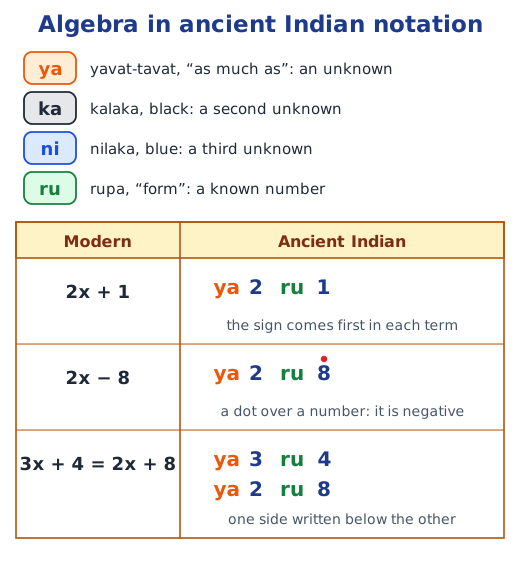
The sign came first in each term, so 2x + 1 was written ya 2 ru 1. A dot over a number showed it was negative, so 2x − 8 was ya 2 ru 8 with a dot over the 8. In an equation, the two sides were written one below the other instead of with an equals sign.
Brahmagupta’s rule
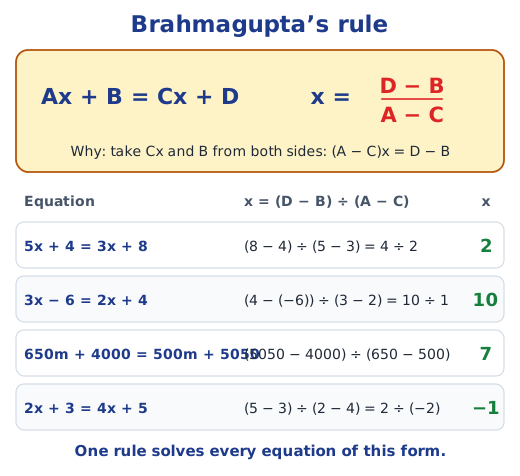
A systematic way of solving problems with one unknown was first given by Aryabhata (499 CE), and Brahmagupta set it out in 628 CE. For any equation of the form Ax + B = Cx + D, the answer is
x = (D − B) ÷ (A − C).
Why? Take Cx and B away from both sides: Ax − Cx = D − B, that is (A − C)x = D − B, and divide by A − C. For 5x + 4 = 3x + 8 the rule gives (8 − 4) ÷ (5 − 3) = 2. For the savings equation 650m + 4000 = 500m + 5050 it gives (5050 − 4000) ÷ (650 − 500) = 7 straight away.
Bhaskaracharya’s horse problem
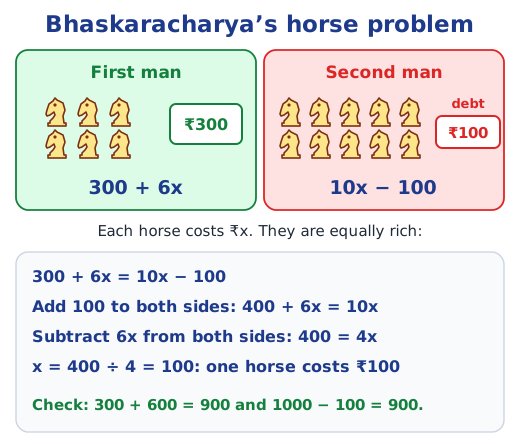
Bhaskaracharya wrote the book Bijaganita in 1150 CE. One of its problems: a man has ₹300 and 6 horses; another has 10 horses but owes ₹100. If they are equally rich and every horse costs the same, what is the price of a horse? Let a horse cost ₹x. Then 300 + 6x = 10x − 100. Adding 100 to both sides gives 400 + 6x = 10x, and taking 6x from both sides gives 400 = 4x, so x = 100. A horse costs ₹100.
A sharing problem from the Bakhshali Manuscript
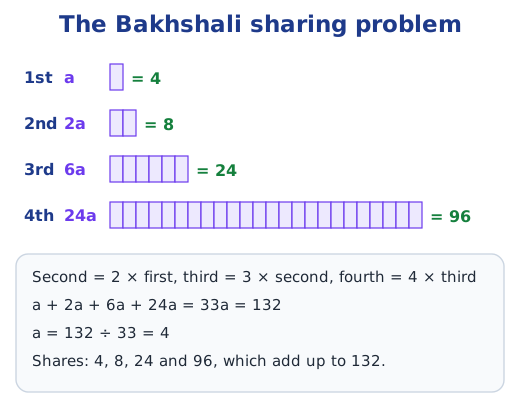
The Bakhshali Manuscript, which the chapter dates to 300 CE, has a sharing puzzle. The first person gets an unknown amount, the second twice as much, the third three times the second and the fourth four times the third, and 132 is shared in all. With a for the first share, the shares are a, 2a, 6a and 24a, so 33a = 132 and a = 4.
Why it matters
Indian mathematicians turned hard ideas into simple procedures that anyone could follow, and algebra still lets us describe patterns, prove claims such as “odd + odd is even” and solve problems of many kinds. Practise the methods in solving simple equations and word problems on equations. Answers to the textbook questions are in the NCERT solutions for Part 2 Chapter 7; see all of Part 2 Chapter 7 notes.
Practice
-
What does the word bija mean?
Show answer
Answer: (b) Seed
-
In the old Indian notation, what did a dot over a number show?
Show answer
Answer: (b) It was negative
-
Which word in the title of Al-Khwarizmi’s book gave us the word algebra?
Show answer
Answer: (c) al-jabr
-
Use Brahmagupta’s rule to solve 5x + 4 = 3x + 8.
Show answer
Answer: Here A = 5, B = 4, C = 3 and D = 8, so x = (8 − 4) ÷ (5 − 3) = 4 ÷ 2 = 2. Check: 5 × 2 + 4 = 14 and 3 × 2 + 8 = 14.
-
The second person gets twice the first, the third three times the second and the fourth four times the third. The total is 132. What does the first get?
Show answer
Answer: If the first gets a, the others get 2a, 6a and 24a, so a + 2a + 6a + 24a = 33a = 132 and a = 4. The four shares are 4, 8, 24 and 96.
Questions students ask
What is bijaganita?
Bijaganita is the Indian name for algebra: using letters or symbols for unknown numbers, writing equations and solving them. Bija means seed. Just as a seed holds a whole tree, the unknown holds the answer, and solving the equation lets it grow out step by step.
Who gave the first systematic method for one unknown?
The chapter says Aryabhata (499 CE) was the first to give an orderly method for problems with one unknown, and that Brahmagupta set it out in his Brahmasphutasiddhanta (628 CE). Brahmagupta also showed how to add, subtract and multiply unknowns written as letters.
How did the word algebra come from Arabic?
Indian mathematics was translated into Arabic in the 8th century. Around 825 CE Al-Khwarizmi wrote Hisab al-jabr wal-muqabala, the calculation of restoring and balancing. When the book was put into Latin in the 12th century, al-jabr became algebra.
Stuck on a question?
Take a photo and Lagnever AI explains it step by step. Try it for 7 days for ₹2.
Get it on Google Play Open in browser
For parents: after the trial, the plan renews monthly by UPI or card autopay. You can cancel anytime in the app.