
NCERT Solutions Class 7 Maths Part 2 Chapter 7: Finding the Unknown
Answers to every question in Part 2 Chapter 7, Finding the Unknown, of Ganita Prakash Grade 7 (2026-27): the weighing puzzles, every question in the text, every Figure it Out, Math Talk and Try This, Mind the Mistake, the history problems and A Magic Trick. Page numbers follow the book (pages 164–190). Each answer was checked by putting it back into its equation. Short notes: Part 2 Chapter 7 notes.
Unknown weights (pages 164–166)
How the hanging scale works. The number at the top is the total weight hanging from the bar. A level bar means the two sides weigh the same, so each side carries half the total.
Fig. 7.1. Total 16, so each side is 8. Left: 3 + turtle + 3 = 8, so the turtle is 2. Right: the flower is 8.
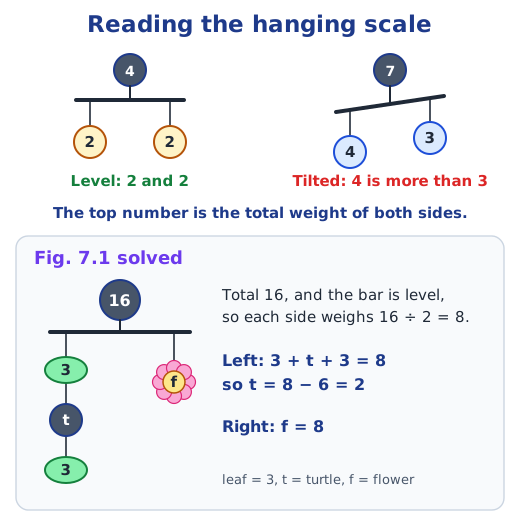
Fig. 7.2. Total 24, so each side is 12. Left: 2 + fish + 2 = 12, so the fish is 8. Right: 8 + submarine = 12, so the submarine is 4.
Fig. 7.3. Total 8, so each side is 4. The book is 4. The two pencil boxes hang level on a small bar, so each pencil box is 2.
Fig. 7.4. Total 18, so each side is 9. Left: 5 + 4 clouds = 9, so each cloud is 1. Right: 3 bolts = 9, so each lightning bolt is 3.
Fig. 7.5. Total 40, so each side is 20. Right: 4 crowns = 20, so each crown is 5. Left: 5 + 5 gems = 20, so each gem is 3.
Fig. 7.6. Three slices of bread make 2 + 2 + 2 = 6, so the two eggs weigh 6 and each egg is 3.
Fig. 7.7. Four crosses make 16. The other side is 4 + two rings, so the two rings weigh 12 and each ring is 6.
Fig. 7.8. The watermelon is 10. The other side is 4 + two bananas, so each banana is 3.
Math Talk: discuss your answers. Each answer can be defended in the same way: the bar is level, so the two sides are equal; the known weights fix what the unknown must be; and putting the value back makes both sides match.
Fig. 7.9. Both pans hold a 2 kg weight. Take it off both: the sack weighs 10 kg.
Fig. 7.10. Take one sack off each pan. One sack is left to balance 10 kg + 4 kg, so a sack weighs 14 kg.
Fig. 7.11. Five sacks balance two sacks with 10 kg, 10 kg and 1 kg. Take two sacks off each pan: three sacks balance 21 kg, so a sack weighs 7 kg.
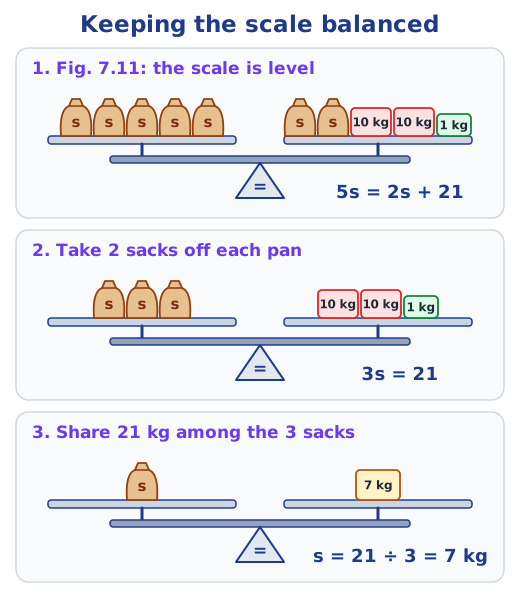
Fig. 7.12. 90 sacks and 50 kg balance 60 sacks and 500 kg. Take 60 sacks and 50 kg off both pans: 30 sacks balance 450 kg, so a sack weighs 15 kg.
The matchstick pattern (pages 166–167)
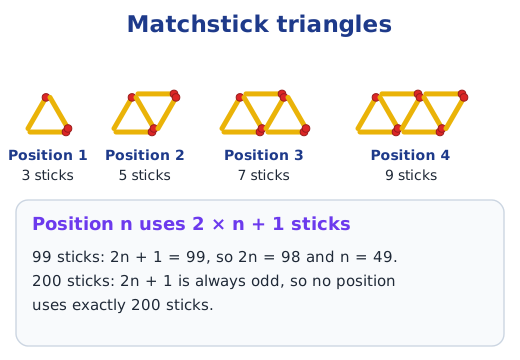
Which position uses exactly 99 sticks? Position n uses 2n + 1 sticks, so we need 2n + 1 = 99. Position 49.
Math Talk: ways to find n with 2n + 1 = 99. Undo the steps: take away 1 to get 98, then halve it to get 49. Or try values until 2n + 1 reaches 99. Or count on: position 1 has 3 sticks and each later position adds 2, so 3 + 2(n − 1) = 99 also gives n = 49.
Can an arrangement use exactly 200 sticks? No. 2n is always even, so 2n + 1 is always odd and can never be 200 (2n + 1 = 200 would need n = 99.5).
Framing equations (page 168)
Frame equations for Figs. 7.6 to 7.11 and solve them.
- Fig. 7.6 (egg e): 2e = 6, so e = 3.
- Fig. 7.7 (ring y): 4 + 2y = 16, so y = 6.
- Fig. 7.8 (banana b): 2b + 4 = 10, so b = 3.
- Fig. 7.9 (sack s): s + 2 = 10 + 2, so s = 10.
- Fig. 7.10: 2s = s + 10 + 4, so s = 14.
- Fig. 7.11: 5s = 2s + 10 + 10 + 1, so 3s = 21 and s = 7.
Every value is the same as the one found with the scales.
Math Talk: frame 5 equations and find ways to solve them. For example x + 9 = 15 (x = 6), 4y = 28 (y = 7), 3z − 2 = 13 (z = 5), p ÷ 4 = 5 (p = 20) and 2q + 3 = q + 8 (q = 5). Each can be solved by trial and error or, faster, by undoing the operations with the same step on both sides.
Solving equations systematically (pages 168–171)
Can 2n + 1 = 99 have another solution? No. Each time n goes up by 1, the LHS goes up by 2, so only n = 49 gives exactly 99.
Solve 5x − 4 = 7 by trial and error. x = 2 gives 6 and x = 3 gives 11, so x lies between 2 and 3. Trying decimals, x = 2.2 gives 11 − 4 = 7. So x = 2.2, which is 11/5. This shows how slow guessing can be.
Adding 10 to both sides of 15 + 8 = 23. 15 + 8 + 10 = 33 and 23 + 10 = 33, so the equality still holds. The same is true for subtracting, multiplying or dividing both sides by one number (except dividing by zero).
Example 1. 14593 − 1459 + 145 − 14 = 13353 − 88 = 13265, without working out the long expression. This works because subtraction undoes addition: taking 88 from both sides removes the + 88.
Example 2. 23 × 41 × 11 × 8 = 5,80,888 ÷ 7 = 82,984. Yes: dividing both sides by 7 takes the factor 7 off the LHS, leaving just the expression we want.
Example 3. Add (−67) to both sides to remove − (−67): 12345 − 5432 + 135 − 24 = 7091 + (−67) = 7024. (Check: 12345 − 5432 = 6913, + 135 = 7048, − 24 = 7024.) On page 170 the book prints + 132 instead of + 135; with + 132 the value would be 7021, so 7024 belongs to the question as asked on page 169.
Example 4. Divide both sides by 8/9, that is, multiply by 9/8: (35/113) × 24 × 14 = (94080/1017) × (9/8) = 11760/113. Check: 35 × 24 × 14 = 11760.
Solve 5x − 4 = 7 and check. Add 4 to both sides: 5x = 11. Divide both sides by 5: x = 11/5. Check: 5 × 11/5 − 4 = 11 − 4 = 7, which is the RHS.
Example 5. 11y + (−5) = 61 gives 11y = 66 and y = 6. Check: 11 × 6 + (−5) = 66 − 5 = 61.
Example 6. 6y + 7 = 4y + 21: subtract 4y to get 2y + 7 = 21, subtract 7 to get 2y = 14, so y = 7. Check: 49 = 49.
Figure it Out (page 172)
1. Solve and check.
- (a) 3x − 10 = 35: 3x = 45, so x = 15. Check: 45 − 10 = 35.
- (b) 5s = 3s: take 3s from both sides, 2s = 0, so s = 0. Check: 0 = 0.
- (c) 3u − 7 = 2u + 3: take 2u from both sides, u − 7 = 3, so u = 10. Check: 23 = 23.
- (d) 4(m + 6) − 8 = 2m − 4: 4m + 16 = 2m − 4, so 2m = −20 and m = −10. Check: 4 × (−4) − 8 = −24 and −20 − 4 = −24.
- (e) u ÷ 15 = 6: multiply both sides by 15, u = 90. Check: 90 ÷ 15 = 6.
2. Frame an equation with no solution. x + 4 = x + 5. Four more than a number is never equal to five more than the same number; taking x from both sides leaves 4 = 5, which is false. Another: 2x + 1 = 2(x + 3).
Solving problems (pages 174–179)
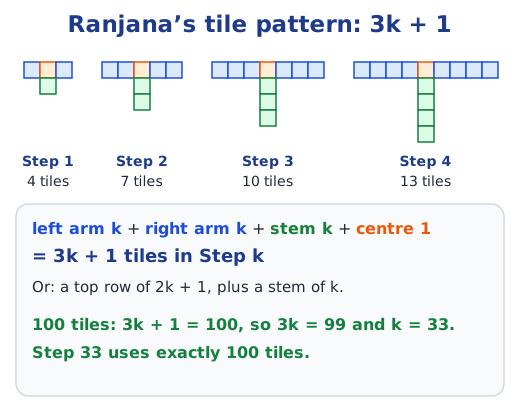
Example 7. Can Ranjana use exactly 100 tiles? Step k uses 3k + 1 tiles, so 3k + 1 = 100, 3k = 99 and k = 33. Yes, at Step 33.
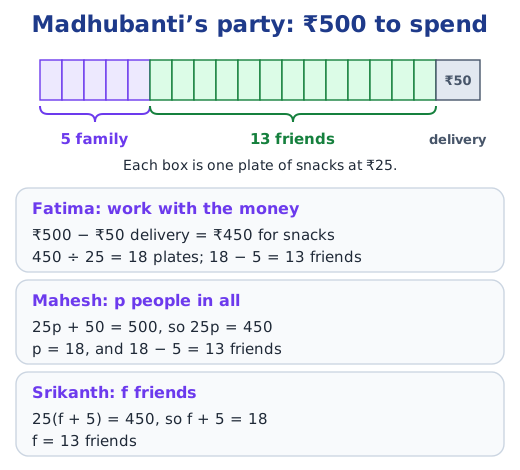
Example 8. How many friends can Madhubanti invite? With p people in all, 25p + 50 = 500, so 25p = 450 and p = 18. Taking away her family of 5, she can invite 13 friends. Srikanth’s way gives the same: 25(f + 5) = 450, so f + 5 = 18 and f = 13.
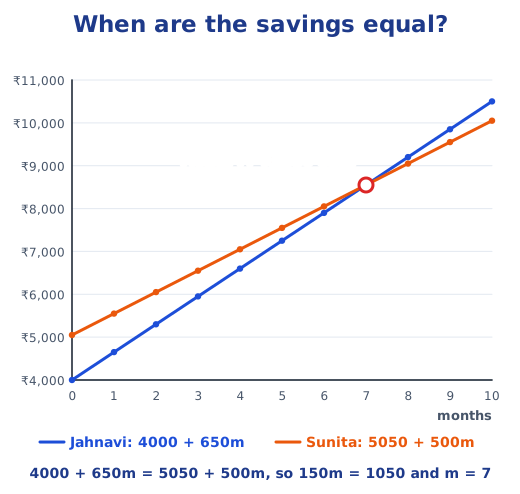
Example 9. Check the answer m = 7. Jahnavi: 4000 + 650 × 7 = 4000 + 4550 = ₹8,550. Sunita: 5050 + 500 × 7 = 5050 + 3500 = ₹8,550. Equal, so the answer is right.
Example 10. All three methods give x = 21. Check: 28 × (21 + 4) + 300 = 28 × 25 + 300 = 700 + 300 = 1000.
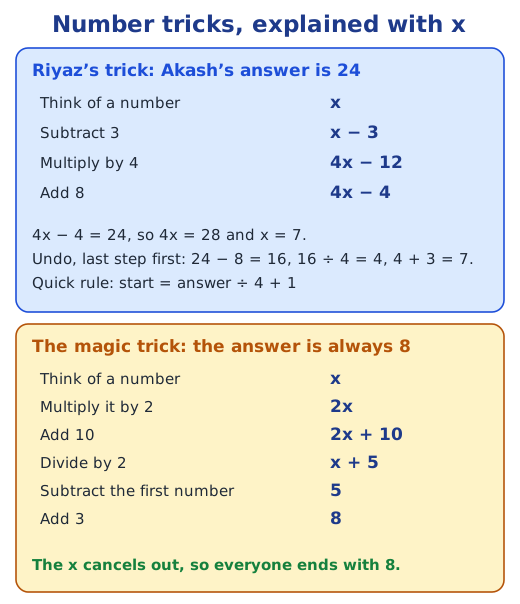
Example 11. Riyaz’s trick. 4x − 4 = 24 gives 4(x − 1) = 24, x − 1 = 6 and x = 7. Try other starting numbers: 5 gives 2, 8 and 16; 10 gives 7, 28 and 36. The final answer is always 4 × (start) − 4. Simple rule: divide the final answer by 4 and add 1 to get the starting number (24 ÷ 4 + 1 = 7).
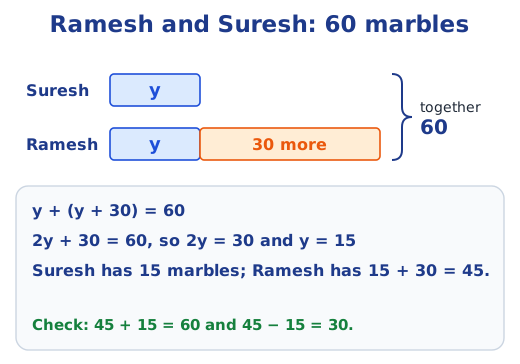
Example 12. Marbles. y + (y + 30) = 60 gives 2y + 30 = 60, 2y = 30 and y = 15. Suresh has 15 marbles and Ramesh 45. Check: 15 + 45 = 60 and 45 − 15 = 30.
Generating equations (pages 179–180)
Math Talk: equations whose solution is y = 5. For example 2y − 1 = 9, y ÷ 5 = 1, 10 − y = 5 and 4y = 3y + 5. Each was made by starting from y = 5 and doing the same operation to both sides, or can be checked by putting y = 5 in.
Form the chains from bottom to top. First chain: 5 = y; subtract 6 to get −1 = −6 + y; subtract y to get −1 − y = −6, that is −y − 1 = −6; multiply by −1 to get y + 1 = 6. Second chain: y = 5; add 2 to get y + 2 = 7; multiply by 3 to get 3y + 6 = 21; subtract 6 to get 3y = 15. Comparing: going up uses the opposite operation of each step going down, in reverse order.
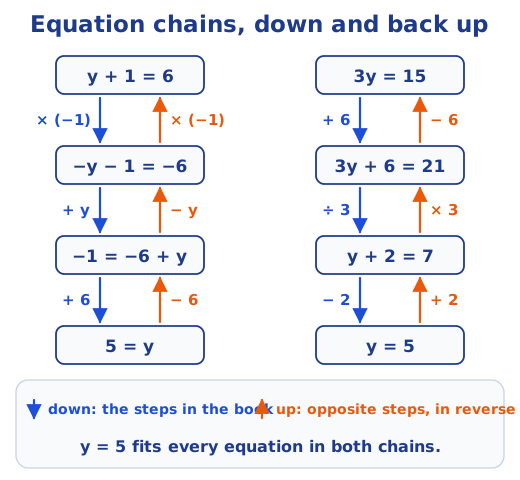
The unknown in each equation of the chains, without calculating. y = 5 in every one, because each equation was made from the one before by the same step on both sides, which keeps the same solution.
Example 13. A situation for 100x + 75 = 250. A school buys 100 pencils at ₹x each and pays ₹75 for delivery; the bill is ₹250. Then 100x = 175 and x = 1.75, so each pencil costs ₹1.75.
Figure it Out (page 181)
1. Five equations with solution x = −2. x + 5 = 3; 3x = −6; 2x + 7 = 3; 10 − x = 12; x ÷ 2 = −1. Putting x = −2 makes each one true.
2. Find the unknowns.
- (a) 2y = 60: y = 30.
- (b) −8 = 5x − 3: 5x = −5, so x = −1.
- (c) −53w = −15: w = 15/53.
- (d) 13 − z = 8: z = 5.
- (e) k + 8 = 12 − k: 2k = 4, so k = 2.
- (f) 7m = m − 3: 6m = −3, so m = −1/2.
- (g) 3n = 10 + n: 2n = 10, so n = 5.
3. The 3-digit number. Let the units digit be u. Then the tens digit is u − 3 and the hundreds digit is u − 6, so u + (u − 3) + (u − 6) = 15, 3u = 24 and u = 8. The number is 258. Check: 2 + 5 + 8 = 15.
4. The brick. Let the weight be w kg. Then w = w/2 + 1, so w/2 = 1 and w = 2 kg. Check: half of 2 is 1, and 1 + 1 = 2.
5. The number. n/4 + 9 = n, so 9 = 3n/4 and n = 12. Check: 12 ÷ 4 + 9 = 3 + 9 = 12.
6. Given 4k + 1 = 13, so 4k = 12 and k = 3:
- (a) 8k + 2 = 2(4k + 1) = 26
- (b) 4k = 12
- (c) k = 3
- (d) 4k − 1 = 11
- (e) −k − 2 = −5
Mind the Mistake, Mend the Mistake (pages 181–182)
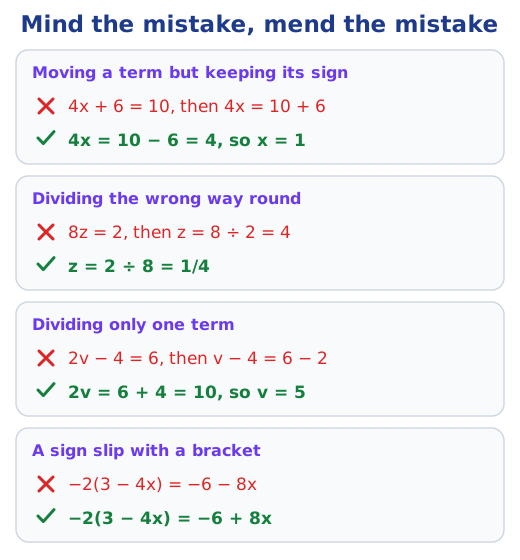
- 4x + 6 = 10. Wrong step: 4x = 10 + 6. Moving + 6 across makes it − 6: 4x = 10 − 6 = 4, so x = 1.
- 7 − 8z = 5. The step 8z = 7 − 5 = 2 is right, but z = 4 is wrong: 8 was divided by 2 instead of 2 by 8. z = 2/8 = 1/4.
- 2v − 4 = 6. Wrong step: v − 4 = 6 − 2 (the factor 2 was taken off only one term and subtracted). First move the 4: 2v = 10, so v = 5.
- 5z + 2 = 3z − 4. Wrong step: 5z + 3z = −4 + 2. Both moved terms should change sign: 5z − 3z = −4 − 2, so 2z = −6 and z = −3.
- 15w − 4w = 26. The step 15w = 26 + 4w is right, but 26 + 4w is not 30. Simplest: 11w = 26, so w = 26/11.
- 3x + 1 = −12. Wrong step: x + 1 = −12/3 (only 3x and −12 were divided). First take 1 away: 3x = −13, so x = −13/3.
- 4(4q + 2) = 50. Wrong step: 4(4q) = 50 − 2 (the 2 inside the bracket is really 4 × 2 = 8). 16q + 8 = 50, so 16q = 42 and q = 21/8.
- −2(3 − 4x) = 14. Wrong step: −6v − 8x = 14. The “v” is a slip, and −2 × (−4x) is + 8x. So −6 + 8x = 14, 8x = 20 and x = 5/2.
- 3(7y + 4) = 9 + 5y. Two wrong steps: dividing by 3 must divide 5y too, and 7y − 5y + 4 = 3 gives 2y = 3 − 4, not 4 − 3. Correct: 21y + 12 = 9 + 5y, so 16y = −3 and y = −3/16.
A Pinch of History (pages 182–184)
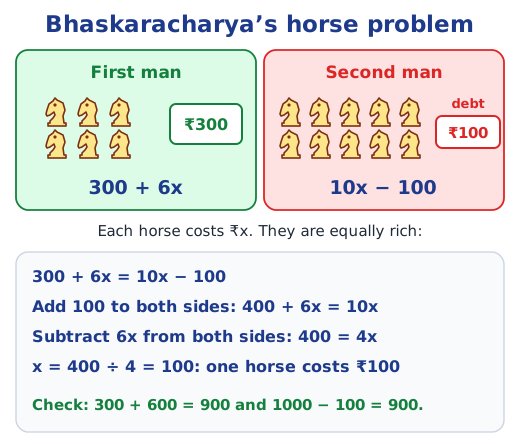
Example 16: Bhaskaracharya’s horse problem. 300 + 6x = 10x − 100 gives 400 = 4x, so a horse costs ₹100. Check: 300 + 600 = 900 and 1000 − 100 = 900. (The book numbers this Example 16 although Examples 14 and 15 do not appear.)
A formula for Ax + B = Cx + D. For 5x + 4 = 3x + 8: x = (8 − 4) ÷ (5 − 3) = 2. For 3x − 6 = 2x + 4, use 3, −6, 2 and 4: x = (4 − (−6)) ÷ (3 − 2) = 10. Brahmagupta’s rule x = (D − B) ÷ (A − C) also gives m = 1050 ÷ 150 = 7 for the savings problem.
Solve 2x + 3 = 4x + 5 with the formula. x = (5 − 3) ÷ (2 − 4) = 2 ÷ (−2) = −1. Check: 2(−1) + 3 = 1 and 4(−1) + 5 = 1.
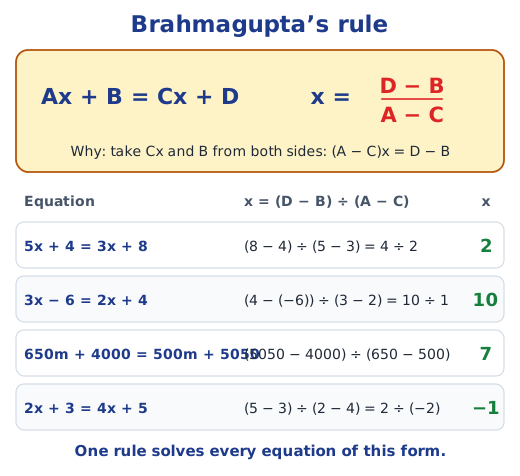
Figure it Out (pages 185–189)
1. Fill in the blanks with integers.
- (a) 5 × ___ − 8 = 37: 5 × ___ = 45, so the blank is 9.
- (b) 37 − (33 − ___) = 35: 33 − ___ = 2, so the blank is 31.
- (c) −3 × (−11 + ___) = 45: −11 + ___ = −15, so the blank is −4.
2. Ranju’s notes. Let her get n notes of each kind. 50n + 100n = 750, so 150n = 750 and n = 5. 5 notes of ₹50 and 5 notes of ₹100.
3. The blobs. There are 3 blobs and 4 dots in view. If each blob hides b dots, 3b + 4 = 25, so 3b = 21 and b = 7.
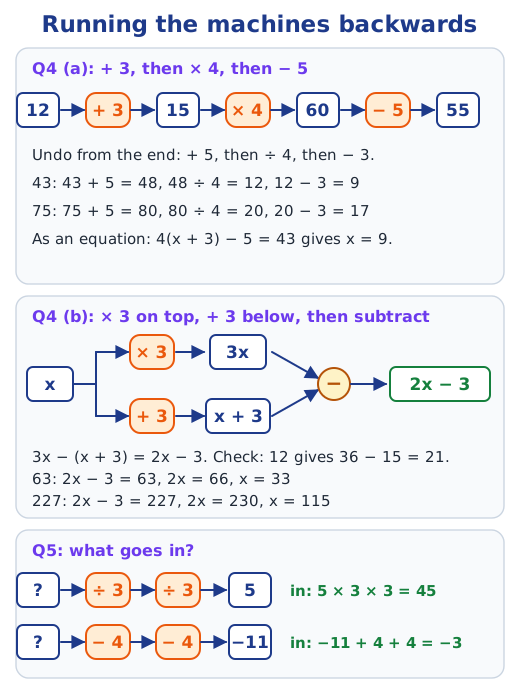
4. The machines. (a) The machine adds 3, multiplies by 4 and subtracts 5. Undo it from the end: 43 + 5 = 48, 48 ÷ 4 = 12, 12 − 3 = 9; and 75 + 5 = 80, 80 ÷ 4 = 20, 20 − 3 = 17. (b) The input goes two ways, × 3 and + 3, and the results are subtracted: 3x − (x + 3) = 2x − 3 (with 12: 36 − 15 = 21). So 2x − 3 = 63 gives x = 33, and 2x − 3 = 227 gives x = 115.
5. Inputs. Dividing by 3 twice gives 5, so the input is 5 × 3 × 3 = 45. Subtracting 4 twice gives −11, so the input is −11 + 4 + 4 = −3.
6. The taxi. 800 + 20k = 2200, so 20k = 1400 and k = 70 km.
7. Two numbers. x + 3x = 76, so 4x = 76 and x = 19. The numbers are 19 and 57.
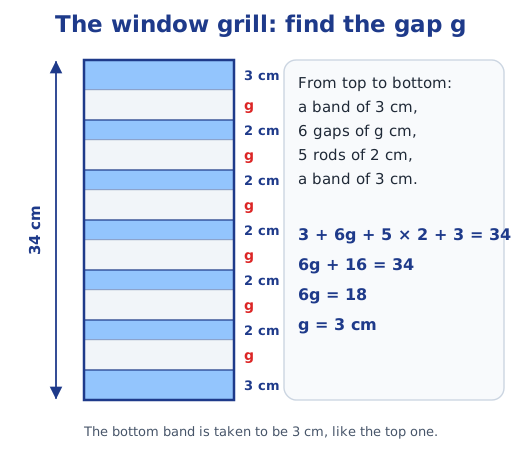
8. The window grill. From top to bottom there is a 3 cm band, six gaps of g cm with five 2 cm rods between them, and a 3 cm band at the bottom (taking the bottom band to be 3 cm like the top one). So 3 + 6g + 5 × 2 + 3 = 34, 6g + 16 = 34, 6g = 18 and the gap is 3 cm.
9. Juice and milkshake. Let a milkshake cost ₹m; a juice costs ₹(m − 15). 4(m − 15) + 7m = 600, so 11m − 60 = 600, 11m = 660 and m = 60. Milkshake ₹60, fruit juice ₹45. Check: 4 × 45 + 7 × 60 = 180 + 420 = 600.
10. Given 28p − 36 = 98. Then 28p − 38 = 98 − 2 = 96, and 14p − 19 is half of 28p − 38, so 14p − 19 = 48.
11. Find and correct the mistakes.
- (a) 6x + 9 = 66: the 6 and 66 were divided by 6 but the 9 was not. Correct: 6x = 57, so x = 57/6 = 9.5. Check: 57 + 9 = 66.
- (b) 14y + 24 = 36: no mistake. Halving gives 7y + 12 = 18, so 7y = 6 and y = 6/7.
- (c) 4x − 5 = 9x + 8: moving − 5 across should give + 5, and at the end 3 ÷ (−5) was written upside down. Correct: 4x = 9x + 13, so −5x = 13 and x = −13/5.
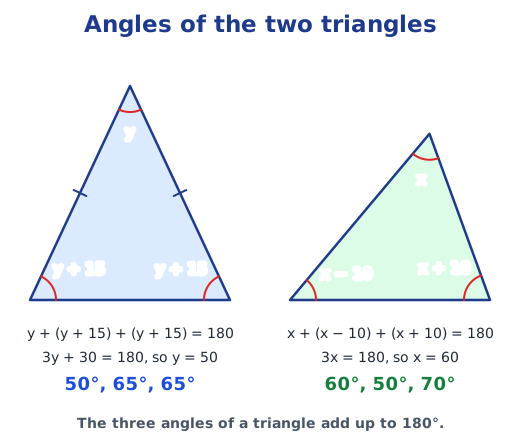
12. Angles of the triangles. The angles of a triangle add up to 180°. First triangle (two equal sides, so equal base angles): y + (y + 15) + (y + 15) = 180, 3y + 30 = 180, y = 50, so the angles are 50°, 65° and 65°. Second: x + (x − 10) + (x + 10) = 180, 3x = 180, x = 60, so the angles are 60°, 50° and 70°.
13. Four equations with u = 6. u + 4 = 10; 3u = 18; u ÷ 2 = 3; 2u − 5 = 7.
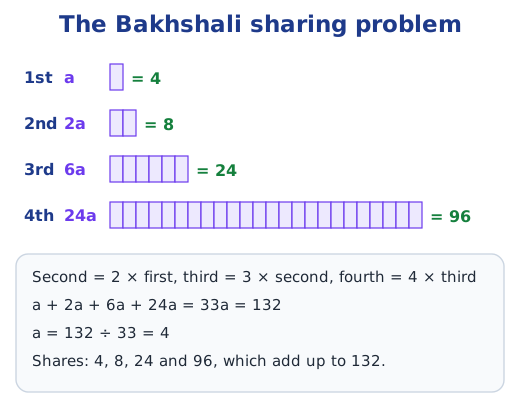
14. The Bakhshali problem. If the first gets a, the second gets 2a, the third 3 × 2a = 6a and the fourth 4 × 6a = 24a. a + 2a + 6a + 24a = 33a = 132, so the first person gets 4 (and the others 8, 24 and 96).
15. The giraffe. h = h/2 + 2.5, so h/2 = 2.5 and the giraffe is 5 m tall.
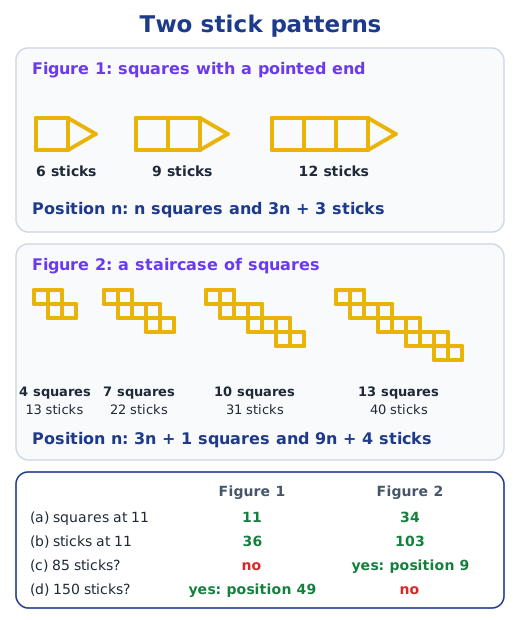
16. The stick patterns. First figure: each position adds one square, made with 3 new sticks, to 6 sticks at position 1, so position n has n squares and 3n + 3 sticks. Second figure: each position adds 3 squares and 9 sticks to the 4 squares and 13 sticks of position 1, so position n has 3n + 1 squares and 9n + 4 sticks.
- (a) Squares at position 11: 11 in the first figure, 34 in the second.
- (b) Sticks at position 11: 36 in the first, 103 in the second.
- (c) 85 sticks: first figure, 3n + 3 = 85 gives 3n = 82, and 82 is not a multiple of 3, so no; second figure, 9n + 4 = 85 gives n = 9, so yes, position 9.
- (d) 150 sticks: first figure, 3n + 3 = 150 gives n = 49, so yes, position 49; second figure, 9n + 4 = 150 gives 9n = 146, and 146 is not a multiple of 9, so no.
17. The number. x + 36 = 10x, so 9x = 36 and x = 4. Check: 4 + 36 = 40 = 10 × 4.
18. Solve.
- (a) 5(r + 2) = 10: r + 2 = 2, so r = 0.
- (b) −3(u + 2) = 2(u − 1): −3u − 6 = 2u − 2, so −5u = 4 and u = −4/5.
- (c) 2(7 − 2n) = −6: 7 − 2n = −3, so 2n = 10 and n = 5.
- (d) 2(x − 4) = −16: x − 4 = −8, so x = −4.
- (e) 6(x − 1) = 2(x − 1) − 4: 4(x − 1) = −4, x − 1 = −1, so x = 0.
- (f) 3 − 7s = 7 − 3s: −4s = 4, so s = −1.
- (g) 2x + 1 = 6 − (2x − 3): 2x + 1 = 9 − 2x, so 4x = 8 and x = 2.
- (h) 10 − 5x = 3(x − 4) − 2(x − 7): the RHS is 3x − 12 − 2x + 14 = x + 2, so 10 − 5x = x + 2, 6x = 8 and x = 4/3.
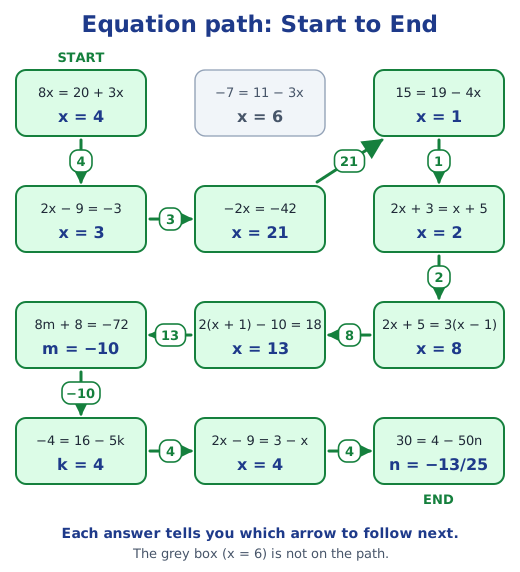
19. The path from Start to End. Solve each box; its answer is the label on the arrow to follow. Start: 8x = 20 + 3x, x = 4 → 2x − 9 = −3, x = 3 → −2x = −42, x = 21 → 15 = 19 − 4x, x = 1 → 2x + 3 = x + 5, x = 2 → 2x + 5 = 3(x − 1), x = 8 → 2(x + 1) − 10 = 18, x = 13 → 8m + 8 = −72, m = −10 → −4 = 16 − 5k, k = 4 → 2x − 9 = 3 − x, x = 4 → End: 30 = 4 − 50n, n = −13/25. The box −7 = 11 − 3x (x = 6) is not on the path.
20. Try This: children and donkeys. Let there be d donkeys; then there are 28 − d children. Feet: 4d + 2(28 − d) = 80, so 2d + 56 = 80, 2d = 24 and d = 12. 12 donkeys and 16 children. Check: 48 + 32 = 80 feet.
A Magic Trick (page 190)
Why does it always give 8? Call the number x. Multiplying by 2 gives 2x, adding 10 gives 2x + 10, dividing by 2 gives x + 5, subtracting the number gives 5, and adding 3 gives 8. The x cancels, so every starting number ends at 8.
Make your own trick. For example: think of a number, add 4, multiply by 3, subtract 12, divide by 3. You always get back the number you started with: x + 4, 3x + 12, 3x, x.
Practice
-
Solve 9m = m − 4.
Show answer
Answer: (b) m = −1/2
-
Given 3k + 2 = 17, what is 6k + 4?
Show answer
Answer: (b) 34
-
In solving 5x − 2 = 8x + 7, which step is right?
Show answer
Answer: (b) 5x = 8x + 7 + 2
-
A number increased by 45 is equal to six times the number. Find the number.
Show answer
Answer: Let the number be x. Then x + 45 = 6x, so 45 = 5x and x = 9. Check: 9 + 45 = 54 and 6 × 9 = 54.
-
A rope is 3 m longer than half its own length. How long is the rope?
Show answer
Answer: Let the length be L metres. Then L = L/2 + 3. Take L/2 from both sides: L/2 = 3, so L = 6. The rope is 6 m long; half of it is 3 m, and 3 + 3 = 6.
Stuck on a question?
Take a photo and Lagnever AI explains it step by step. Try it for 7 days for ₹2.
Get it on Google Play Open in browser
For parents: after the trial, the plan renews monthly by UPI or card autopay. You can cancel anytime in the app.