
Class 7 Maths Part 2 Chapter 7: Finding the Unknown Notes
This chapter in five lines
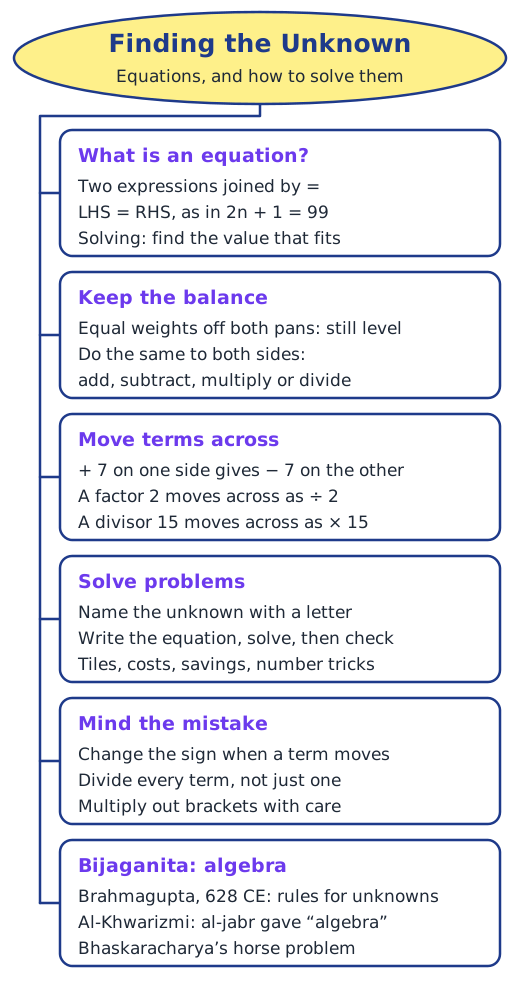
Finding the Unknown is about equations: two expressions joined by an equals sign, such as 2n + 1 = 99. You solve one by doing the same operation on both sides, the way a balanced scale stays level when equal weights come off both pans, or by moving a term across with the opposite operation. Equations turn word problems into simple steps, and the chapter ends with bijaganita, the algebra of Brahmagupta and Bhaskaracharya.
What is this chapter about?
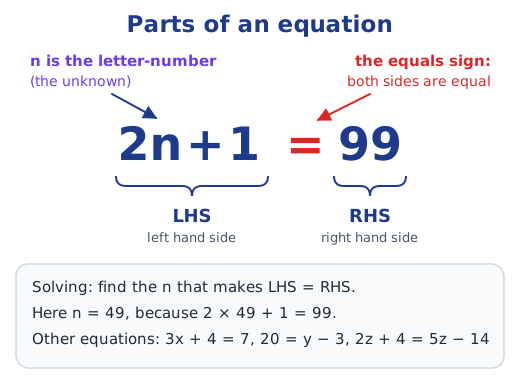
Earlier you used letter-numbers such as n to describe a pattern: position n of a matchstick pattern needs 2n + 1 sticks. This chapter asks the question the other way round. If Jasmine has exactly 99 sticks, which position can she build? To answer it we write 2n + 1 = 99 and look for the n that makes it true. Such statements are equations, and finding the unknown is called solving them.
Unknown weights and balances
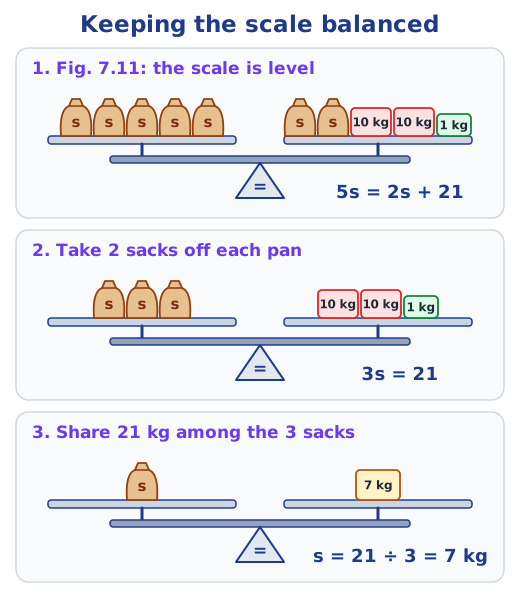
The chapter starts with hanging scales and pan balances. The number on a hanging scale is the total weight, and a level bar means both sides weigh the same. On a pan balance, five sacks balance two sacks and 21 kg of weights. Take two sacks off each pan and the scale stays level, so three sacks weigh 21 kg and one sack weighs 7 kg. This idea, removing equal amounts from both sides, is the key to every equation in the chapter.
An equation has a left hand side (LHS) and a right hand side (RHS), joined by the equals sign. Its solution is the value of the letter-number that makes the two sides equal.
Solving equations systematically
You can guess and test values, which is the trial and error method, but that can be slow. A surer way uses one fact: if you add, subtract, multiply or divide both sides by the same number, the equation stays true. For 5x − 4 = 7, add 4 to both sides to get 5x = 11, then divide both sides by 5 to get x = 11/5. Put the answer back to check it. If the unknown is on both sides, as in 6y + 7 = 4y + 21, first subtract 4y from both sides.
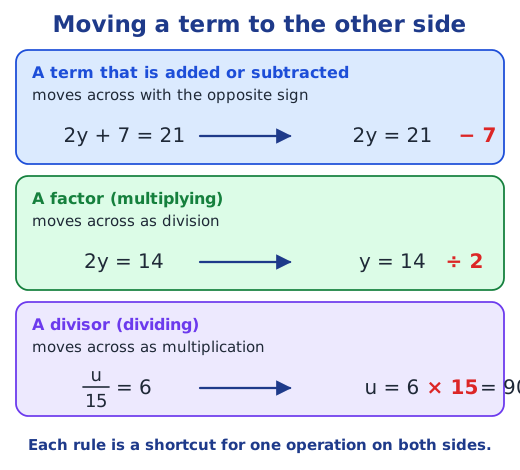
A faster way to write the same steps is to move a term across the equals sign with the opposite operation: + 7 on one side becomes − 7 on the other, a factor 2 becomes ÷ 2, and a divisor 15 becomes × 15. Read more in solving simple equations.
Solving problems with equations
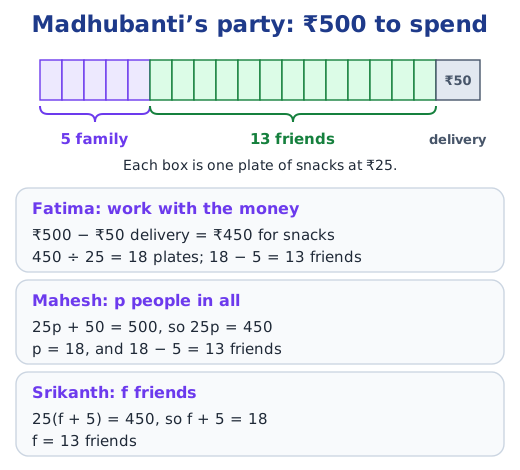
Equations help with real questions. Name the unknown with a letter, write what the problem says as an equation, solve it and answer the question asked. Ranjana’s tile pattern uses 3k + 1 tiles at Step k, so 100 tiles fit Step 33. Madhubanti can spend ₹500 on snacks at ₹25 a plate plus ₹50 delivery, so 25p + 50 = 500 and 18 people can come: her family of 5 and 13 friends. Two friends who save at different rates have equal savings after 7 months. You can also go backwards and build equations that have a chosen solution. See word problems on equations.
Mind the mistake
The chapter shows worked solutions with slips in them for you to find. The usual ones are keeping the sign of a term that moves across, dividing only one term of a side, dividing the wrong way round, and sign slips when multiplying out a bracket.
A pinch of history
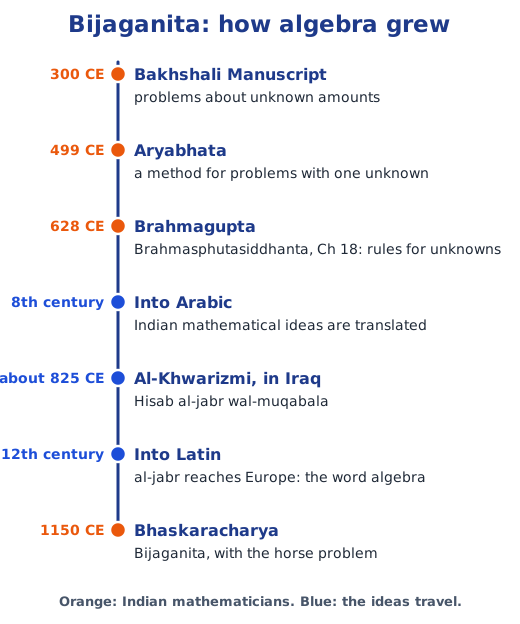
In India, algebra was called bijaganita. Brahmagupta wrote rules for working with unknowns in 628 CE, and his rule for Ax + B = Cx + D gives x = (D − B) ÷ (A − C) at once. The ideas travelled into Arabic and later to Europe, where Al-Khwarizmi’s book title al-jabr gave us the word algebra. Bhaskaracharya’s Bijaganita (1150 CE) has a famous problem about the price of a horse. Read bijaganita: algebra in ancient India. Answers to every question, including the puzzles, machines and the path from Start to End, are in the NCERT solutions for Part 2 Chapter 7.
Key terms
| Term | Meaning |
|---|---|
| Equation | A statement that two algebraic expressions are equal, written with an equals sign between them, such as 3x + 4 = 7 or 2z + 4 = 5z − 14. |
| Letter-number (unknown) | A letter such as x, n or y that stands for a number we do not know yet. |
| LHS and RHS | The left hand side and the right hand side of an equation: what is written before and after the equals sign. |
| Solution | The value of the unknown that makes the LHS equal to the RHS. The solution of 2n + 1 = 99 is n = 49. |
| Trial and error | Solving by trying one value after another until the two sides match. It works, but it can take many tries. |
| Same operation on both sides | Adding, subtracting, multiplying or dividing both sides by the same number keeps an equation true (division by zero is not allowed). |
| Inverse operations | Operations that undo each other: addition and subtraction, and multiplication and division. |
| Moving a term across | Shifting a term to the other side with the inverse operation: + 7 becomes − 7, a factor 2 becomes ÷ 2, and a divisor 15 becomes × 15. It is often called transposing. |
| Additive inverse | The number that adds to a given number to make 0. The additive inverse of 7 is −7, and of −5 it is 5. |
| Checking a solution | Putting the value back into the equation to see that the LHS and the RHS come out equal. |
| Bijaganita | The old Indian name for algebra. Bija means seed: the answer hides inside the unknown, as a tree hides inside a seed. |
| Brahmagupta’s rule | For an equation Ax + B = Cx + D, the solution is x = (D − B) ÷ (A − C). |
Topics in this chapter
Practice
-
Which of these is an equation?
Show answer
Answer: (b) 3x + 4 = 7
-
What is the solution of 2n + 1 = 99?
Show answer
Answer: (b) n = 49
-
When + 7 on the left side is moved to the right side, it becomes:
Show answer
Answer: (b) − 7
-
Solve 3u − 7 = 2u + 3.
Show answer
Answer: (c) u = 10
-
Ramesh has 30 more marbles than Suresh, and they have 60 together. How many does Suresh have?
Show answer
Answer: (b) 15
-
Who gave the rule x = (D − B) ÷ (A − C) for Ax + B = Cx + D?
Show answer
Answer: (b) Brahmagupta
Questions students ask
What are the main topics of Class 7 Maths Part 2 Chapter 7?
Unknown weights on scales and patterns of matchsticks; what an equation is; solving equations by trial and error and then systematically, by doing the same operation on both sides or moving terms across; solving word problems with equations; building equations from a given solution; spotting mistakes in solutions; and the history of bijaganita, or algebra, in India.
Is Finding the Unknown in the new Ganita Prakash Part 2 book?
Yes. It is Chapter 7, the last chapter of Ganita Prakash, the Class 7 Maths textbook Part 2 (2026-27), on pages 164 to 190. It comes after Constructions and Tilings and uses the letter-numbers of earlier chapters to find unknown values.
What is the easiest way to solve an equation?
Get the unknown alone on one side. Undo what has been added or subtracted, then undo what has been multiplied or divided, doing the same to both sides each time. Then put your answer back into the equation to check that both sides match.
Stuck on a question?
Take a photo and Lagnever AI explains it step by step. Try it for 7 days for ₹2.
Get it on Google Play Open in browser
For parents: after the trial, the plan renews monthly by UPI or card autopay. You can cancel anytime in the app.