
Word problems: from a story to an equation
Answer in short
To solve a word problem with an equation, choose a letter for the unknown quantity, write the facts as an equation, solve it with the same step on both sides, and answer the question that was asked. For example, 25p + 50 = 500 gives p = 18 people at Madhubanti’s party, so she can invite 13 friends.
Stuck on a question? Take a photo and Lagnever AI explains it step by step. Try it for 7 days for ₹2. Get it on Google Play
Four steps for any word problem
Word problems become easy when you follow the same four steps every time:
- Name the unknown with a letter, and say what it stands for.
- Write the facts of the problem using that letter.
- Make the equation from the two amounts that are equal, and solve it.
- Answer the question that was asked, and check it in the story.
A pattern of tiles
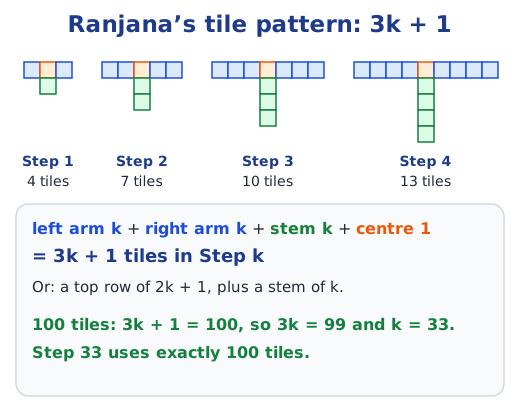
Ranjana makes T shapes with square tiles: Step 1 uses 4 tiles, Step 2 uses 7 and Step 3 uses 10. At Step k the top row has k tiles on each side of a centre tile, and a stem of k tiles hangs below it, so the total is k + k + k + 1 = 3k + 1. Can she use exactly 100 tiles? Solve 3k + 1 = 100: 3k = 99, so k = 33. Step 33 uses exactly 100 tiles.
Money: a party and two savers
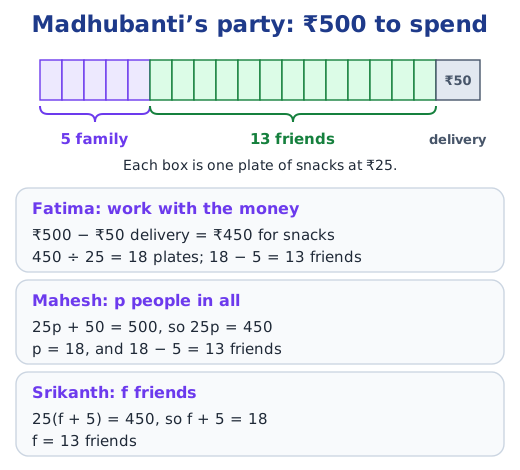
Madhubanti may spend ₹500 on snacks for a party. Each plate costs ₹25, and the shop charges ₹50 to deliver. If p people come in all, the cost is 25p + 50, so 25p + 50 = 500. Then 25p = 450 and p = 18. Her family has 5 members, so she can invite 13 friends. Another way: let f be the number of friends; then 25(f + 5) = 450, so f + 5 = 18 and f = 13. Both ways agree.
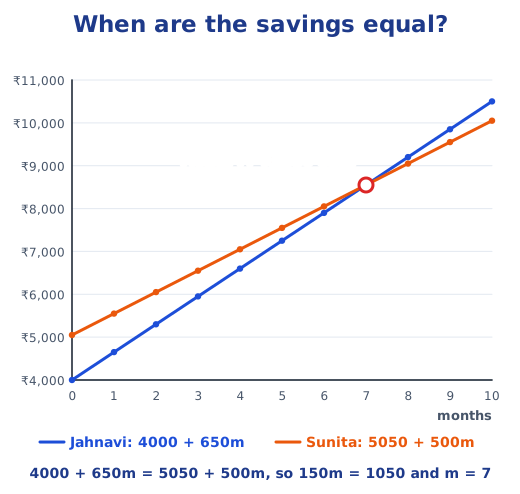
Jahnavi starts with ₹4,000 and saves ₹650 a month, while Sunita starts with ₹5,050 and saves ₹500 a month. After m months they have 4000 + 650m and 5050 + 500m. Setting these equal gives 150m = 1050, so m = 7. Check: after 7 months each has ₹8,550.
Number tricks
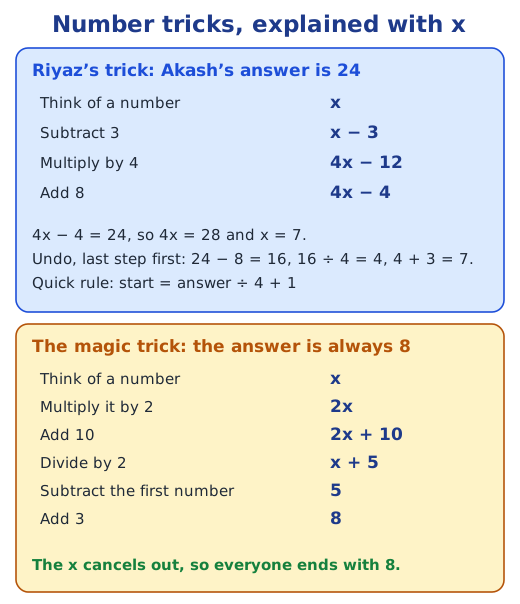
Riyaz asks Akash to think of a number, take away 3, multiply by 4 and add 8; Akash says 24. With x as the number, the steps give x − 3, then 4x − 12, then 4x − 4. So 4x − 4 = 24, 4x = 28 and x = 7. The rule works for any answer: the starting number is the answer divided by 4, plus 1. A letter also explains a magic trick in which everyone ends with 8, whatever number they start with.
Two unknowns, one letter
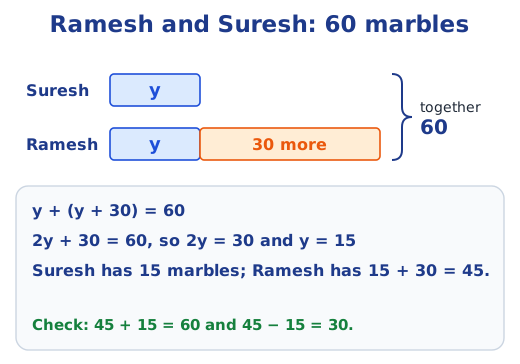
Ramesh and Suresh have 60 marbles together, and Ramesh has 30 more than Suresh. There seem to be two unknowns, but one letter is enough: if Suresh has y, Ramesh has y + 30. Then y + (y + 30) = 60, so 2y = 30 and y = 15. Suresh has 15 marbles and Ramesh 45. The same trick solves “two numbers add up to 76 and one is three times the other”: x + 3x = 76 gives x = 19, so the numbers are 19 and 57.
Making equations from an answer
We can also work backwards: start from a solution and build equations. From y = 5, add 2 to both sides to get y + 2 = 7, multiply by 3 to get 3y + 6 = 21, and take away 6 to get 3y = 15. Each new equation has the same solution, because the same step was done to both sides. Going back up the chain uses the opposite steps in reverse order.
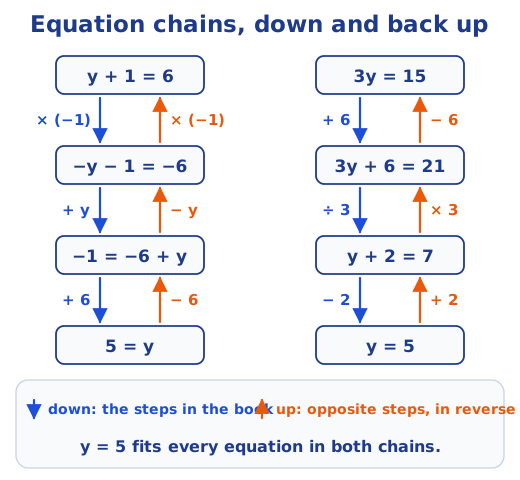
An equation can also be read as a story. 100x + 75 = 250 could mean 100 pencils at ₹x each with ₹75 for delivery and a bill of ₹250, so each pencil costs ₹1.75.
Why it matters
With these steps, a question about tiles, money or marbles becomes one small equation. Practise the solving itself in solving simple equations, and see how Bhaskaracharya posed problems like these in bijaganita: algebra in ancient India. Answers to the textbook questions are in the NCERT solutions for Part 2 Chapter 7; see all of Part 2 Chapter 7 notes.
Practice
-
Ranjana’s Step k uses 3k + 1 tiles. Which step uses exactly 100 tiles?
Show answer
Answer: (b) Step 33
-
A taxi charges ₹800 a day plus ₹20 for each km. The bill is ₹2200. How many km were travelled?
Show answer
Answer: (b) 70
-
Two numbers add up to 76, and one is three times the other. The smaller number is:
Show answer
Answer: (a) 19
-
Think of a number, double it, add 10, halve the result, take away the number you thought of and add 3. Why is the answer always 8?
Show answer
Answer: Call the number x. The steps give 2x, then 2x + 10, then x + 5, then 5 after taking away x, and 8 after adding 3. The x cancels out, so the answer does not depend on the number chosen.
-
Write two equations whose solution is u = 6.
Show answer
Answer: For example u + 4 = 10 and 3u − 5 = 13. With u = 6, 6 + 4 = 10 and 18 − 5 = 13, so both are true.
Questions students ask
How do you turn a word problem into an equation?
Read the problem and decide what is unknown. Give it a letter, such as p for the number of people. Write the other quantities using that letter, for example 25p for the cost of p plates. Then write the fact that two amounts are equal, here 25p + 50 = 500, and solve it.
Can a word problem be solved without an equation?
Often, yes. In the party problem Fatima simply took the delivery charge away from ₹500 and divided by 25. An equation does the same work in a fixed pattern, which helps when the numbers are large or the unknown appears on both sides.
How can I make equations that have a given solution?
Start with the answer, such as y = 5, and do the same operation to both sides again and again: add 2 to get y + 2 = 7, multiply by 3 to get 3y + 6 = 21, and so on. Every equation in such a chain has the same solution.
Stuck on a question?
Take a photo and Lagnever AI explains it step by step. Try it for 7 days for ₹2.
Get it on Google Play Open in browser
For parents: after the trial, the plan renews monthly by UPI or card autopay. You can cancel anytime in the app.