
NCERT Solutions Class 10 Maths Chapter 8: Introduction to Trigonometry
Answers to the questions inside Chapter 8, Introduction to Trigonometry, all twelve worked examples, and every question of Exercises 8.1, 8.2 and 8.3, from Mathematics, the Class 10 NCERT textbook. Page numbers follow the 2026-27 reprint (pages 113–132). The exercise questions are quoted from the book; the examples and in-chapter questions are restated in short and labelled by number and page. The book’s figures are not copied: every figure here is our own drawing, made to scale from the data in the question. Every value, every MCQ and every identity was checked by calculation, the identities at hundreds of angles, and all answers match the answer key at the end of the book. Short notes: Chapter 8 notes.
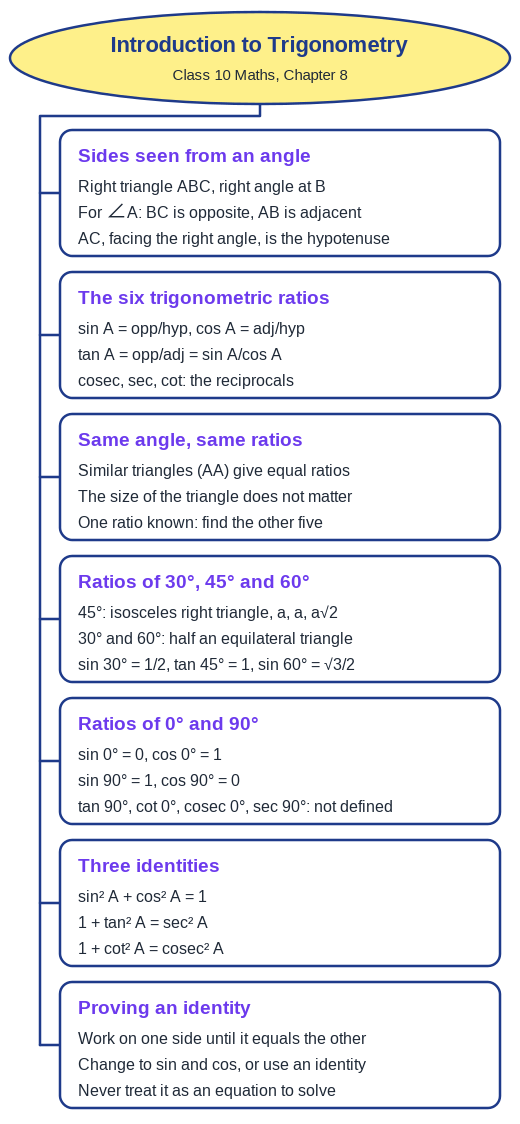
Questions inside the chapter: trigonometric ratios (pages 115–118)
Page 115: define the trigonometric ratios for angle C of the right triangle (Fig. 8.5). For ∠C, the opposite side is AB, the adjacent side is BC and the hypotenuse is AC. So sin C = AB/AC, cos C = BC/AC, tan C = AB/BC, cosec C = AC/AB, sec C = AC/BC and cot C = BC/AB.
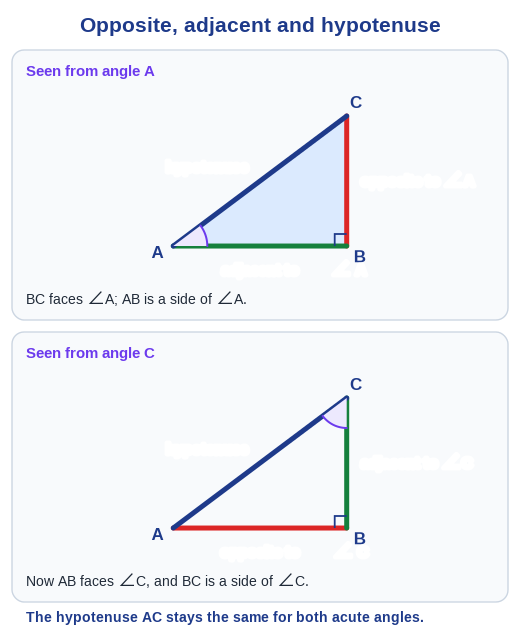
Pages 116–117: P is on AC and Q on AC produced, with PM ⊥ AB and QN ⊥ AB produced (Fig. 8.6). Do the ratios of ∠A in △PAM and △QAN differ from those in △CAB? No. △PAM and △CAB have ∠A common and a right angle each, so they are similar (AA). Their sides are proportional: AM/AB = AP/AC = MP/BC. Rearranging, MP/AP = BC/AC, so sin A is the same in both, and in the same way AM/AP = AB/AC = cos A and MP/AM = BC/AB = tan A. The same argument works for △QAN, which also has ∠A and a right angle. So the ratios of an angle do not depend on the size of the triangle.
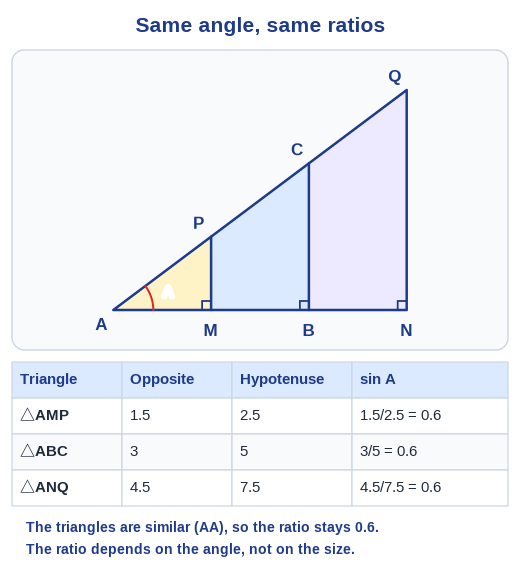
Page 117: if sin A = 1/3, why is AB = 2√2 k and not −2√2 k? Find the other ratios. AB is the length of a side, and a length cannot be negative, so only the positive square root is kept. With BC = k, AC = 3k and AB = 2√2 k: cos A = 2√2/3, tan A = 1/(2√2) = √2/4, cosec A = 3, sec A = 3/(2√2) = 3√2/4 and cot A = 2√2.
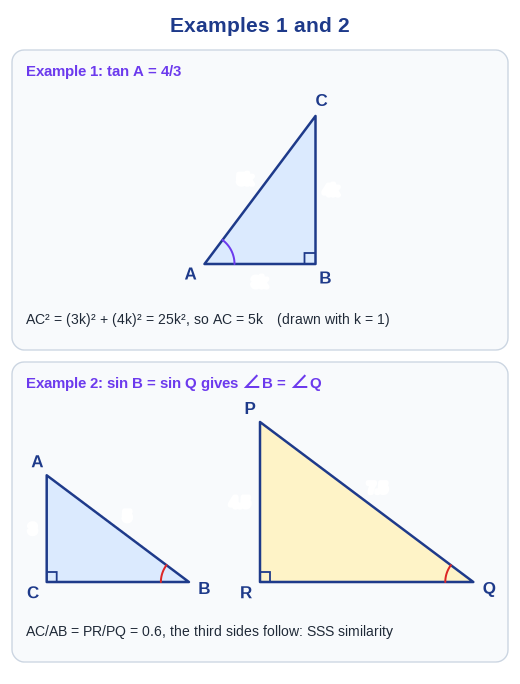
Example 1 (page 118): tan A = 4/3; find the other ratios. Take BC = 4k and AB = 3k. Then AC² = 9k² + 16k² = 25k², so AC = 5k. sin A = 4/5, cos A = 3/5, cot A = 3/4, cosec A = 5/4 and sec A = 5/3.
Example 2 (page 118): ∠B and ∠Q are acute and sin B = sin Q; prove ∠B = ∠Q. Take △ABC right-angled at C and △PQR right-angled at R. Then AC/AB = PR/PQ, so AC/PR = AB/PQ = k, say. By the Pythagoras theorem, BC = √(AB² − AC²) = √(k²PQ² − k²PR²) = k√(PQ² − PR²) = k × QR. So AC/PR = AB/PQ = BC/QR, the triangles are similar by SSS (Theorem 6.4), and ∠B = ∠Q. (The RHS similarity note at the end of Chapter 6 gives the same result in one step.)
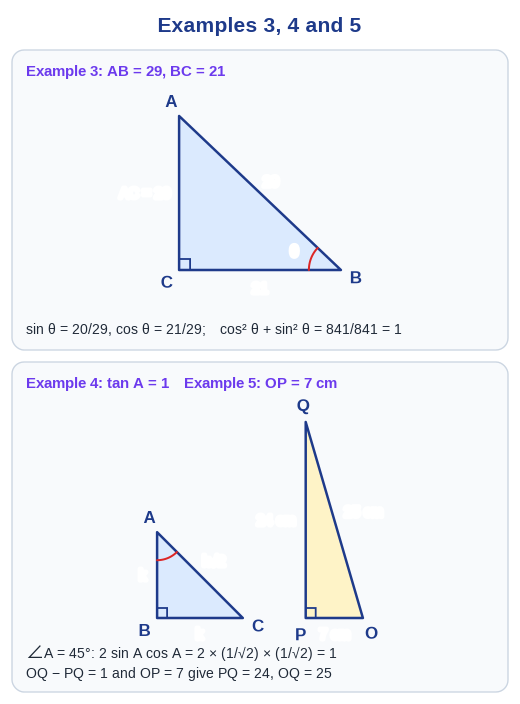
Example 3 (page 119): in △ACB right-angled at C, AB = 29 and BC = 21, ∠ABC = θ; find cos² θ + sin² θ and cos² θ − sin² θ. AC = √(29² − 21²) = √((29 − 21)(29 + 21)) = √400 = 20. So sin θ = 20/29 and cos θ = 21/29. (i) cos² θ + sin² θ = (441 + 400)/841 = 841/841 = 1. (ii) cos² θ − sin² θ = (441 − 400)/841 = 41/841.
Example 4 (page 120): in △ABC right-angled at B, tan A = 1; verify 2 sin A cos A = 1. tan A = BC/AB = 1, so AB = BC = k and AC = k√2. Then sin A = cos A = 1/√2, and 2 sin A cos A = 2 × 1/2 = 1.
Example 5 (page 120): in △OPQ right-angled at P, OP = 7 cm and OQ − PQ = 1 cm; find sin Q and cos Q. By the Pythagoras theorem OQ² = OP² + PQ². The first “Why?”: OQ = 1 + PQ, from the given difference, so (1 + PQ)² = OP² + PQ². Expanding, 1 + 2PQ + PQ² = OP² + PQ². The second “Why?”: PQ² cancels from both sides and OP = 7, so 1 + 2PQ = 49. So PQ = 24 cm and OQ = 25 cm, and sin Q = OP/OQ = 7/25, cos Q = PQ/OQ = 24/25.
Exercise 8.1 (page 121)
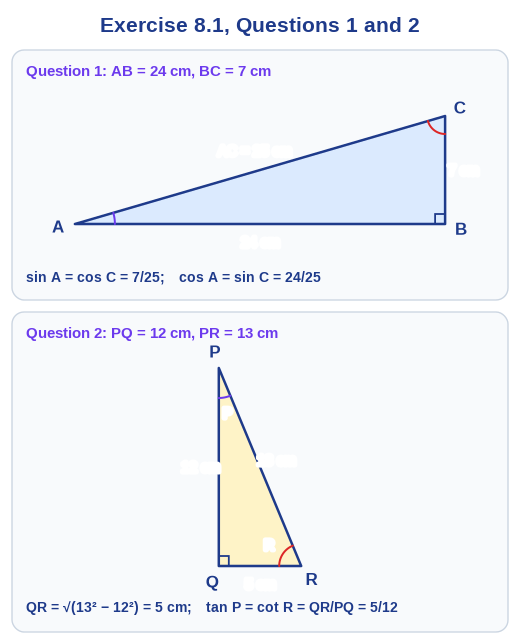
1. “In △ ABC, right-angled at B, AB = 24 cm, BC = 7 cm. Determine : (i) sin A, cos A (ii) sin C, cos C”
Given: △ABC with ∠B = 90°, AB = 24 cm and BC = 7 cm.
To find: sin A, cos A, sin C and cos C.
- By the Pythagoras theorem, AC² = AB² + BC² = 576 + 49 = 625. So AC = 25 cm (the hypotenuse).
- For ∠A, the opposite side is BC = 7 and the adjacent side is AB = 24.
- For ∠C, the opposite side is AB = 24 and the adjacent side is BC = 7.
Answer: (i) sin A = 7/25, cos A = 24/25 (ii) sin C = 24/25, cos C = 7/25.
2. “In Fig. 8.13, find tan P – cot R.” (Fig. 8.13 shows △PQR right-angled at Q with PQ = 12 cm and PR = 13 cm.)
Given: △PQR with ∠Q = 90°, PQ = 12 cm and PR = 13 cm.
To find: tan P − cot R.
- QR = √(PR² − PQ²) = √(169 − 144) = √25 = 5 cm.
- For ∠P, QR is opposite and PQ is adjacent, so tan P = QR/PQ = 5/12.
- For ∠R, QR is adjacent and PQ is opposite, so cot R = adjacent/opposite = QR/PQ = 5/12.
- tan P − cot R = 5/12 − 5/12 = 0.
Answer: tan P − cot R = 0.
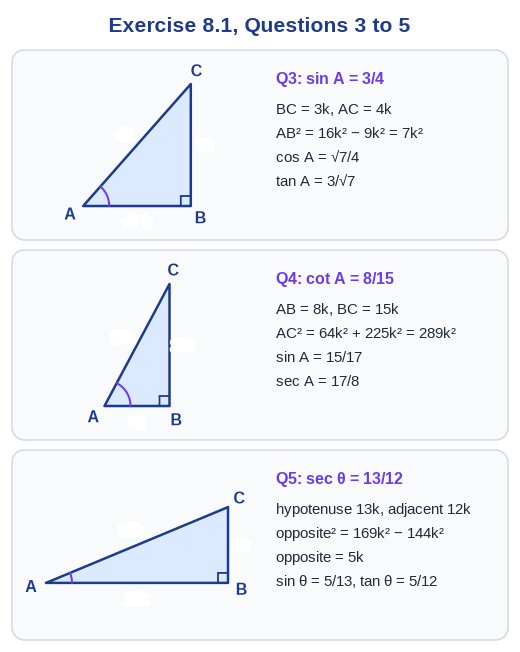
3. “If sin A = 3/4, calculate cos A and tan A.”
Given: sin A = 3/4.
To find: cos A and tan A.
- sin A = opposite/hypotenuse = 3/4. So in a right triangle ABC (right angle at B), take BC = 3k and AC = 4k, where k is any positive number.
- By the Pythagoras theorem, AB = √(AC² − BC²) = √(16k² − 9k²) = √7 k.
- cos A = AB/AC = √7 k/4k = √7/4.
- tan A = BC/AB = 3k/(√7 k) = 3/√7.
Answer: cos A = √7/4 and tan A = 3/√7 (= 3√7/7).
4. “Given 15 cot A = 8, find sin A and sec A.”
Given: 15 cot A = 8, so cot A = 8/15.
To find: sin A and sec A.
- cot A = adjacent/opposite = 8/15. Take AB = 8k (adjacent) and BC = 15k (opposite).
- AC = √(64k² + 225k²) = √(289k²) = 17k.
- sin A = BC/AC = 15/17 and sec A = AC/AB = 17/8.
Answer: sin A = 15/17 and sec A = 17/8.
5. “Given sec θ = 13/12, calculate all other trigonometric ratios.”
Given: sec θ = 13/12.
To find: sin θ, cos θ, tan θ, cosec θ and cot θ.
- sec θ = hypotenuse/adjacent = 13/12. Take the hypotenuse 13k and the adjacent side 12k.
- Opposite side = √(169k² − 144k²) = √(25k²) = 5k.
- Now use the definitions: sin θ = 5/13, cos θ = 12/13, tan θ = 5/12, cosec θ = 13/5, cot θ = 12/5.
Answer: sin θ = 5/13, cos θ = 12/13, tan θ = 5/12, cosec θ = 13/5, cot θ = 12/5.
6. “If ∠ A and ∠ B are acute angles such that cos A = cos B, then show that ∠ A = ∠ B.”
Given: ∠A and ∠B are acute and cos A = cos B.
To prove: ∠A = ∠B.
Proof: (It follows Example 2, with cosines in place of sines.)
- Put ∠A in a right triangle ACX, right-angled at C, and ∠B in a right triangle BDY, right-angled at D.
- cos A = AC/AX and cos B = BD/BY. Since cos A = cos B, AC/AX = BD/BY. So AC/BD = AX/BY. Call this common value k.
- By the Pythagoras theorem, CX = √(AX² − AC²) = √(k²BY² − k²BD²) = k√(BY² − BD²) = k × DY.
- So AC/BD = AX/BY = CX/DY = k. All three pairs of sides are in the same ratio, so △ACX ~ △BDY (SSS similarity).
- Corresponding angles of similar triangles are equal, so ∠A = ∠B.
Hence proved.
7. “If cot θ = 7/8, evaluate : (i) ((1 + sin θ)(1 – sin θ))/((1 + cos θ)(1 – cos θ)), (ii) cot² θ”
Given: cot θ = 7/8.
To find: the values of (i) and (ii).
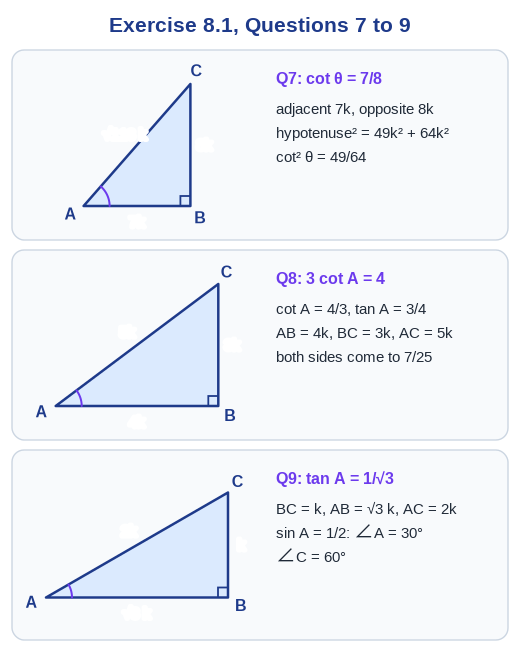
- cot θ = adjacent/opposite = 7/8. Take the adjacent side 7k and the opposite side 8k.
- Hypotenuse = √(49k² + 64k²) = √113 k. So sin θ = 8/√113 and cos θ = 7/√113.
- (i) Top: (1 + sin θ)(1 − sin θ) = 1 − sin² θ = 1 − 64/113 = 49/113.
- Bottom: (1 + cos θ)(1 − cos θ) = 1 − cos² θ = 1 − 49/113 = 64/113.
- So (i) = (49/113) ÷ (64/113) = 49/64.
- (ii) cot² θ = (7/8)² = 49/64.
Answer: (i) 49/64 (ii) 49/64.
(Both answers are equal because 1 − sin² θ = cos² θ and 1 − cos² θ = sin² θ, so the expression in (i) is cos² θ/sin² θ = cot² θ.)
8. “If 3 cot A = 4, check whether (1 – tan² A)/(1 + tan² A) = cos² A – sin² A or not.”
Given: 3 cot A = 4, so cot A = 4/3 and tan A = 3/4. To check: whether (1 − tan² A)/(1 + tan² A) = cos² A − sin² A.
- Take AB = 4k (adjacent) and BC = 3k (opposite). Then AC = √(16k² + 9k²) = 5k.
- So sin A = 3/5 and cos A = 4/5.
- LHS = (1 − 9/16)/(1 + 9/16) = (7/16)/(25/16) = 7/25.
- RHS = 16/25 − 9/25 = 7/25.
Answer: LHS = RHS = 7/25, so yes, it holds.
9. “In triangle ABC, right-angled at B, if tan A = 1/√3, find the value of: (i) sin A cos C + cos A sin C (ii) cos A cos C – sin A sin C”
Given: △ABC with ∠B = 90° and tan A = 1/√3.
To find: the values of (i) and (ii).
- tan A = BC/AB = 1/√3. Take BC = k and AB = √3 k.
- AC = √(k² + 3k²) = 2k.
- For ∠A: sin A = BC/AC = 1/2 and cos A = AB/AC = √3/2.
- For ∠C (AB is opposite, BC is adjacent): sin C = √3/2 and cos C = 1/2.
- (i) sin A cos C + cos A sin C = (1/2)(1/2) + (√3/2)(√3/2) = 1/4 + 3/4 = 1.
- (ii) cos A cos C − sin A sin C = (√3/2)(1/2) − (1/2)(√3/2) = 0.
Answer: (i) 1 (ii) 0.
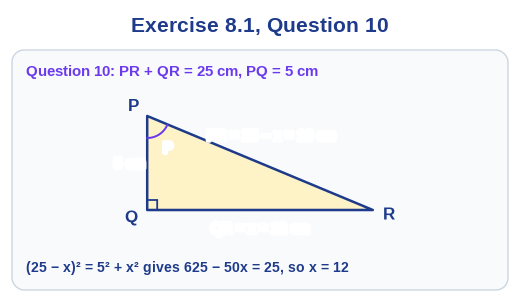
10. “In △ PQR, right-angled at Q, PR + QR = 25 cm and PQ = 5 cm. Determine the values of sin P, cos P and tan P.”
Given: △PQR with ∠Q = 90°, PR + QR = 25 cm and PQ = 5 cm.
To find: sin P, cos P and tan P.
- Let QR = x cm. Then PR = (25 − x) cm.
- By the Pythagoras theorem, PR² = PQ² + QR², so (25 − x)² = 25 + x².
- 625 − 50x + x² = 25 + x². The x² cancels, so 50x = 600 and x = 12.
- So QR = 12 cm and PR = 25 − 12 = 13 cm.
- For ∠P, QR is opposite and PQ is adjacent.
Answer: sin P = 12/13, cos P = 5/13, tan P = 12/5.
11. “State whether the following are true or false. Justify your answer. (i) The value of tan A is always less than 1. (ii) sec A = 12/5 for some value of angle A. (iii) cos A is the abbreviation used for the cosecant of angle A. (iv) cot A is the product of cot and A. (v) sin θ = 4/3 for some angle θ.”
(i) False. tan A = opposite/adjacent, and the opposite side can be longer than the adjacent side. In Example 1, tan A = 4/3, and tan 60° = √3; both are more than 1.
(ii) True. sec A = hypotenuse/adjacent, and 12/5 > 1. A right triangle with hypotenuse 12 and adjacent side 5 exists: its third side is √(144 − 25) = √119.
(iii) False. cos A is short for the cosine of A. The cosecant is written cosec A.
(iv) False. cot A is one symbol, the cotangent of angle A. “cot” alone has no meaning.
(v) False. sin θ = opposite/hypotenuse, and the hypotenuse is the longest side, so sin θ can never be more than 1. 4/3 is more than 1.
Answer: (i) False (ii) True (iii) False (iv) False (v) False.
Questions inside the chapter: specific angles (pages 122–124)
Page 122: in △ABC right-angled at B with ∠A = ∠C = 45°, why is BC = AB? Sides opposite equal angles of a triangle are equal. BC is opposite ∠A and AB is opposite ∠C, and these angles are equal.
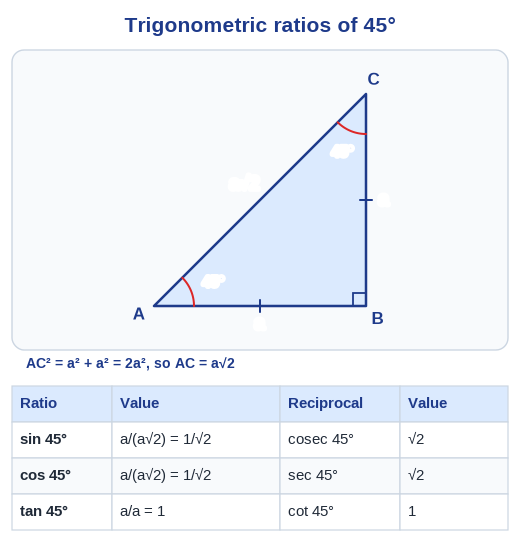
Page 122: AD ⊥ BC in the equilateral triangle ABC; why is △ABD ≅ △ACD? Both have a right angle at D, the hypotenuses AB and AC are equal (sides of an equilateral triangle), and AD is common. So they are congruent by RHS. Then BD = DC and ∠BAD = ∠CAD (CPCT), so ∠BAD = 30°.
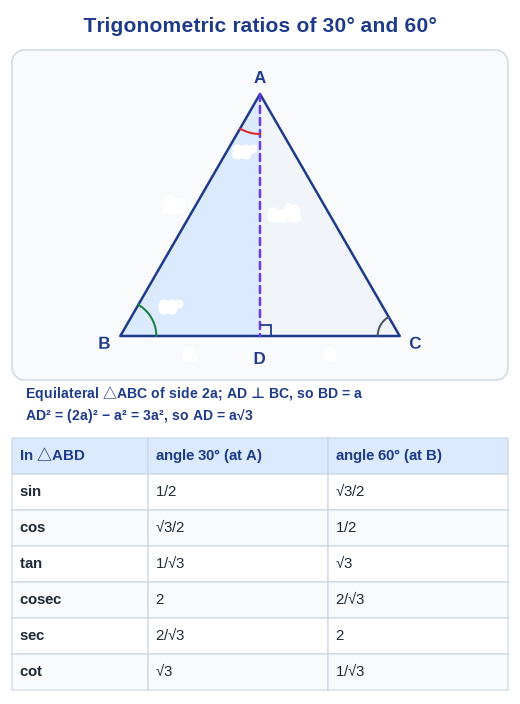
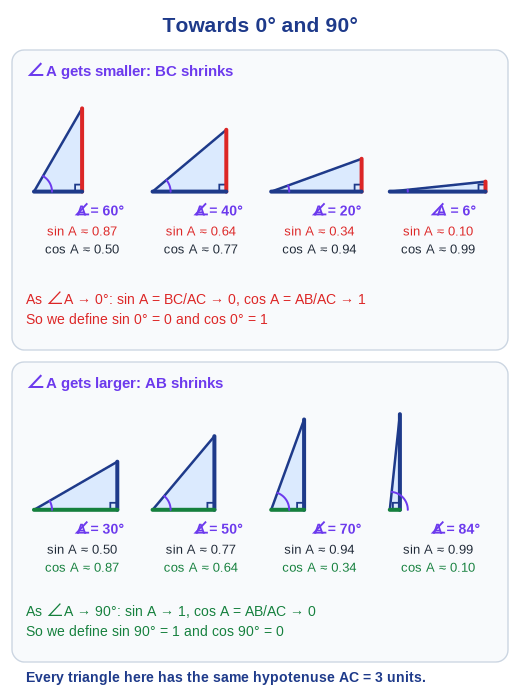
Page 124: why are cot 0° and cosec 0° not defined? cot 0° = 1/tan 0° = 1/0, and cosec 0° = 1/sin 0° = 1/0. Division by 0 has no value.
Page 124: find the other ratios of 90°. With sin 90° = 1 and cos 90° = 0: tan 90° = 1/0 is not defined, cosec 90° = 1/1 = 1, sec 90° = 1/0 is not defined, and cot 90° = 0/1 = 0.
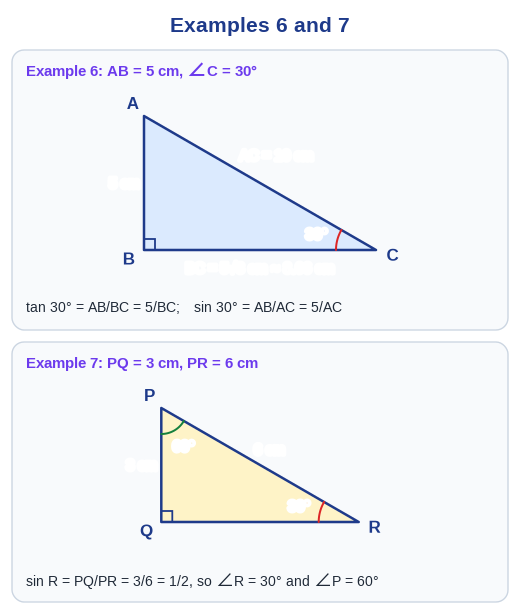
Example 6 (pages 125–126): in △ABC right-angled at B, AB = 5 cm and ∠ACB = 30°; find BC and AC. For ∠C, AB is opposite and BC adjacent, so AB/BC = tan 30°: 5/BC = 1/√3 and BC = 5√3 cm. The “Why?”: sin 30° = AB/AC because AB is opposite ∠C and AC is the hypotenuse. So 1/2 = 5/AC and AC = 10 cm. Check by the Pythagoras theorem: √(25 + 75) = 10.
Example 7 (page 126): in △PQR right-angled at Q, PQ = 3 cm and PR = 6 cm; find ∠QPR and ∠PRQ. sin R = PQ/PR = 3/6 = 1/2, so ∠PRQ = 30°. The “Why?”: the angles of a triangle add up to 180°, and ∠Q = 90°, so ∠QPR = 180° − 90° − 30° = 60°.
Example 8 (page 126): sin (A − B) = 1/2, cos (A + B) = 1/2, 0° < A + B ≤ 90°, A > B; find A and B. The first “Why?”: sin 30° = 1/2, and A − B is an acute angle, so A − B = 30°. The second “Why?”: cos 60° = 1/2, so A + B = 60°. Adding the two, 2A = 90°, so A = 45° and B = 15°.
Exercise 8.2 (page 127)
1. “Evaluate the following : (i) sin 60° cos 30° + sin 30° cos 60° (ii) 2 tan² 45° + cos² 30° – sin² 60° (iii) cos 45°/(sec 30° + cosec 30°) (iv) (sin 30° + tan 45° – cosec 60°)/(sec 30° + cos 60° + cot 45°) (v) (5 cos² 60° + 4 sec² 30° – tan² 45°)/(sin² 30° + cos² 30°)”
(i) (√3/2)(√3/2) + (1/2)(1/2) = 3/4 + 1/4 = 1.
(ii) 2(1)² + (√3/2)² − (√3/2)² = 2 + 3/4 − 3/4 = 2.
(iii) sec 30° + cosec 30° = 2/√3 + 2 = (2 + 2√3)/√3. So the value is (1/√2) × √3/(2 + 2√3) = √3/(2√2(1 + √3)). Multiply the top and the bottom by (√3 − 1): √3(√3 − 1)/(2√2 × 2) = (3 − √3)/(4√2). Multiply the top and the bottom by √2: (3√2 − √6)/8.
(iv) Top: 1/2 + 1 − 2/√3 = 3/2 − 2/√3. Bottom: 2/√3 + 1/2 + 1 = 3/2 + 2/√3. Multiply both by 2√3: the value is (3√3 − 4)/(3√3 + 4). Multiply the top and the bottom by (3√3 − 4): (3√3 − 4)²/(27 − 16) = (27 − 24√3 + 16)/11 = (43 − 24√3)/11.
(v) Top: 5(1/4) + 4(4/3) − 1 = 5/4 + 16/3 − 1 = (15 + 64 − 12)/12 = 67/12. Bottom: 1/4 + 3/4 = 1. So the value is 67/12.
Answer: (i) 1 (ii) 2 (iii) (3√2 − √6)/8 (iv) (43 − 24√3)/11 (v) 67/12.
2. “Choose the correct option and justify your choice : (i) 2 tan 30°/(1 + tan² 30°) = (A) sin 60° (B) cos 60° (C) tan 60° (D) sin 30° (ii) (1 – tan² 45°)/(1 + tan² 45°) = (A) tan 90° (B) 1 (C) sin 45° (D) 0 (iii) sin 2A = 2 sin A is true when A = (A) 0° (B) 30° (C) 45° (D) 60° (iv) 2 tan 30°/(1 – tan² 30°) = (A) cos 60° (B) sin 60° (C) tan 60° (D) sin 30°”
(i) (A). 2(1/√3)/(1 + 1/3) = (2/√3) × (3/4) = 3/(2√3) = √3/2 = sin 60°.
(ii) (D). (1 − 1)/(1 + 1) = 0/2 = 0.
(iii) (A). At A = 0°: sin 0° = 0 = 2 sin 0°. Check the others: at 30°, sin 60° = √3/2 but 2 sin 30° = 1; at 45°, sin 90° = 1 but 2 sin 45° = √2; at 60°, 2 sin 60° = √3, which is more than 1, and no sine is ever more than 1. So only 0° works.
(iv) (C). 2(1/√3)/(1 − 1/3) = (2/√3) × (3/2) = 3/√3 = √3 = tan 60°.
Answer: (i) (A) (ii) (D) (iii) (A) (iv) (C).
3. “If tan (A + B) = √3 and tan (A – B) = 1/√3 ; 0° < A + B ≤ 90°; A > B, find A and B.”
Given: tan (A + B) = √3, tan (A − B) = 1/√3, 0° < A + B ≤ 90° and A > B.
To find: A and B.
- tan 60° = √3, so A + B = 60°. …(1)
- tan 30° = 1/√3, and A − B is an acute angle because A > B, so A − B = 30°. …(2)
- Add (1) and (2): 2A = 90°, so A = 45°.
- Put A = 45° in (1): B = 60° − 45° = 15°.
Answer: A = 45° and B = 15°.
4. “State whether the following are true or false. Justify your answer. (i) sin (A + B) = sin A + sin B. (ii) The value of sin θ increases as θ increases. (iii) The value of cos θ increases as θ increases. (iv) sin θ = cos θ for all values of θ. (v) cot A is not defined for A = 0°.”
(i) False. Take A = 30° and B = 60°: sin 90° = 1, but sin 30° + sin 60° = (1 + √3)/2, which is about 1.37.
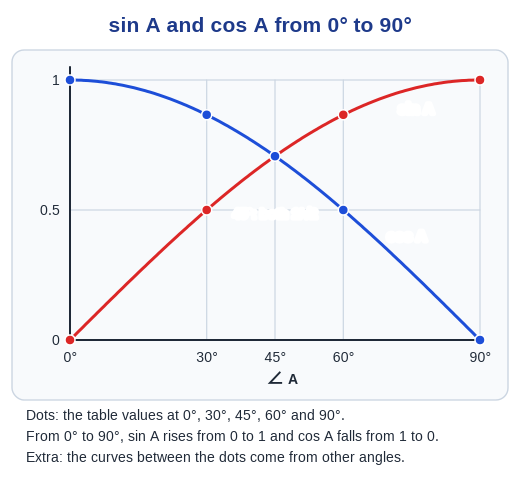
(ii) True (for θ from 0° to 90°). sin 0° = 0, sin 30° = 1/2, sin 45° ≈ 0.71, sin 60° ≈ 0.87, sin 90° = 1.
(iii) False. cos θ decreases: cos 0° = 1, cos 30° ≈ 0.87, cos 60° = 1/2, cos 90° = 0.
(iv) False. sin 0° = 0 but cos 0° = 1. The two are equal only at θ = 45°.
(v) True. cot 0° = cos 0°/sin 0° = 1/0, which is not defined.
Answer: (i) False (ii) True (iii) False (iv) False (v) True.
Questions inside the chapter: identities (pages 128–131)
Page 128: is 1 + tan² A = sec² A true at A = 0°? At 90°? At 0°: 1 + 0 = 1 = sec² 0°, so yes. At 90°, tan A and sec A are not defined, so the identity holds for 0° ≤ A < 90°. In the same way, 1 + cot² A = cosec² A holds for 0° < A ≤ 90°.
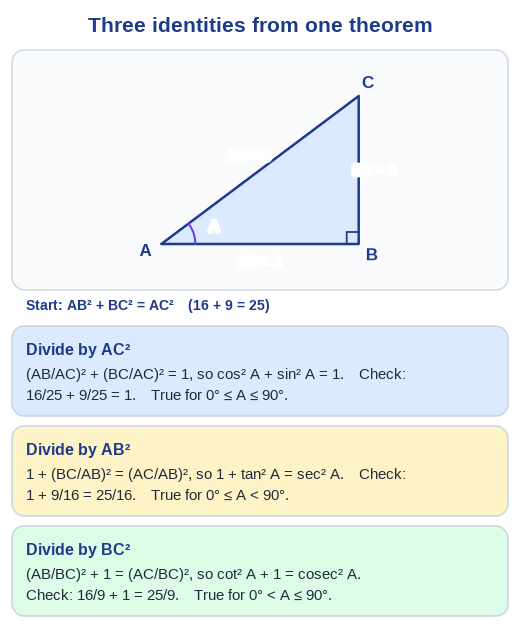
Page 129: from tan A = 1/√3, find the others. cot A = √3. sec² A = 1 + 1/3 = 4/3, so sec A = 2/√3 and cos A = √3/2. sin A = √(1 − 3/4) = 1/2, so cosec A = 2.
Example 9 (page 129): express cos A, tan A and sec A in terms of sin A. cos² A = 1 − sin² A. The “Why?”: A is acute, so cos A is positive and we take the positive root. cos A = √(1 − sin² A), tan A = sin A/√(1 − sin² A) and sec A = 1/√(1 − sin² A).
Example 10 (pages 129–130): prove sec A (1 − sin A)(sec A + tan A) = 1. LHS = (1/cos A)(1 − sin A)((1 + sin A)/cos A) = (1 − sin² A)/cos² A = cos² A/cos² A = 1 = RHS.
Example 11 (page 130): prove (cot A − cos A)/(cot A + cos A) = (cosec A − 1)/(cosec A + 1). LHS = (cos A/sin A − cos A)/(cos A/sin A + cos A). Take cos A out of the top and the bottom: cos A (1/sin A − 1)/(cos A (1/sin A + 1)) = (cosec A − 1)/(cosec A + 1) = RHS.
Example 12 (pages 130–131): prove (sin θ − cos θ + 1)/(sin θ + cos θ − 1) = 1/(sec θ − tan θ), using sec² θ = 1 + tan² θ. Divide the top and the bottom by cos θ: LHS = (tan θ − 1 + sec θ)/(tan θ + 1 − sec θ). Multiply the top and the bottom by (tan θ − sec θ). The top becomes (tan θ + sec θ)(tan θ − sec θ) − (tan θ − sec θ) = (tan² θ − sec² θ) − tan θ + sec θ = −1 − tan θ + sec θ, because tan² θ − sec² θ = −1. This is −(tan θ − sec θ + 1), and the bottom is (tan θ − sec θ + 1)(tan θ − sec θ). Cancelling, LHS = −1/(tan θ − sec θ) = 1/(sec θ − tan θ) = RHS.
Exercise 8.3 (pages 131–132)
1. “Express the trigonometric ratios sin A, sec A and tan A in terms of cot A.”
- cosec² A = 1 + cot² A, so cosec A = √(1 + cot² A). We take the positive root because A is acute.
- sin A = 1/cosec A = 1/√(1 + cot² A).
- tan A = 1/cot A.
- sec² A = 1 + tan² A = 1 + 1/cot² A = (cot² A + 1)/cot² A, so sec A = √(1 + cot² A)/cot A.
Answer: sin A = 1/√(1 + cot² A), tan A = 1/cot A, sec A = √(1 + cot² A)/cot A.
2. “Write all the other trigonometric ratios of ∠ A in terms of sec A.”
- cos A = 1/sec A.
- sec² A − tan² A = 1, so tan² A = sec² A − 1 and tan A = √(sec² A − 1).
- cot A = 1/tan A = 1/√(sec² A − 1).
- sin A = tan A × cos A = √(sec² A − 1)/sec A.
- cosec A = 1/sin A = sec A/√(sec² A − 1).
Answer: cos A = 1/sec A, tan A = √(sec² A − 1), cot A = 1/√(sec² A − 1), sin A = √(sec² A − 1)/sec A, cosec A = sec A/√(sec² A − 1).
3. “Choose the correct option. Justify your choice. (i) 9 sec² A – 9 tan² A = (A) 1 (B) 9 (C) 8 (D) 0 (ii) (1 + tan θ + sec θ) (1 + cot θ – cosec θ) = (A) 0 (B) 1 (C) 2 (D) –1 (iii) (sec A + tan A) (1 – sin A) = (A) sec A (B) sin A (C) cosec A (D) cos A (iv) (1 + tan² A)/(1 + cot² A) = (A) sec² A (B) –1 (C) cot² A (D) tan² A”
(i) (B). 9 sec² A − 9 tan² A = 9(sec² A − tan² A) = 9 × 1 = 9.
(ii) (C). In sin and cos: (1 + sin θ/cos θ + 1/cos θ)(1 + cos θ/sin θ − 1/sin θ) = ((cos θ + sin θ + 1)/cos θ) × ((sin θ + cos θ − 1)/sin θ). The top is ((sin θ + cos θ) + 1)((sin θ + cos θ) − 1) = (sin θ + cos θ)² − 1 = 1 + 2 sin θ cos θ − 1 = 2 sin θ cos θ. Dividing by sin θ cos θ gives 2.
(iii) (D). (1/cos A + sin A/cos A)(1 − sin A) = (1 + sin A)(1 − sin A)/cos A = (1 − sin² A)/cos A = cos² A/cos A = cos A.
(iv) (D). (1 + tan² A)/(1 + cot² A) = sec² A/cosec² A = (1/cos² A) × sin² A = sin² A/cos² A = tan² A.
Answer: (i) (B) (ii) (C) (iii) (D) (iv) (D).
4. “Prove the following identities, where the angles involved are acute angles for which the expressions are defined.”
In each part, start from one side (usually the more complicated one) and change it step by step until it becomes the other side. LHS means left-hand side and RHS means right-hand side.
(i) “(cosec θ – cot θ)² = (1 – cos θ)/(1 + cos θ)”
LHS = (1/sin θ − cos θ/sin θ)² = (1 − cos θ)²/sin² θ = (1 − cos θ)²/(1 − cos² θ) — using sin² θ = 1 − cos² θ = (1 − cos θ)²/((1 − cos θ)(1 + cos θ)) — difference of squares = (1 − cos θ)/(1 + cos θ) = RHS.
Hence proved.
(ii) “cos A/(1 + sin A) + (1 + sin A)/cos A = 2 sec A”
LHS = (cos² A + (1 + sin A)²)/((1 + sin A) cos A) — common denominator = (cos² A + 1 + 2 sin A + sin² A)/((1 + sin A) cos A) = (2 + 2 sin A)/((1 + sin A) cos A) — using sin² A + cos² A = 1 = 2(1 + sin A)/((1 + sin A) cos A) = 2/cos A = 2 sec A = RHS.
Hence proved.
(iii) “tan θ/(1 – cot θ) + cot θ/(1 – tan θ) = 1 + sec θ cosec θ [Hint : Write the expression in terms of sin θ and cos θ]”
Write s = sin θ and c = cos θ for short. LHS = (s/c)/((s − c)/s) + (c/s)/((c − s)/c) = s²/(c(s − c)) − c²/(s(s − c)) — the second denominator has (c − s) = −(s − c) = (s³ − c³)/(sc(s − c)) = (s − c)(s² + sc + c²)/(sc(s − c)) — using a³ − b³ = (a − b)(a² + ab + b²) = (1 + sc)/(sc) — s² + c² = 1, and (s − c) cancels (θ ≠ 45°, where the expression is not defined) = 1/(sc) + 1 = 1 + sec θ cosec θ = RHS.
Hence proved.
(iv) “(1 + sec A)/sec A = sin² A/(1 – cos A) [Hint : Simplify LHS and RHS separately]”
LHS = (1 + 1/cos A)/(1/cos A) = ((cos A + 1)/cos A) × cos A = 1 + cos A. RHS = (1 − cos² A)/(1 − cos A) = (1 − cos A)(1 + cos A)/(1 − cos A) = 1 + cos A. Both sides equal 1 + cos A, so LHS = RHS.
Hence proved.
(v) “(cos A – sin A + 1)/(cos A + sin A – 1) = cosec A + cot A, using the identity cosec² A = 1 + cot² A.”
Divide the top and the bottom by sin A: LHS = (cot A − 1 + cosec A)/(cot A + 1 − cosec A). In the top, replace 1 by cosec² A − cot² A = (cosec A − cot A)(cosec A + cot A): top = (cosec A + cot A) − (cosec A − cot A)(cosec A + cot A) = (cosec A + cot A)(1 − cosec A + cot A). The bracket (1 − cosec A + cot A) is the same as the bottom (cot A + 1 − cosec A), so it cancels. LHS = cosec A + cot A = RHS.
Hence proved.
(vi) “√((1 + sin A)/(1 – sin A)) = sec A + tan A”
Multiply the top and the bottom inside the root by (1 + sin A): LHS = √((1 + sin A)²/(1 − sin² A)) = √((1 + sin A)²/cos² A) = (1 + sin A)/cos A — both are positive for an acute angle = 1/cos A + sin A/cos A = sec A + tan A = RHS.
Hence proved.
(vii) “(sin θ – 2 sin³ θ)/(2 cos³ θ – cos θ) = tan θ”
LHS = sin θ (1 − 2 sin² θ)/(cos θ (2 cos² θ − 1)). Now 1 − 2 sin² θ = 1 − 2(1 − cos² θ) = 2 cos² θ − 1. So the two brackets are equal and cancel (they are not 0, since θ ≠ 45° where the expression is not defined). LHS = sin θ/cos θ = tan θ = RHS.
Hence proved.
(viii) “(sin A + cosec A)² + (cos A + sec A)² = 7 + tan² A + cot² A”
LHS = sin² A + 2 sin A cosec A + cosec² A + cos² A + 2 cos A sec A + sec² A = (sin² A + cos² A) + 2 + 2 + cosec² A + sec² A — because sin A cosec A = 1 and cos A sec A = 1 = 1 + 4 + (1 + cot² A) + (1 + tan² A) = 7 + tan² A + cot² A = RHS.
Hence proved.
(ix) “(cosec A – sin A)(sec A – cos A) = 1/(tan A + cot A) [Hint : Simplify LHS and RHS separately]”
LHS = ((1 − sin² A)/sin A) × ((1 − cos² A)/cos A) = (cos² A/sin A) × (sin² A/cos A) = sin A cos A. RHS = 1/(sin A/cos A + cos A/sin A) = 1/((sin² A + cos² A)/(sin A cos A)) = sin A cos A. Both sides equal sin A cos A, so LHS = RHS.
Hence proved.
(x) “((1 + tan² A)/(1 + cot² A)) = ((1 – tan A)/(1 – cot A))² = tan² A”
First part: (1 + tan² A)/(1 + cot² A) = sec² A/cosec² A = sin² A/cos² A = tan² A, as in Question 3 (iv). Second part: 1 − cot A = 1 − 1/tan A = (tan A − 1)/tan A. So (1 − tan A)/(1 − cot A) = (1 − tan A) × tan A/(tan A − 1) = −tan A, and its square is tan² A. All three expressions equal tan² A (for A ≠ 45°, where the middle one is not defined).
Hence proved.
The summary of the chapter (page 132)
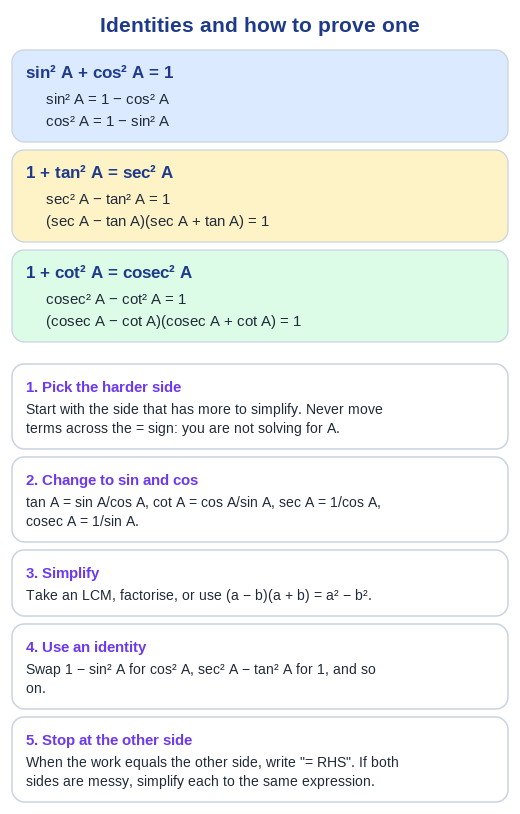
The book ends with a six-point summary: the definitions of sin, cos and tan; the reciprocal ratios and tan A = sin A/cos A; that one known ratio gives the rest; the values for 0°, 30°, 45°, 60° and 90°; that sin A and cos A never exceed 1 while sec A and cosec A are at least 1; and the three identities with the angles where they hold. Each point is covered above and in the chapter notes.
Practice
-
If sin A = 12/13, then cot A is:
Show answer
Answer: (a) 5/12
-
The value of 2 sin 30° cos 30° is:
Show answer
Answer: (a) sin 60°
-
(cosec A − cot A)(cosec A + cot A) equals:
Show answer
Answer: (b) 1
-
In △ABC right-angled at C, AB = 10 cm and ∠A = 30°. Find BC and AC.
Show answer
Answer: BC is opposite to ∠A, so sin 30° = BC/AB gives BC = 10 × 1/2 = 5 cm. AC is adjacent to ∠A, so cos 30° = AC/AB gives AC = 10 × √3/2 = 5√3 cm. Check: 25 + 75 = 100 = 10².
-
Prove that tan A + cot A = sec A cosec A.
Show answer
Answer: LHS = sin A/cos A + cos A/sin A = (sin² A + cos² A)/(sin A cos A) = 1/(sin A cos A) = (1/cos A)(1/sin A) = sec A cosec A = RHS.
Stuck on a question?
Take a photo and Lagnever AI explains it step by step. Try it for 7 days for ₹2.
Get it on Google Play Open in browser
For parents: after the trial, the plan renews monthly by UPI or card autopay. You can cancel anytime in the app.