
Class 10 Maths Chapter 8: Introduction to Trigonometry Notes
This chapter in five lines
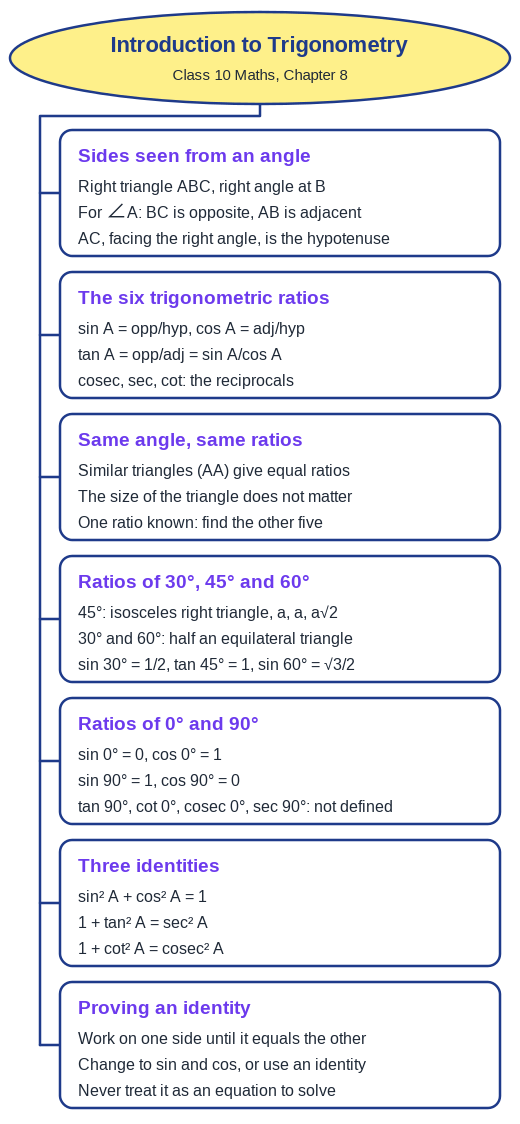
Trigonometry studies how the sides and angles of a triangle are related. For an acute angle A of a right triangle, the six trigonometric ratios compare pairs of sides: sin A = opposite/hypotenuse, cos A = adjacent/hypotenuse, tan A = opposite/adjacent, and cosec A, sec A and cot A are their reciprocals. The chapter finds these ratios for 0°, 30°, 45°, 60° and 90°, and proves three identities, starting with sin² A + cos² A = 1.
What is this chapter about?
Can you find the height of a tower without climbing it, or the width of a river without crossing it? In each case a right triangle can be imagined, with one side you can measure and one you cannot. Trigonometry links the sides of a triangle with its angles, and that link answers such questions. The chapter is 20 pages long. It does the groundwork; the next chapter, Some Applications of Trigonometry, uses it for heights and distances.
The chapter works only with acute angles of a right triangle, plus the special cases 0° and 90°.
What are the sides of a right triangle called?
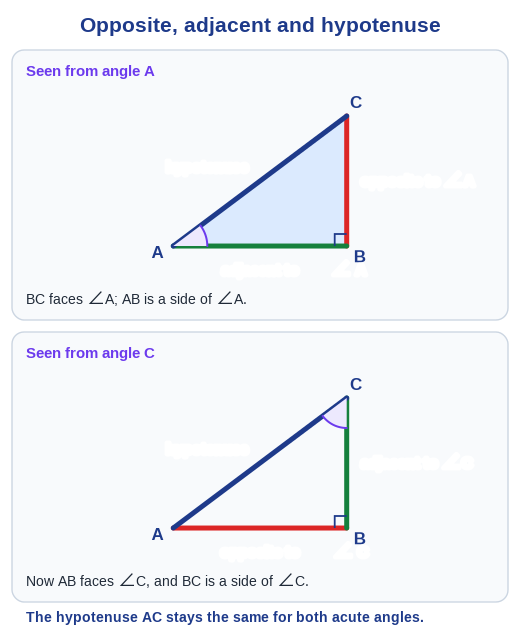
Take △ABC with the right angle at B. The side AC, facing the right angle, is the hypotenuse. Now stand at angle A. The side BC faces it, so BC is the side opposite to ∠A. The side AB helps to make ∠A, so AB is the side adjacent to ∠A. If you stand at angle C instead, the names swap: AB becomes opposite and BC becomes adjacent.
What are the six trigonometric ratios?
For the angle A in this triangle:
- sin A = opposite/hypotenuse = BC/AC
- cos A = adjacent/hypotenuse = AB/AC
- tan A = opposite/adjacent = BC/AB
- cosec A = 1/sin A = AC/BC
- sec A = 1/cos A = AC/AB
- cot A = 1/tan A = AB/BC
Also tan A = sin A/cos A and cot A = cos A/sin A. In a triangle with AB = 4, BC = 3 and AC = 5, sin A = 3/5, cos A = 4/5 and tan A = 3/4.
The value of a ratio depends on the angle only. A bigger triangle with the same angle A is similar to the first one, so its sides are in the same ratio. And if one ratio is known, the rest follow: draw a right triangle, give its sides the values k and so on, and find the third side by the Pythagoras theorem. More on the trigonometric ratios page.
The name “sine” has an Indian origin. Aryabhata, around A.D. 500, wrote about the half-chord, ardha-jya, later shortened to jya or jiva. Through Arabic and then Latin translations it became sinus, and later “sine”.
What are the ratios of 0°, 30°, 45°, 60° and 90°?
These angles come up again and again. For 45°, use a right triangle with two equal arms a, so the hypotenuse is a√2. For 30° and 60°, cut an equilateral triangle of side 2a in half: the halves have sides a, a√3 and 2a. For 0° and 90°, imagine angle A shrinking or growing, and see where sin A and cos A are heading.
| ∠A | 0° | 30° | 45° | 60° | 90° |
|---|---|---|---|---|---|
| sin A | 0 | 1/2 | 1/√2 | √3/2 | 1 |
| cos A | 1 | √3/2 | 1/√2 | 1/2 | 0 |
| tan A | 0 | 1/√3 | 1 | √3 | not defined |
| cosec A | not defined | 2 | √2 | 2/√3 | 1 |
| sec A | 1 | 2/√3 | √2 | 2 | not defined |
| cot A | not defined | √3 | 1 | 1/√3 | 0 |
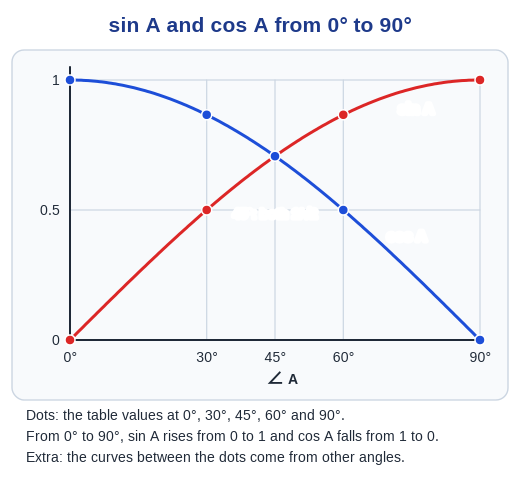
A quick way to remember the first row: sin 0°, 30°, 45°, 60°, 90° are √0/2, √1/2, √2/2, √3/2, √4/2. The cos row is the same list backwards (Extra: a memory aid, not from the book). As A goes from 0° to 90°, sin A rises from 0 to 1 and cos A falls from 1 to 0.
With these values, a right triangle can be solved from one side and one more part. In Example 6 of the book, AB = 5 cm and ∠C = 30° give BC = 5√3 cm and AC = 10 cm.
What are the trigonometric identities?
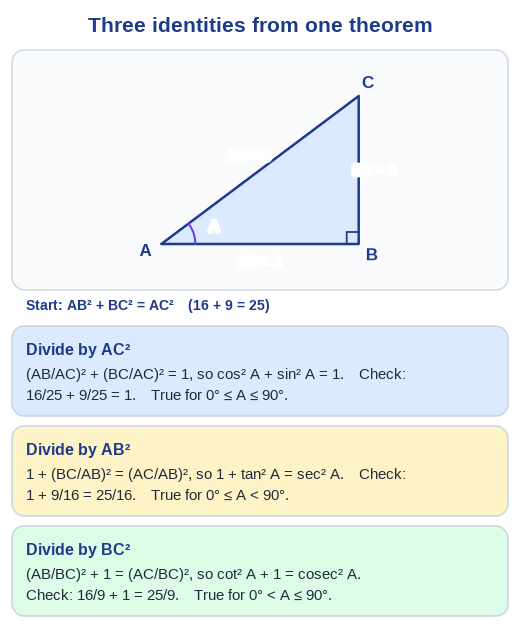
An identity is an equation that is true for every value of the angle where both sides make sense. All three identities of the chapter come from the Pythagoras theorem AB² + BC² = AC², divided by one side squared:
- divide by AC²: sin² A + cos² A = 1, for 0° ≤ A ≤ 90°
- divide by AB²: 1 + tan² A = sec² A, for 0° ≤ A < 90°
- divide by BC²: 1 + cot² A = cosec² A, for 0° < A ≤ 90°
They let you write any ratio in terms of any other, and they are the tools for proving longer identities, such as sec A (1 − sin A)(sec A + tan A) = 1. The methods are on the trigonometric identities page.
Before we move on
This chapter leans on two earlier ideas: the Baudhayana-Pythagoras theorem from Class 8, and the AA criterion for similar triangles from Chapter 6. The current book has no section on complementary angles here. Every example and all three exercises are answered in the NCERT solutions for Chapter 8.
Key terms
| Term | Meaning |
|---|---|
| Trigonometry | The branch of mathematics that studies the relationships between the sides and angles of a triangle. The name comes from Greek words for three, sides and measure. |
| Hypotenuse | The side of a right triangle opposite the right angle. It is the longest side. |
| Opposite side | For an acute angle of a right triangle, the side that faces the angle. In △ABC right-angled at B, BC is opposite to ∠A. |
| Adjacent side | For an acute angle of a right triangle, the side other than the hypotenuse that forms the angle. In △ABC right-angled at B, AB is adjacent to ∠A. |
| sin A, cos A, tan A | sine, cosine and tangent of angle A: opposite/hypotenuse, adjacent/hypotenuse and opposite/adjacent. |
| cosec A, sec A, cot A | cosecant, secant and cotangent of angle A: the reciprocals 1/sin A, 1/cos A and 1/tan A. |
| sin² A | A short way to write (sin A)². It is not sin(A²). Also, sin A is one symbol: it is not 'sin' multiplied by A. |
| Not defined | A ratio whose denominator is 0 has no value. For example tan 90° and cosec 0° are not defined. |
| Trigonometric identity | An equation with trigonometric ratios that is true for every value of the angle for which both sides are defined. |
| θ (theta) | A Greek letter often used as the name of an angle, as in sin θ. |
Topics in this chapter
Practice
-
In △ABC right-angled at B, AB = 12 cm and BC = 5 cm. sin A is:
Show answer
Answer: (c) 5/13
-
If tan A = 1, then ∠A (an acute angle) is:
Show answer
Answer: (b) 45°
-
The value of sin 30° + cos 60° is:
Show answer
Answer: (c) 1
-
Which of these is not defined?
Show answer
Answer: (c) tan 90°
-
sec² A − tan² A equals:
Show answer
Answer: (b) 1
Questions students ask
What are the main topics of Class 10 Maths Chapter 8?
Three sections: trigonometric ratios of an acute angle of a right triangle (8.2), trigonometric ratios of 0°, 30°, 45°, 60° and 90° (8.3), and trigonometric identities (8.4), followed by a summary.
Are trigonometric ratios of complementary angles in the 2026-27 book?
No. The rationalised book (marked Reprint 2026-27) has no section on complementary angles in this chapter, and none of its exercises uses them. The chapter goes from the ratios of specific angles straight to the identities.
How many exercises does Chapter 8 have?
Three. Exercise 8.1 (11 questions) is on the ratios, Exercise 8.2 (4 questions) on the ratios of specific angles, and Exercise 8.3 (4 questions, the last with ten proofs) on identities. All of them, with the 12 examples, are worked out on the NCERT solutions page.
Why does the value of sin A not depend on the size of the triangle?
Two right triangles with the same acute angle A are similar by the AA criterion of Chapter 6. Their corresponding sides are in the same ratio, so the opposite side divided by the hypotenuse comes out the same in both.
Stuck on a question?
Take a photo and Lagnever AI explains it step by step. Try it for 7 days for ₹2.
Get it on Google Play Open in browser
For parents: after the trial, the plan renews monthly by UPI or card autopay. You can cancel anytime in the app.