
How do you prove trigonometric identities?
Answer in short
A trigonometric identity is true for every angle at which both sides are defined. Class 10 uses three: sin² A + cos² A = 1, 1 + tan² A = sec² A and 1 + cot² A = cosec² A. To prove another, simplify one side, using sin and cos or these three, until it equals the other side.
Stuck on a question? Take a photo and Lagnever AI explains it step by step. Try it for 7 days for ₹2. Get it on Google Play
Where do the three identities come from?
Take △ABC right-angled at B. The Pythagoras theorem says AB² + BC² = AC². Divide every term by the same square, and the ratios appear:
- Divide by AC²: (AB/AC)² + (BC/AC)² = 1, that is cos² A + sin² A = 1. This holds for every A from 0° to 90°.
- Divide by AB²: 1 + (BC/AB)² = (AC/AB)², that is 1 + tan² A = sec² A. It holds at 0°, but not at 90°, where tan A and sec A are not defined.
- Divide by BC²: (AB/BC)² + 1 = (AC/BC)², that is cot² A + 1 = cosec² A. It holds at 90°, but not at 0°.
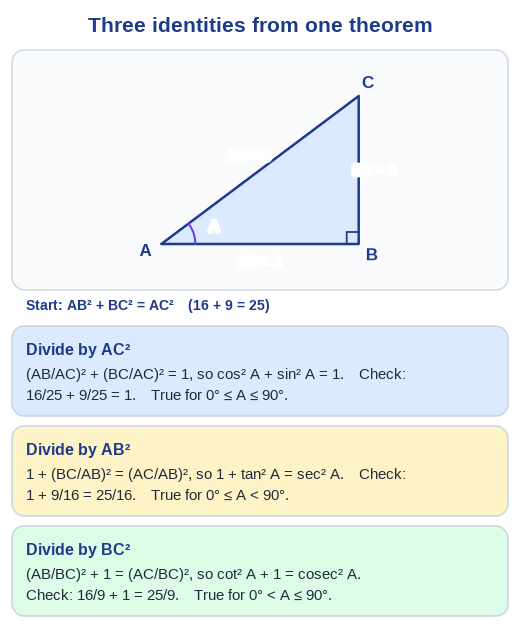
With the 3-4-5 triangle: sin A = 3/5 and cos A = 4/5, and 9/25 + 16/25 = 1. Also tan A = 3/4, and 1 + 9/16 = 25/16 = (5/4)² = sec² A.
How do you write one ratio in terms of another?
The identities let you express every ratio through any one of them. In terms of sin A:
- cos² A = 1 − sin² A, so cos A = √(1 − sin² A). The minus root is dropped because cos A is positive for an acute angle.
- tan A = sin A/√(1 − sin² A) and sec A = 1/√(1 − sin² A).
This is also a quick way to get values. If tan A = 1/√3, then sec² A = 1 + 1/3 = 4/3, so sec A = 2/√3 and cos A = √3/2. Then sin A = √(1 − 3/4) = 1/2, and cosec A = 2.
How do you prove an identity?
An identity is not an equation to solve. You must show that the two sides are always equal, so you work on one side until it turns into the other. A plan that works for most questions:
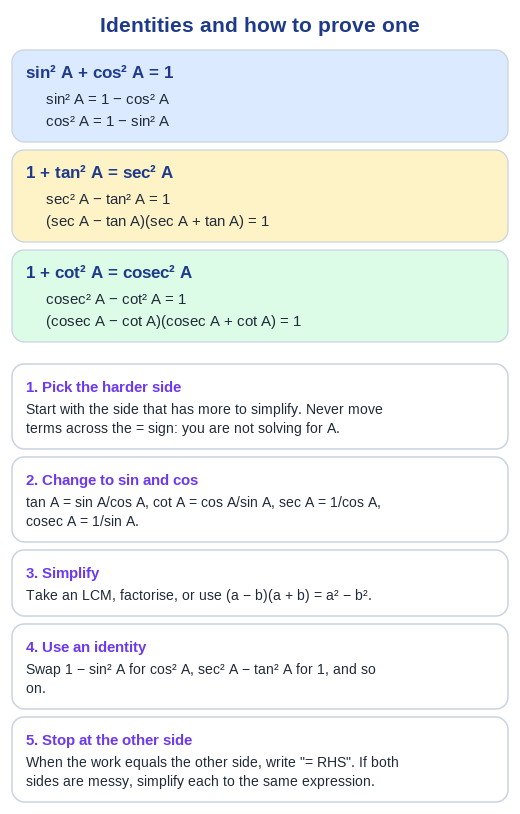
- Start with the side that has more to simplify, usually the left-hand side (LHS).
- If nothing obvious fits, change tan, cot, sec and cosec into sin and cos.
- Simplify: take an LCM, factorise, or use (a − b)(a + b) = a² − b².
- Replace pieces using an identity, for example 1 − sin² A by cos² A.
- Stop when you reach the right-hand side (RHS). If both sides are messy, simplify each one separately to the same expression.
A worked proof
Prove that sec A (1 − sin A)(sec A + tan A) = 1 (Example 10 of the book).
LHS = (1/cos A)(1 − sin A)(1/cos A + sin A/cos A) — changing to sin and cos = (1 − sin A)(1 + sin A)/cos² A — the two denominators multiply to cos² A = (1 − sin² A)/cos² A — using (a − b)(a + b) = a² − b² = cos² A/cos² A — using sin² A + cos² A = 1 = 1 = RHS.
A proof with sec and tan
Prove that (sin θ − cos θ + 1)/(sin θ + cos θ − 1) = 1/(sec θ − tan θ) (Example 12). Divide the top and the bottom by cos θ to bring in tan θ and sec θ:
LHS = (tan θ − 1 + sec θ)/(tan θ + 1 − sec θ).
The trick is to write the 1 in the numerator as sec² θ − tan² θ = (sec θ − tan θ)(sec θ + tan θ). Then the numerator is
(sec θ + tan θ) − (sec θ − tan θ)(sec θ + tan θ) = (sec θ + tan θ)(1 − sec θ + tan θ).
The bracket (1 − sec θ + tan θ) is exactly the denominator, so it cancels, leaving sec θ + tan θ. Finally, because (sec θ + tan θ)(sec θ − tan θ) = 1, we have sec θ + tan θ = 1/(sec θ − tan θ) = RHS. The same idea, with cosec and cot, proves Exercise 8.3, Question 4 (v).
Checking your work
Before writing a proof, put a value such as A = 30° into both sides. If the numbers disagree, something is wrong. This check is not a proof, but it catches copying mistakes early. We checked every identity of the chapter this way at hundreds of angles before writing the solutions.
Read next: the trigonometric ratios, which these identities connect. All ten proofs of Exercise 8.3 are on the NCERT solutions page, and the chapter notes give the full picture.
Practice
-
(1 − cos² A) × cosec² A equals:
Show answer
Answer: (b) 1
-
If sec A + tan A = 3, then sec A − tan A is:
Show answer
Answer: (c) 1/3
-
cos A × tan A equals:
Show answer
Answer: (a) sin A
-
Prove that (1 + tan² A) cos² A = 1.
Show answer
Answer: LHS = (1 + tan² A) cos² A = sec² A × cos² A (identity 1 + tan² A = sec² A) = (1/cos² A) × cos² A = 1 = RHS.
-
Prove that (sin A + cos A)² + (sin A − cos A)² = 2.
Show answer
Answer: LHS = (sin² A + 2 sin A cos A + cos² A) + (sin² A − 2 sin A cos A + cos² A) = 2 sin² A + 2 cos² A = 2(sin² A + cos² A) = 2 × 1 = 2 = RHS.
Questions students ask
What is the difference between an identity and an equation?
An equation such as 2 sin A = 1 is true only for some angles (here A = 30°). An identity such as sin² A + cos² A = 1 is true for every angle at which its terms are defined. You solve an equation; you prove an identity.
Which identity should I use in a proof?
Look at the ratios in the question. If you see sec and tan, use 1 + tan² A = sec² A; if you see cosec and cot, use 1 + cot² A = cosec² A. If nothing fits, write everything in sin and cos and use sin² A + cos² A = 1.
Why does the book say the angles are acute and the expressions are defined?
Some expressions break down at special angles. In Exercise 8.3, Question 4 (iii), 1 − cot θ is 0 at θ = 45°, so the left side is not defined there. The identity is claimed only where every part has a value.
Can I check an identity with a number?
Yes, as a check, not as a proof. Put A = 30° or 60° into both sides; if they differ, the identity is wrong or you copied it wrongly. If they agree, you still need the general proof.
Stuck on a question?
Take a photo and Lagnever AI explains it step by step. Try it for 7 days for ₹2.
Get it on Google Play Open in browser
For parents: after the trial, the plan renews monthly by UPI or card autopay. You can cancel anytime in the app.