
What are trigonometric ratios?
Answer in short
Trigonometric ratios compare two sides of a right triangle as seen from one acute angle A: sin A = opposite/hypotenuse, cos A = adjacent/hypotenuse and tan A = opposite/adjacent. Their reciprocals are cosec A, sec A and cot A. The values depend only on the angle: sin 30° is always 1/2.
Stuck on a question? Take a photo and Lagnever AI explains it step by step. Try it for 7 days for ₹2. Get it on Google Play
How are the ratios defined?
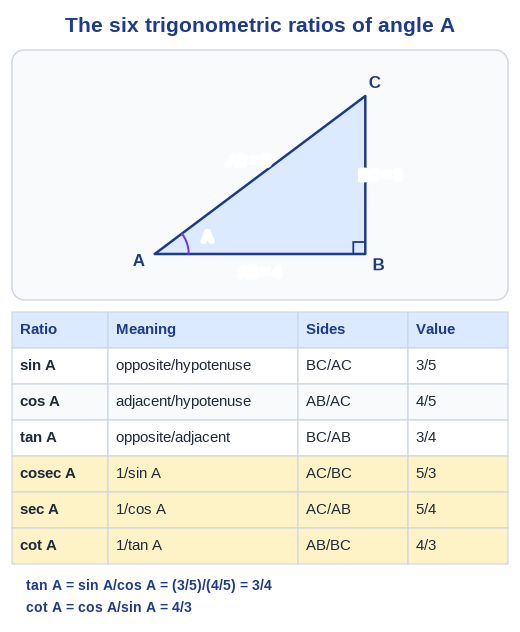
Take a right triangle ABC with the right angle at B, and look at the acute angle A. The hypotenuse AC faces the right angle. The side BC faces angle A, so it is the opposite side. The side AB, which forms angle A with the hypotenuse, is the adjacent side.
Six ratios can be made from three sides. Their names are:
- sin A = opposite/hypotenuse = BC/AC
- cos A = adjacent/hypotenuse = AB/AC
- tan A = opposite/adjacent = BC/AB
- cosec A = AC/BC, sec A = AC/AB and cot A = AB/BC, the reciprocals of the first three.
Dividing sin A by cos A gives (BC/AC) ÷ (AB/AC) = BC/AB, so tan A = sin A/cos A, and cot A = cos A/sin A.
Why does the size of the triangle not matter?
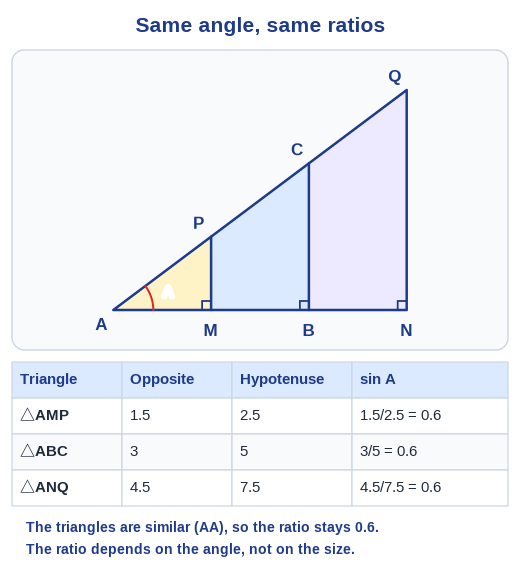
Draw a smaller and a larger right triangle that share angle A, as in our figure. All of them have a right angle and the angle A, so they are similar by the AA criterion of Chapter 6. Similar triangles have their sides in the same ratio, so the opposite side divided by the hypotenuse is 0.6 in each of them. The ratios belong to the angle, not to the triangle.
How do you find all six from one ratio?
Suppose sin A = 1/3. Then BC : AC = 1 : 3, so take BC = k and AC = 3k for some positive k. By the Pythagoras theorem, AB² = 9k² − k² = 8k², so AB = 2√2 k. (AB is a length, so we keep only the positive root.) Now every ratio can be read off: cos A = 2√2/3, tan A = 1/(2√2), cosec A = 3, sec A = 3/(2√2) and cot A = 2√2.
The same three steps work every time: write the given ratio as two sides with k, find the third side, then use the definitions.
What are the ratios of 45°?
If one acute angle of a right triangle is 45°, the other is also 45°, so the two arms are equal: AB = BC = a. Then AC² = a² + a² = 2a² and AC = a√2.
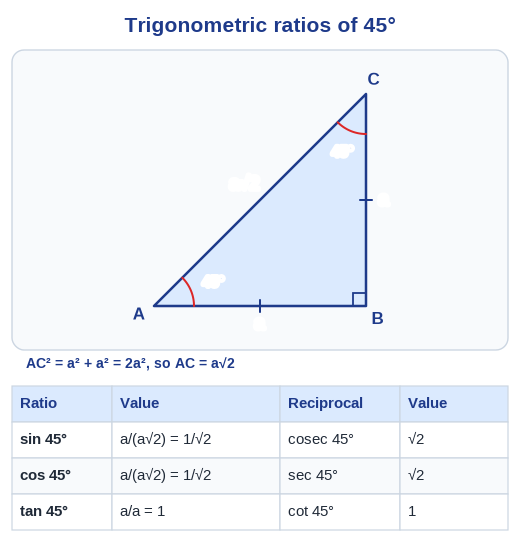
So sin 45° = cos 45° = 1/√2, tan 45° = 1, cosec 45° = sec 45° = √2 and cot 45° = 1.
What are the ratios of 30° and 60°?
Take an equilateral triangle ABC of side 2a and drop the perpendicular AD to BC. The two halves are congruent (RHS), so BD = a and ∠BAD = 30°, while ∠ABD = 60°. By the Pythagoras theorem, AD² = 4a² − a² = 3a², so AD = a√3.
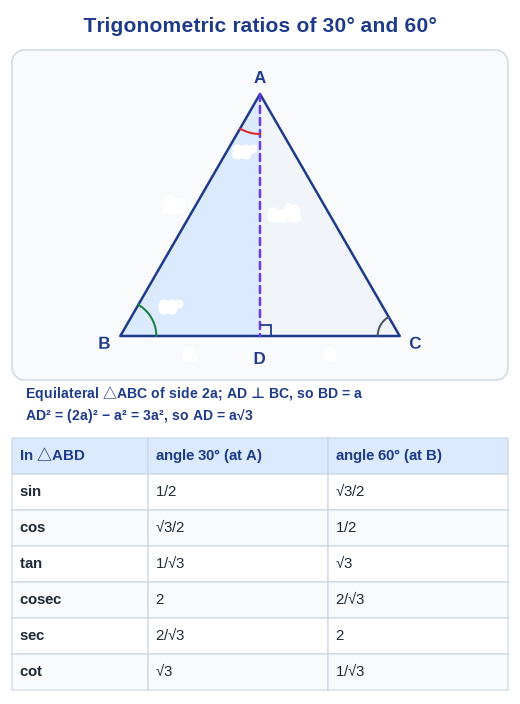
In △ABD: sin 30° = BD/AB = 1/2, cos 30° = AD/AB = √3/2 and tan 30° = 1/√3. For 60° the opposite and adjacent sides swap: sin 60° = √3/2, cos 60° = 1/2 and tan 60° = √3.
What happens at 0° and 90°?
Keep the hypotenuse fixed and let angle A shrink. The side BC shrinks towards 0 and AB grows towards AC. So sin A heads to 0 and cos A heads to 1, and we define sin 0° = 0 and cos 0° = 1. Now let A grow towards 90°. This time AB shrinks, so sin A heads to 1 and cos A to 0, and we define sin 90° = 1 and cos 90° = 0.
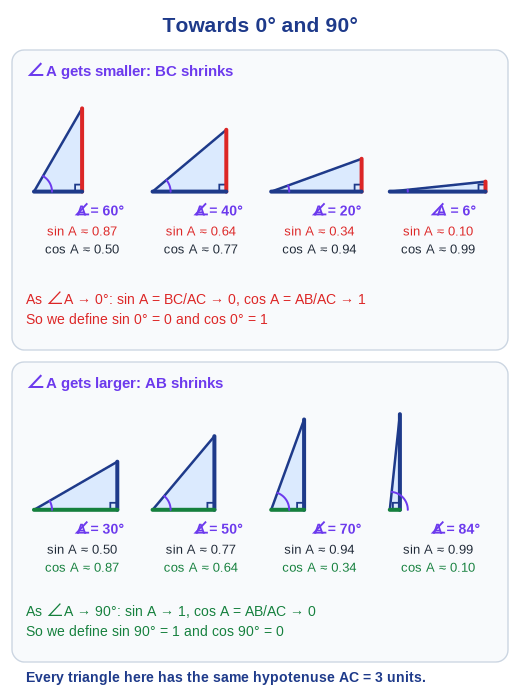
The other ratios follow from these. tan 0° = 0/1 = 0 and sec 0° = 1, but cot 0° and cosec 0° would need a division by 0, so they are not defined. At 90°, cosec 90° = 1 and cot 90° = 0, while tan 90° and sec 90° are not defined.
How are the values used?
With one side and one acute angle, the other sides follow. In △ABC right-angled at B, if AB = 5 cm and ∠C = 30°, then tan 30° = AB/BC gives BC = 5√3 cm, and sin 30° = AB/AC gives AC = 10 cm. With two sides, an angle follows: in △PQR right-angled at Q, PQ = 3 cm and PR = 6 cm give sin R = 1/2, so ∠R = 30° and ∠P = 60°.
Read next: the trigonometric identities, which connect these ratios to one another. Every question of Exercises 8.1 and 8.2 is solved in the NCERT solutions, and the chapter notes give the full picture.
Practice
-
If cos A = 5/13, then tan A is:
Show answer
Answer: (b) 12/5
-
In △PQR right-angled at Q, PQ = 8 cm and QR = 6 cm. cosec P is:
Show answer
Answer: (a) 10/6
-
The value of tan 60° × cot 30° is:
Show answer
Answer: (c) 3
-
If sin A = 8/17, find cos A, tan A and sec A.
Show answer
Answer: Take the opposite side 8k and the hypotenuse 17k. The adjacent side is √(289k² − 64k²) = √(225k²) = 15k. So cos A = 15/17, tan A = 8/15 and sec A = 17/15.
-
In △ABC right-angled at B, AC = 12 cm and ∠A = 60°. Find AB and BC.
Show answer
Answer: cos 60° = AB/AC, so AB = 12 × 1/2 = 6 cm. sin 60° = BC/AC, so BC = 12 × √3/2 = 6√3 cm. Check: 6² + (6√3)² = 36 + 108 = 144 = 12².
Questions students ask
Why do we only use acute angles in this chapter?
The ratios are defined with a right triangle, and the other two angles of a right triangle are always acute. The book adds 0° and 90° by looking at what happens as the angle shrinks or grows. Ratios of larger angles come in higher classes.
Why is tan 90° not defined?
tan 90° = sin 90°/cos 90° = 1/0, and division by 0 has no value. In the same way sec 90° = 1/cos 90°, cot 0° = cos 0°/sin 0° and cosec 0° = 1/sin 0° have 0 in the denominator, so they are not defined.
Can sec A or cosec A be less than 1?
No. sec A = hypotenuse/adjacent and cosec A = hypotenuse/opposite, and the hypotenuse is the longest side, so both are at least 1. That is why a value like sec A = 12/5 is possible but sin θ = 4/3 is not.
How do I remember the table of values?
Learn the sin row as √0/2, √1/2, √2/2, √3/2, √4/2 for 0°, 30°, 45°, 60°, 90°, which simplify to 0, 1/2, 1/√2, √3/2, 1. The cos row is the same list backwards, and tan = sin/cos fills the third row. This trick is Extra, not from the book.
Stuck on a question?
Take a photo and Lagnever AI explains it step by step. Try it for 7 days for ₹2.
Get it on Google Play Open in browser
For parents: after the trial, the plan renews monthly by UPI or card autopay. You can cancel anytime in the app.