
NCERT Solutions Class 10 Science Chapter 1: Chemical Reactions and Equations
Answers to the three Questions boxes inside Chapter 1, Chemical Reactions and Equations, the other questions the chapter asks along the way, all twenty end-of-chapter exercises and the group activity, from Science, the Class 10 NCERT textbook. Page numbers follow the 2026-27 reprint (pages 1–16). The exercises are quoted from the book; the in-chapter questions are restated in short. Every equation below was checked atom by atom. Short notes: Chapter 1 notes.
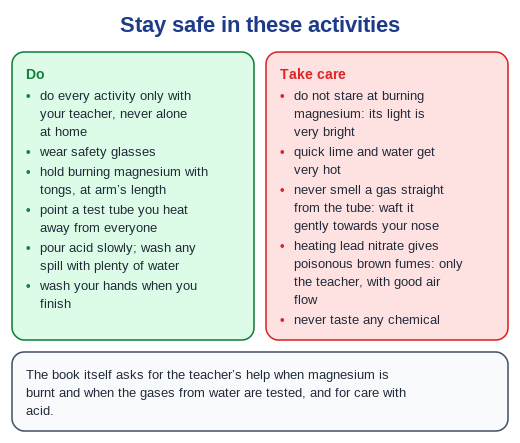
Stay safe. Burning magnesium, heating solids and anything with acids is done only in the laboratory with your teacher. Wear safety glasses, use tongs, point a heated test tube away from everyone and never taste or directly smell a chemical.
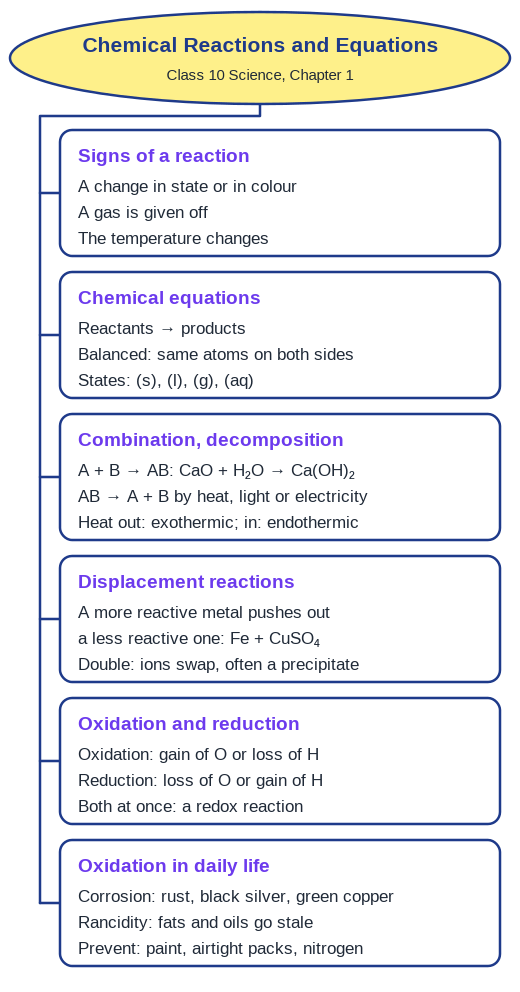
Questions, page 6
Question 1 (page 6): why rub the magnesium ribbon with sandpaper before burning it? Magnesium kept in air slowly gets a dull coating, mostly of magnesium oxide, from reacting with the air. This layer does not burn and keeps the magnesium underneath from meeting oxygen, so the ribbon is hard to light. Rubbing it with sandpaper removes the layer and exposes fresh metal, which then burns readily with its bright white flame.
Question 2 (page 6): write balanced equations for three reactions.
(i) Hydrogen and chlorine form hydrogen chloride:
H₂ + Cl₂ → 2HCl
Check: H 2 = 2, Cl 2 = 2.
(ii) Barium chloride and aluminium sulphate give barium sulphate and aluminium chloride:
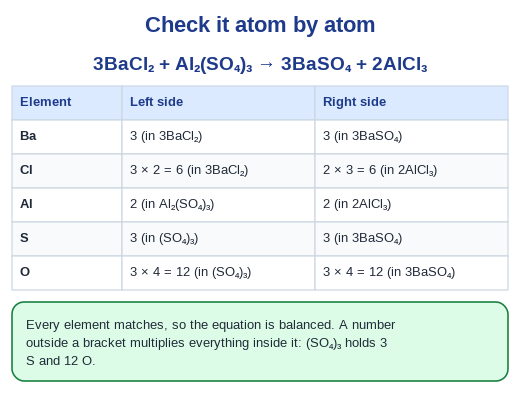
3BaCl₂ + Al₂(SO₄)₃ → 3BaSO₄ + 2AlCl₃
Check: Ba 3 = 3, Cl 6 = 6, Al 2 = 2, S 3 = 3, O 12 = 12.
(iii) Sodium and water give sodium hydroxide and hydrogen:
2Na + 2H₂O → 2NaOH + H₂
Check: Na 2 = 2, O 2 = 2, H 4 = 2 + 2.
Question 3 (page 6): write balanced equations with state symbols.
(i) Barium chloride and sodium sulphate, both dissolved in water, react; barium sulphate settles out and sodium chloride stays dissolved:
BaCl₂(aq) + Na₂SO₄(aq) → BaSO₄(s) + 2NaCl(aq)
(ii) Sodium hydroxide and hydrochloric acid, both in water, give dissolved sodium chloride and water:
NaOH(aq) + HCl(aq) → NaCl(aq) + H₂O(l)
Questions, page 10
Question 1 (page 10): X is the substance whose solution whitewashes walls. Name it, give its formula and write its reaction with water.
(i) X is calcium oxide, also called quick lime, CaO.
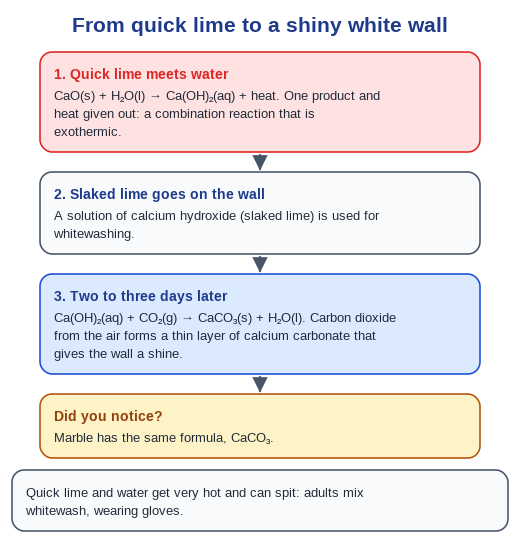
(ii) With water it forms calcium hydroxide (slaked lime) and gives out a lot of heat:
CaO(s) + H₂O(l) → Ca(OH)₂(aq) + heat
The solution of slaked lime is what is brushed onto the walls. Over two to three days it takes in carbon dioxide from the air and forms a thin, shiny layer of calcium carbonate: Ca(OH)₂ + CO₂ → CaCO₃ + H₂O.
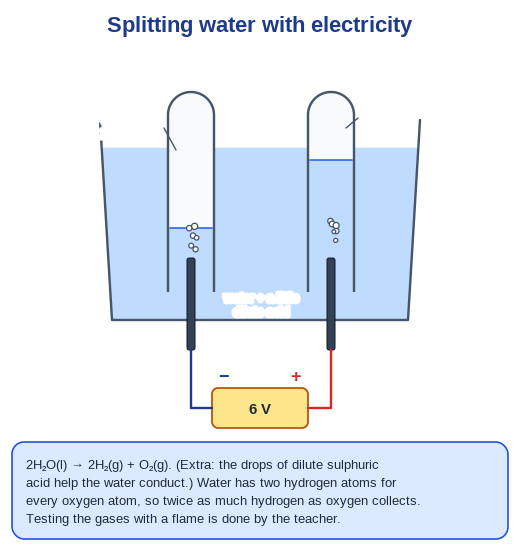
Question 2 (page 10): in the electrolysis of water (Activity 1.7), which gas fills twice the volume of the other, and why? The current splits water into hydrogen and oxygen:
2H₂O(l) → 2H₂(g) + O₂(g)
Each water molecule has two hydrogen atoms for every oxygen atom, so two molecules of hydrogen form for each molecule of oxygen. Equal numbers of gas molecules take up equal volumes under the same conditions (Extra: this is how the volume ratio follows from the equation), so the volume of hydrogen is twice that of oxygen. The gas collected in double amount is hydrogen; it gathers over the electrode joined to the negative terminal.
Questions, page 13
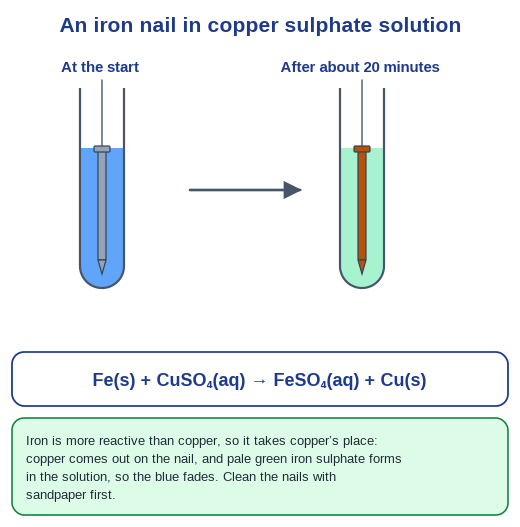
Question 1 (page 13): why does blue copper sulphate solution lose its colour around an iron nail? Iron is more reactive than copper, so it displaces copper from copper sulphate. Blue copper sulphate is used up and pale green iron sulphate forms in its place, so the blue colour fades, while reddish-brown copper coats the nail:
Fe(s) + CuSO₄(aq) → FeSO₄(aq) + Cu(s)
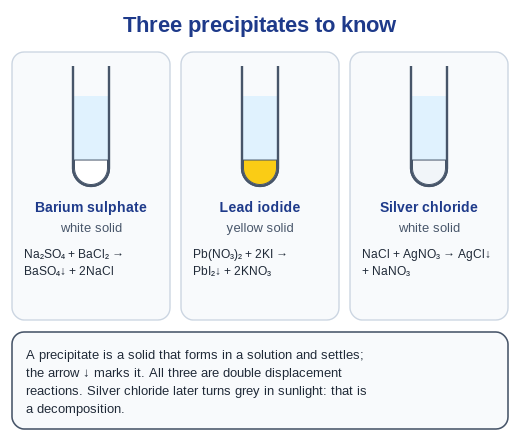
Question 2 (page 13): one more double displacement reaction, not the one from Activity 1.10. Silver nitrate and sodium chloride solutions swap ions and give a white precipitate of silver chloride:
AgNO₃(aq) + NaCl(aq) → AgCl(s) + NaNO₃(aq)
Another example from the chapter itself is lead nitrate with potassium iodide, which gives a yellow precipitate of lead iodide: Pb(NO₃)₂(aq) + 2KI(aq) → PbI₂(s) + 2KNO₃(aq).
Question 3 (page 13): in two given reactions, which substance is oxidised and which is reduced?
(i) 4Na(s) + O₂(g) → 2Na₂O(s). Sodium gains oxygen, so sodium is oxidised; oxygen is the substance that is reduced.
(ii) CuO(s) + H₂(g) → Cu(s) + H₂O(l). Copper(II) oxide loses oxygen, so CuO is reduced; hydrogen gains oxygen, so H₂ is oxidised.
Other questions inside the chapter (pages 5–13)
Balance Eq. (1.2) (page 5). Mg + O₂ → MgO has two oxygen atoms on the left and one on the right. Take 2MgO, then 2Mg: 2Mg + O₂ → 2MgO. With states: 2Mg(s) + O₂(g) → 2MgO(s).
What type of reaction is Activity 1.1? (page 7) Magnesium and oxygen form a single product, magnesium oxide, and heat and light are given out, so it is a combination reaction that is also exothermic. Magnesium is oxidised as well.
What form of energy decomposes silver chloride and silver bromide? (page 10) Light, from the sun: 2AgCl(s) → 2Ag(s) + Cl₂(g) and 2AgBr(s) → 2Ag(s) + Br₂(g).
Barium hydroxide with ammonium chloride (page 10). The bottom of the test tube feels cold: the reaction takes in heat from its surroundings, including your palm, so it is endothermic. (Extra: Ba(OH)₂ + 2NH₄Cl → BaCl₂ + 2NH₃ + 2H₂O. Ammonia, a gas with a sharp smell, is given off, so do this with your teacher in an airy room.)
Recall Activity 1.2 (page 12). (i) The precipitate is yellow: it is lead iodide, PbI₂. (ii) Pb(NO₃)₂(aq) + 2KI(aq) → PbI₂(s) + 2KNO₃(aq). (iii) Yes, it is a double displacement reaction: lead and potassium exchange partners. It is also a precipitation reaction.
Recall Activity 1.1 (page 13). Magnesium gains oxygen to form magnesium oxide, so magnesium is oxidised.
What the activities show (Activities 1.1–1.11)
Do every one of these only with your teacher.
- 1.1, burning magnesium: a blinding white light and a white powder, magnesium oxide. Hold the ribbon with tongs, away from your eyes.
- 1.2, lead nitrate and potassium iodide: a yellow precipitate of lead iodide forms.
- 1.3, zinc in dilute acid: bubbles of hydrogen form round the zinc and the flask gets warm. Handle the acid with care.
- 1.4, quick lime and water: the beaker gets hot as slaked lime forms. Add the water slowly.
- 1.5, heating ferrous sulphate: the green crystals change colour and a smell of burning sulphur comes off. Point the tube away from everyone and do not breathe the fumes.
- 1.6, heating lead nitrate: brown fumes of nitrogen dioxide. These are poisonous: a teacher demonstration only.
- 1.7, electrolysis of water: bubbles at both electrodes; one tube fills with twice as much gas (hydrogen) as the other (oxygen). The teacher tests the gases with a burning candle: hydrogen burns with a pop, and oxygen makes the flame burn brighter.
- 1.8, silver chloride in sunlight: white turns grey as silver forms.
- 1.9, iron nails in copper sulphate: the nails turn brown and the blue solution fades.
- 1.10, sodium sulphate and barium chloride: a white precipitate of barium sulphate.
- 1.11, heating copper powder: the brown surface turns black as copper(II) oxide forms.
Exercises 1 to 3: choose the answer
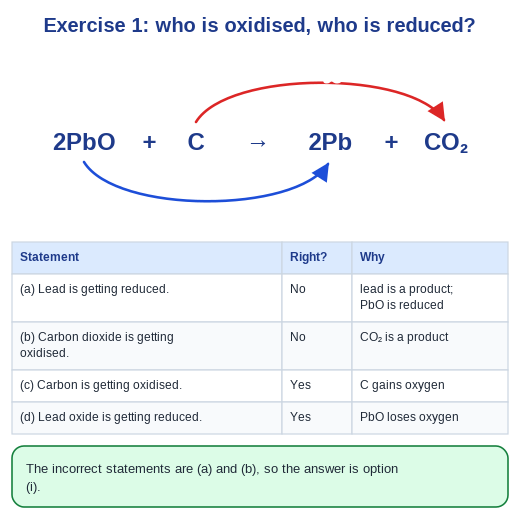
1. “Which of the statements about the reaction below are incorrect? 2PbO(s) + C(s) → 2Pb(s) + CO₂(g) (a) Lead is getting reduced. (b) Carbon dioxide is getting oxidised. (c) Carbon is getting oxidised. (d) Lead oxide is getting reduced. (i) (a) and (b) (ii) (a) and (c) (iii) (a), (b) and (c) (iv) all”
(i) (a) and (b). Lead oxide loses oxygen, so lead oxide (not lead) is reduced: (a) is incorrect and (d) is correct. Carbon gains oxygen, so carbon is oxidised: (c) is correct. Carbon dioxide is a product; it is not being oxidised: (b) is incorrect.
2. “Fe₂O₃ + 2Al → Al₂O₃ + 2Fe The above reaction is an example of a (a) combination reaction. (b) double displacement reaction. (c) decomposition reaction. (d) displacement reaction.”
(d) displacement reaction. Aluminium, the more reactive metal, takes the oxygen from iron(III) oxide and sets iron out on its own. It is also a redox reaction: aluminium is oxidised and iron(III) oxide is reduced. Chapter 3 shows that this reaction, the thermit reaction, is used to join railway tracks.
3. “What happens when dilute hydrochloric acid is added to iron fillings? Tick the correct answer. (a) Hydrogen gas and iron chloride are produced. (b) Chlorine gas and iron hydroxide are produced. (c) No reaction takes place. (d) Iron salt and water are produced.”
(a) Hydrogen gas and iron chloride are produced. (The book means iron filings.) Iron is more reactive than hydrogen and displaces it from the acid:
Fe(s) + 2HCl(aq) → FeCl₂(aq) + H₂(g)
Exercises 4 to 8: writing and balancing equations
4. “What is a balanced chemical equation? Why should chemical equations be balanced?” A balanced chemical equation has the same number of atoms of each element on the reactant side and on the product side, for example 2H₂ + O₂ → 2H₂O. Equations must be balanced because of the law of conservation of mass: in a chemical reaction mass is neither created nor destroyed. Atoms only rearrange into new substances, so every atom present before the reaction must be present after it. A balanced equation also tells us the correct proportions in which substances react.
5. “Translate the following statements into chemical equations and then balance them. (a) Hydrogen gas combines with nitrogen to form ammonia. (b) Hydrogen sulphide gas burns in air to give water and sulpur dioxide. (c) Barium chloride reacts with aluminium sulphate to give aluminium chloride and a precipitate of barium sulphate. (d) Potassium metal reacts with water to give potassium hydroxide and hydrogen gas.”
(a) 3H₂(g) + N₂(g) → 2NH₃(g). Check: H 6 = 6, N 2 = 2.
(b) 2H₂S(g) + 3O₂(g) → 2H₂O(l) + 2SO₂(g). (The book means sulphur dioxide.) Check: H 4 = 4, S 2 = 2, O 6 = 2 + 4.
(c) 3BaCl₂(aq) + Al₂(SO₄)₃(aq) → 2AlCl₃(aq) + 3BaSO₄(s). Check: Ba 3 = 3, Cl 6 = 6, Al 2 = 2, S 3 = 3, O 12 = 12.
(d) 2K(s) + 2H₂O(l) → 2KOH(aq) + H₂(g). Check: K 2 = 2, O 2 = 2, H 4 = 2 + 2.
6. “Balance the following chemical equations. (a) HNO₃ + Ca(OH)₂ → Ca(NO₃)₂ + H₂O (b) NaOH + H₂SO₄ → Na₂SO₄ + H₂O (c) NaCl + AgNO₃ → AgCl + NaNO₃ (d) BaCl₂ + H₂SO₄ → BaSO₄ + HCl”
(a) 2HNO₃ + Ca(OH)₂ → Ca(NO₃)₂ + 2H₂O. Check: H 2 + 2 = 4, N 2 = 2, O 6 + 2 = 6 + 2, Ca 1 = 1.
(b) 2NaOH + H₂SO₄ → Na₂SO₄ + 2H₂O. Check: Na 2 = 2, S 1 = 1, O 2 + 4 = 4 + 2, H 2 + 2 = 4.
(c) NaCl + AgNO₃ → AgCl + NaNO₃ is already balanced: Na, Cl, Ag and N are 1 on each side, and O is 3 on each side.
(d) BaCl₂ + H₂SO₄ → BaSO₄ + 2HCl. Check: Ba 1 = 1, Cl 2 = 2, H 2 = 2, S 1 = 1, O 4 = 4.
7. “Write the balanced chemical equations for the following reactions. (a) Calcium hydroxide + Carbon dioxide → Calcium carbonate + Water (b) Zinc + Silver nitrate → Zinc nitrate + Silver (c) Aluminium + Copper chloride → Aluminium chloride + Copper (d) Barium chloride + Potassium sulphate → Barium sulphate + Potassium chloride”
(a) Ca(OH)₂ + CO₂ → CaCO₃ + H₂O. Already balanced: Ca 1, C 1, O 4, H 2 on each side.
(b) Zn + 2AgNO₃ → Zn(NO₃)₂ + 2Ag. Check: Zn 1 = 1, Ag 2 = 2, N 2 = 2, O 6 = 6.
(c) 2Al + 3CuCl₂ → 2AlCl₃ + 3Cu. Check: Al 2 = 2, Cu 3 = 3, Cl 6 = 6.
(d) BaCl₂ + K₂SO₄ → BaSO₄ + 2KCl. Check: Ba 1 = 1, Cl 2 = 2, K 2 = 2, S 1 = 1, O 4 = 4.
8. “Write the balanced chemical equation for the following and identify the type of reaction in each case. (a) Potassium bromide(aq) + Barium iodide(aq) → Potassium iodide(aq) + Barium bromide(s) (b) Zinc carbonate(s) → Zinc oxide(s) + Carbon dioxide(g) (c) Hydrogen(g) + Chlorine(g) → Hydrogen chloride(g) (d) Magnesium(s) + Hydrochloric acid(aq) → Magnesium chloride(aq) + Hydrogen(g)”
(a) 2KBr(aq) + BaI₂(aq) → 2KI(aq) + BaBr₂(s). Double displacement: the two compounds exchange ions; as the question marks barium bromide as a solid, it is written as a precipitation reaction. (Extra: in the laboratory barium bromide dissolves easily in water, so no precipitate is actually seen; answer as the question is set.)
(b) ZnCO₃(s) → ZnO(s) + CO₂(g), on heating. Decomposition (thermal decomposition): one reactant gives two products.
(c) H₂(g) + Cl₂(g) → 2HCl(g). Combination: two reactants form one product.
(d) Mg(s) + 2HCl(aq) → MgCl₂(aq) + H₂(g). Displacement: magnesium, being more reactive, displaces hydrogen from hydrochloric acid.
Exercises 9 to 15: types of reactions
9. “What does one mean by exothermic and endothermic reactions? Give examples.”
An exothermic reaction gives out heat along with its products. The surroundings get warmer. Examples:
- Quick lime with water: CaO(s) + H₂O(l) → Ca(OH)₂(aq) + heat
- Burning natural gas: CH₄(g) + 2O₂(g) → CO₂(g) + 2H₂O(g)
- Respiration in our cells
An endothermic reaction takes in energy, as heat, light or electricity. Examples:
- Calcium carbonate breaking down on heating: CaCO₃(s) → CaO(s) + CO₂(g)
- Silver chloride in sunlight: 2AgCl(s) → 2Ag(s) + Cl₂(g)
- Barium hydroxide with ammonium chloride, which makes the test tube feel cold
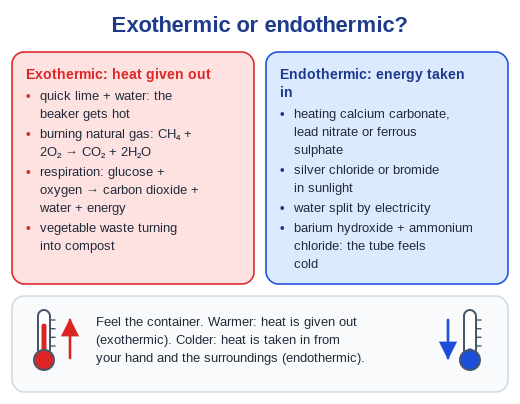
10. “Why is respiration considered an exothermic reaction? Explain.” We get energy from our food. During digestion, carbohydrates in rice, potatoes and bread are broken down into glucose. In the cells of our body, glucose combines with oxygen and forms carbon dioxide and water, and energy is released:
C₆H₁₂O₆(aq) + 6O₂(aq) → 6CO₂(aq) + 6H₂O(l) + energy
Because energy is given out, respiration is an exothermic reaction. This energy keeps our body warm and lets us work.
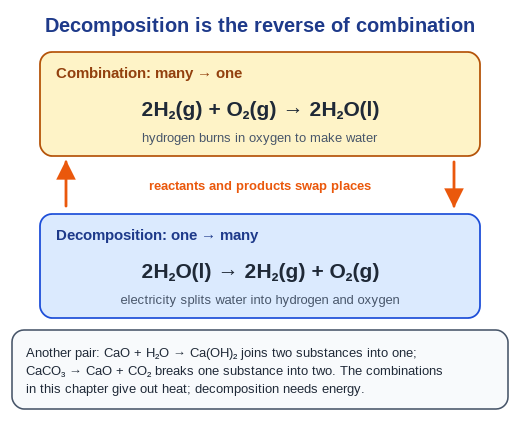
11. “Why are decomposition reactions called the opposite of combination reactions? Write equations for these reactions.”
- In a combination reaction, two or more reactants join to form one product.
- In a decomposition reaction, one reactant breaks down into two or more products.
So one is the reverse of the other. Example with water:
- Combination: hydrogen and oxygen join to form water, 2H₂(g) + O₂(g) → 2H₂O(l).
- Decomposition: electricity splits water back into them, 2H₂O(l) → 2H₂(g) + O₂(g).
Another pair: CaO(s) + H₂O(l) → Ca(OH)₂(aq) is a combination, and CaCO₃(s) → CaO(s) + CO₂(g) on heating is a decomposition. Combination reactions like these usually give out heat, while decomposition reactions need energy to be supplied.
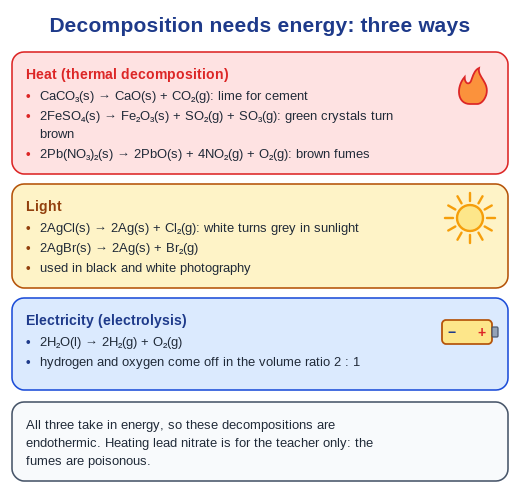
12. “Write one equation each for decomposition reactions where energy is supplied in the form of heat, light or electricity.”
- Heat: CaCO₃(s) → CaO(s) + CO₂(g)
- Light: 2AgCl(s) → 2Ag(s) + Cl₂(g), in sunlight
- Electricity: 2H₂O(l) → 2H₂(g) + O₂(g), by electrolysis
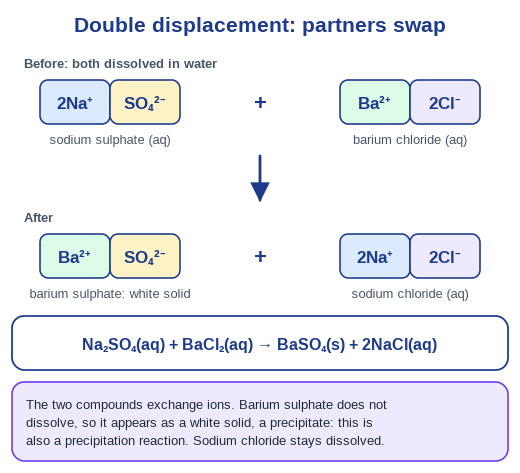
13. “What is the difference between displacement and double displacement reactions? Write equations for these reactions.” In a displacement reaction, a more reactive element takes the place of a less reactive element in its compound; only one element moves. Example: Fe(s) + CuSO₄(aq) → FeSO₄(aq) + Cu(s). In a double displacement reaction, two compounds exchange their ions, so both change partners, often giving a precipitate. Example: Na₂SO₄(aq) + BaCl₂(aq) → BaSO₄(s) + 2NaCl(aq).
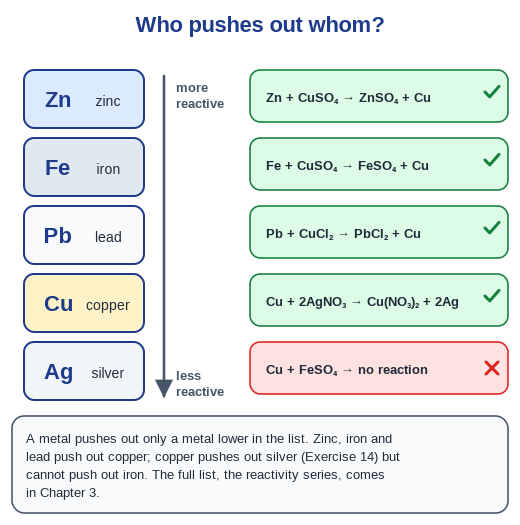
14. “In the refining of silver, the recovery of silver from silver nitrate solution involved displacement by copper metal. Write down the reaction involved.” Copper is more reactive than silver, so it displaces silver:
Cu(s) + 2AgNO₃(aq) → Cu(NO₃)₂(aq) + 2Ag(s)
Check: Cu 1 = 1, Ag 2 = 2, N 2 = 2, O 6 = 6.
15. “What do you mean by a precipitation reaction? Explain by giving examples.” A precipitation reaction is one in which an insoluble solid, called a precipitate, forms when two solutions are mixed; the solid separates out of the solution. Examples: sodium sulphate and barium chloride give a white precipitate of barium sulphate, Na₂SO₄(aq) + BaCl₂(aq) → BaSO₄(s) + 2NaCl(aq); lead nitrate and potassium iodide give a yellow precipitate of lead iodide, Pb(NO₃)₂(aq) + 2KI(aq) → PbI₂(s) + 2KNO₃(aq). Both are also double displacement reactions.
Exercises 16 to 20: oxidation in daily life
16. “Explain the following in terms of gain or loss of oxygen with two examples each. (a) Oxidation (b) Reduction”
(a) Oxidation is the gain of oxygen by a substance. Examples: copper heated in air, 2Cu + O₂ → 2CuO, where copper gains oxygen; and ZnO + C → Zn + CO, where carbon gains oxygen and becomes carbon monoxide.
(b) Reduction is the loss of oxygen by a substance. Examples: CuO + H₂ → Cu + H₂O, where copper(II) oxide loses oxygen and becomes copper; and ZnO + C → Zn + CO, where zinc oxide loses oxygen and becomes zinc.
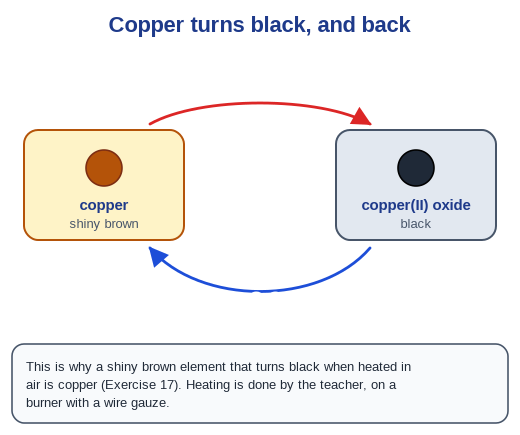
17. “A shiny brown coloured element ‘X’ on heating in air becomes black in colour. Name the element ‘X’ and the black coloured compound formed.” X is copper. On heating in air it combines with oxygen to form black copper(II) oxide, CuO: 2Cu + O₂ → 2CuO.
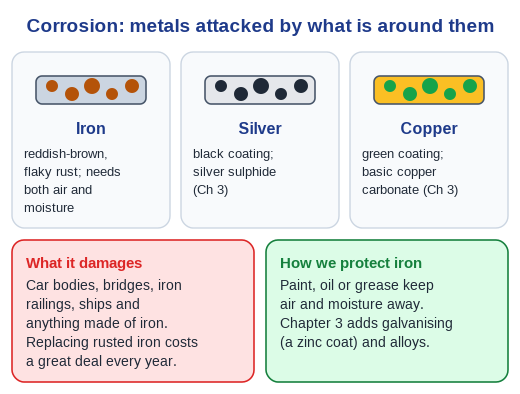
18. “Why do we apply paint on iron articles?” Iron left in moist air corrodes: it gets coated with reddish-brown rust, which weakens and slowly destroys it. A coat of paint keeps air and moisture from reaching the iron, so it does not rust. That is why gates, grills, railings and bridges are painted.
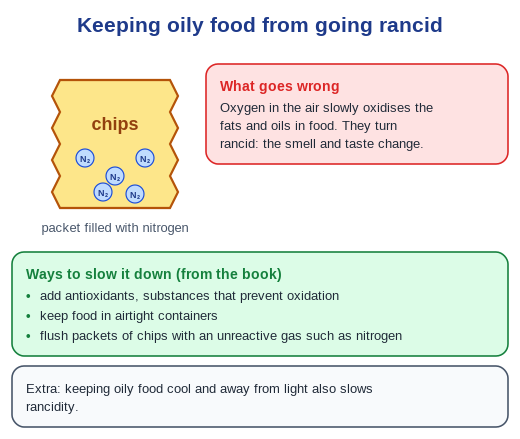
19. “Oil and fat containing food items are flushed with nitrogen. Why?” Fats and oils are slowly oxidised by oxygen in the air and turn rancid, so the food smells and tastes bad. Nitrogen is an unreactive gas. Flushing the packet with nitrogen pushes out the air, so there is little oxygen left to oxidise the fats and oils, and the food stays fresh longer. Makers of chips usually do this.
20. “Explain the following terms with one example each. (a) Corrosion (b) Rancidity”
(a) Corrosion is the slow damage of a metal when moisture, air, acids and other substances around it act on it. Example: iron left in moist air gets a coat of reddish-brown rust. (Silver turning black and copper turning green are other examples.)
(b) Rancidity is the oxidation of fats and oils in food, which changes their smell and taste. Example: fried snacks or butter left open for a long time smell and taste stale. Antioxidants, airtight containers and nitrogen in packets slow it down.
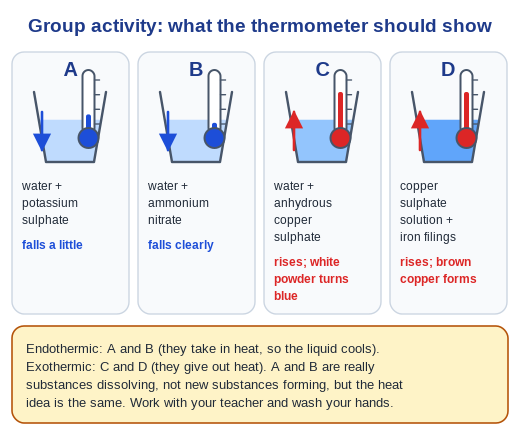
Group activity (page 16)
Do this with your teacher, wear safety glasses and wash your hands afterwards. Record the temperature of each liquid before and after adding the solid, and stir gently. What you should find:
- A, potassium sulphate in water: the temperature falls a little. Endothermic.
- B, ammonium nitrate in water: the temperature falls clearly. Endothermic.
- C, anhydrous copper sulphate in water: the temperature rises, and the white powder turns blue. Exothermic.
- D, iron filings in copper sulphate solution: the temperature rises, the blue colour fades and brown copper forms. Exothermic (this is the displacement reaction Fe + CuSO₄ → FeSO₄ + Cu).
Strictly, A and B are substances dissolving rather than new substances forming, but the same idea applies: a fall in temperature means heat is taken in, and a rise means heat is given out. The exact change depends on the amounts used.
Practice
-
Balance: Al + HCl → AlCl₃ + H₂.
Show answer
Answer: (b) 2Al + 6HCl → 2AlCl₃ + 3H₂
-
AgNO₃(aq) + NaCl(aq) → AgCl(s) + NaNO₃(aq) is a:
Show answer
Answer: (c) double displacement reaction
-
Which metal can push copper out of copper sulphate solution?
Show answer
Answer: (c) zinc
-
Write the balanced equation, with states, for calcium carbonate breaking down on heating.
Show answer
Answer: CaCO₃(s) → CaO(s) + CO₂(g), with heat written on the arrow. Ca 1 = 1, C 1 = 1, O 3 = 1 + 2.
-
In Fe₂O₃ + 3CO → 2Fe + 3CO₂, which substance is oxidised and which is reduced?
Show answer
Answer: Carbon monoxide gains oxygen, so it is oxidised to carbon dioxide; iron(III) oxide loses oxygen, so it is reduced to iron.
Stuck on a question?
Take a photo and Lagnever AI explains it step by step. Try it for 7 days for ₹2.
Get it on Google Play Open in browser
For parents: after the trial, the plan renews monthly by UPI or card autopay. You can cancel anytime in the app.