
Class 10 Science Chapter 1: Chemical Reactions and Equations Notes
This chapter in five lines
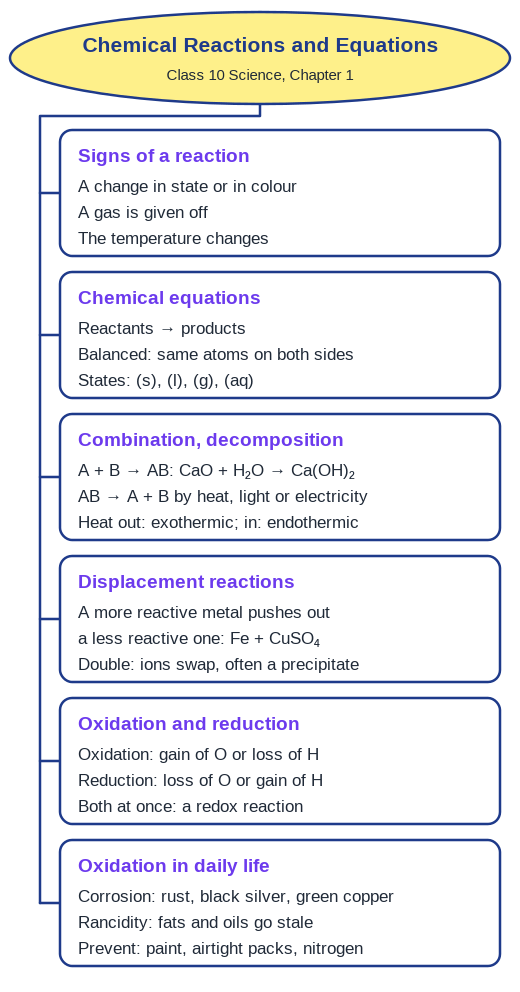
A chemical reaction turns reactants into new products; a change in state, colour or temperature, or a gas given off, shows it has happened. A chemical equation writes it in formulae and is balanced so that every element has the same number of atoms on both sides. Reactions can be combination, decomposition, displacement, double displacement or redox. Corrosion and rancidity are oxidation in daily life.
What is this chapter about?
Leave milk out on a hot day and it turns sour. An iron tawa left in damp air gets a reddish coat. Grapes ferment, food cooks, and inside your body food is digested and you respire. In each case the substances you started with have changed into new ones. That is a chemical change, and we say a chemical reaction has taken place. This chapter shows how to spot a reaction, how to write it as a balanced chemical equation, and how to sort reactions into types. Chapters 2 and 3 build on it.
How do we stay safe in these activities?
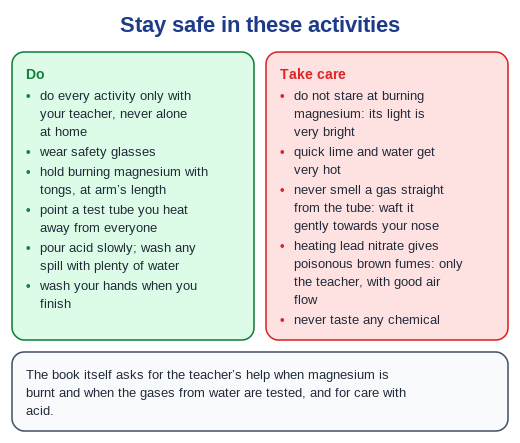
Several activities in this chapter burn magnesium, heat solids or use acids. Do them only in the school laboratory, with your teacher. Wear safety glasses, hold burning magnesium with tongs at arm’s length and do not stare at its bright flame. Point a test tube you are heating away from everyone. Heating lead nitrate gives poisonous brown fumes, so that one is for the teacher alone. Never taste a chemical, and wash your hands at the end.
How do we know a chemical reaction has happened?
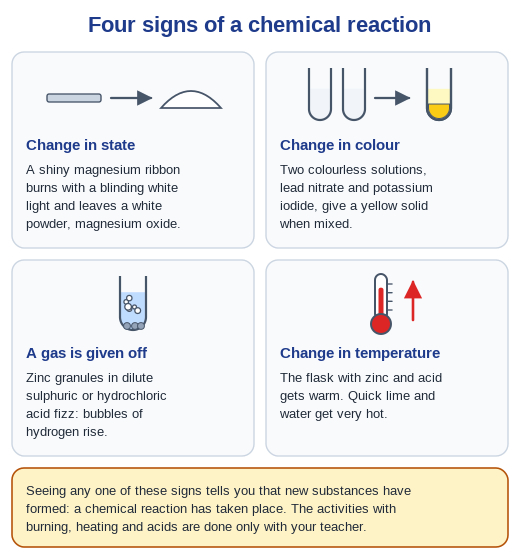
Look for at least one of four signs. A change in state: a shiny magnesium ribbon burns with a blinding white light and leaves a white powder, magnesium oxide. A change in colour: two colourless solutions, lead nitrate and potassium iodide, give a yellow solid. A gas given off: zinc granules in dilute sulphuric or hydrochloric acid fizz with bubbles of hydrogen. A change in temperature: the flask with zinc and acid gets warm.
What is a chemical equation?
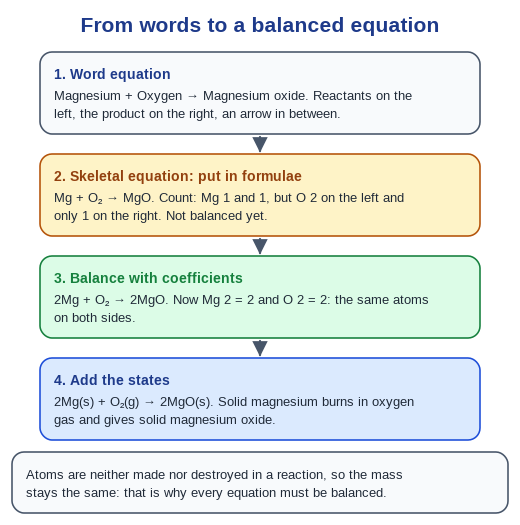
“Magnesium burns in oxygen to form magnesium oxide” is a long sentence. A word equation shortens it: Magnesium + Oxygen → Magnesium oxide. The substances that change, the reactants, go on the left with plus signs between them; the new substances, the products, go on the right; the arrow points towards the products. Using formulae gives a chemical equation: Mg + O₂ → MgO. Count the atoms and you find two oxygen atoms on the left but one on the right. An equation like this, with formulae but not yet balanced, is a skeletal chemical equation.
Why and how do we balance an equation?
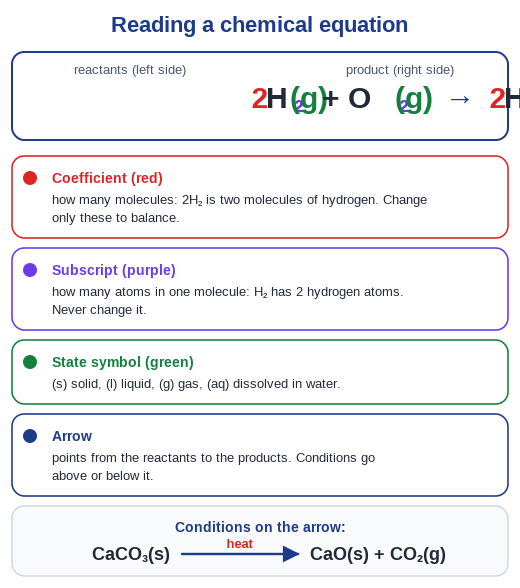
Mass is neither created nor destroyed in a reaction (the law of conservation of mass). The atoms only rearrange, so each element must have the same number of atoms on both sides. To balance, change only the numbers in front of formulae (the coefficients), never the formulae themselves. The book balances iron reacting with steam, Fe + H₂O → Fe₃O₄ + H₂, by trial: start with Fe₃O₄, the formula with the most atoms; take 4H₂O for its four oxygen atoms, then 4H₂ for the eight hydrogen atoms, then 3Fe. The result is 3Fe + 4H₂O → Fe₃O₄ + 4H₂. This is the hit-and-trial method. Then add state symbols: 3Fe(s) + 4H₂O(g) → Fe₃O₄(s) + 4H₂(g), where (g) shows the water is steam. Conditions such as heat, pressure or sunlight go above or below the arrow. Read how to balance a chemical equation.
What is a combination reaction?
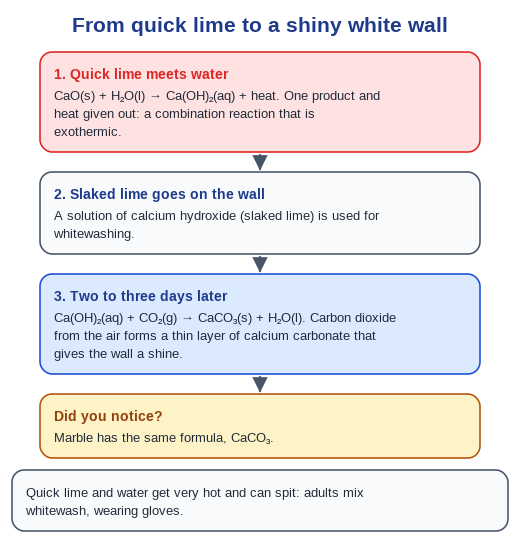
Add water slowly to quick lime (calcium oxide) and the beaker gets very hot: CaO(s) + H₂O(l) → Ca(OH)₂(aq) + heat. Two reactants form a single product, slaked lime, so this is a combination reaction. Burning coal (C + O₂ → CO₂) and making water from hydrogen and oxygen (2H₂ + O₂ → 2H₂O) are combinations too. Reactions that give out heat are exothermic: quick lime with water, burning natural gas, respiration and vegetable waste rotting into compost. Read the types of chemical reactions.
What is a decomposition reaction?
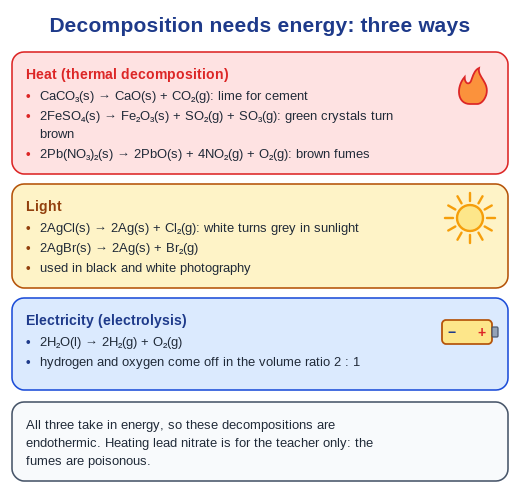
In a decomposition reaction, one substance breaks down into simpler ones. It needs energy. Heat splits calcium carbonate into quick lime and carbon dioxide, a reaction used to make lime for cement, and turns green ferrous sulphate crystals into ferric oxide, sulphur dioxide and sulphur trioxide; this is thermal decomposition. Heated lead nitrate gives off brown nitrogen dioxide. Electricity splits water into hydrogen and oxygen, with twice as much hydrogen. Sunlight turns white silver chloride grey as it breaks into silver and chlorine, which is used in black and white photography. Reactions that take in energy are endothermic.
What are displacement and double displacement reactions?
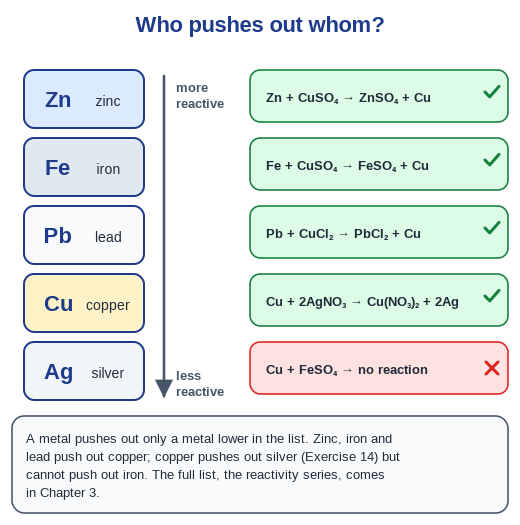
Dip a clean iron nail in blue copper sulphate solution for about 20 minutes. The nail turns brown and the blue fades: Fe + CuSO₄ → FeSO₄ + Cu. Iron, being more reactive, has pushed copper out of its compound. This is a displacement reaction; zinc and lead displace copper in the same way. Mix sodium sulphate and barium chloride solutions and a white solid appears: Na₂SO₄ + BaCl₂ → BaSO₄ + 2NaCl. Here two compounds swap ions, a double displacement reaction. The insoluble solid, a precipitate, makes it a precipitation reaction as well.
What are oxidation and reduction?
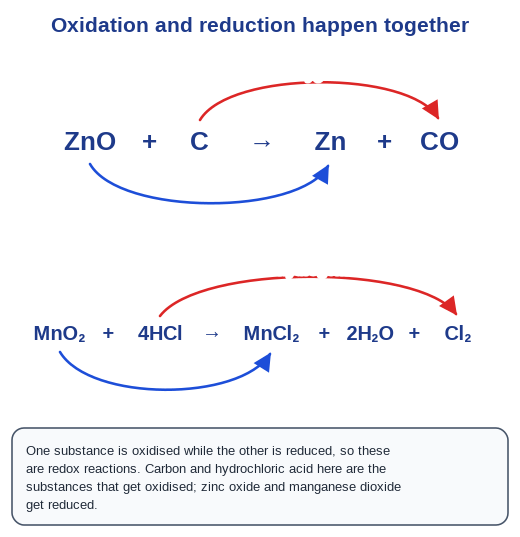
Heat copper powder in a china dish and it turns black: 2Cu + O₂ → 2CuO. Copper has gained oxygen, so it is oxidised. Pass hydrogen over the hot black copper(II) oxide and it turns brown again: CuO + H₂ → Cu + H₂O. Copper(II) oxide loses oxygen and is reduced, while hydrogen gains oxygen and is oxidised. When one reactant is oxidised and another reduced, it is a redox reaction. More generally, oxidation is gain of oxygen or loss of hydrogen, and reduction is loss of oxygen or gain of hydrogen. Read oxidation and reduction.
What are corrosion and rancidity?
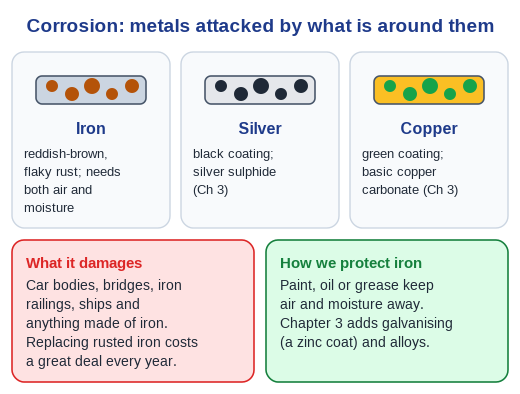
Oxidation goes on around us all the time. Corrosion is a metal being attacked by moisture, air, acids and other substances around it: iron gets reddish-brown rust, silver turns black and copper gets a green coat. It damages car bodies, bridges, railings and ships, so we paint iron. Rancidity is what happens when fats and oils are oxidised: food smells and tastes stale. Antioxidants, airtight containers and packets of chips flushed with nitrogen slow it down.
Before we move on
Every reaction in this chapter can be written, balanced and named. For each equation you meet, count the atoms on both sides and ask which type it is. Answers to the Questions boxes and all twenty exercises are in the NCERT solutions for Chapter 1.
Key terms
| Term | Meaning |
|---|---|
| Chemical reaction | A change in which substances turn into new substances with a different nature and identity. |
| Reactants and products | Reactants are the substances that change, written on the left; products are the new substances formed, written on the right. |
| Skeletal chemical equation | An equation in formulae that is not yet balanced, such as Mg + O₂ → MgO. |
| Balanced chemical equation | An equation with the same number of atoms of each element on both sides, as the law of conservation of mass requires. |
| State symbols | (s) solid, (l) liquid, (g) gas and (aq) dissolved in water, written after each formula. |
| Combination reaction | Two or more substances join to give just one product: CaO + H₂O → Ca(OH)₂. |
| Decomposition reaction | One substance breaks down into two or more simpler ones, using heat, light or electricity. |
| Exothermic and endothermic reactions | Exothermic reactions give out heat; endothermic reactions take in energy. |
| Displacement reaction | A more reactive element pushes a less reactive one out of its compound: Fe + CuSO₄ → FeSO₄ + Cu. |
| Double displacement reaction | Two compounds exchange ions: Na₂SO₄ + BaCl₂ → BaSO₄ + 2NaCl. |
| Precipitate | An insoluble solid that forms in a solution during a reaction; a reaction that gives one is a precipitation reaction. |
| Oxidation and reduction | Oxidation is gain of oxygen or loss of hydrogen; reduction is loss of oxygen or gain of hydrogen. |
| Redox reaction | A reaction in which one reactant is oxidised while another is reduced. |
| Corrosion | The slow damage of a metal attacked by moisture, air, acids and the like, such as the rusting of iron. |
| Rancidity | The change in smell and taste of fats and oils when they are oxidised. |
Topics in this chapter
Practice
-
Which of these is NOT a sign that a chemical reaction has taken place?
Show answer
Answer: (d) sugar dissolves in water
-
The balanced form of Mg + O₂ → MgO is:
Show answer
Answer: (b) 2Mg + O₂ → 2MgO
-
CaCO₃ → CaO + CO₂ on heating is a:
Show answer
Answer: (c) decomposition reaction
-
In Fe + CuSO₄ → FeSO₄ + Cu, the blue colour of the solution fades because:
Show answer
Answer: (b) iron displaces copper from copper sulphate
-
In CuO + H₂ → Cu + H₂O, the substance reduced is:
Show answer
Answer: (c) CuO
-
Chips packets are filled with nitrogen to:
Show answer
Answer: (b) stop the oil in the chips from being oxidised
Questions students ask
What are the main topics of Class 10 Science Chapter 1?
How to tell that a reaction has happened, writing and balancing chemical equations with state symbols, five types of reactions (combination, decomposition, displacement, double displacement and redox), exothermic and endothermic reactions, and two everyday effects of oxidation: corrosion and rancidity.
Is Chemical Reactions and Equations in the 2026-27 NCERT book?
Yes. It is Chapter 1 of Science, the Class 10 NCERT textbook marked Reprint 2026-27, on pages 1 to 16. Chapters 2 and 3, on acids, bases and salts and on metals and non-metals, build on it.
Which reactions in this chapter should I practise for the board exam?
Practise writing and balancing every equation the chapter uses, with state symbols, and naming its type: the burning of magnesium, quick lime with water, the heating of calcium carbonate, lead nitrate and ferrous sulphate, the electrolysis of water, silver chloride in sunlight, iron in copper sulphate and barium chloride with sodium sulphate.
What is the difference between a physical change and a chemical reaction?
In a physical change, such as ice melting or sugar dissolving, no new substance forms. In a chemical reaction, such as milk turning sour or iron rusting, the substances change into new ones with different properties.
Stuck on a question?
Take a photo and Lagnever AI explains it step by step. Try it for 7 days for ₹2.
Get it on Google Play Open in browser
For parents: after the trial, the plan renews monthly by UPI or card autopay. You can cancel anytime in the app.