
How do you balance a chemical equation?
Answer in short
Write the skeletal equation with correct formulae, then count the atoms of each element on both sides. Put whole-number coefficients in front of formulae until every element matches, starting with the formula that has the most atoms. Never change a formula’s subscripts. Finally check each element again and add the state symbols (s), (l), (g) or (aq).
Stuck on a question? Take a photo and Lagnever AI explains it step by step. Try it for 7 days for ₹2. Get it on Google Play
Why must a chemical equation be balanced?
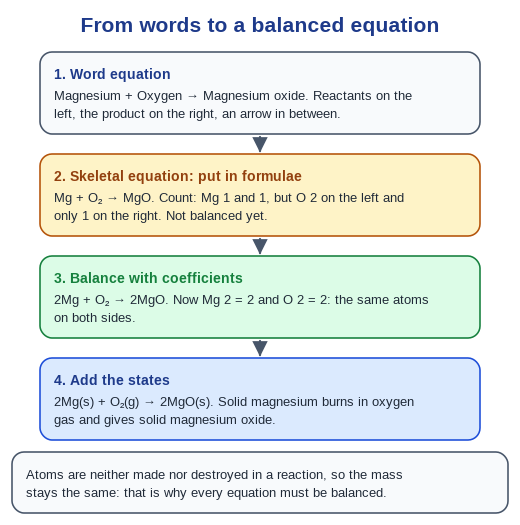
When magnesium burns, it joins with oxygen from the air to form magnesium oxide. In formulae: Mg + O₂ → MgO. Count the oxygen atoms. There are two on the left, in one O₂ molecule, but only one on the right, in MgO. It looks as though an oxygen atom has vanished. It has not. In a chemical reaction, atoms are neither created nor destroyed; they only change partners. This is the law of conservation of mass: the total mass of the products equals the total mass of the reactants. So a correct equation must have the same number of atoms of each element on both sides. An equation that does not, like Mg + O₂ → MgO, is called a skeletal chemical equation. Balanced, it reads 2Mg + O₂ → 2MgO.
What can we change while balancing?
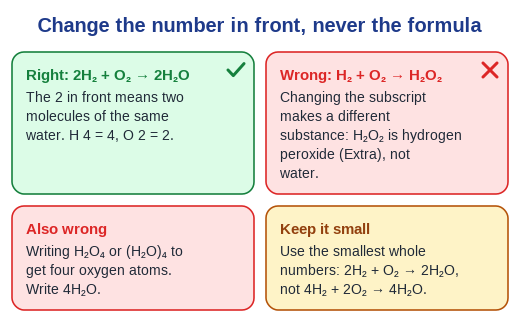
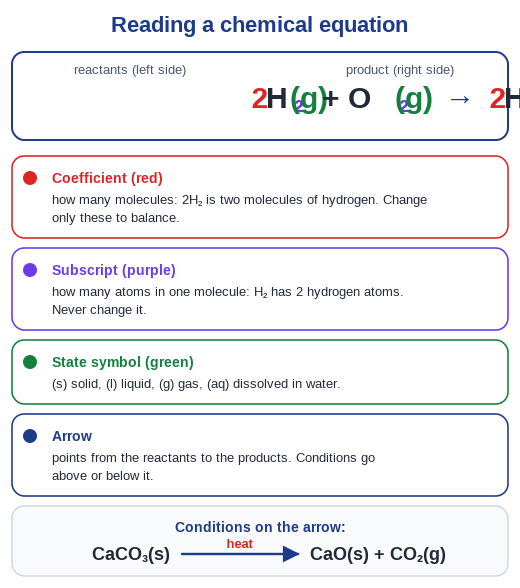
Only the coefficients, the numbers written in front of the formulae. 2H₂O means two molecules of water. The small numbers inside a formula, the subscripts, belong to the substance itself. H₂O is water; H₂O₂ is hydrogen peroxide (Extra), a different substance. So to get four oxygen atoms from water, write 4H₂O, never H₂O₄ or (H₂O)₄.
How does the hit-and-trial method work?
The book balances the reaction of iron with steam, Fe + H₂O → Fe₃O₄ + H₂. Here is the same method in short steps.
- List the atoms. Left: Fe 1, H 2, O 1. Right: Fe 3, H 2, O 4.
- Start with the biggest formula. Fe₃O₄ has the most atoms, and oxygen is its largest count. Four oxygen atoms on the right need 4H₂O on the left.
- Balance the next element. 4H₂O has 8 hydrogen atoms, so the right side needs 4H₂.
- Balance what is left. Fe₃O₄ has 3 iron atoms, so write 3Fe.
- Check everything. 3Fe + 4H₂O → Fe₃O₄ + 4H₂: Fe 3 = 3, H 8 = 8, O 4 = 4.
The method is called hit and trial because you try coefficients and adjust them, using the smallest whole numbers that work.
Can you show one more example?
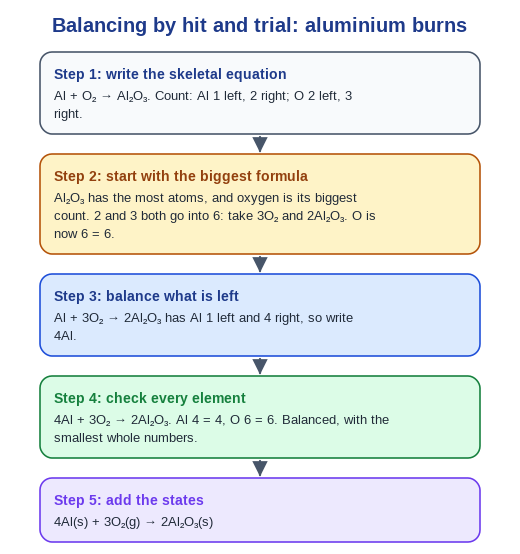
Aluminium burns in oxygen to form aluminium oxide: Al + O₂ → Al₂O₃.
- Oxygen: 2 on the left, 3 on the right. Both 2 and 3 divide 6, so take 3O₂ (6 atoms) and 2Al₂O₃ (6 atoms).
- Aluminium: 1 on the left, now 2 × 2 = 4 on the right, so write 4Al.
- Check: 4Al + 3O₂ → 2Al₂O₃. Al 4 = 4, O 6 = 6.
How do we count atoms in a bracket?
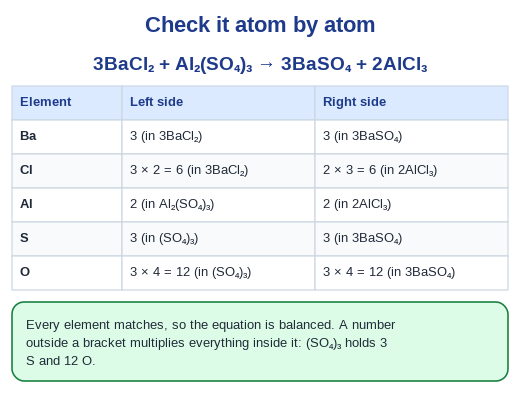
A number after a bracket multiplies everything inside it. Al₂(SO₄)₃ has 2 Al, 3 × 1 = 3 S and 3 × 4 = 12 O. A coefficient multiplies the whole formula: 3BaCl₂ has 3 Ba and 3 × 2 = 6 Cl. Making a small table, element by element, is the surest check, as below for barium chloride reacting with aluminium sulphate.
How do we add states and conditions?
A balanced equation becomes more useful when it shows the physical state of each substance: (s) for solid, (l) for liquid, (g) for gas and (aq) for a solution in water. The iron and steam equation becomes 3Fe(s) + 4H₂O(g) → Fe₃O₄(s) + 4H₂(g); the (g) on water tells us it is steam. Conditions are written on the arrow. Heat appears above the arrow when calcium carbonate breaks down, and the book writes “340 atm” above the arrow when carbon monoxide and hydrogen form methanol, CH₃OH. Sunlight and chlorophyll are written on the arrow for photosynthesis.
A tip for the board exam
Write the formulae correctly first; a wrong formula can never be balanced into a right answer. Then balance, check element by element, and add state symbols if the question asks for them.
Next, sort reactions by what happens in them: types of chemical reactions. See also the chapter notes and the NCERT solutions.
Practice
-
How many oxygen atoms are there in 3Ca(OH)₂?
Show answer
Answer: (d) 6
-
The balanced equation for hydrogen burning in oxygen is:
Show answer
Answer: (b) 2H₂ + O₂ → 2H₂O
-
In an equation, (aq) after a formula means the substance is:
Show answer
Answer: (c) dissolved in water
-
Balance: N₂ + H₂ → NH₃.
Show answer
Answer: N₂ + 3H₂ → 2NH₃. Nitrogen: 2 = 2. Hydrogen: 3 × 2 = 6 on the left and 2 × 3 = 6 on the right.
-
Balance: Fe + O₂ → Fe₃O₄.
Show answer
Answer: 3Fe + 2O₂ → Fe₃O₄. Iron: 3 = 3. Oxygen: 2 × 2 = 4 on the left and 4 on the right.
Questions students ask
Why do we balance chemical equations?
Because atoms are neither created nor destroyed in a reaction. The law of conservation of mass says the total mass of the products equals that of the reactants, so each element must have the same number of atoms on both sides.
What is a skeletal chemical equation?
An equation written with the correct formulae but not yet balanced. Mg + O₂ → MgO is skeletal, because it has two oxygen atoms on the left and one on the right. Balanced, it becomes 2Mg + O₂ → 2MgO.
What is the hit-and-trial method?
It is the way the book balances equations: try a coefficient, count the atoms, and adjust step by step until every element matches, using the smallest whole numbers.
Do we always write state symbols?
No. They are added when the physical state matters, for example (g) on H₂O to show that water reacts as steam. If a question asks for state symbols, write one after every formula.
Stuck on a question?
Take a photo and Lagnever AI explains it step by step. Try it for 7 days for ₹2.
Get it on Google Play Open in browser
For parents: after the trial, the plan renews monthly by UPI or card autopay. You can cancel anytime in the app.