
What are the types of chemical reactions?
Answer in short
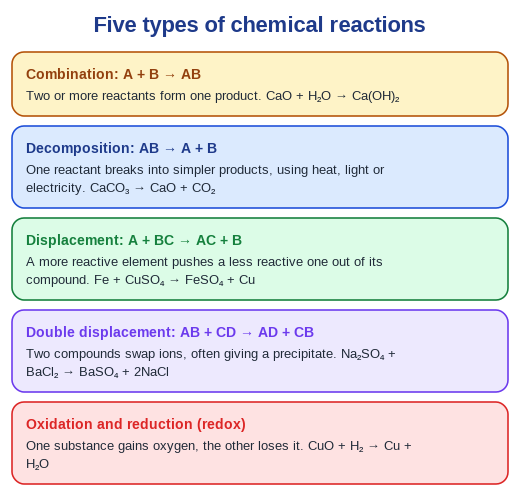
Class 10 sorts reactions into combination (A + B → AB), decomposition (AB → A + B), displacement (a more reactive element pushes out a less reactive one), double displacement (two compounds swap ions, often giving a precipitate) and oxidation-reduction, or redox. Reactions that give out heat are exothermic; those that take in energy are endothermic.
Stuck on a question? Take a photo and Lagnever AI explains it step by step. Try it for 7 days for ₹2. Get it on Google Play
How can we sort chemical reactions?
During a reaction, atoms do not turn into other atoms, and none disappear. Bonds between atoms break and new bonds form, giving new substances. Looking at how the reactants rearrange, the chapter sorts reactions into five types.
What is a combination reaction?
Two or more substances join to form a single product. Add water slowly to quick lime (calcium oxide) and the mixture gets very hot as slaked lime forms:
CaO(s) + H₂O(l) → Ca(OH)₂(aq) + heat
A solution of slaked lime is used to whitewash walls. Over two or three days it reacts with carbon dioxide from the air, Ca(OH)₂ + CO₂ → CaCO₃ + H₂O, and the thin layer of calcium carbonate makes the wall shine. Burning coal, C + O₂ → CO₂, and making water, 2H₂ + O₂ → 2H₂O, are combination reactions too.
What are exothermic and endothermic reactions?
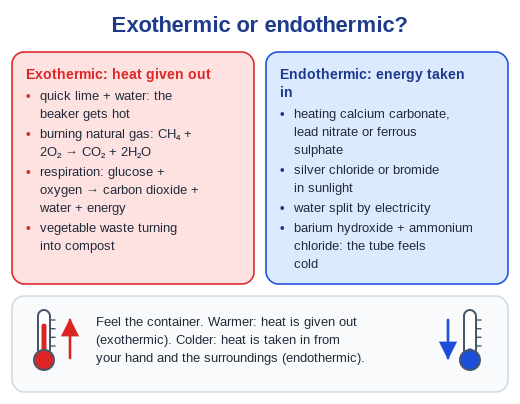
Reactions that give out heat are exothermic. Quick lime with water is one. So are burning natural gas, CH₄ + 2O₂ → CO₂ + 2H₂O, and respiration, in which glucose from our food combines with oxygen in our cells: C₆H₁₂O₆ + 6O₂ → 6CO₂ + 6H₂O + energy. Vegetable waste turning into compost also gives out heat. Reactions that take in energy are endothermic. Mix barium hydroxide with ammonium chloride in a test tube, with your teacher, and the tube feels cold.
What is a decomposition reaction?
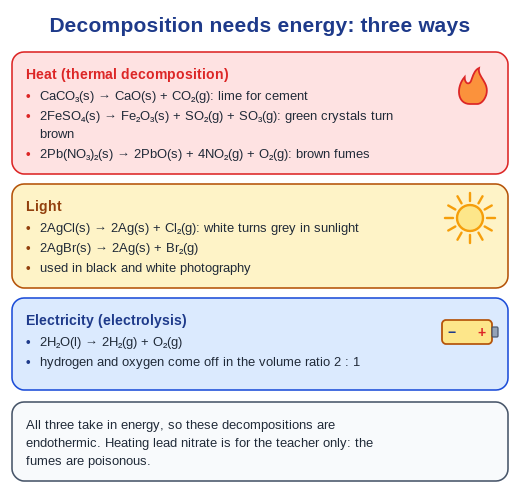
A single reactant breaks down into two or more simpler products. Breaking bonds needs energy, so these reactions are endothermic. The energy can come in three forms.
- Heat (thermal decomposition): calcium carbonate gives quick lime for cement, CaCO₃ → CaO + CO₂. Green ferrous sulphate crystals first lose their water, then break down with a smell of burning sulphur: 2FeSO₄ → Fe₂O₃ + SO₂ + SO₃. Lead nitrate gives brown fumes of nitrogen dioxide: 2Pb(NO₃)₂ → 2PbO + 4NO₂ + O₂. These are done only by the teacher.
- Electricity: passing a current through water with a few drops of dilute sulphuric acid gives hydrogen and oxygen, 2H₂O → 2H₂ + O₂, with twice as much hydrogen by volume.
- Light: white silver chloride turns grey in sunlight, 2AgCl → 2Ag + Cl₂; silver bromide behaves the same way. Black and white photography uses these reactions.
What is a displacement reaction?
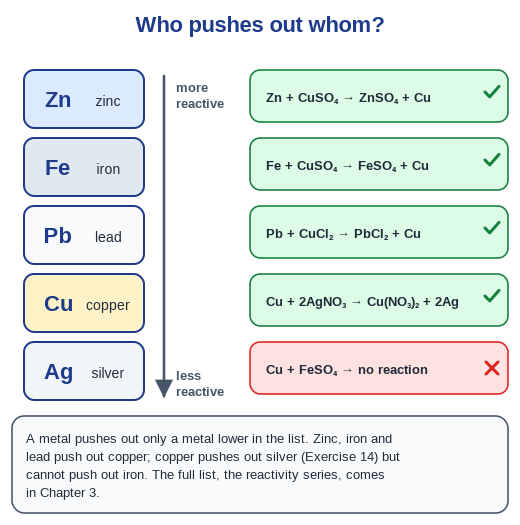
A more reactive element pushes a less reactive one out of its compound. Put clean iron nails into blue copper sulphate solution. After about 20 minutes the nails have a brown coat of copper and the blue colour has faded, because iron sulphate has formed:
Fe(s) + CuSO₄(aq) → FeSO₄(aq) + Cu(s)
Zinc and lead are also more reactive than copper: Zn + CuSO₄ → ZnSO₄ + Cu and Pb + CuCl₂ → PbCl₂ + Cu. Copper, being less reactive than iron, cannot push iron out of iron sulphate. Chapter 3 lists metals in order of reactivity.
What is a double displacement reaction?
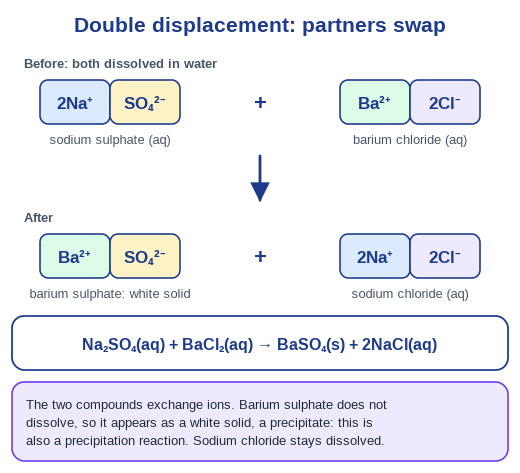
Two compounds exchange their ions. Mix sodium sulphate and barium chloride solutions and a white solid forms:
Na₂SO₄(aq) + BaCl₂(aq) → BaSO₄(s) + 2NaCl(aq)
Barium ions (Ba²⁺) pair with sulphate ions (SO₄²⁻) to form barium sulphate, which does not dissolve, while sodium chloride stays in solution. An insoluble solid formed this way is a precipitate, and any reaction that gives one is a precipitation reaction. Lead nitrate and potassium iodide give a yellow precipitate of lead iodide in the same way: Pb(NO₃)₂ + 2KI → PbI₂ + 2KNO₃.
Where does redox fit in?
The fifth type looks at oxygen and hydrogen. In CuO + H₂ → Cu + H₂O, copper(II) oxide loses oxygen and hydrogen gains it: one substance is reduced while the other is oxidised, a redox reaction. Read more in oxidation and reduction.
A reaction can belong to more than one group: magnesium burning in air is a combination, it is exothermic, and magnesium is oxidised. Back to balancing chemical equations, the chapter notes or the NCERT solutions.
Practice
-
2H₂ + O₂ → 2H₂O is a:
Show answer
Answer: (a) combination reaction
-
Which energy breaks down silver chloride into silver and chlorine?
Show answer
Answer: (b) light
-
Mixing solutions of lead nitrate and potassium iodide gives:
Show answer
Answer: (b) a yellow precipitate of lead iodide
-
Why is respiration called exothermic?
Show answer
Answer: Glucose combines with oxygen in our cells to give carbon dioxide and water, and energy is released in the process.
-
Name the type: Zn + CuSO₄ → ZnSO₄ + Cu.
Show answer
Answer: Displacement. Zinc is more reactive than copper, so it pushes copper out of copper sulphate.
Questions students ask
How many types of chemical reactions are there in Class 10?
The chapter describes five: combination, decomposition, displacement, double displacement, and oxidation and reduction (redox). It also sorts reactions by heat into exothermic and endothermic, and calls reactions that give a precipitate precipitation reactions.
How is displacement different from double displacement?
In displacement, an element replaces another element in a compound: Fe + CuSO₄ → FeSO₄ + Cu. In double displacement, two compounds exchange ions: Na₂SO₄ + BaCl₂ → BaSO₄ + 2NaCl.
Why is decomposition called the opposite of combination?
Combination joins two or more substances into one; decomposition breaks one substance into two or more. Hydrogen and oxygen combine to form water, and electricity decomposes water back into hydrogen and oxygen.
Is every decomposition endothermic?
The decompositions in this chapter all need energy, as heat, light or electricity, to break the reactant down, so the book calls them endothermic.
Stuck on a question?
Take a photo and Lagnever AI explains it step by step. Try it for 7 days for ₹2.
Get it on Google Play Open in browser
For parents: after the trial, the plan renews monthly by UPI or card autopay. You can cancel anytime in the app.