
NCERT Solutions Class 10 Science Chapter 2: Acids, Bases and Salts
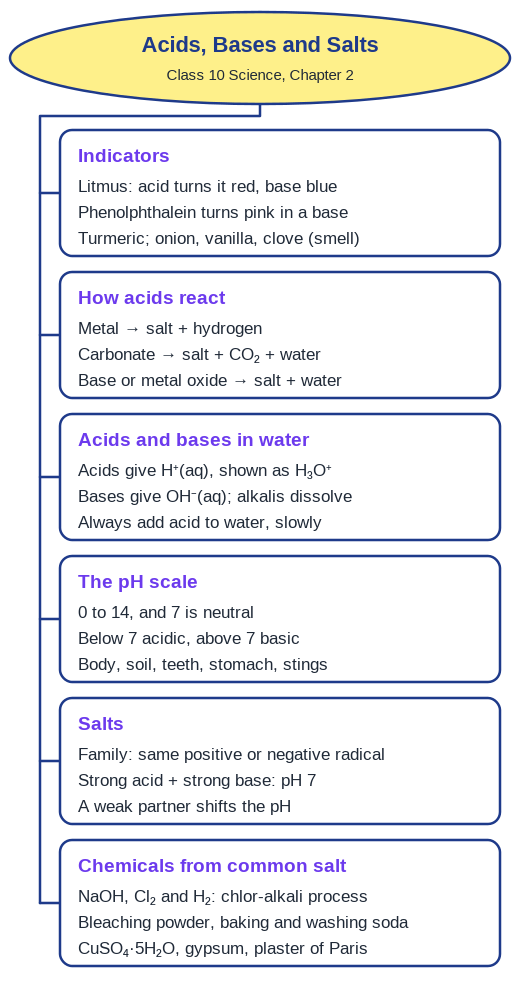
Answers to the five Questions boxes inside Chapter 2, Acids, Bases and Salts, the other questions the chapter asks along the way, all fifteen end-of-chapter exercises and both group activities, from Science, the Class 10 NCERT textbook. Page numbers follow the 2026-27 reprint (pages 17–36). The exercises are quoted from the book; the in-chapter questions are restated in short. Every equation below was checked atom by atom. Short notes: Chapter 2 notes.
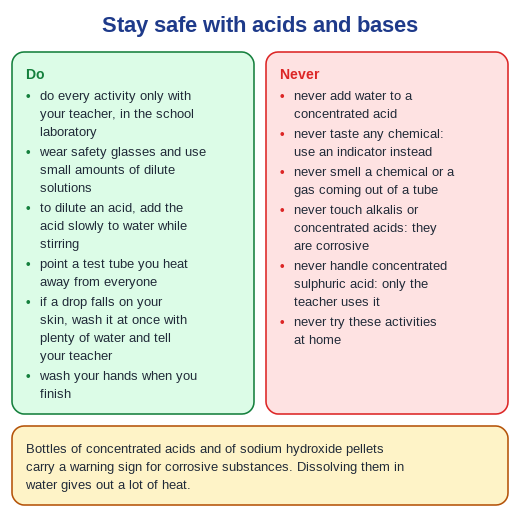
Stay safe. Acids and alkalis can burn the skin. Do every activity only in the laboratory with your teacher, wear safety glasses and use small amounts of dilute solutions. Always add acid to water, never water to acid. Never taste a chemical, never smell a chemical or a gas from a tube, and wash any splash at once with plenty of water.
Questions, page 18
Question 1 (page 18): three test tubes hold distilled water, an acidic solution and a basic solution. With only red litmus paper, how do you tell them apart? Dip a strip of red litmus in each. The solution that turns it blue is the basic one; in the other two the paper stays red. Now put a drop of each of those two on the strip that has just turned blue. The one that turns it red again is the acid. The one that leaves it blue is distilled water, which is neutral.
Questions, page 22
Question 1 (page 22): why should curd and sour foods not be kept in brass or copper vessels? Curd and sour foods contain acids. Acids react with metals, and brass is made of copper and zinc (Extra, from Chapter 3 of the same book). The reaction forms salts that pass into the food and can make it harmful to eat, while the vessel corrodes. So such foods are kept in glass, steel or earthen pots.
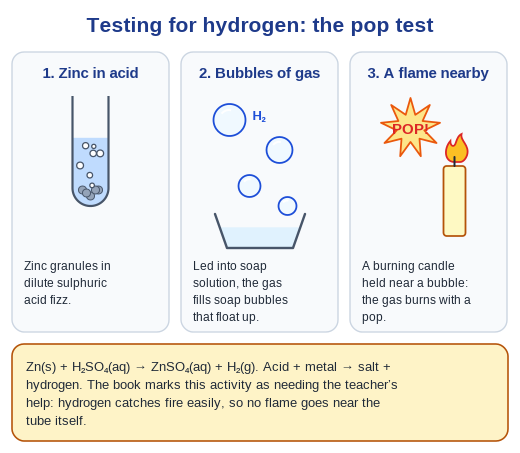
Question 2 (page 22): which gas usually comes off when an acid reacts with a metal? Give an example and a test for the gas. Hydrogen. For example, zinc and dilute sulphuric acid:
Zn(s) + H₂SO₄(aq) → ZnSO₄(aq) + H₂(g)
Test: let the gas fill a soap bubble, or collect a little in a test tube, and let your teacher bring a burning candle or splint near it. Hydrogen burns with a pop sound.
Question 3 (page 22): metal compound A fizzes with dilute hydrochloric acid, the gas puts out a burning candle, and one product is calcium chloride. Write the balanced equation. A gas that puts out a flame is carbon dioxide, so A is a carbonate; the product calcium chloride shows the metal is calcium. A is calcium carbonate:
CaCO₃(s) + 2HCl(aq) → CaCl₂(aq) + CO₂(g) + H₂O(l)
Check: Ca 1 = 1, C 1 = 1, O 3 = 2 + 1, H 2 = 2, Cl 2 = 2.
Questions, page 25
Question 1 (page 25): why do HCl and HNO₃ show acidic character in water, while solutions of alcohol and glucose do not? In water, HCl and HNO₃ give hydrogen ions, H⁺(aq), and these ions are what make a solution acidic. Alcohol and glucose also contain hydrogen, but they do not give H⁺ ions in water, so they show no acidic character.
Question 2 (page 25): why do acid solutions in water carry an electric current? It contains ions: H⁺(aq) (as H₃O⁺) and anions such as Cl⁻. Moving ions carry the electric current.
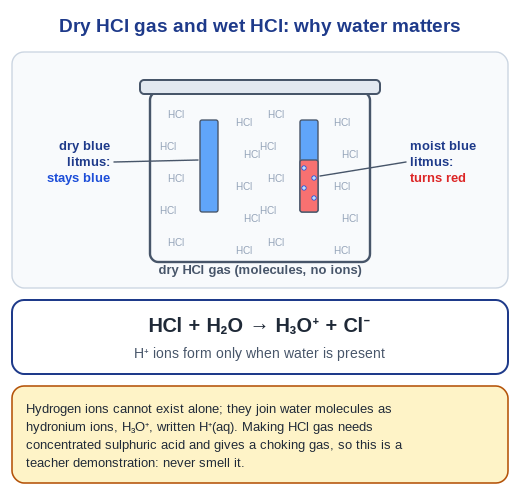
Question 3 (page 25): dry HCl gas leaves dry litmus unchanged. Why? Hydrogen ions separate from HCl only when water is present. Dry HCl gas and dry litmus have no water, so no H⁺ ions form and the litmus does not change.
Question 4 (page 25): why is the acid added to water when diluting, and not water to the acid? Dissolving a concentrated acid in water is highly exothermic. If water is poured onto the acid, the little water heats up at once and can boil, so the mixture splashes out and burns, and the glass may break from the local heating. Adding the acid slowly to plenty of water, with stirring, spreads the heat safely.
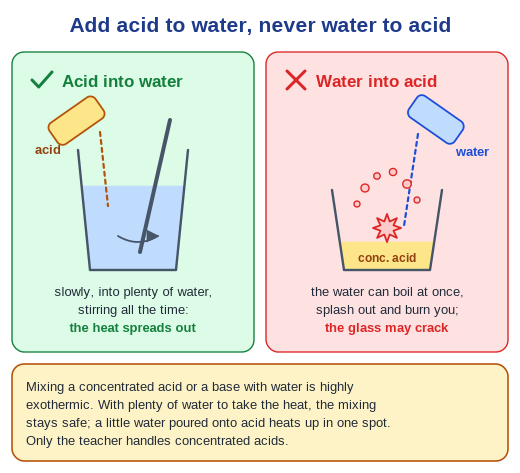
Question 5 (page 25): how does diluting an acid affect the concentration of hydronium ions? It decreases. The same number of H₃O⁺ ions is spread through more water, so there are fewer per unit volume.
Question 6 (page 25): how does dissolving more base in sodium hydroxide solution affect the concentration of hydroxide ions? It increases, because the extra base gives more OH⁻ ions into the same volume of solution.
Questions, page 28
Question 1 (page 28): solution A has pH 6 and solution B has pH 8. Which has more hydrogen ions, and which is acidic? A has the higher hydrogen ion concentration, because a lower pH means more H⁺ ions. A (pH 6) is acidic and B (pH 8) is basic.
Question 2 (page 28): how does the concentration of H⁺(aq) ions affect the nature of a solution? The higher the H⁺(aq) concentration, the lower the pH and the more acidic the solution. As it falls, the solution becomes less acidic, then neutral at pH 7, then basic.
Question 3 (page 28): are there H⁺(aq) ions in basic solutions too, and if so, why are they still basic? Yes. Water itself always gives a very small number of H⁺ and OH⁻ ions (Extra). A solution is basic because its OH⁻ ions far outnumber its H⁺ ions.
Question 4 (page 28): when would a farmer treat soil with quick lime, slaked lime or chalk? When the soil is too acidic (its pH is too low) for the crops. Quick lime and slaked lime are bases and chalk is a basic carbonate; they neutralise the extra acid and raise the soil’s pH.
Questions, page 33
Question 1 (page 33): common name of Ca(ClO)₂. Bleaching powder.
Question 2 (page 33): the substance that gives bleaching powder with chlorine. Dry slaked lime, calcium hydroxide, Ca(OH)₂: 2Ca(OH)₂ + 2Cl₂ → Ca(ClO)₂ + CaCl₂ + 2H₂O.
Question 3 (page 33): the sodium compound used for softening hard water. Washing soda, sodium carbonate, Na₂CO₃·10H₂O. It removes the permanent hardness of water.
Question 4 (page 33): what happens when a solution of sodium hydrogencarbonate is heated? Give the equation. (The book prints “hydrocarbonate”; it means hydrogencarbonate.) It breaks down into sodium carbonate, water and carbon dioxide, which bubbles off:
2NaHCO₃ → Na₂CO₃ + H₂O + CO₂
Check: Na 2 = 2, H 2 = 2, C 2 = 1 + 1, O 6 = 3 + 1 + 2.
Question 5 (page 33): the reaction of plaster of Paris with water. It sets into gypsum:
CaSO₄·½H₂O + 1½H₂O → CaSO₄·2H₂O
Check: Ca 1 = 1, S 1 = 1, H 1 + 3 = 4, O 4½ + 1½ = 6.
Other questions inside the chapter (pages 17–33)
Acidity after overeating (page 17). Choose baking soda solution. It is basic, and a base cancels (neutralises) the effect of an acid; lemon juice and vinegar are acids and would make it worse.
Vanilla, onion and clove as olfactory indicators (page 19). In the usual result, the smell of onion and of vanilla goes away in dilute sodium hydroxide but stays in dilute hydrochloric acid, and clove oil behaves in the same way, so all three can serve as olfactory indicators. Onion and vanilla show it most clearly. (Expected result; the book leaves it to your observation.)
Equations for Activity 2.3 (page 20). Zn + H₂SO₄ → ZnSO₄ + H₂; Zn + 2HCl → ZnCl₂ + H₂; with acetic acid, Zn + 2CH₃COOH → (CH₃COO)₂Zn + H₂, more slowly. Nitric acid is different: Chapter 3 of the same book explains that it usually does not give hydrogen with metals, because it is a strong oxidising agent.
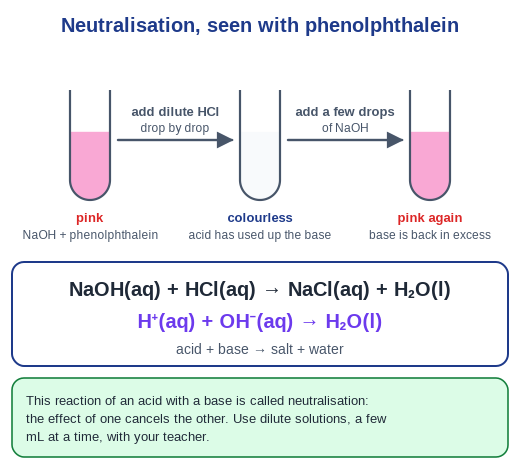
Phenolphthalein in Activity 2.6 (page 21). The pink colour goes because the acid neutralises all the base: with no base left, phenolphthalein is colourless. A few drops of NaOH make the solution basic again, so the pink returns.
Copper oxide and hydrochloric acid (pages 21–22). CuO + 2HCl → CuCl₂ + H₂O. The black oxide dissolves and the solution turns blue-green, the colour of copper(II) chloride.
The conductivity test with alkalis (page 23). The bulb glows with sodium hydroxide or calcium hydroxide solution too. So alkalis also give ions in water: OH⁻ ions.
Dry HCl gas and HCl solution (Activity 2.9, page 23). Dry HCl gas does not change dry blue litmus, so it is not acidic; on wet litmus it turns red, so HCl in water (HCl solution) is acidic. The H⁺ ions form only in water.
Which bases in Table 2.1 are alkalis? (page 24). Sodium hydroxide, potassium hydroxide and ammonium hydroxide dissolve readily in water, and calcium hydroxide dissolves a little (lime water is its solution), so these are alkalis. Magnesium hydroxide hardly dissolves in water (Extra), so it is a base but not usually called an alkali.
Activity 2.10 (page 24). The base of the beaker gets warmer, so dissolving the acid (or sodium hydroxide pellets) is exothermic.
Strong and weak bases (page 26). A strong base gives many OH⁻ ions in water, such as sodium hydroxide; a weak base gives few, such as ammonium hydroxide (Extra example).
Life on Venus (page 27). Living things survive only in a narrow pH range, so life as we know it could not survive in clouds of sulphuric acid.
The pH of soil in your backyard (page 27). It depends on where you live. Test the filtrate as in Activity 2.12 and note which plants grow there; the soil pH in which they grow well is the right one for them.
The nature of the dock plant (page 28). Basic. The book’s point is that the dock leaf neutralises the methanoic acid of the nettle sting. A paste of baking soda on a bee sting works in the same way.
Families of salts (Activity 2.13, pages 28–29).
| Salt | Formula | From acid + base |
|---|---|---|
| Potassium sulphate | K₂SO₄ | H₂SO₄ + KOH |
| Sodium sulphate | Na₂SO₄ | H₂SO₄ + NaOH |
| Calcium sulphate | CaSO₄ | H₂SO₄ + Ca(OH)₂ |
| Magnesium sulphate | MgSO₄ | H₂SO₄ + Mg(OH)₂ |
| Copper sulphate | CuSO₄ | H₂SO₄ + Cu(OH)₂ |
| Sodium chloride | NaCl | HCl + NaOH |
| Sodium nitrate | NaNO₃ | HNO₃ + NaOH |
| Sodium carbonate | Na₂CO₃ | H₂CO₃ (carbonic acid) + NaOH |
| Ammonium chloride | NH₄Cl | HCl + NH₄OH |
Families with more than one member: the sulphate family (five salts), the sodium family (four) and the chloride family (two).
pH of salts (Activity 2.14, page 29). Expected: sodium chloride and potassium nitrate are neutral (strong acid + strong base); aluminium chloride, zinc sulphate and copper sulphate are acidic (strong acid + weak base); sodium acetate, sodium carbonate and sodium hydrogencarbonate are basic (weak acid + strong base).
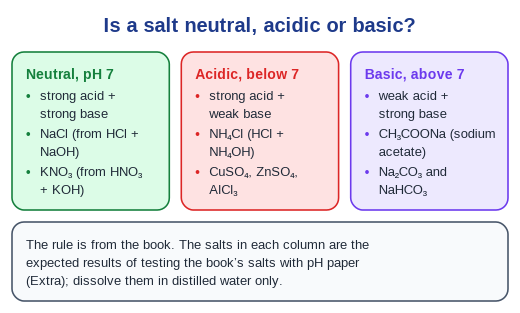
Why baking soda neutralises acids (page 31). Its solution is basic (pH above 7), so it neutralises an acid, and it is mild enough not to corrode.
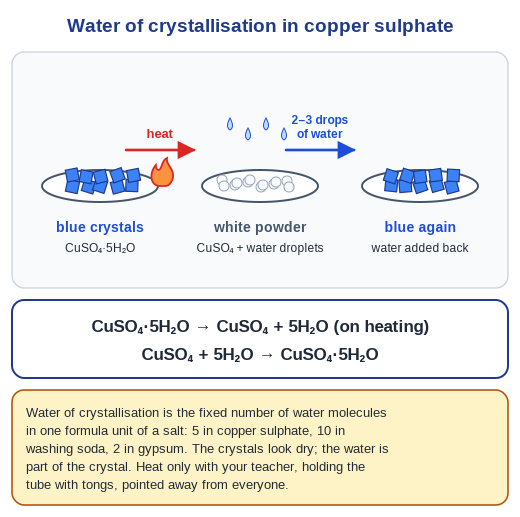
What 10H₂O means (page 32). Each formula unit of washing soda holds ten water molecules as water of crystallisation. They are part of the crystal, so the crystals are not wet.
Why “plaster of Paris”? (page 33). Extra: the name comes from Paris, where plaster was made on a large scale from the gypsum found around the city.
What the activities show (Activities 2.1–2.15)
Do every one of these only with your teacher.
- 2.1, indicators on a watch-glass: HCl, H₂SO₄, HNO₃ and CH₃COOH turn blue litmus red and leave phenolphthalein colourless; NaOH, Ca(OH)₂, KOH, Mg(OH)₂ and NH₄OH turn red litmus blue and phenolphthalein pink. Methyl orange turns red in the acids and yellow in the bases (Extra). Use a drop at a time; never touch the solutions.
- 2.2, onion, vanilla and clove: their smell fades in the base and stays in the acid (see page 19 above). Waft gently; never sniff the acid or base.
- 2.3, zinc and dilute sulphuric acid: bubbles of hydrogen; soap bubbles filled with it burn with a pop. The book says this needs the teacher’s help.
- 2.4, zinc with warm sodium hydroxide: hydrogen again, with sodium zincate. Hot alkali is corrosive: teacher only.
- 2.5, sodium carbonate and sodium hydrogencarbonate with dilute HCl: brisk fizzing; the gas turns lime water milky.
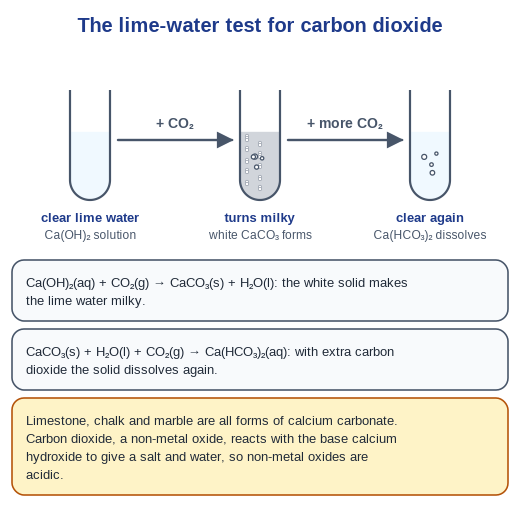
- 2.6, NaOH with phenolphthalein, then HCl: pink turns colourless, and pink again with more base.
- 2.7, copper oxide in dilute HCl: the oxide dissolves and the solution turns blue-green.
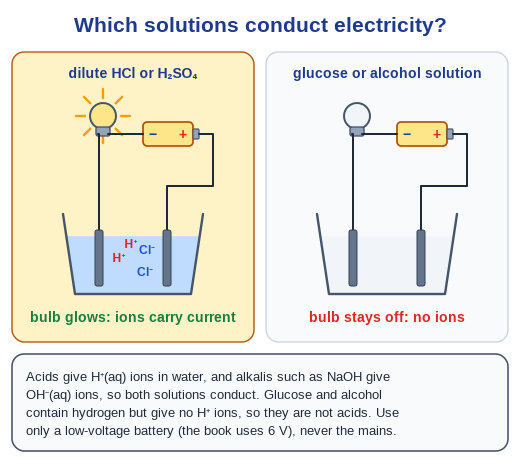
- 2.8, conductivity: the bulb glows with acids (and alkalis), not with glucose or alcohol. Use only the 6 V battery, never the mains.
- 2.9, HCl gas from salt and concentrated sulphuric acid: dry blue litmus stays blue, wet blue litmus turns red. Concentrated acid and the choking gas mean this is a teacher demonstration. (Extra: NaCl + H₂SO₄ → NaHSO₄ + HCl.)
- 2.10, concentrated acid or NaOH pellets in water: the beaker gets warm. Teacher only, acid into water.
- 2.11, pH paper on common liquids: lemon juice, tomato juice, coffee and the aerated drink are acidic; carrot juice is slightly acidic; tap water is close to neutral; saliva is near neutral and turns more acidic after a meal (pages 26–27 explain why); 1 M NaOH is strongly basic and 1 M HCl strongly acidic, so your teacher handles those two.
- 2.12, soil pH: the filtrate shows whether your soil is acidic, neutral or basic.
- 2.13 and 2.14, salts: see the table and the expected results above. Use distilled water only.
- 2.15, heating copper sulphate crystals: blue turns white and water drops collect; a few drops of water bring the blue back. Hold the tube with tongs and point it away from everyone.
Exercises 1 to 4: choose the answer
1. “A solution turns red litmus blue, its pH is likely to be (a) 1 (b) 4 (c) 5 (d) 10”
(d) 10. A solution that turns red litmus blue is basic, and a basic solution has a pH above 7. The others are acidic.
2. “A solution reacts with crushed egg-shells to give a gas that turns lime-water milky. The solution contains (a) NaCl (b) HCl (c) LiCl (d) KCl”
(b) HCl. Egg-shells are mostly calcium carbonate (Extra). An acid reacts with a carbonate to give carbon dioxide, which turns lime water milky. The other three are neutral salts and do not do this.
CaCO₃(s) + 2HCl(aq) → CaCl₂(aq) + H₂O(l) + CO₂(g)
3. “10 mL of a solution of NaOH is found to be completely neutralised by 8 mL of a given solution of HCl. If we take 20 mL of the same solution of NaOH, the amount HCl solution (the same solution as before) required to neutralise it will be (a) 4 mL (b) 8 mL (c) 12 mL (d) 16 mL”
(d) 16 mL. The solutions are the same, so the volumes keep the same ratio. 10 mL of NaOH needs 8 mL of HCl. 20 mL of NaOH is twice as much, so it needs 2 × 8 mL = 16 mL of HCl.
4. “Which one of the following types of medicines is used for treating indigestion? (a) Antibiotic (b) Analgesic (c) Antacid (d) Antiseptic”
(c) Antacid. Indigestion comes from too much acid in the stomach. An antacid is a mild base, such as milk of magnesia, that neutralises the extra acid.
Exercises 5 to 8: reactions and ions
5. “Write word equations and then balanced equations for the reaction taking place when – (a) dilute sulphuric acid reacts with zinc granules. (b) dilute hydrochloric acid reacts with magnesium ribbon. (c) dilute sulphuric acid reacts with aluminium powder. (d) dilute hydrochloric acid reacts with iron filings.”
(a) Sulphuric acid + Zinc → Zinc sulphate + Hydrogen
H₂SO₄(aq) + Zn(s) → ZnSO₄(aq) + H₂(g). Check: H 2 = 2, S 1 = 1, O 4 = 4, Zn 1 = 1.
(b) Hydrochloric acid + Magnesium → Magnesium chloride + Hydrogen
2HCl(aq) + Mg(s) → MgCl₂(aq) + H₂(g). Check: H 2 = 2, Cl 2 = 2, Mg 1 = 1.
(c) Sulphuric acid + Aluminium → Aluminium sulphate + Hydrogen
3H₂SO₄(aq) + 2Al(s) → Al₂(SO₄)₃(aq) + 3H₂(g). Check: H 6 = 6, S 3 = 3, O 12 = 12, Al 2 = 2.
(d) Hydrochloric acid + Iron → Iron(II) chloride + Hydrogen
2HCl(aq) + Fe(s) → FeCl₂(aq) + H₂(g). Check: H 2 = 2, Cl 2 = 2, Fe 1 = 1.
6. “Compounds such as alcohols and glucose also contain hydrogen but are not categorised as acids. Describe an Activity to prove it.” With your teacher, fix two iron nails through a cork and stand the cork in a 100 mL beaker. Join the nails to a 6 V battery through a bulb and a switch. Pour in dilute hydrochloric acid and switch on: the bulb glows, because the acid gives H⁺ and Cl⁻ ions that carry the current. Repeat with dilute sulphuric acid: it glows again. Now rinse the beaker and repeat with glucose solution and then with alcohol solution: the bulb does not glow. So glucose and alcohol do not give H⁺ ions in water, even though they contain hydrogen, and they are not acids. Use only the low-voltage battery, never the mains.
7. “Why does distilled water not conduct electricity, whereas rain water does?” Distilled water is almost pure water and has hardly any ions, so it does not conduct. Rain water dissolves gases such as carbon dioxide from the air as it falls (Extra: carbon dioxide in water forms a weak acid), so it contains ions, and ions carry the current. That is also why rain water is slightly acidic, and very acidic in acid rain.
8. “Why does dry HCL gas not show acidic behaviour in the absence of water?” (The book prints “HCL”; it means HCl.) An acid shows its acidic behaviour through H⁺ ions, and HCl gives H⁺ ions only in water: HCl + H₂O → H₃O⁺ + Cl⁻. Dry HCl gas is made of HCl molecules with no H⁺ ions, so it does not turn dry blue litmus red or behave as an acid.
Exercises 9 to 12: pH
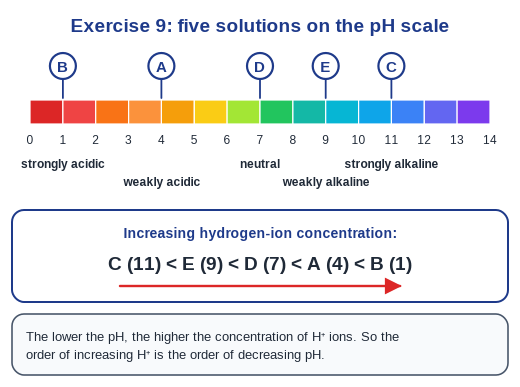
9. “Five solutions A,B,C,D and E when tested with universal indicator showed pH as 4,1,11,7 and 9, respectively. Which solution is (a) neutral? (b) strongly alkaline? (c) strongly acidic? (d) weakly acidic? (e) weakly alkaline? Arrange the pH in increasing order of hydrogen-ion concentration.”
(a) Neutral: D (pH 7). (b) Strongly alkaline: C (pH 11). (c) Strongly acidic: B (pH 1). (d) Weakly acidic: A (pH 4). (e) Weakly alkaline: E (pH 9).
The lower the pH, the higher the hydrogen-ion concentration. In increasing order of H⁺ concentration: 11 (C) < 9 (E) < 7 (D) < 4 (A) < 1 (B).
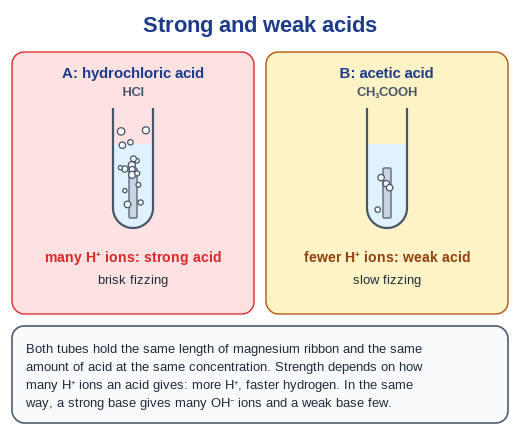
10. “Equal lengths of magnesium ribbons are taken in test tubes A and B. Hydrochloric acid (HCl) is added to test tube A, while acetic acid (CH₃COOH) is added to test tube B. Amount and concentration taken for both the acids are same. In which test tube will the fizzing occur more vigorously and why?” In test tube A. Hydrochloric acid is a strong acid: at the same concentration it gives many more H⁺ ions than acetic acid, a weak acid. More H⁺ ions react with the magnesium faster, so hydrogen is given off more quickly and the fizzing is more vigorous. Mg + 2HCl → MgCl₂ + H₂.
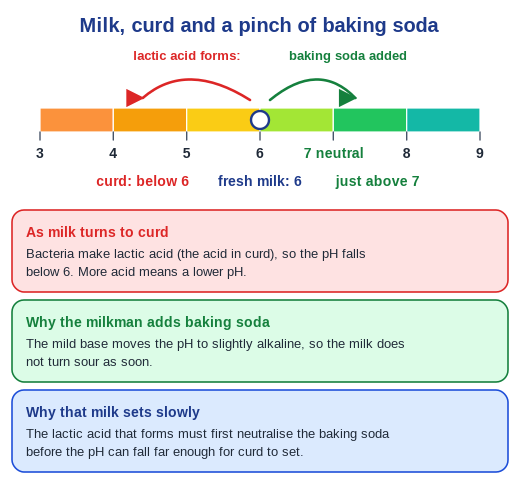
11. “Fresh milk has a pH of 6. How do you think the pH will change as it turns into curd? Explain your answer.” The pH will fall below 6. As milk turns into curd, lactic acid forms (curd contains lactic acid). More acid means more H⁺ ions, so the milk becomes more acidic and its pH goes down.
12. “A milkman adds a very small amount of baking soda to fresh milk. (a) Why does he shift the pH of the fresh milk from 6 to slightly alkaline? (b) Why does this milk take a long time to set as curd?”
(a) Baking soda is a mild base. Slightly alkaline milk does not turn sour as soon, because any acid that forms is neutralised, so the milk keeps fresh for longer.
(b) The lactic acid that forms must first neutralise the baking soda. Only after that can the milk become acidic enough to set, so curd takes longer to form.
Exercises 13 to 15: salts
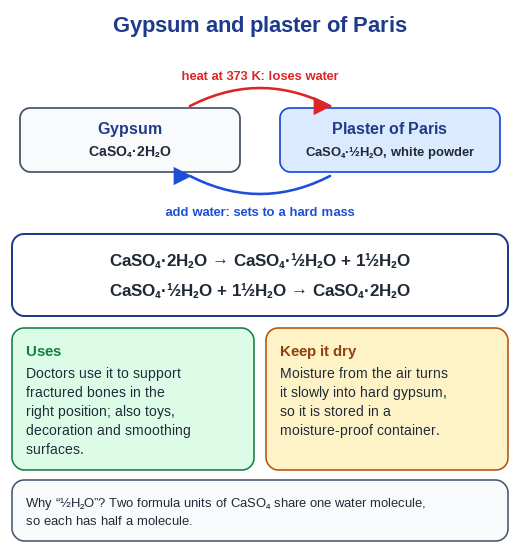
13. “Plaster of Paris should be stored in a moisture-proof container. Explain why?” Plaster of Paris takes up water and turns into gypsum, a hard solid mass: CaSO₄·½H₂O + 1½H₂O → CaSO₄·2H₂O. If it is left open, moisture from the air slowly sets it into hard lumps, and it is no longer useful as a powder for plaster or moulds. A moisture-proof container keeps it dry.
14. “What is a neutralisation reaction? Give two examples.” When an acid and a base react to form a salt and water, the reaction is called a neutralisation reaction; the effect of each cancels the other. In ions, H⁺(aq) + OH⁻(aq) → H₂O(l). Examples:
- NaOH(aq) + HCl(aq) → NaCl(aq) + H₂O(l)
- Mg(OH)₂ + 2HCl → MgCl₂ + 2H₂O, which is how milk of magnesia relieves acidity in the stomach.
15. “Give two important uses of washing soda and baking soda.”
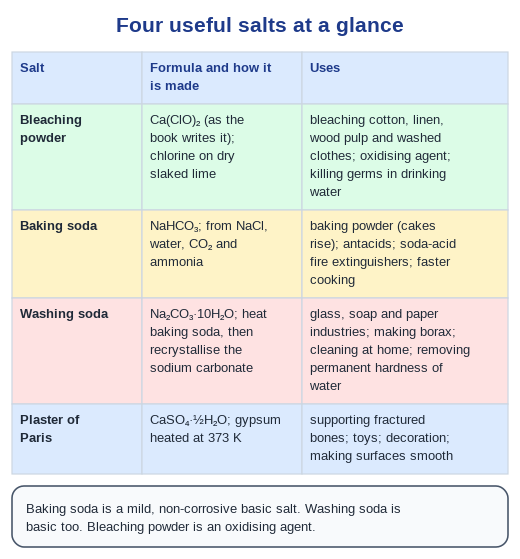
- Washing soda: (i) it removes the permanent hardness of water; (ii) it is used in the glass, soap and paper industries. It is also a household cleaning agent and is used to make borax.
- Baking soda: (i) mixed with tartaric acid it makes baking powder, whose carbon dioxide makes cakes soft and spongy; (ii) it is an ingredient of antacids. Soda-acid fire extinguishers use it too.
Group activity (pages 35–36)
(I) Your own indicator from beetroot. Do this with your teacher; the liquids are the kitchen ones the book names, but nothing is tasted. Lemon juice, soda-water and vinegar are acidic, and baking soda solution is basic. So the beetroot extract keeps its red-pink colour in A, B and C and changes colour in D, the baking soda (the exact shade depends on how strong the extract is; compare with a tube of plain water). Red cabbage leaves and the petals of Petunia, Hydrangea and Geranium give indicators in the same way.
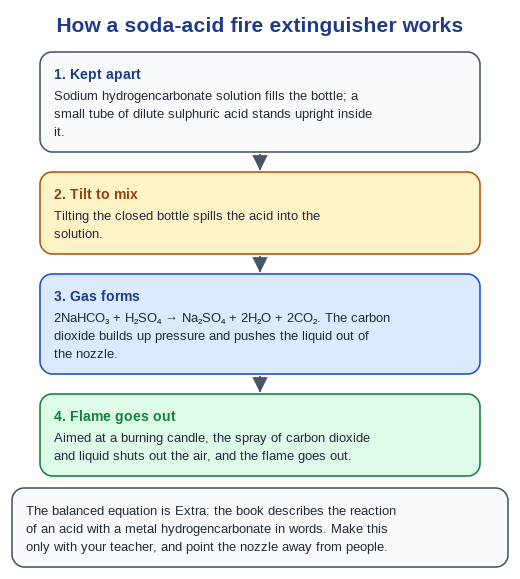
(II) A soda-acid fire extinguisher. When the bottle is tilted, the dilute sulphuric acid mixes with the sodium hydrogencarbonate solution and carbon dioxide forms. The gas builds up pressure and drives a spray out of the nozzle. Aimed at a burning candle, the spray puts the flame out, because carbon dioxide shuts out the air the flame needs. (Extra: 2NaHCO₃ + H₂SO₄ → Na₂SO₄ + 2H₂O + 2CO₂.) Make it only with your teacher and point the nozzle away from people.
Practice
-
Which of these is a strong acid?
Show answer
Answer: (c) hydrochloric acid
-
Which would you rub on a bee sting to ease the pain?
Show answer
Answer: (b) baking soda
-
Sodium carbonate reacts with dilute hydrochloric acid to give:
Show answer
Answer: (b) 2NaCl + H₂O + CO₂
-
Write the balanced equation for the chlor-alkali process.
Show answer
Answer: 2NaCl(aq) + 2H₂O(l) → 2NaOH(aq) + Cl₂(g) + H₂(g). Check: Na 2 = 2, Cl 2 = 2, H 4 = 2 + 2, O 2 = 2.
-
Solution X has pH 3 and solution Y has pH 5. Which has more hydrogen ions?
Show answer
Answer: X. The lower the pH, the higher the hydrogen ion concentration, so X (pH 3) is the more acidic of the two.
Stuck on a question?
Take a photo and Lagnever AI explains it step by step. Try it for 7 days for ₹2.
Get it on Google Play Open in browser
For parents: after the trial, the plan renews monthly by UPI or card autopay. You can cancel anytime in the app.