
Class 10 Science Chapter 2: Acids, Bases and Salts Notes
This chapter in five lines
Acids turn blue litmus red and give H⁺(aq) ions in water; bases turn red litmus blue and give OH⁻(aq) ions. Acids react with metals, carbonates, bases and metal oxides, and an acid and a base neutralise each other to form a salt and water. The pH scale, 0 to 14, shows how acidic or basic a solution is. Common salt is the raw material for sodium hydroxide, bleaching powder, baking soda and washing soda.
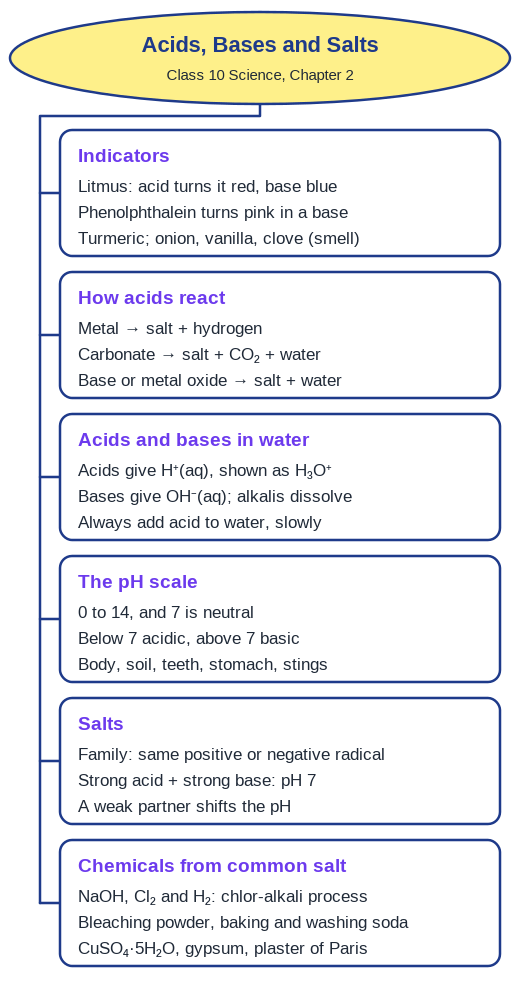
What is this chapter about?
Lemon and tamarind taste sour because of acids; soap feels slippery and tastes bitter because it is basic. When someone has acidity after a heavy meal, a spoon of baking soda in water helps, because a base cancels the effect of an acid. This chapter explains why: how we test for acids and bases, how they react, what pH means, and how one everyday salt, common salt, gives us several useful chemicals.
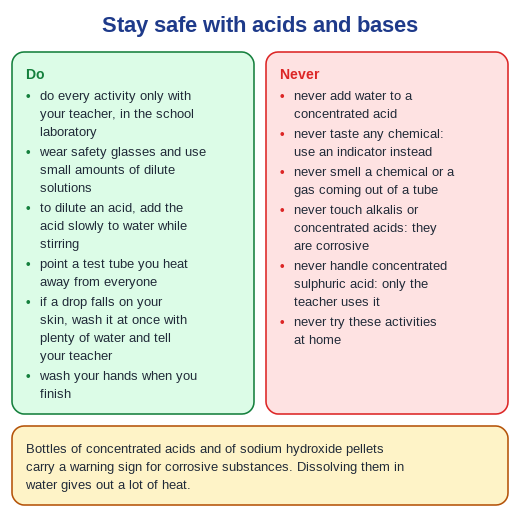
How do we stay safe with acids and bases?
Never taste a substance to find out whether it is an acid or a base: use an indicator. Concentrated acids and alkalis burn the skin and are corrosive. Do every activity only in the laboratory with your teacher, wear safety glasses, use small amounts of dilute solutions, never smell a chemical or a gas from a tube, and wash any splash with plenty of water at once.
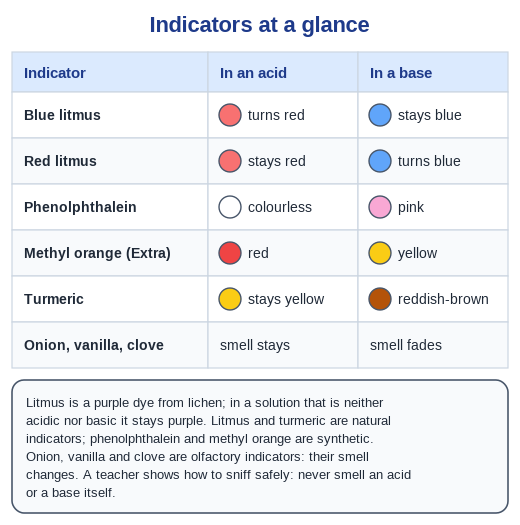
How do indicators tell an acid from a base?
An indicator changes colour, or smell, in an acid or a base. Acids turn blue litmus red; bases turn red litmus blue. Litmus is a purple dye made from lichen. Turmeric is another natural indicator: a curry stain on a white shirt turns reddish-brown when basic soap is rubbed on it. Phenolphthalein and methyl orange are synthetic indicators; phenolphthalein turns pink in a base. Onion, vanilla and clove are olfactory indicators, because their smell changes.
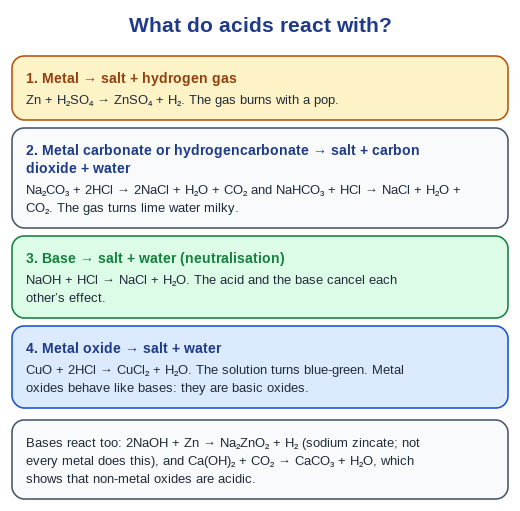
How do acids and bases react?
With a metal such as zinc, an acid gives a salt and hydrogen, which burns with a pop. With a metal carbonate or hydrogencarbonate it gives a salt, water and carbon dioxide, which turns lime water milky. With a base it gives a salt and water: this is neutralisation. Metal oxides also give a salt and water with acids, so they are basic oxides; carbon dioxide reacts with lime water, a base, so non-metal oxides are acidic. Some metals, like zinc, also react with warm sodium hydroxide to give hydrogen. Read the chemical properties of acids and bases.
What do all acids and all bases have in common?
Solutions of acids conduct electricity, while glucose and alcohol solutions, which also contain hydrogen, do not. In water, an acid gives hydrogen ions, H⁺(aq). These cannot exist alone and join water molecules as hydronium ions, H₃O⁺. Dry HCl gas, with no water, does not change dry litmus. Bases give hydroxide ions, OH⁻(aq), in water; a base that dissolves in water is an alkali. So neutralisation is really H⁺(aq) + OH⁻(aq) → H₂O(l).
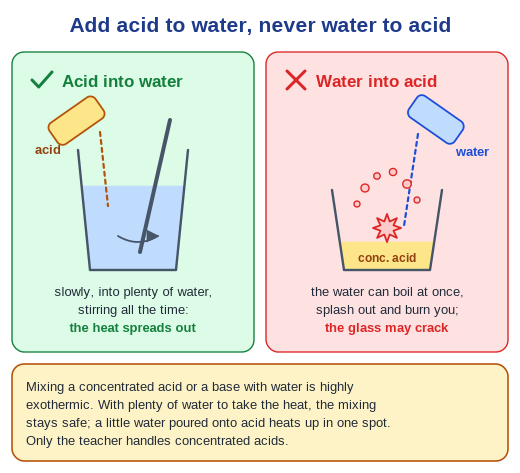
Dissolving a concentrated acid or base in water gives out a lot of heat. That is why the acid is always added slowly to water with stirring, never water to acid. Adding water lowers the concentration of ions: the acid or base is diluted.
What is the pH scale?
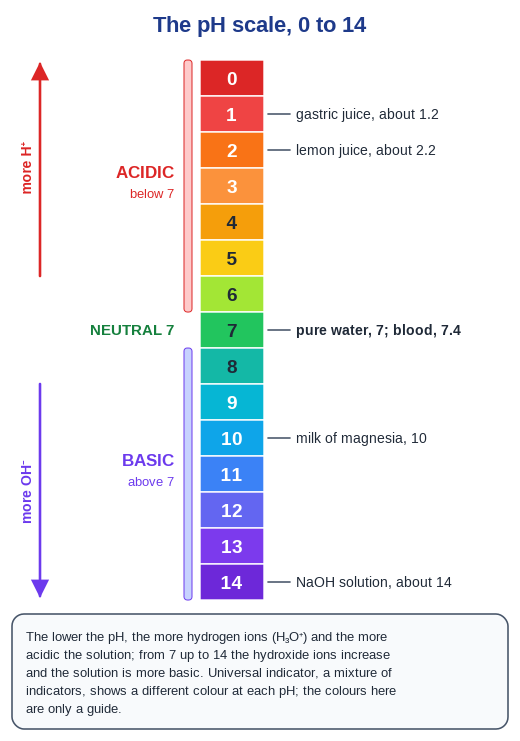
A universal indicator, a mixture of indicators, shows a different colour at each hydrogen ion concentration. The pH scale runs from 0, the most acidic, to 14, the most alkaline. The p comes from the German word potenz, meaning power. A neutral solution has pH 7, an acidic one less than 7, a basic one more than 7. The more hydronium ions, the lower the pH. At the same concentration, hydrochloric acid gives more H⁺ ions than acetic acid, so it is a strong acid and acetic acid a weak acid. Read the pH scale.
Why does pH matter in everyday life?
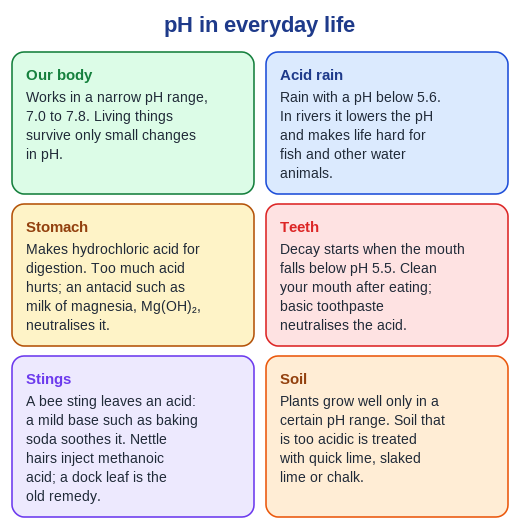
Our body works in the pH range 7.0 to 7.8. Rain with a pH below 5.6 is acid rain, and it makes life hard for animals in rivers. The stomach makes hydrochloric acid; when it makes too much, an antacid such as milk of magnesia neutralises it. Tooth decay starts below pH 5.5, so we clean our teeth after eating. A bee sting leaves an acid that baking soda soothes. Farmers treat soil that is too acidic with lime or chalk.
What are salts, and what is their pH?
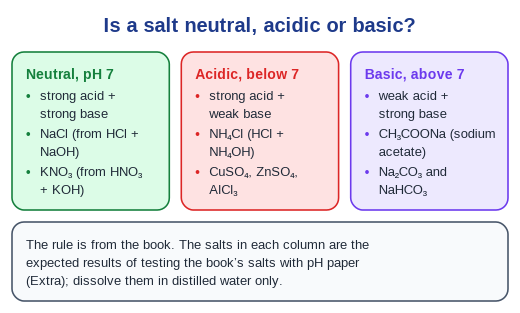
Salts with the same positive or negative radical form a family: NaCl and Na₂SO₄ are sodium salts; NaCl and KCl are chloride salts. A salt made from a strong acid and a strong base, like sodium chloride, is neutral (pH 7). A salt of a strong acid and a weak base is acidic, and a salt of a strong base and a weak acid is basic.
Which chemicals do we get from common salt?
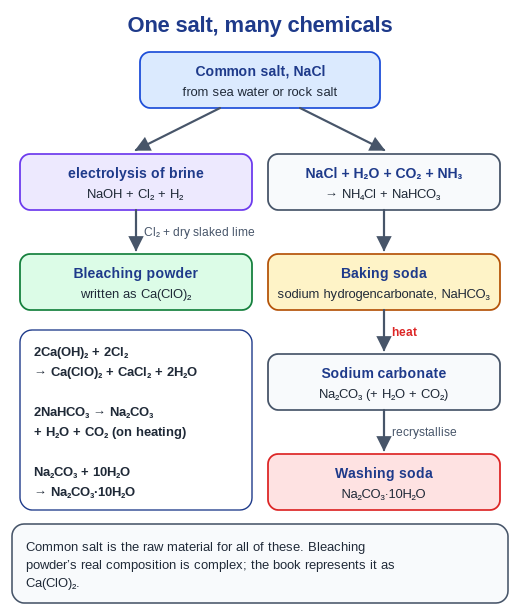
Sodium chloride comes from sea water and from rock salt, mined from beds left by seas that dried up long ago. Salt was the symbol of Gandhiji’s Dandi March. Passing electricity through brine gives sodium hydroxide, chlorine and hydrogen: the chlor-alkali process. Chlorine and dry slaked lime give bleaching powder. Salt, water, carbon dioxide and ammonia give baking soda, NaHCO₃. Heating baking soda gives sodium carbonate, which crystallises with water as washing soda, Na₂CO₃·10H₂O. Read baking soda, washing soda and bleaching powder.
What is water of crystallisation?
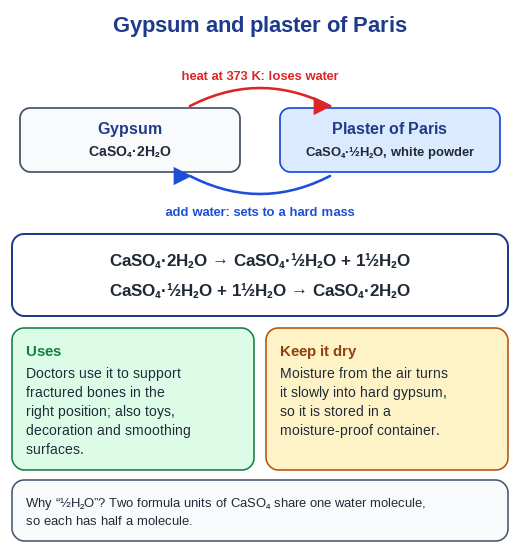
Blue copper sulphate crystals look dry, yet heating them drives out water and leaves a white powder; a few drops of water turn it blue again. The water locked in a crystal is its water of crystallisation: CuSO₄·5H₂O has five water molecules per formula unit. Gypsum, CaSO₄·2H₂O, heated at 373 K, becomes plaster of Paris, CaSO₄·½H₂O, which sets hard with water and holds broken bones in place.
Before we move on
For every reaction in this chapter, write a balanced equation and say what kind of substance each reactant is: acid, base or salt. Answers to the five Questions boxes and all fifteen exercises are in the NCERT solutions for Chapter 2.
Key terms
| Term | Meaning |
|---|---|
| Indicator | A dye or mixture of dyes that shows by a colour change whether a substance is acidic or basic, such as litmus, turmeric or phenolphthalein. |
| Olfactory indicator | A substance whose smell changes in an acid or a base, such as onion, vanilla or clove. |
| Acid | A substance that gives hydrogen ions, H⁺(aq), in water; it tastes sour and turns blue litmus red. |
| Base and alkali | A base gives hydroxide ions, OH⁻(aq), in water. Bases that can dissolve in water are called alkalis. |
| Neutralisation | An acid and a base react and form a salt and water: NaOH + HCl → NaCl + H₂O. |
| Hydronium ion | H₃O⁺, the form hydrogen ions take in water, since H⁺ cannot exist alone. |
| Dilution | Mixing an acid or a base with water, which lowers the concentration of its ions; always add acid to water. |
| pH scale | A scale, usually 0 to 14, for hydrogen ion concentration: 7 neutral, below 7 acidic, above 7 basic. |
| Universal indicator | A mixture of indicators that shows a different colour at each pH. |
| Strong and weak acids | At the same concentration, a strong acid such as HCl gives more H⁺ ions than a weak acid such as acetic acid. |
| Salt | A compound formed when an acid reacts with a base; salts with the same positive or negative radical form a family. |
| Chlor-alkali process | Electrolysis of brine giving sodium hydroxide, chlorine and hydrogen. |
| Water of crystallisation | The fixed number of water molecules in one formula unit of a salt, such as 5 in CuSO₄·5H₂O. |
| Plaster of Paris | Calcium sulphate hemihydrate, CaSO₄·½H₂O, made by heating gypsum at 373 K; it sets hard with water. |
Topics in this chapter
Practice
-
A solution turns phenolphthalein pink. The solution is:
Show answer
Answer: (b) basic
-
Which gas is given off when zinc reacts with dilute sulphuric acid?
Show answer
Answer: (c) hydrogen
-
A solution with pH 2 is:
Show answer
Answer: (d) strongly acidic
-
The chemical formula of washing soda is:
Show answer
Answer: (b) Na₂CO₃·10H₂O
-
While diluting a concentrated acid, you should:
Show answer
Answer: (b) add the acid slowly to water while stirring
-
Plaster of Paris is made by heating:
Show answer
Answer: (b) gypsum
Questions students ask
What are the main topics of Class 10 Science Chapter 2?
Acid-base indicators, the reactions of acids and bases with metals, carbonates, oxides and each other, H⁺ and OH⁻ ions in water, the pH scale and its uses in daily life, the pH of salts, and the chemicals made from common salt: sodium hydroxide, bleaching powder, baking soda, washing soda and plaster of Paris.
Is Acids, Bases and Salts in the 2026-27 NCERT book?
Yes. It is Chapter 2 of Science, the Class 10 NCERT textbook marked Reprint 2026-27, on pages 17 to 36. It builds on the equations of Chapter 1, and Chapter 3, on metals and non-metals, follows it.
Which equations of this chapter should I practise for the board exam?
Write and balance the reactions of acids with zinc and with sodium carbonate and sodium hydrogencarbonate, the lime-water test, NaOH with HCl, copper oxide with HCl, the chlor-alkali process, bleaching powder, baking soda on heating, washing soda, and gypsum and plaster of Paris.
Why is the solution of an acid or a base in water dangerous to make?
Dissolving a concentrated acid or base in water gives out a lot of heat. If water is poured onto a concentrated acid, the mixture can splash out and burn, so the acid is always added slowly to plenty of water, and only by the teacher.
Stuck on a question?
Take a photo and Lagnever AI explains it step by step. Try it for 7 days for ₹2.
Get it on Google Play Open in browser
For parents: after the trial, the plan renews monthly by UPI or card autopay. You can cancel anytime in the app.