
What are baking soda, washing soda and bleaching powder?
Answer in short
They are three useful chemicals made from common salt. Baking soda is sodium hydrogencarbonate, NaHCO₃, a mild base used in cooking, baking powder and antacids. Washing soda is Na₂CO₃·10H₂O, used for cleaning and for removing permanent hardness of water. Bleaching powder, written Ca(ClO)₂, bleaches cloth and paper and kills germs in drinking water.
Stuck on a question? Take a photo and Lagnever AI explains it step by step. Try it for 7 days for ₹2. Get it on Google Play
Why is common salt called a raw material for chemicals?
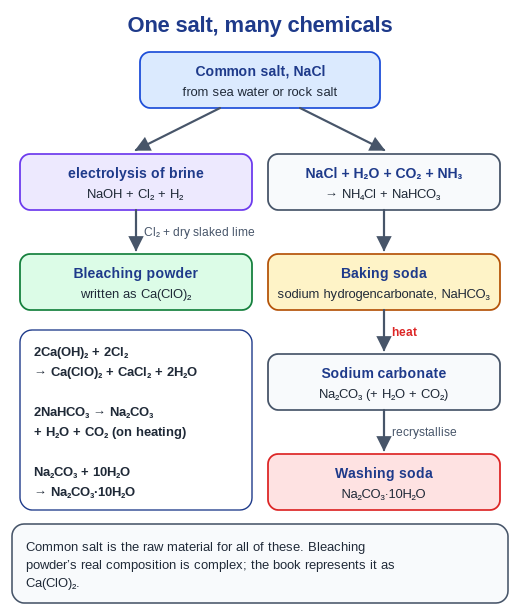
The salt formed when hydrochloric acid reacts with sodium hydroxide is sodium chloride, the neutral salt in our food. It is separated from sea water and also mined as rock salt, large brown crystals left where ancient seas dried up. Salt was the symbol of Gandhiji’s Dandi March. From this one cheap salt we get sodium hydroxide, bleaching powder, baking soda and washing soda.
How is sodium hydroxide made?
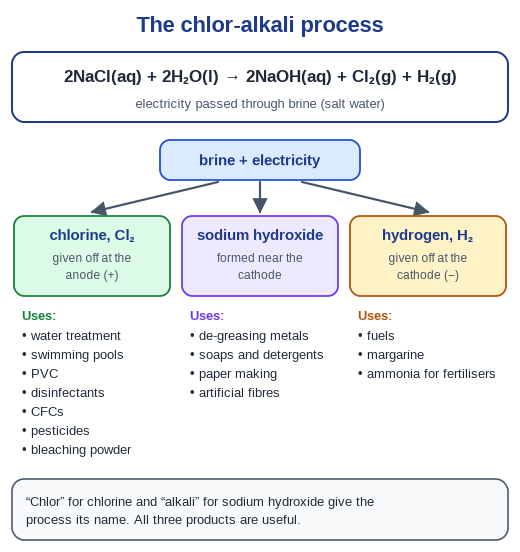
Electricity is passed through brine, a solution of sodium chloride in water:
2NaCl(aq) + 2H₂O(l) → 2NaOH(aq) + Cl₂(g) + H₂(g)
Chlorine bubbles off at the anode and hydrogen at the cathode, while sodium hydroxide solution collects near the cathode. This is the chlor-alkali process: chlor for chlorine, alkali for sodium hydroxide. All three products are useful. Chlorine goes into water treatment, PVC, disinfectants and pesticides; hydrogen into fuels, margarine and ammonia for fertilisers; sodium hydroxide into soaps and detergents, paper and artificial fibres.
How is bleaching powder made, and what is it used for?
Chlorine from the chlor-alkali process is passed over dry slaked lime, calcium hydroxide. The product is bleaching powder. Its real composition is complex, but it is represented as Ca(ClO)₂:
2Ca(OH)₂ + 2Cl₂ → Ca(ClO)₂ + CaCl₂ + 2H₂O
It bleaches cotton and linen in the textile industry, wood pulp in paper factories and washed clothes in laundries. Many chemical industries use it as an oxidising agent, and it is used to kill germs in drinking water.
What is baking soda?
Baking soda is sodium hydrogencarbonate, NaHCO₃. It is made from sodium chloride:
NaCl + H₂O + CO₂ + NH₃ → NH₄Cl + NaHCO₃
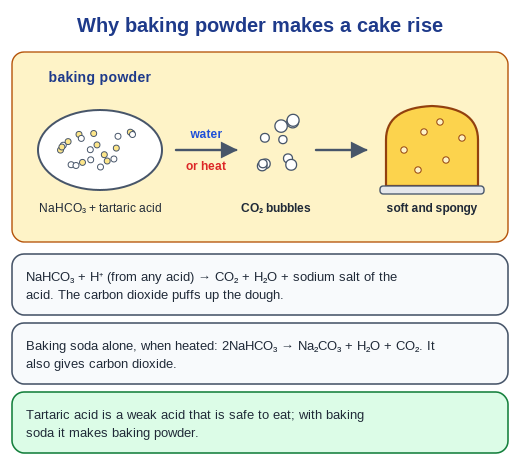
It is a mild basic salt that does not corrode, so it can neutralise an acid. In the kitchen it makes pakoras crisp and speeds up cooking, because on heating it gives carbon dioxide:
2NaHCO₃ → Na₂CO₃ + H₂O + CO₂
Its uses:
- Baking powder is baking soda mixed with tartaric acid, a weak acid that is safe to eat. Wet or heated, it reacts (NaHCO₃ + H⁺ → CO₂ + H₂O + a sodium salt), and the carbon dioxide makes bread and cakes rise, soft and spongy.
- It goes into antacids, where, as a base, it neutralises extra stomach acid.
- Soda-acid fire extinguishers use it to make carbon dioxide.
What is washing soda?
Heating baking soda gives sodium carbonate. When sodium carbonate is recrystallised from water, each formula unit takes ten water molecules and gives washing soda, Na₂CO₃·10H₂O:
Na₂CO₃ + 10H₂O → Na₂CO₃·10H₂O
Washing soda is also a basic salt. It is used in the glass, soap and paper industries, to make sodium compounds such as borax, as a household cleaning agent, and to remove the permanent hardness of water.
What is water of crystallisation?
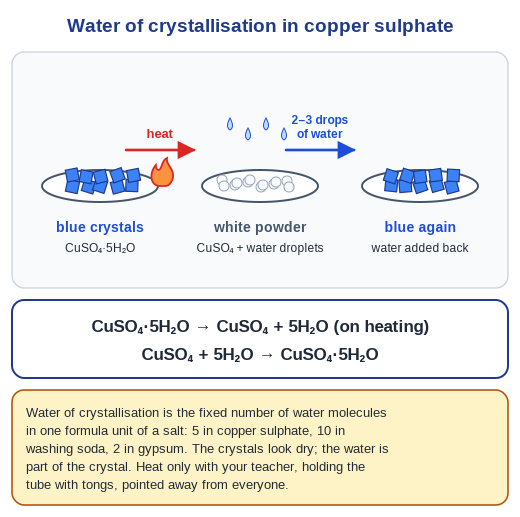
Do the 10H₂O make washing soda wet? No. Let your teacher heat a few blue copper sulphate crystals in a dry test tube, and they turn white while water drops collect in the tube; add two or three drops of water and the blue returns. The crystals held water, called water of crystallisation: the fixed number of water molecules in one formula unit of a salt. Copper sulphate has five, CuSO₄·5H₂O; washing soda ten; gypsum, CaSO₄·2H₂O, two.
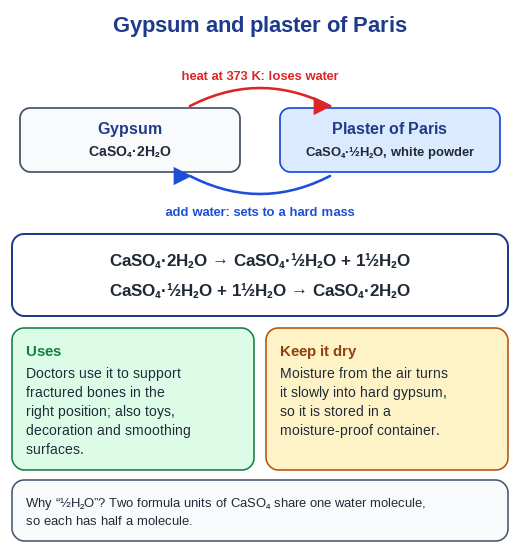
What is plaster of Paris?
Heat gypsum at 373 K and it loses water, becoming calcium sulphate hemihydrate, CaSO₄·½H₂O: plaster of Paris. It is a white powder. Mixed with water, it turns back into gypsum and sets into a hard mass:
CaSO₄·½H₂O + 1½H₂O → CaSO₄·2H₂O
Half a water molecule? Two formula units of CaSO₄ share one water molecule. Doctors use plaster of Paris to hold fractured bones in place; it is also used for toys, decorations and smoothing surfaces. It must be kept in a moisture-proof container, or it slowly sets in damp air.
A tip for the board exam
For each of these chemicals, learn its formula, one equation for how it forms and two uses. Exercises 13 and 15 and the last Questions box test them; see the NCERT solutions.
Back to the pH scale or the chapter notes.
Practice
-
Which gas is used to make bleaching powder?
Show answer
Answer: (b) chlorine
-
Which compound is used for softening hard water?
Show answer
Answer: (b) washing soda
-
How many molecules of water of crystallisation does gypsum have per formula unit?
Show answer
Answer: (b) 2
-
What gas makes a cake soft and spongy when baking powder is used?
Show answer
Answer: Carbon dioxide, formed when baking soda reacts with the tartaric acid in baking powder (or when it is heated).
-
Name the three products of the chlor-alkali process.
Show answer
Answer: Sodium hydroxide, chlorine gas and hydrogen gas.
Questions students ask
What is the chemical name of baking soda?
Sodium hydrogencarbonate, NaHCO₃. It is made from sodium chloride, water, carbon dioxide and ammonia, and it is a mild basic salt that does not corrode.
What is the difference between baking soda and baking powder?
Baking soda is sodium hydrogencarbonate alone. Baking powder is baking soda mixed with tartaric acid, a weak edible acid; with water or heat, the two react and give carbon dioxide that makes cakes rise.
Why is the chlor-alkali process called so?
The name comes from two of its products: “chlor” from chlorine and “alkali” from sodium hydroxide. Hydrogen is the third product.
Why is plaster of Paris used for broken bones?
It is a white powder that, mixed with water, sets into hard gypsum. Doctors use it to hold fractured bones in the right position while they heal.
Stuck on a question?
Take a photo and Lagnever AI explains it step by step. Try it for 7 days for ₹2.
Get it on Google Play Open in browser
For parents: after the trial, the plan renews monthly by UPI or card autopay. You can cancel anytime in the app.