
What is the pH scale?
Answer in short
The pH scale measures the hydrogen ion concentration of a solution, usually from 0 to 14. A neutral solution has pH 7, an acidic solution has a pH below 7 and a basic solution a pH above 7. The more hydrogen ions a solution has, the lower its pH. Universal indicator or pH paper shows the pH by its colour.
Stuck on a question? Take a photo and Lagnever AI explains it step by step. Try it for 7 days for ₹2. Get it on Google Play
What does the pH of a solution tell us?
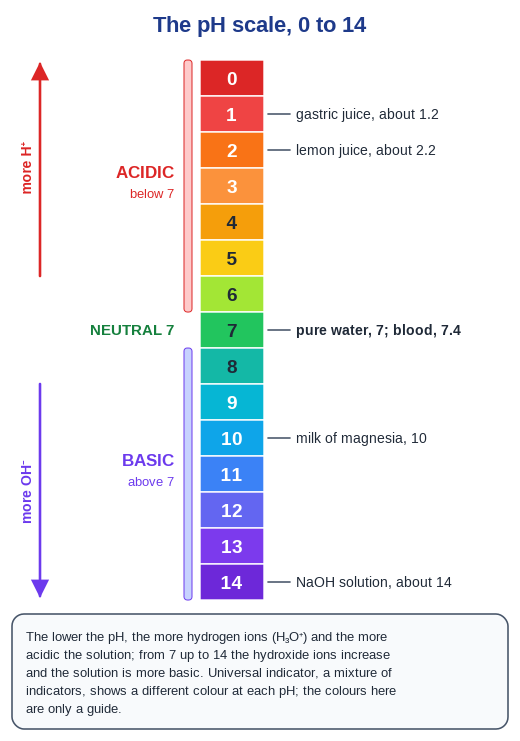
Indicators tell us whether a solution is acidic or basic. The pH scale also tells us how strongly. It measures the concentration of hydrogen ions (hydronium ions, H₃O⁺) and usually runs from 0, the most acidic, to 14, the most alkaline. The p stands for potenz, German for power.
- pH 7: neutral, like pure water.
- Below 7: acidic. The lower the number, the more hydronium ions and the more acidic the solution.
- Above 7: basic. From 7 up to 14 the hydroxide ions, OH⁻, increase and the solution becomes more alkaline.
How do we measure pH?
We use a universal indicator, a mixture of several indicators that shows a different colour at each hydrogen ion concentration. Usually it comes as paper soaked in the indicator. Dip a strip in the solution and match its colour with the chart. Gastric juice is about pH 1.2 and lemon juice about 2.2, while milk of magnesia is about 10 and sodium hydroxide solution about 14. Blood is 7.4.
Try this with your teacher on lemon juice, tomato juice, coffee, carrot juice, an aerated drink, tap water and saliva before and after a meal. Use only a drop on the paper, never taste anything, and leave the 1 M acid and alkali samples to your teacher.
What makes an acid strong or weak?
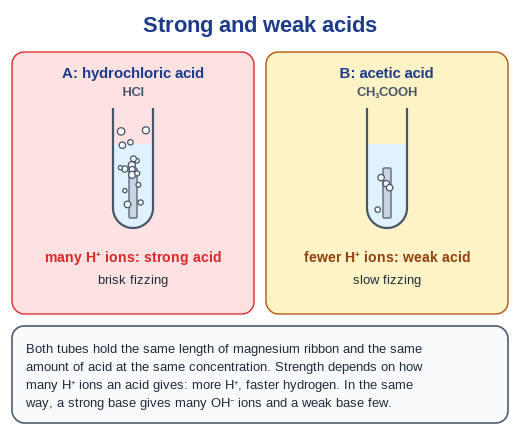
Compare one-molar solutions of hydrochloric acid and acetic acid. They do not give the same number of hydrogen ions. Hydrochloric acid gives more H⁺ ions, so it is a strong acid; acetic acid gives fewer, so it is a weak acid. Drop equal pieces of magnesium ribbon into equal amounts of each: the strong acid fizzes much faster. In the same way, a strong base gives many OH⁻ ions and a weak base gives few.
Why does pH matter to living things?
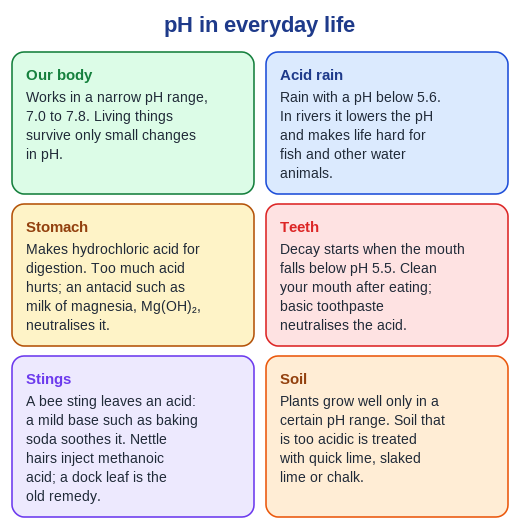
Living things survive only in a narrow pH range. Our body works between pH 7.0 and 7.8. Rain with a pH below 5.6 is acid rain; in rivers it lowers the pH and makes it hard for fish to survive. The planet Venus is wrapped in dense clouds of sulphuric acid: could life as we know it survive there?
Soil: plants grow well only in a certain pH range. You can shake about 2 g of soil with 5 mL of water, filter it and test the filtrate with pH paper. Soil that is too acidic is treated with quick lime, slaked lime or chalk.
How does pH affect digestion and teeth?
The stomach makes hydrochloric acid, which helps digest food without harming the stomach. During indigestion it makes too much, causing pain and irritation. An antacid, a mild base such as milk of magnesia (magnesium hydroxide), neutralises the extra acid.
Tooth decay starts when the mouth’s pH falls below 5.5. Tooth enamel, made of calcium hydroxyapatite, is harder than anything else in the body. Water cannot dissolve it, but acid wears it away. Bacteria in the mouth make acids from sugar and food bits left after eating. Cleaning the mouth after meals prevents this, and toothpastes, which are generally basic, neutralise the acid.
How do plants and animals use acids?
A honey-bee sting leaves an acid that causes pain; rubbing a mild base such as baking soda on it gives relief. The stinging hairs of nettle leaves inject methanoic acid; the traditional remedy is to rub the spot with a dock leaf, a plant often found close to nettles. Many foods carry acids too: vinegar has acetic acid, orange and lemon citric acid, tamarind tartaric acid, tomato oxalic acid and curd lactic acid. Ant stings, like nettle stings, contain methanoic acid.
What is the pH of a salt?
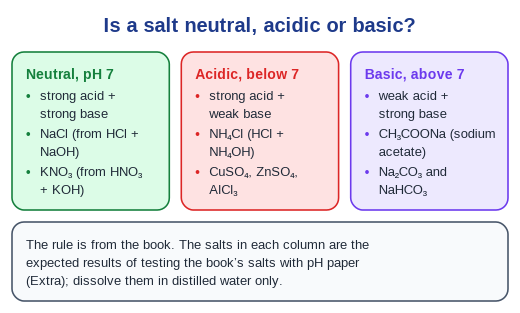
It depends on the acid and the base the salt comes from. A salt made from a strong acid and a strong base, like sodium chloride, is neutral, with pH 7. A salt of a strong acid and a weak base is acidic, below 7, and a salt of a strong base and a weak acid is basic, above 7. Dissolve salts in distilled water only when you test them.
A tip for the board exam
When you compare solutions, remember that a lower pH means more hydrogen ions. Exercises 9, 10, 11 and 12 are about pH; see the NCERT solutions.
Back to the chemical properties of acids and bases, on to baking soda, washing soda and bleaching powder, or the chapter notes.
Practice
-
A solution has pH 9. It is:
Show answer
Answer: (d) weakly basic
-
Which has the highest hydrogen ion concentration?
Show answer
Answer: (a) pH 1
-
Milk of magnesia is used as an antacid because it is:
Show answer
Answer: (b) a mild base
-
Why does tooth decay start after we eat sweets and do not clean our teeth?
Show answer
Answer: Bacteria in the mouth break down sugar and food bits into acids; when the pH falls below 5.5, tooth enamel starts to corrode.
-
Is a solution of sodium chloride acidic, basic or neutral? Why?
Show answer
Answer: Neutral, pH 7, because sodium chloride is the salt of a strong acid (HCl) and a strong base (NaOH).
Questions students ask
What does pH stand for?
The p comes from potenz, a German word meaning power. pH is simply a number that tells how acidic or basic a solution is.
What is the pH of pure water?
7. Pure water is neutral: it is neither acidic nor basic.
What is acid rain?
Rain whose pH is less than 5.6. When it flows into rivers it lowers their pH, and fish and other water animals find it hard to survive.
Why do farmers add lime to some fields?
When soil is too acidic for crops, lime (quick lime, CaO, or slaked lime, Ca(OH)₂) or chalk, CaCO₃, neutralises the extra acid and raises the pH.
Stuck on a question?
Take a photo and Lagnever AI explains it step by step. Try it for 7 days for ₹2.
Get it on Google Play Open in browser
For parents: after the trial, the plan renews monthly by UPI or card autopay. You can cancel anytime in the app.