
What are the chemical properties of acids and bases?
Answer in short
Acids turn blue litmus red and bases turn red litmus blue. An acid reacts with a metal to give a salt and hydrogen, with a carbonate to give a salt, carbon dioxide and water, and with a base or metal oxide to give a salt and water. In water, acids give H⁺ ions and bases give OH⁻ ions.
Stuck on a question? Take a photo and Lagnever AI explains it step by step. Try it for 7 days for ₹2. Get it on Google Play
How do we test for an acid or a base without tasting it?
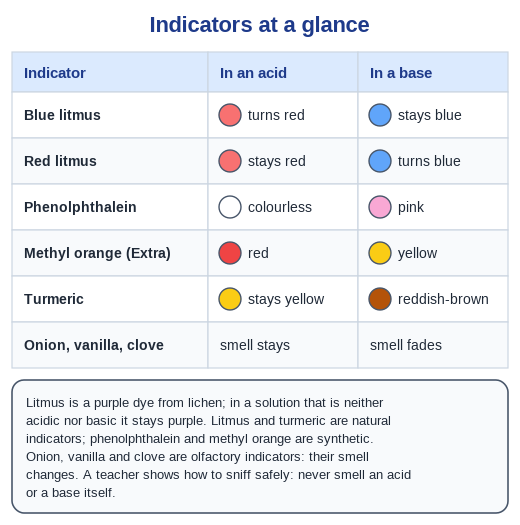
We use an indicator, a substance that changes colour or smell. Blue litmus turns red in an acid; red litmus turns blue in a base. Phenolphthalein stays colourless in an acid and turns pink in a base. Turmeric turns reddish-brown in a base. The smell of onion, vanilla and clove fades in a basic solution, so they are olfactory indicators. Your teacher will show you how to waft a smell gently; never smell an acid or a base itself.
What happens when an acid meets a metal?
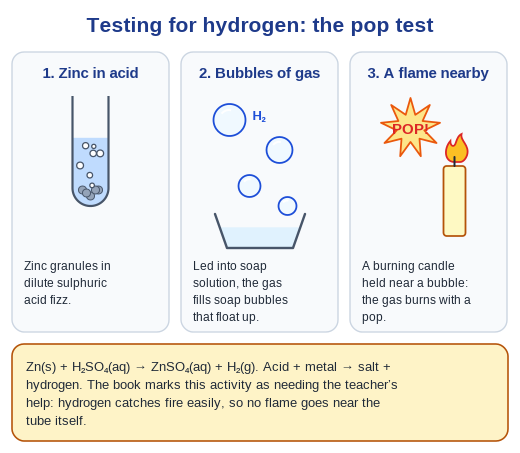
Drop zinc granules into dilute sulphuric acid and bubbles form on the zinc. The gas is hydrogen. Bubbled through soap solution, it fills soap bubbles, and a burning candle brought near one makes it burn with a pop. The book marks this activity as needing the teacher’s help.
Zn(s) + H₂SO₄(aq) → ZnSO₄(aq) + H₂(g)
The metal has pushed hydrogen out of the acid and formed a salt, zinc sulphate. In general: acid + metal → salt + hydrogen gas. Hydrochloric and acetic acids behave the same way. Some metals react with bases too: zinc warmed with sodium hydroxide solution gives sodium zincate and hydrogen, 2NaOH(aq) + Zn(s) → Na₂ZnO₂(s) + H₂(g).
What happens when an acid meets a carbonate?
Add dilute hydrochloric acid to sodium carbonate or to sodium hydrogencarbonate and the mixture fizzes:
Na₂CO₃(s) + 2HCl(aq) → 2NaCl(aq) + H₂O(l) + CO₂(g)
NaHCO₃(s) + HCl(aq) → NaCl(aq) + H₂O(l) + CO₂(g)
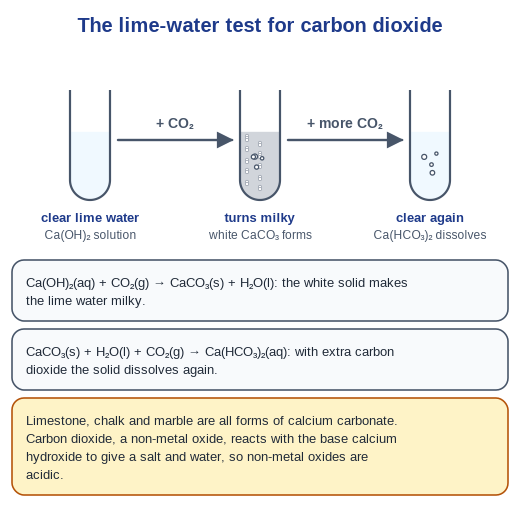
The gas is carbon dioxide. Passed through lime water (calcium hydroxide solution), it gives a white solid, calcium carbonate, so the lime water turns milky. With more carbon dioxide, soluble calcium hydrogencarbonate forms and the milkiness clears. Limestone, chalk and marble are all calcium carbonate. In general: metal carbonate or hydrogencarbonate + acid → salt + carbon dioxide + water.
What is neutralisation?
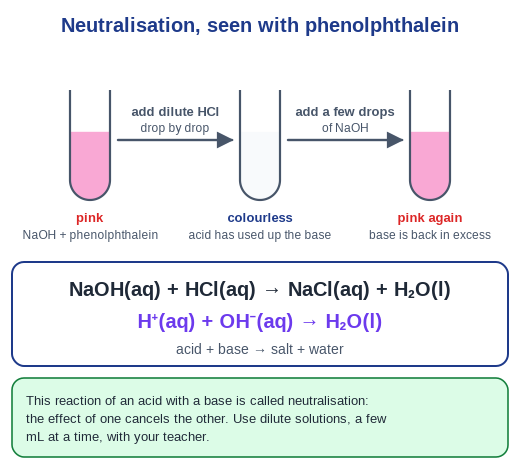
Put two drops of phenolphthalein in dilute sodium hydroxide: it turns pink. Add dilute hydrochloric acid drop by drop and the pink disappears; a few drops of the base bring it back. The acid and the base have cancelled each other’s effect:
NaOH(aq) + HCl(aq) → NaCl(aq) + H₂O(l)
This is a neutralisation reaction: base + acid → salt + water. Copper oxide behaves like a base. It dissolves in dilute hydrochloric acid and the solution turns blue-green as copper(II) chloride forms: CuO + 2HCl → CuCl₂ + H₂O. So metal oxides are basic oxides. Carbon dioxide, a non-metal oxide, reacts with the base calcium hydroxide to give a salt and water, so non-metal oxides are acidic.
What do all acids have in common?
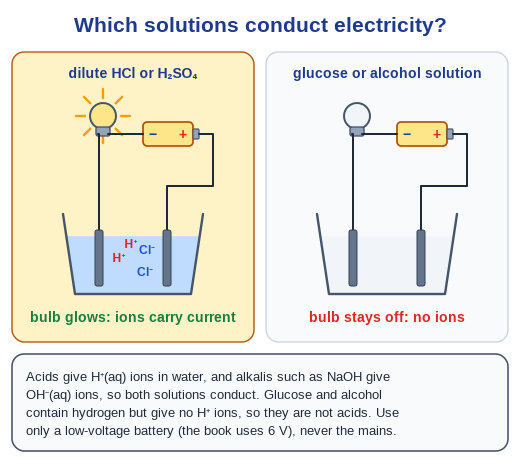
Dip two nails joined to a 6 V battery and a bulb into dilute HCl or H₂SO₄ and the bulb glows. In glucose or alcohol solution it does not. A current flows through a solution only when it has ions. In water every acid gives hydrogen ions, H⁺(aq), together with an anion such as Cl⁻, NO₃⁻ or SO₄²⁻. These ions make it acidic.
The ions form only with water. Dry HCl gas does not change dry blue litmus, but moist litmus turns red: HCl + H₂O → H₃O⁺ + Cl⁻. An H⁺ ion cannot exist alone; it joins a water molecule as a hydronium ion, H₃O⁺.
What do bases give in water?
Bases give hydroxide ions: NaOH → Na⁺ + OH⁻, and Mg(OH)₂ → Mg²⁺ + 2OH⁻. Bases that can dissolve in water are alkalis. Alkalis feel soapy, taste bitter and are corrosive, so never taste or touch them. Since acids give H⁺ and bases give OH⁻, every neutralisation is at heart H⁺(aq) + OH⁻(aq) → H₂O(l).
Why add acid to water and not water to acid?
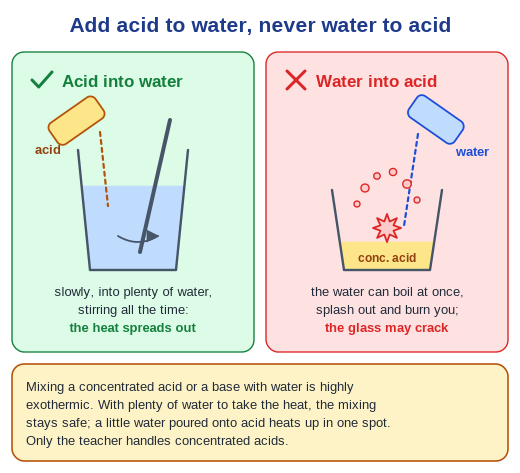
Dissolving a concentrated acid or base in water is highly exothermic. If water is poured onto concentrated acid, the heat can make the mixture splash out and burn, and the glass may crack. Acid added slowly to plenty of water, with constant stirring, lets the heat spread. Mixing with water also lowers the concentration of H₃O⁺ or OH⁻ ions per unit volume; this is dilution. Only your teacher handles concentrated acids.
A tip for the board exam
Learn the four general reactions of acids in words, then practise one balanced equation for each. Exercises 5, 6 and 8 test exactly these; their answers are on the NCERT solutions page.
Next: the pH scale, or back to the chapter notes.
Practice
-
Which gas turns lime water milky?
Show answer
Answer: (c) carbon dioxide
-
Copper oxide dissolves in dilute hydrochloric acid to give a blue-green solution of:
Show answer
Answer: (b) copper(II) chloride
-
Which of these solutions will make a bulb glow in a simple circuit?
Show answer
Answer: (c) dilute hydrochloric acid
-
Write the balanced equation for sodium hydrogencarbonate and hydrochloric acid.
Show answer
Answer: NaHCO₃ + HCl → NaCl + H₂O + CO₂. Na 1 = 1, H 2 = 2, C 1 = 1, O 3 = 1 + 2, Cl 1 = 1.
-
Why are metal oxides called basic oxides?
Show answer
Answer: Because, like bases, they react with acids to give a salt and water, for example CuO + 2HCl → CuCl₂ + H₂O.
Questions students ask
What are the chemical properties of acids?
Acids react with metals to give a salt and hydrogen, with metal carbonates and hydrogencarbonates to give a salt, carbon dioxide and water, and with bases and metal oxides to give a salt and water. They turn blue litmus red and give H⁺ ions in water.
Do bases react with metals?
Some do. Zinc warmed with sodium hydroxide solution gives sodium zincate and hydrogen gas: 2NaOH + Zn → Na₂ZnO₂ + H₂. Not every metal reacts like this.
Why does dry HCl gas not turn dry blue litmus red?
HCl gives hydrogen ions only in the presence of water. Dry HCl gas is made of molecules with no H⁺ ions, so dry litmus does not change; moist litmus turns red.
What is an alkali?
Alkalis are bases that can dissolve in water, such as sodium hydroxide or potassium hydroxide. Alkalis are soapy to touch, bitter and corrosive, so never taste or touch them.
Stuck on a question?
Take a photo and Lagnever AI explains it step by step. Try it for 7 days for ₹2.
Get it on Google Play Open in browser
For parents: after the trial, the plan renews monthly by UPI or card autopay. You can cancel anytime in the app.