
NCERT Solutions Class 10 Science Chapter 3: Metals and Non-metals
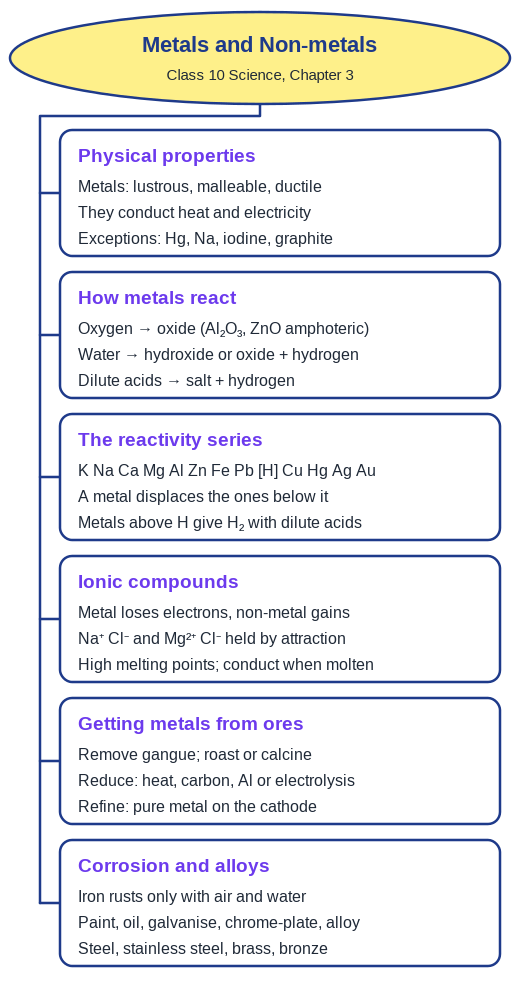
Answers to the five Questions boxes inside Chapter 3, Metals and Non-metals, the other questions the chapter asks along the way, Activities 3.1–3.14, and all sixteen end-of-chapter exercises, from Science, the Class 10 NCERT textbook. Page numbers follow the 2026-27 reprint (pages 37–57). The exercises are quoted from the book; the in-chapter questions are restated in short. Every equation below was checked atom by atom and charge by charge. Short notes: Chapter 3 notes.
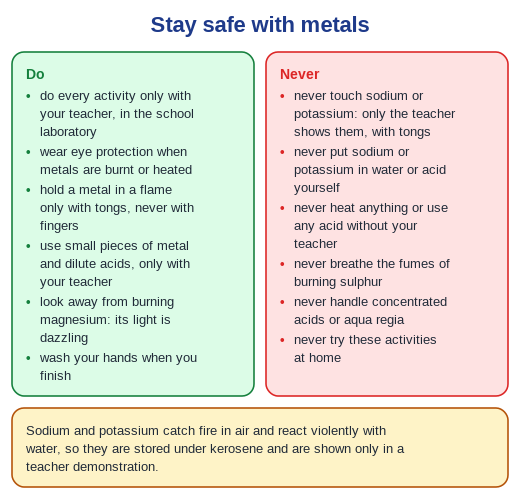
Stay safe. Do every activity only in the laboratory with your teacher, and wear eye protection when metals are burnt or heated. Sodium and potassium are shown only in a teacher demonstration: they catch fire in air and react violently with water. Never heat anything or use any acid without your teacher, never breathe the fumes of burning sulphur, and wash any splash at once with plenty of water.
Questions, page 40
Question 1 (page 40): name a metal that (i) stays liquid at room temperature, (ii) is soft enough to cut easily with a knife, (iii) conducts heat better than any other metal, (iv) conducts heat poorly. (i) Mercury. (ii) Sodium (lithium and potassium too). (iii) Silver; copper also conducts heat very well. (iv) Lead (mercury too).
Question 2 (page 40): what do malleable and ductile mean? A malleable substance can be beaten into thin sheets; gold and silver are more malleable than any other metal. A ductile substance can be drawn into thin wires; gold is the most ductile metal.
Questions, page 46
Question 1 (page 46): why is sodium kept in kerosene oil? Sodium reacts so vigorously with oxygen that it can catch fire if kept in the open, and it reacts violently with water. Kerosene keeps air and moisture away from it, which prevents accidental fires.
Question 2 (page 46): write the equations for (i) iron and steam, (ii) calcium, and potassium, in water.
(i) 3Fe(s) + 4H₂O(g) → Fe₃O₄(s) + 4H₂(g). Check: Fe 3 = 3, H 8 = 8, O 4 = 4.
(ii) Ca(s) + 2H₂O(l) → Ca(OH)₂(aq) + H₂(g). Check: Ca 1 = 1, H 4 = 2 + 2, O 2 = 2.
2K(s) + 2H₂O(l) → 2KOH(aq) + H₂(g) + heat. Check: K 2 = 2, H 4 = 2 + 2, O 2 = 2.
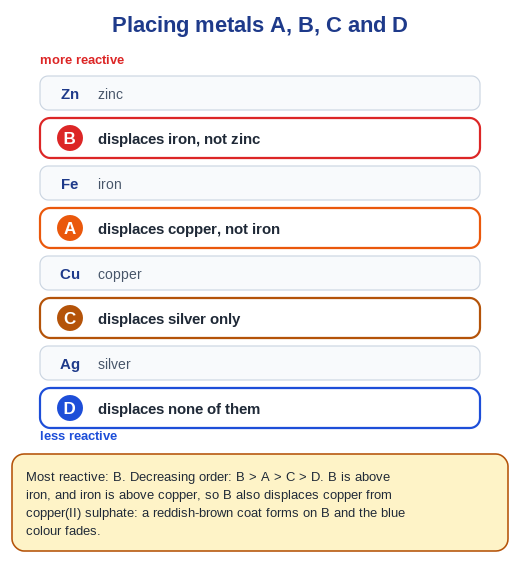
Question 3 (page 46): metals A, B, C and D are tested in solutions of zinc sulphate, iron(II) sulphate, copper(II) sulphate and silver nitrate; use the results in the book’s table. From the table: A displaces copper but not iron; B displaces iron but not zinc; C displaces only silver; D displaces none of them.
(i) The most reactive metal is B, because it displaces iron, which is itself above copper and silver.
(ii) B is more reactive than iron, and iron is more reactive than copper, so B displaces copper from copper(II) sulphate: a reddish-brown coat of copper forms on B and the blue colour of the solution fades.
(iii) Decreasing reactivity: B > A > C > D.
Question 4 (page 46): what gas comes off when a reactive metal meets dilute hydrochloric acid? Give the equation for iron and dilute H₂SO₄. Hydrogen. Fe(s) + H₂SO₄(aq) → FeSO₄(aq) + H₂(g). Check: Fe 1 = 1, H 2 = 2, S 1 = 1, O 4 = 4.
Question 5 (page 46): what happens when zinc is added to iron(II) sulphate solution? Zinc is more reactive than iron, so it displaces iron. The pale green solution slowly becomes colourless as zinc sulphate forms, and a dark grey deposit of iron forms on the zinc.
Zn(s) + FeSO₄(aq) → ZnSO₄(aq) + Fe(s). Check: Zn 1 = 1, Fe 1 = 1, S 1 = 1, O 4 = 4.
Questions, page 49
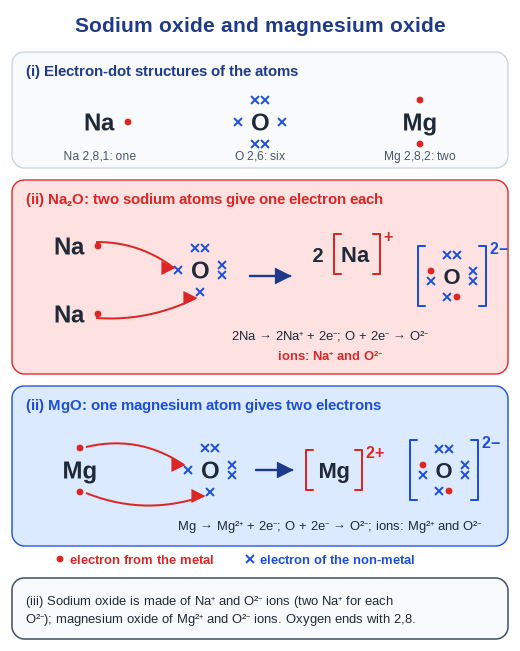
Question 1 (page 49): (i) electron-dot structures of sodium, oxygen and magnesium; (ii) the formation of Na₂O and MgO by transfer of electrons; (iii) the ions in these compounds.
(i) Sodium (2,8,1) has one outer electron, oxygen (2,6) has six and magnesium (2,8,2) has two. In the diagram they are drawn around each symbol.
(ii) Na₂O: each of two sodium atoms gives one electron to an oxygen atom, which needs two to complete its octet.
2Na → 2Na⁺ + 2e⁻
O + 2e⁻ → O²⁻
MgO: one magnesium atom gives both its outer electrons to one oxygen atom.
Mg → Mg²⁺ + 2e⁻
O + 2e⁻ → O²⁻
(iii) Na₂O contains Na⁺ and O²⁻ ions (two Na⁺ for each O²⁻); MgO contains Mg²⁺ and O²⁻ ions.
Question 2 (page 49): what makes the melting points of ionic compounds so high? The oppositely charged ions attract each other strongly. A large amount of energy is needed to overcome this inter-ionic attraction, so ionic compounds melt only at high temperatures; sodium chloride, for example, melts at 1074 K.
Questions, page 53
Question 1 (page 53): define mineral, ore and gangue. (i) A mineral is an element or compound that occurs naturally in the earth’s crust. (ii) An ore is a mineral that contains a high percentage of a metal, so that the metal can be extracted from it profitably. (iii) Gangue is the impurities, such as soil and sand, that come mixed with an ore when it is mined.
Question 2 (page 53): two metals found in the free state in nature. Gold and silver (platinum and copper also occur in the free state).
Question 3 (page 53): the chemical process used to get a metal from its oxide. Reduction. For metals in the middle of the series, the oxide is heated with carbon: ZnO + C → Zn + CO. A more reactive metal can also be used, as in the thermit reaction. The most reactive metals are obtained by electrolytic reduction.
Questions, page 55
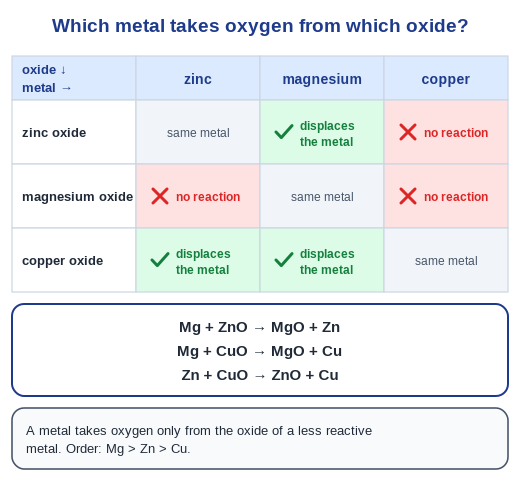
Question 1 (page 55): the oxides of zinc, magnesium and copper are each heated with zinc, magnesium and copper. Where does displacement take place? A metal takes oxygen only from the oxide of a less reactive metal. The order is Mg > Zn > Cu, so displacement happens in three cases:
- Magnesium with zinc oxide: Mg + ZnO → MgO + Zn
- Magnesium with copper oxide: Mg + CuO → MgO + Cu
- Zinc with copper oxide: Zn + CuO → ZnO + Cu
Zinc with magnesium oxide, and copper with zinc oxide or magnesium oxide, give no reaction. A metal heated with its own oxide shows no displacement.
Question 2 (page 55): which metals do not corrode easily? Metals low in the reactivity series, such as gold and platinum, which do not react with air or water. Silver is also unreactive with oxygen, though it slowly turns black with sulphur in the air.
Question 3 (page 55): what are alloys? An alloy is a uniform (homogeneous) mixture of a metal with other metals, or with a non-metal, such as steel, brass, bronze and solder. It is made by melting the main metal and mixing in the other elements in fixed amounts.
Other questions inside the chapter (pages 37–54)
Uses of metals and non-metals (page 37). Copper and aluminium make electric wires because they conduct electricity and can be drawn into wires; aluminium and steel make cooking vessels because they conduct heat and have high melting points; gold and silver make jewellery because they shine and can be beaten into shapes. Oxygen is needed for breathing and burning, and carbon in the form of coal is a fuel. In each case the use follows from the properties.
Metals for cooking vessels (page 38). Aluminium, iron (steel), copper and brass. They carry heat well and melt only at very high temperatures, so food cooks evenly and the vessel does not melt on the stove.
Why electric wires are coated with PVC or rubber (page 39). These materials are poor conductors of electricity. The coating stops current reaching anyone who touches the wire, and stops two wires touching and short-circuiting.
Why school bells are made of metal (page 39). Metals are sonorous: they ring when struck.
Which bases and acids form in Activity 3.8 (page 40). Magnesium ash dissolved in water turns red litmus blue, so magnesium oxide is basic. The solution from burning sulphur turns blue litmus red, so sulphur dioxide is acidic. Equations: 2Mg + O₂ → 2MgO and S + O₂ → SO₂; with water, MgO + H₂O → Mg(OH)₂ and SO₂ + H₂O → H₂SO₃ (these two are Extra).
The cation and anion in MgCl₂ (page 48). The cation is Mg²⁺ and the anion Cl⁻.
Oxidised and reduced in 3MnO₂ + 4Al → 3Mn + 2Al₂O₃ (page 52). Aluminium is oxidised (it gains oxygen to become Al₂O₃); manganese dioxide is reduced (it loses oxygen to become Mn).
Why a galvanised article is protected even if the zinc coat breaks (page 54). Zinc is more reactive than iron, so where both are exposed, the zinc reacts with air and water first and the iron is spared. The zinc keeps protecting the iron until it is used up.
What the activities show (Activities 3.1–3.14)
Do every one of these only with your teacher.
- 3.1, appearance: the metals look dull before rubbing and shine after the sandpaper removes the surface layer: metallic lustre.
- 3.2, cutting: iron, copper, aluminium and magnesium cannot be cut with a knife; sodium cuts easily. Sodium is handled only by the teacher, with tongs, after drying it between filter paper.
- 3.3, hammering: the metals flatten and spread out instead of breaking: they are malleable. Keep fingers clear and wear eye protection.
- 3.4, wires: copper and aluminium (electric wires), iron (fencing and binding wire), gold and silver (jewellery): metals are ductile.
- 3.5, heating a wire: the pin stuck with wax drops off after some time because heat travels along the wire, but the wire does not melt: metals conduct heat and have high melting points. Only with your teacher, and do not touch the hot wire.
- 3.6, circuit: the bulb glows with every metal in the gap: metals conduct electricity. Use only a low-voltage cell.
- 3.7, carbon, sulphur and iodine: coal and sulphur are dull and brittle and do not conduct; iodine is lustrous but brittle; graphite conducts. Never touch iodine.
- 3.8, burning magnesium and sulphur: see page 40 above. Look away from burning magnesium; burning sulphur gives a choking gas, so this is a teacher demonstration.
- 3.9, burning metals: sodium reacts most vigorously, then magnesium, with its dazzling white flame; iron filings burn when sprinkled into a flame; copper does not burn but gets a black coat; aluminium, zinc and lead do not burn easily. Order towards oxygen: Na > Mg > the others. The oxides of sodium and magnesium dissolve to some extent in water to give alkaline solutions; the others hardly dissolve. Teacher demonstration with eye protection.
- 3.10, metals and water: sodium reacts violently with cold water and the hydrogen catches fire (teacher demonstration only, with a tiny piece); magnesium floats in hot water as hydrogen bubbles stick to it; aluminium, zinc and iron react only with steam; lead and copper do not react even with steam. Decreasing order with water: Na > Mg > Al, Zn, Fe > Pb, Cu.
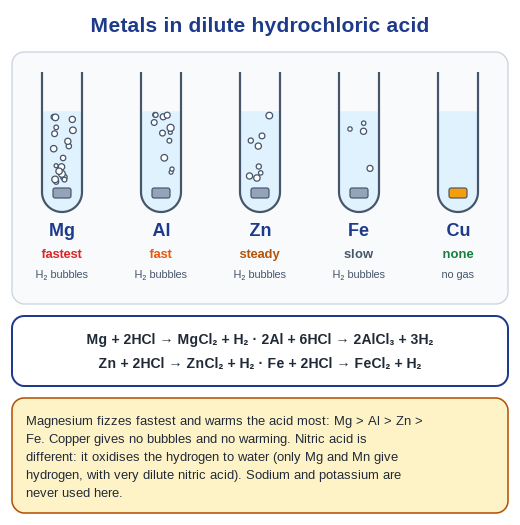
- 3.11, metals in dilute HCl: magnesium fizzes fastest and shows the highest temperature, then aluminium, zinc and iron; copper does not react. Mg + 2HCl → MgCl₂ + H₂; 2Al + 6HCl → 2AlCl₃ + 3H₂; Zn + 2HCl → ZnCl₂ + H₂; Fe + 2HCl → FeCl₂ + H₂. Never use sodium or potassium here.
- 3.12, salt solutions: the iron nail in copper sulphate gets a reddish-brown copper coat and the blue fades; the copper wire in iron sulphate shows no change. Fe + CuSO₄ → FeSO₄ + Cu, a displacement reaction, so iron is more reactive than copper. This fits Activities 3.9–3.11, where iron reacts with steam and dilute acid but copper reacts with neither.
- 3.13, salts: sodium chloride, potassium iodide and barium chloride are crystalline solids that do not melt easily in the flame; a sodium salt colours the flame golden-yellow (Extra). They dissolve in water but not in petrol or kerosene, and their solutions conduct: they are ionic compounds. Barium salts are poisonous, so handle them only as your teacher shows.
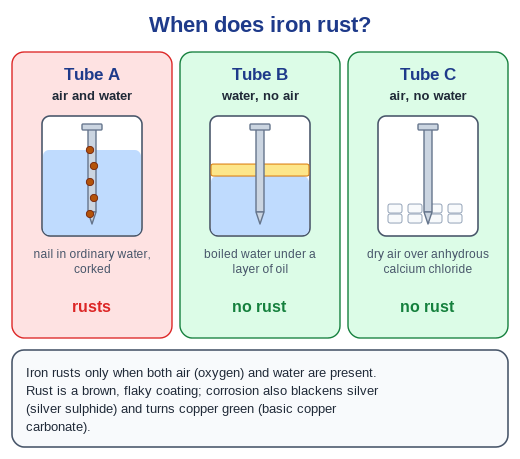
- 3.14, rusting: the nails rust only in tube A, where both air and water reach them. Tube B (boiled water under oil, no air) and tube C (dry air over anhydrous calcium chloride) show no rust. So iron needs both air and water to rust.
Exercises 1 to 4: choose the answer
1. “Which of the following pairs will give displacement reactions? (a) NaCl solution and copper metal (b) MgCl₂ solution and aluminium metal (c) FeSO₄ solution and silver metal (d) AgNO₃ solution and copper metal.”
(d) AgNO₃ solution and copper metal. Copper is above silver in the reactivity series, so it displaces silver: Cu + 2AgNO₃ → Cu(NO₃)₂ + 2Ag. In (a), (b) and (c) the metal is less reactive than the one in the salt (copper below sodium, aluminium below magnesium, silver below iron), so nothing happens.
2. “Which of the following methods is suitable for preventing an iron frying pan from rusting? (a) Applying grease (b) Applying paint (c) Applying a coating of zinc (d) All of the above.”
(c) Applying a coating of zinc, as the book’s answer key gives. A frying pan is heated and holds food: grease would burn off and mix with the food, and paint would scorch and peel. A zinc coating (galvanising) stays on and protects the iron. For an iron article that is not heated, such as a gate, all three methods would work.
3. “An element reacts with oxygen to give a compound with a high melting point. This compound is also soluble in water. The element is likely to be (a) calcium (b) carbon (c) silicon (d) iron.”
(a) Calcium. Calcium forms calcium oxide, an ionic compound with a very high melting point (2850 K): 2Ca + O₂ → 2CaO. It dissolves in (reacts with) water to give calcium hydroxide, as in Chapter 1: CaO + H₂O → Ca(OH)₂. Carbon gives carbon dioxide, a gas. Silicon’s oxide (sand) and iron’s oxides do not dissolve in water (Extra).
4. “Food cans are coated with tin and not with zinc because (a) zinc is costlier than tin. (b) zinc has a higher melting point than tin. (c) zinc is more reactive than tin. (d) zinc is less reactive than tin.”
(c) Zinc is more reactive than tin. A coating of reactive zinc could react with acids in the food and form zinc salts that spoil it. Tin is less reactive, so it keeps the food safe.
Exercises 5 to 8: properties and reactions
5. “You are given a hammer, a battery, a bulb, wires and a switch. (a) How could you use them to distinguish between samples of metals and non-metals? (b) Assess the usefulness of these tests in distinguishing between metals and non-metals.”
(a) Hammer test: place each sample on a hard surface and strike it gently. A metal flattens into a sheet (it is malleable); a non-metal such as sulphur or coal breaks into pieces (it is brittle). Wear eye protection. Conduction test: join the battery, switch, bulb and wires in a circuit with a gap, and place each sample across the gap. If the bulb glows, the sample conducts electricity and is probably a metal; if it does not, it is probably a non-metal. Use a low-voltage battery only.
(b) The tests sort most samples, but not all. Graphite, a non-metal, conducts electricity and would light the bulb. Mercury, a liquid metal, cannot be hammered at all, and soft metals like sodium cannot be tested safely this way. So physical tests are useful but not decisive; chemical properties, such as whether the oxide is basic or acidic, settle the doubtful cases.
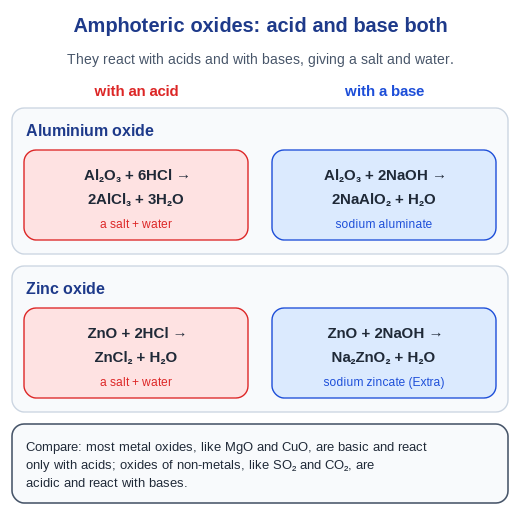
6. “What are amphoteric oxides? Give two examples of amphoteric oxides.” Metal oxides that react with both acids and bases to give a salt and water are amphoteric oxides. Examples: aluminium oxide and zinc oxide.
- Al₂O₃ + 6HCl → 2AlCl₃ + 3H₂O and Al₂O₃ + 2NaOH → 2NaAlO₂ + H₂O (sodium aluminate)
- ZnO + 2HCl → ZnCl₂ + H₂O and ZnO + 2NaOH → Na₂ZnO₂ + H₂O (sodium zincate; Extra)
7. “Name two metals which will displace hydrogen from dilute acids, and two metals which will not.” Metals above hydrogen in the reactivity series displace it: magnesium and zinc (also aluminium and iron). Metals below hydrogen do not: copper and silver (also gold). For example, Mg + 2HCl → MgCl₂ + H₂, while copper in dilute HCl shows no bubbles.
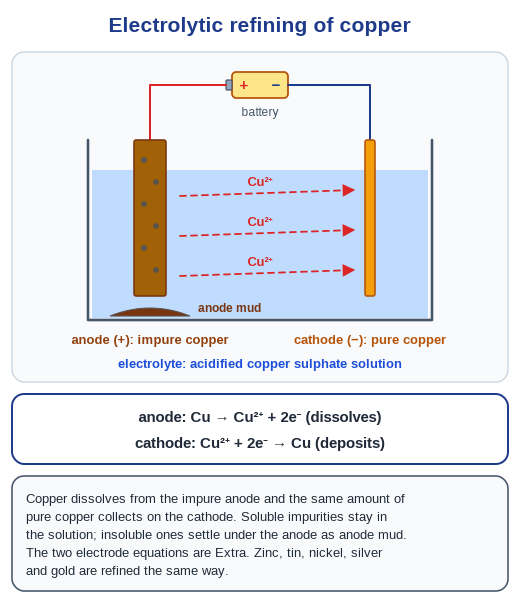
8. “In the electrolytic refining of a metal M, what would you take as the anode, the cathode and the electrolyte?” Anode: a block of impure metal M. Cathode: a thin strip of pure metal M. Electrolyte: a solution of a salt of M (for copper, acidified copper sulphate). Pure M dissolves from the anode and deposits on the cathode; insoluble impurities settle as anode mud.
Exercises 9 to 12: oxides, rusting and reasons
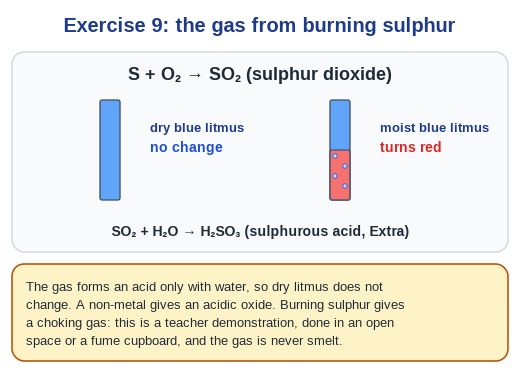
9. “Pratyush took sulphur powder on a spatula and heated it. He collected the gas evolved by inverting a test tube over it, as shown in figure below. (a) What will be the action of gas on (i) dry litmus paper? (ii) moist litmus paper? (b) Write a balanced chemical equation for the reaction taking place.” (The figure is in the book, page 57.)
(a) (i) No change on dry litmus paper, because the gas forms an acid only with water. (ii) Moist blue litmus turns red: sulphur dioxide dissolves in the water and forms an acid (SO₂ + H₂O → H₂SO₃, sulphurous acid; Extra).
(b) S(s) + O₂(g) → SO₂(g). Check: S 1 = 1, O 2 = 2.
Burning sulphur gives a choking gas: this is a teacher demonstration, done in the open or in a fume cupboard, and the gas is never smelt.
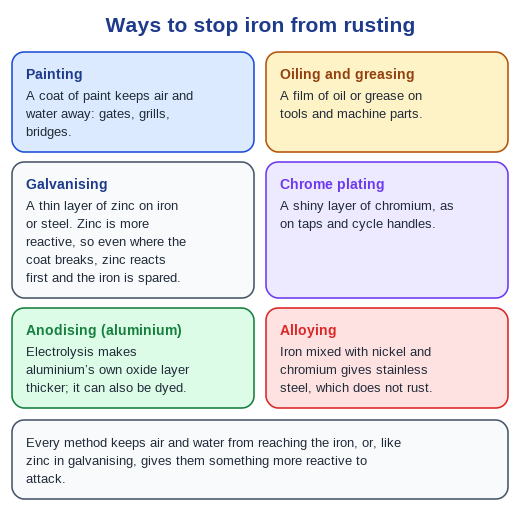
10. “State two ways to prevent the rusting of iron.” (i) Painting, oiling or greasing, which keep air and water away from the iron. (ii) Galvanising, coating the iron with a thin layer of zinc. Chrome plating and alloying (stainless steel) also work.
11. “What type of oxides are formed when non-metals combine with oxygen?” Non-metals form acidic or neutral oxides. Sulphur dioxide and carbon dioxide are acidic: in water they turn blue litmus red. Carbon monoxide is an example of a neutral oxide (Extra).
12. “Give reasons (a) Platinum, gold and silver are used to make jewellery. (b) Sodium, potassium and lithium are stored under oil. (c) Aluminium is a highly reactive metal, yet it is used to make utensils for cooking. (d) Carbonate and sulphide ores are usually converted into oxides during the process of extraction.”
(a) They are near the bottom of the reactivity series, so they do not react with air or water and keep their shine for a long time (silver only slowly darkens with sulphur in the air and can be polished). They are lustrous, malleable and ductile, so they can be shaped into fine designs.
(b) These alkali metals react so vigorously with oxygen and with moisture that sodium and potassium can catch fire in the open. Oil keeps air and water away from them.
(c) Aluminium is covered by a thin, protective layer of aluminium oxide that stops further reaction with air and water. It also conducts heat well, has a high melting point and can be beaten into the shape of a vessel.
(d) A metal is got more easily from its oxide than from its sulphide or carbonate. So sulphide ores are roasted (2ZnS + 3O₂ → 2ZnO + 2SO₂) and carbonate ores calcined (ZnCO₃ → ZnO + CO₂), and the oxide is then reduced.
Exercises 13 to 16: reasoning
13. “You must have seen tarnished copper vessels being cleaned with lemon or tamarind juice. Explain why these sour substances are effective in cleaning the vessels.” In moist air, copper slowly gets a dull green coat of basic copper carbonate. Lemon contains citric acid and tamarind contains tartaric acid (Chapter 2 of the same book). The acids react with this basic coating and turn it into soluble salts, water and carbon dioxide, which wash away. The clean copper underneath shines again.
14. “Differentiate between metal and non-metal on the basis of their chemical properties.”
| Property | Metals | Non-metals |
|---|---|---|
| Oxides | basic; Al₂O₃ and ZnO are amphoteric | acidic or neutral |
| Ions | lose electrons: Na⁺, Mg²⁺ | gain electrons: Cl⁻, O²⁻ |
| Dilute acids | those above H give hydrogen | do not displace hydrogen |
For example, 2Mg + O₂ → 2MgO gives a basic oxide, while S + O₂ → SO₂ gives an acidic one. Non-metals also combine with hydrogen to form hydrides, and among metals a more reactive one displaces a less reactive one from its salt solution.
15. “A man went door to door posing as a goldsmith. He promised to bring back the glitter of old and dull gold ornaments. An unsuspecting lady gave a set of gold bangles to him which he dipped in a particular solution. The bangles sparkled like new but their weight was reduced drastically. The lady was upset but after a futile argument the man beat a hasty retreat. Can you play the detective to find out the nature of the solution he had used?” He used aqua regia, a freshly made mixture of three parts concentrated hydrochloric acid to one part concentrated nitric acid (3:1). It is one of the few liquids that can dissolve gold. It dissolved the dull outer layer of the bangles, so they shone like new, but the dissolved gold stayed in his solution, and the bangles lost weight.
16. “Give reasons why copper is used to make hot water tanks and not steel (an alloy of iron).” Copper does not react with water, not even hot water or steam, so a copper tank does not corrode. Iron reacts with steam, and steel rusts when water and air reach it. Copper is also a very good conductor of heat, so the water heats quickly.
Practice
-
Which metal does not react with dilute hydrochloric acid?
Show answer
Answer: (d) copper
-
Lead is added to copper sulphate solution. Lead is above copper in the reactivity series, so:
Show answer
Answer: (b) lead displaces copper
-
Solder is used to join electrical wires because it:
Show answer
Answer: (b) has a low melting point
-
Write the balanced equation for zinc oxide with sodium hydroxide.
Show answer
Answer: ZnO + 2NaOH → Na₂ZnO₂ + H₂O (sodium zincate; Extra). Check: Zn 1 = 1, O 3 = 2 + 1, Na 2 = 2, H 2 = 2.
-
Element X forms the ion X²⁺ with configuration 2,8. Name X and write the formula of its chloride.
Show answer
Answer: X has 2,8,2, twelve electrons, so it is magnesium. Its chloride is MgCl₂: one Mg²⁺ for every two Cl⁻.
Stuck on a question?
Take a photo and Lagnever AI explains it step by step. Try it for 7 days for ₹2.
Get it on Google Play Open in browser
For parents: after the trial, the plan renews monthly by UPI or card autopay. You can cancel anytime in the app.