
Class 10 Science Chapter 3: Metals and Non-metals Notes
This chapter in five lines
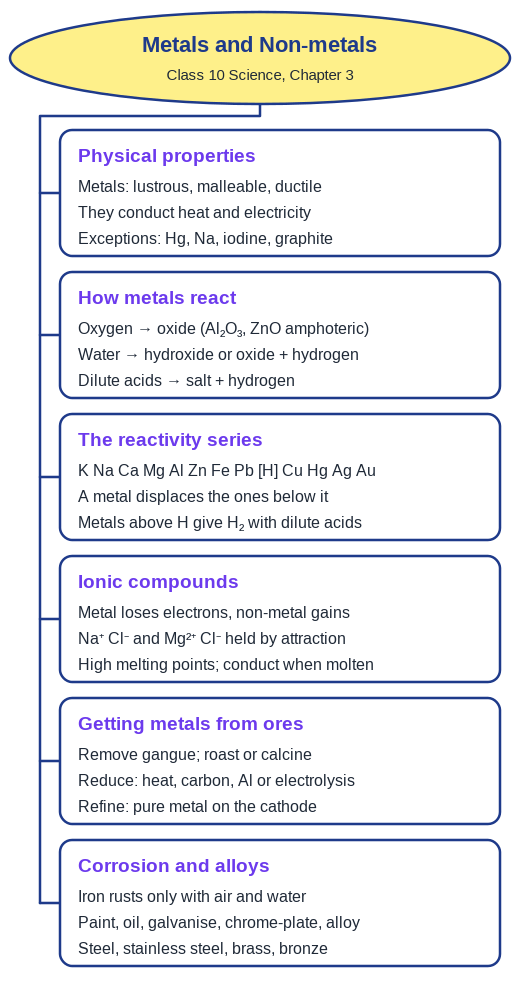
Metals are lustrous, malleable, ductile and good conductors; non-metals mostly are not, with exceptions. Metals form basic oxides, react with water and acids at different rates, and fit into a reactivity series. They give electrons to non-metals to form ionic compounds. Metals are extracted from ores by heating, reduction or electrolysis, refined, protected from corrosion and mixed into alloys.
What is this chapter about?
Look around a kitchen: steel and aluminium vessels, a copper-bottomed pot, gold earrings, an iron tawa that rusts if left wet. All of these are metals. The oxygen we breathe and the carbon in coal are non-metals. This chapter compares the two groups, ranks metals by how readily they react, explains how metals and non-metals join to form ionic compounds, and shows how metals are taken out of rocks, protected from rust and mixed into alloys.
How do we stay safe in this chapter’s activities?
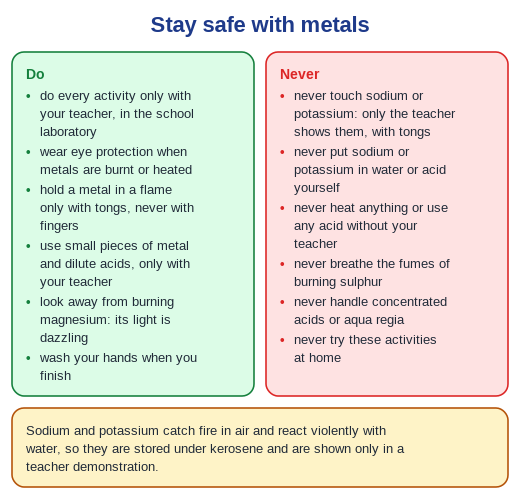
Many activities here burn metals, heat salts or use acids. Do them only in the laboratory with your teacher, and wear eye protection. Sodium and potassium catch fire in air and react violently with water, so they are kept under kerosene and shown only in a teacher demonstration. Never heat anything or use any acid without your teacher.
How are metals different from non-metals?
Clean a metal with sandpaper and it shines: this is metallic lustre. Metals are generally hard. They are malleable (they can be beaten into sheets) and ductile (they can be drawn into wires); about 2 km of wire can be drawn from just one gram of gold. Metals conduct heat and electricity, have high melting points and are sonorous, which is why school bells are made of metal. Non-metals such as carbon, sulphur and iodine are brittle, dull and poor conductors.
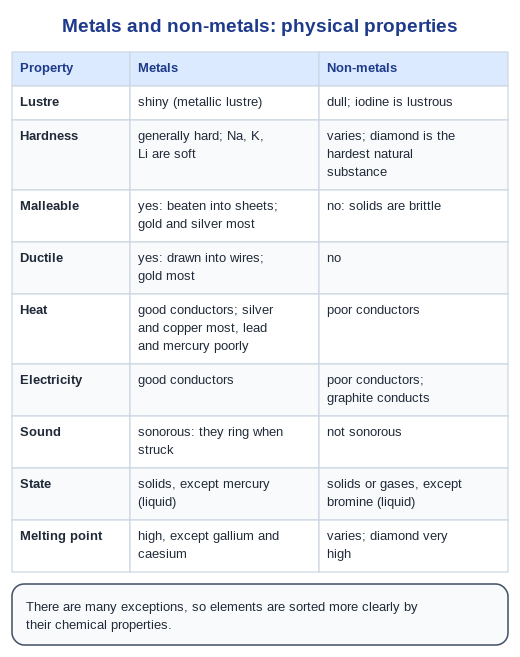
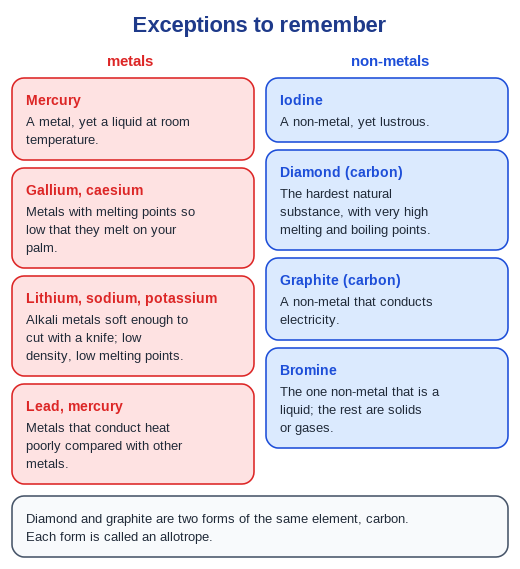
There are many exceptions. Mercury is a liquid metal; gallium and caesium melt on your palm; sodium, potassium and lithium can be cut with a knife. Iodine is a lustrous non-metal, graphite conducts electricity, and diamond, another form (allotrope) of carbon, is harder than any other natural substance. So chemical properties sort elements more clearly.
How do metals react with oxygen, water and acids?
Almost all metals form oxides with oxygen, such as 2Cu + O₂ → 2CuO. Metal oxides are basic, but aluminium oxide and zinc oxide react with acids and with bases too: they are amphoteric. The oxides of sodium and potassium dissolve in water and give alkalis. Most non-metals give acidic oxides, like sulphur dioxide.
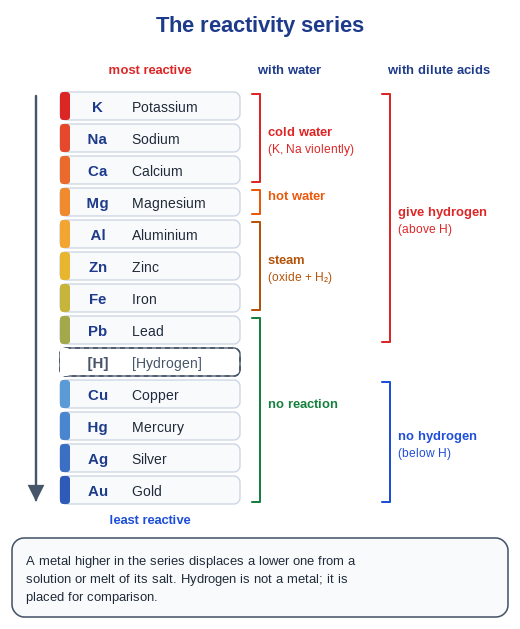
With water, potassium and sodium react violently, calcium gently, magnesium only with hot water, and aluminium, zinc and iron only with steam. Lead, copper, silver and gold show no reaction with water. With dilute hydrochloric acid, magnesium fizzes fastest, then aluminium, zinc and iron, while copper does not react. A metal can also push a less reactive metal out of its salt solution: Fe + CuSO₄ → FeSO₄ + Cu. Read the reactivity series of metals.
What is the reactivity series?
Putting all these results together gives a list of metals from the most to the least reactive: potassium, sodium, calcium, magnesium, aluminium, zinc, iron, lead, then hydrogen for comparison, then copper, mercury, silver and gold. Metals above hydrogen push hydrogen out of dilute acids. A metal displaces any metal below it from a solution of its salt.
How do metals and non-metals form ionic compounds?
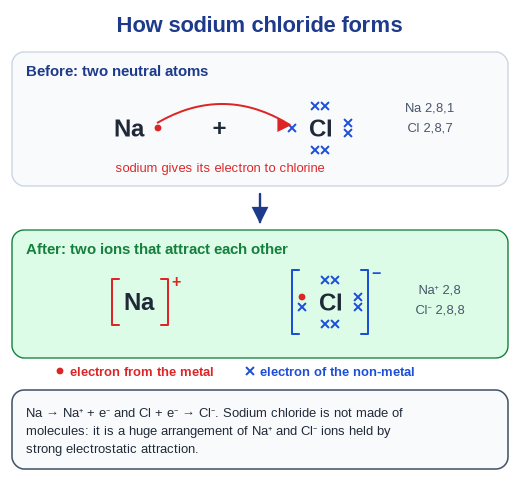
Noble gases, with a full outer shell, hardly react. Other atoms react to reach a full shell. Sodium (2,8,1) gives away its one outer electron and becomes Na⁺ (2,8). Chlorine (2,8,7) takes one electron and becomes Cl⁻ (2,8,8). The oppositely charged ions attract each other strongly: this is sodium chloride. When a metal hands over electrons to a non-metal like this (a transfer of electrons), the compound formed is called ionic or electrovalent. Read how ionic compounds form.
Ionic compounds are hard but brittle solids with high melting and boiling points, because the attraction between the ions is strong. They usually dissolve in water but not in kerosene or petrol. They conduct electricity when molten or dissolved, when the ions can move, but not as solids.
How are metals taken out of their ores?
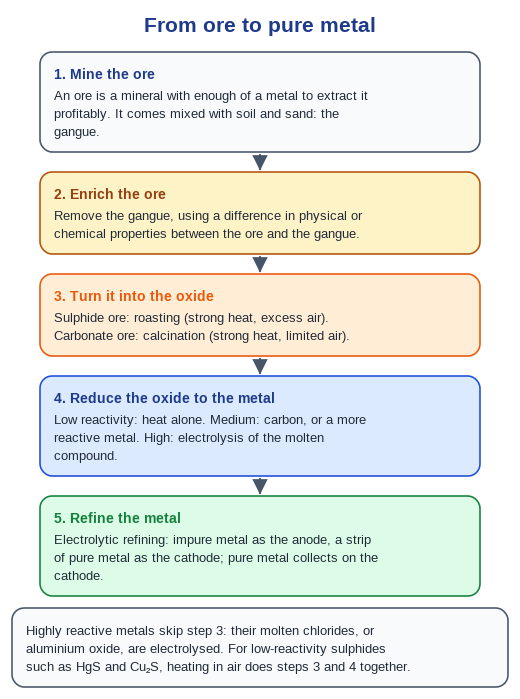
Metals come from the earth’s crust, and some salts from sea water. A naturally occurring element or compound is a mineral; a mineral rich enough in a metal to extract it profitably is an ore. The ore is first cleaned of gangue (soil and sand). Gold, silver and platinum are found in the free state, as the metals themselves. Metals in the middle of the series occur as oxides, sulphides or carbonates: sulphides are roasted and carbonates calcined to give oxides, which carbon then reduces. Aluminium can reduce iron oxide in the thermit reaction, used to join railway tracks. The most reactive metals are obtained by electrolysis of their molten compounds. Finally the metal is purified by electrolytic refining. Read extraction of metals.
What is corrosion, and how do we stop it?
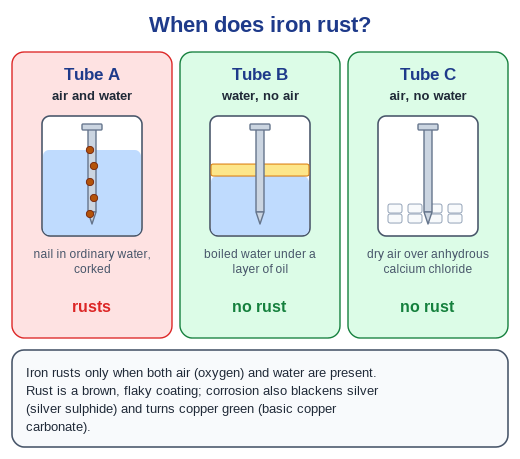
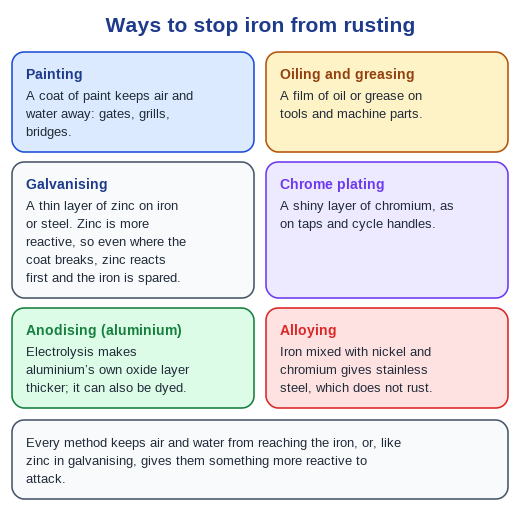
Silver turns black, copper gains a green coat and iron rusts when they stay in moist air for long: this is corrosion. Iron rusts only when both air and water are present. We stop rusting by painting, oiling, greasing, galvanising (a zinc coat), chrome plating, anodising (for aluminium) or making alloys. Delhi’s iron pillar, close to the Qutub Minar, was made by Indian iron workers more than 1600 years ago and still resists rust. It is 8 m high and weighs about 6 tonnes.
What are alloys?
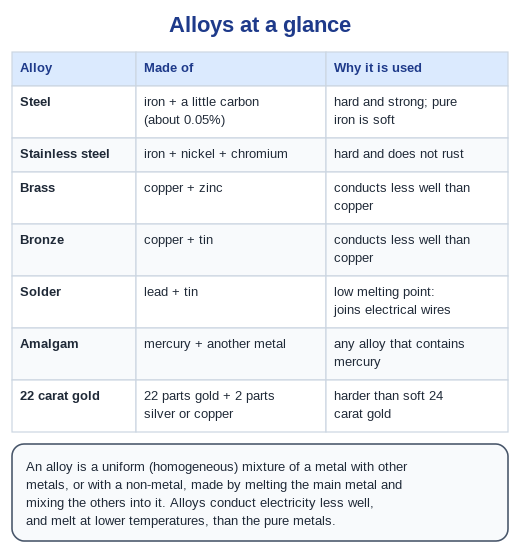
Pure iron is soft and stretches when hot, so it is never used alone. With a little carbon it becomes hard, strong steel; with nickel and chromium it becomes stainless steel, which does not rust. An alloy is a uniform (homogeneous) mixture of a metal with other metals, or with a non-metal. Alloys conduct electricity less well, and melt at lower temperatures, than pure metals. Solder, of lead and tin, melts easily and joins electrical wires. Ornaments in India are usually 22 carat gold: 22 parts of gold with 2 parts of copper or silver, because pure 24 carat gold is too soft.
Before we move on
Learn the reactivity series by heart, and for each reaction in this chapter write a balanced equation and say which metal is more reactive. Answers to the five Questions boxes and all sixteen exercises are in the NCERT solutions for Chapter 3.
Key terms
| Term | Meaning |
|---|---|
| Malleable | Able to be beaten into thin sheets; gold and silver are more malleable than any other metal. |
| Ductile | Able to be drawn into thin wires; gold is the most ductile metal. |
| Sonorous | Making a ringing sound when struck on a hard surface, as metals do. |
| Allotrope | One of the different forms of the same element, such as diamond and graphite for carbon. |
| Amphoteric oxide | A metal oxide that reacts with both acids and bases to give a salt and water, such as Al₂O₃ and ZnO. |
| Reactivity series | A list of metals in order of decreasing reactivity, also called the activity series. |
| Ionic (electrovalent) compound | A compound made when a metal hands electrons over to a non-metal, such as NaCl or MgCl₂. |
| Cation and anion | A cation is a positive ion (Na⁺, Mg²⁺); an anion is a negative ion (Cl⁻, O²⁻). |
| Mineral and ore | A mineral is an element or compound found naturally in the earth’s crust; an ore is a mineral from which a metal can be extracted profitably. |
| Gangue | The soil, sand and other impurities mixed with an ore when it is mined. |
| Roasting and calcination | Strong heating of a sulphide ore in excess air (roasting), or of a carbonate ore in limited air (calcination), to get the metal oxide. |
| Thermit reaction | Iron(III) oxide reduced by aluminium, giving molten iron and much heat: Fe₂O₃ + 2Al → 2Fe + Al₂O₃ + heat. |
| Electrolytic refining | Purifying a metal by electrolysis: impure metal is the anode, pure metal collects on the cathode. |
| Corrosion | The slow eating away of a metal surface by air, moisture or other substances, such as the rusting of iron. |
| Alloy | A uniform (homogeneous) mixture of a metal with other metals or with a non-metal; an alloy containing mercury is an amalgam. |
Topics in this chapter
Practice
-
Which metal is a liquid at room temperature?
Show answer
Answer: (b) mercury
-
Which of these oxides is amphoteric?
Show answer
Answer: (c) Al₂O₃
-
Which metal reacts with water only as steam?
Show answer
Answer: (c) iron
-
Heating a carbonate ore strongly with only a little air, to get the oxide, is called:
Show answer
Answer: (b) calcination
-
In electrolytic refining of copper, the cathode is:
Show answer
Answer: (b) a thin strip of pure copper
-
Brass is an alloy of:
Show answer
Answer: (c) copper and zinc
Questions students ask
What are the main topics of Class 10 Science Chapter 3?
The physical properties of metals and non-metals and their exceptions, how metals react with oxygen, water, acids and salt solutions, the reactivity series, ionic compounds and their properties, how metals are extracted and refined, corrosion and its prevention, and alloys.
Is Metals and Non-metals in the 2026-27 NCERT book?
Yes. It is Chapter 3 of Science, the Class 10 NCERT textbook marked Reprint 2026-27, on pages 37 to 57. It uses the displacement reactions of Chapter 1 and the acids and bases of Chapter 2.
Which parts of this chapter should I practise for the board exam?
Learn the reactivity series in order, and write and balance the reactions of metals with oxygen, water, acids and salt solutions, the amphoteric oxide reactions, roasting, calcination, reduction and the thermit reaction. Practise electron-dot diagrams for NaCl, MgCl₂, Na₂O and MgO, and the electrolytic refining set-up.
Why is sodium kept in kerosene?
Sodium reacts so vigorously with oxygen and with water that it can catch fire in the open air. Kerosene keeps air and moisture away from it. For the same reason, sodium and potassium are shown only in a teacher demonstration.
Stuck on a question?
Take a photo and Lagnever AI explains it step by step. Try it for 7 days for ₹2.
Get it on Google Play Open in browser
For parents: after the trial, the plan renews monthly by UPI or card autopay. You can cancel anytime in the app.