
How are ionic compounds formed?
Answer in short
An ionic compound forms when a metal atom gives one or more electrons to a non-metal atom. The metal becomes a positive ion and the non-metal a negative ion, each with a full outer shell, and the opposite charges hold them together. Sodium chloride, Na⁺Cl⁻, and magnesium chloride, Mg²⁺(Cl⁻)₂, are examples.
Stuck on a question? Take a photo and Lagnever AI explains it step by step. Try it for 7 days for ₹2. Get it on Google Play
Why do atoms lose or gain electrons?
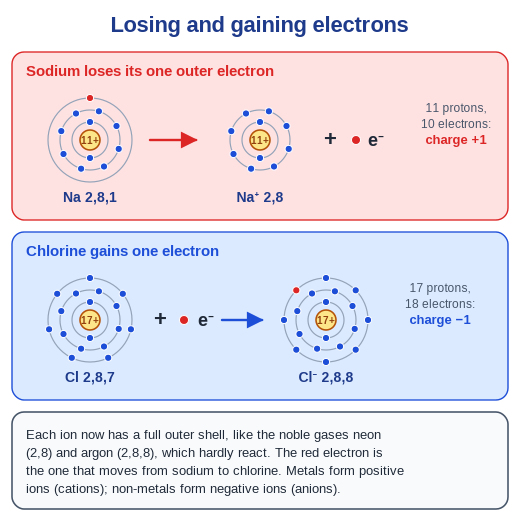
Noble gases such as neon (2,8) and argon (2,8,8) have a completely filled outer shell, and they hardly react. Other atoms react so that they too reach a full outer shell, usually eight electrons, an octet. A sodium atom (11 electrons: 2,8,1) has only one electron in its outer M shell. If it gives that away, the full L shell becomes its outer shell. It still has 11 protons but only 10 electrons, so it becomes a positive ion, the sodium cation, Na⁺.
A chlorine atom (17 electrons: 2,8,7) needs one more electron. When it gains one, it has 17 protons and 18 electrons, and becomes the chloride anion, Cl⁻ (2,8,8).
Na → Na⁺ + e⁻
Cl + e⁻ → Cl⁻
How does sodium chloride form?
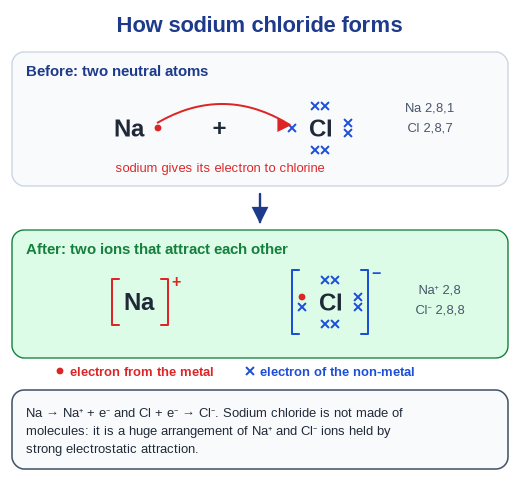
If sodium and chlorine react, the electron sodium loses is taken by chlorine. The two ions now have opposite charges, and a strong electrostatic force pulls them together. Sodium chloride is not made of separate molecules; it is a huge, regular arrangement of Na⁺ and Cl⁻ ions.
An electron-dot diagram shows only the outer electrons. Here the metal’s electrons are red dots and the non-metal’s are blue crosses, so you can see which electron moved.
How does magnesium chloride form?
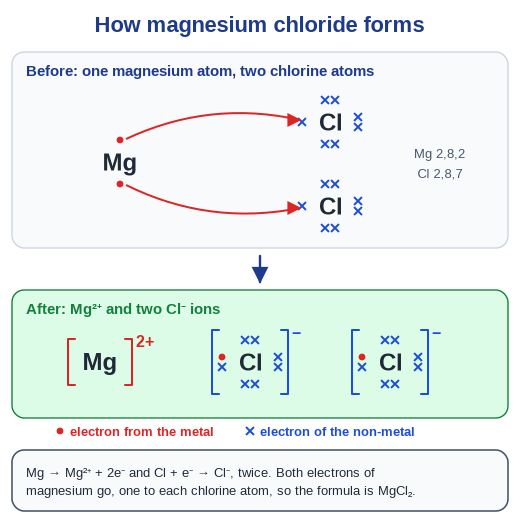
Magnesium (2,8,2) has two outer electrons, and each chlorine atom can take only one. So one magnesium atom gives one electron to each of two chlorine atoms:
Mg → Mg²⁺ + 2e⁻
Each Cl takes one: Cl + e⁻ → Cl⁻
The result is one Mg²⁺ ion for every two Cl⁻ ions, which is why the formula is MgCl₂. Compounds made when a metal hands electrons over to a non-metal in this way are called ionic compounds or electrovalent compounds.
How do I draw an electron-dot diagram correctly?
- Write the electronic configuration and pick out the outer electrons: Na 1, Mg 2, O 6, Cl 7.
- Put them around the symbol on four sides, one at a time, then pair them up.
- Use one mark for the metal’s electrons and another for the non-metal’s.
- Show each transfer with a curved arrow from the metal’s electron to the non-metal.
- Write each ion in square brackets with its charge: [Na]⁺ with no outer dots, [Cl]⁻ with eight.
- Check that the charges add up to zero: Na⁺ and Cl⁻; Mg²⁺ and 2Cl⁻.
What are the properties of ionic compounds?
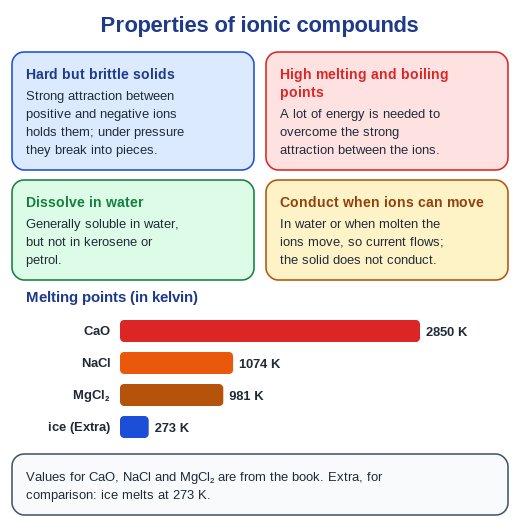
Heat a little sodium chloride or potassium iodide on a spatula, with your teacher, and it does not melt easily. Try dissolving it: it dissolves in water but not in kerosene or petrol. These results point to four properties:
- Physical nature: solids that are fairly hard because of the strong attraction between ions, but brittle: they break under pressure.
- High melting and boiling points: much energy is needed to overcome the attraction. Sodium chloride melts at 1074 K and calcium oxide at 2850 K.
- Solubility: generally soluble in water, insoluble in kerosene and petrol.
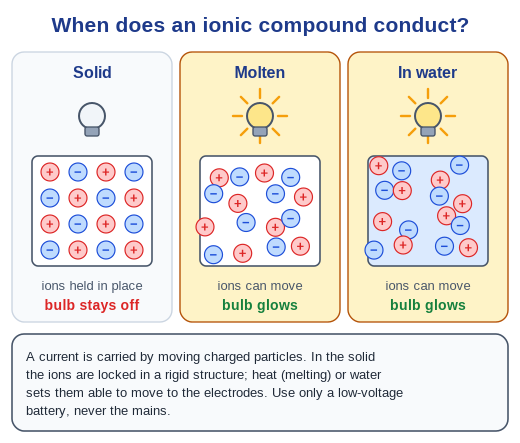
- Conduction: they conduct electricity in solution or when molten, but not as solids.
Why does an ionic compound conduct only when molten or dissolved?
A current flows when charged particles move. In the solid, the ions are locked in a rigid structure and cannot move, so there is no current. In water, the ions separate and move to the opposite electrodes. Strong heating that melts the compound also overcomes the attraction between the ions, so they move freely and the melt conducts.
A tip for the board exam
Practise the electron-dot diagrams of NaCl, MgCl₂, Na₂O and MgO until you can draw them without looking. The Questions box on page 49 asks for exactly this; the worked answer is on the NCERT solutions page.
Next: extraction of metals, or back to the reactivity series and the chapter notes.
Practice
-
What is the charge on a magnesium ion?
Show answer
Answer: (b) +2
-
The electronic configuration of a chloride ion is:
Show answer
Answer: (b) 2,8,8
-
Solid sodium chloride does not conduct electricity because:
Show answer
Answer: (b) its ions cannot move
-
Name the cation and the anion in MgCl₂.
Show answer
Answer: The cation is the magnesium ion, Mg²⁺, and the anion is the chloride ion, Cl⁻. There are two Cl⁻ for each Mg²⁺.
-
Why does calcium oxide melt at 2850 K while ice melts at 273 K?
Show answer
Answer: Calcium oxide is ionic, and a lot of energy is needed to break the strong attraction between its ions. (The value for ice is Extra, for comparison.)
Questions students ask
What is an ionic bond?
It is the strong electrostatic attraction between oppositely charged ions formed when a metal gives electrons to a non-metal. The book calls the compounds formed this way ionic or electrovalent compounds.
How do you draw the electron-dot structure of sodium chloride?
Write Na with one dot and Cl with seven crosses around it. Draw an arrow from the dot to chlorine. Then write [Na]⁺ with no dots, and [Cl]⁻ with eight electrons, seven crosses and one dot, inside square brackets.
Why are ionic compounds brittle?
The ions sit in a rigid arrangement held by strong forces. A hard knock pushes layers of ions out of place, and the solid breaks into pieces instead of bending like a metal.
Do ionic compounds dissolve in kerosene?
Generally no. Electrovalent compounds usually dissolve in water but not in solvents such as kerosene and petrol.
Stuck on a question?
Take a photo and Lagnever AI explains it step by step. Try it for 7 days for ₹2.
Get it on Google Play Open in browser
For parents: after the trial, the plan renews monthly by UPI or card autopay. You can cancel anytime in the app.