
How are metals extracted from their ores?
Answer in short
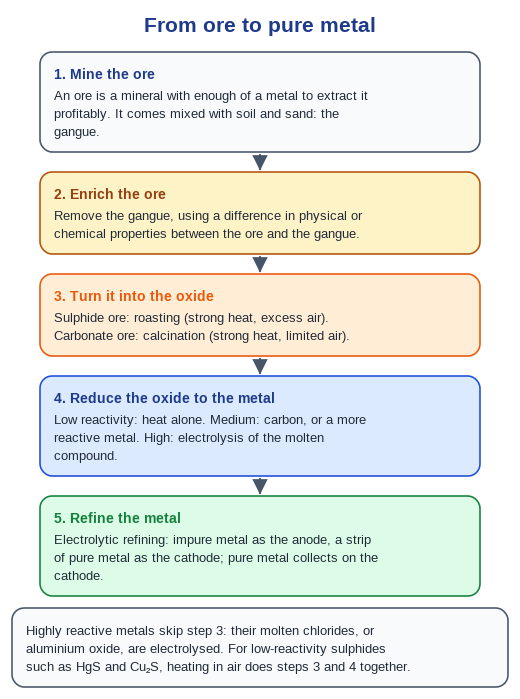
A metal is extracted in steps: the ore is mined and cleaned of gangue, sulphide ores are roasted and carbonate ores calcined to give the oxide, and the oxide is reduced to the metal. Reactivity decides the method: heat alone, carbon, a more reactive metal or electrolysis. The metal is then purified by electrolytic refining.
Stuck on a question? Take a photo and Lagnever AI explains it step by step. Try it for 7 days for ₹2. Get it on Google Play
Where do metals come from?
The earth’s crust is the main source of metals; sea water also holds soluble salts such as sodium chloride and magnesium chloride. An element or compound that occurs naturally in the crust is a mineral. Where a mineral has a high percentage of one metal, so that the metal can be extracted profitably, it is called an ore. Ores come out of the ground mixed with soil, sand and other impurities, the gangue. The first step, enrichment of the ore, removes the gangue using a difference in physical or chemical properties between the ore and the gangue. The whole work of extracting metals and refining them for use is called metallurgy.
How does reactivity decide the method?
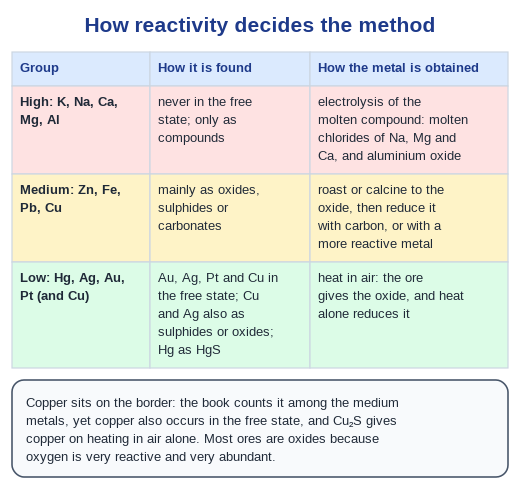
Metals low in the reactivity series, such as gold, silver and platinum, are often found in the free state, as the metal itself; copper and silver also occur as sulphides or oxides. Metals at the top (K, Na, Ca, Mg and Al) react far too readily to stay uncombined: they never occur in the free state. Metals in the middle (Zn, Fe, Pb) occur mainly as oxides, sulphides or carbonates. Many ores are oxides, because oxygen is very reactive and very abundant. So each group needs its own method.
How are metals low in the series extracted?
These metals are so unreactive that heating alone is enough. Cinnabar, HgS, an ore of mercury, is first turned into the oxide by heating in air, and further heating then gives mercury:
2HgS(s) + 3O₂(g) → 2HgO(s) + 2SO₂(g)
2HgO(s) → 2Hg(l) + O₂(g)
Copper from Cu₂S is obtained the same way, by heating in air: 2Cu₂S + 3O₂ → 2Cu₂O + 2SO₂, then 2Cu₂O + Cu₂S → 6Cu + SO₂.
How are metals in the middle extracted?
Zinc, iron and lead usually occur as sulphides or carbonates, and a metal is easier to obtain from its oxide. So the ore is first changed into the oxide. Roasting heats a sulphide ore strongly in excess air; calcination heats a carbonate ore strongly in limited air:
2ZnS(s) + 3O₂(g) → 2ZnO(s) + 2SO₂(g) (roasting)
ZnCO₃(s) → ZnO(s) + CO₂(g) (calcination)
The oxide is then reduced with a reducing agent such as carbon (coke): ZnO(s) + C(s) → Zn(s) + CO(g). Taking oxygen away from the oxide is reduction, as in Chapter 1.

What is the thermit reaction?
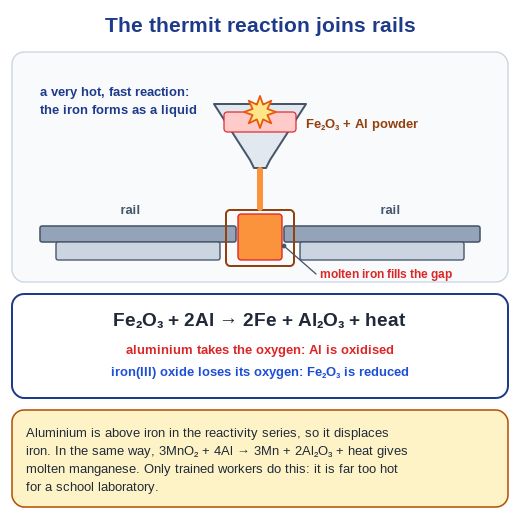
A highly reactive metal such as sodium, calcium or aluminium can also reduce an oxide, by displacement. Heated with aluminium powder, manganese dioxide gives manganese: 3MnO₂ + 4Al → 3Mn + 2Al₂O₃ + heat. Aluminium is oxidised and MnO₂ is reduced. These reactions give out so much heat that the metal forms as a liquid. The reaction of iron(III) oxide with aluminium, the thermit reaction, is used to join railway tracks and cracked machine parts:
Fe₂O₃(s) + 2Al(s) → 2Fe(l) + Al₂O₃(s) + heat
How are the most reactive metals extracted?
Heating with carbon does not work for the oxides of sodium, magnesium, calcium or aluminium, because these metals hold oxygen more strongly than carbon does. They are obtained by electrolytic reduction. Sodium, magnesium and calcium come from the electrolysis of their molten chlorides. The metal collects at the cathode, the negative electrode, and chlorine at the anode, the positive one:
At the cathode: Na⁺ + e⁻ → Na
At the anode: 2Cl⁻ → Cl₂ + 2e⁻
Aluminium is obtained in the same way, by the electrolysis of aluminium oxide.
How is a metal refined?
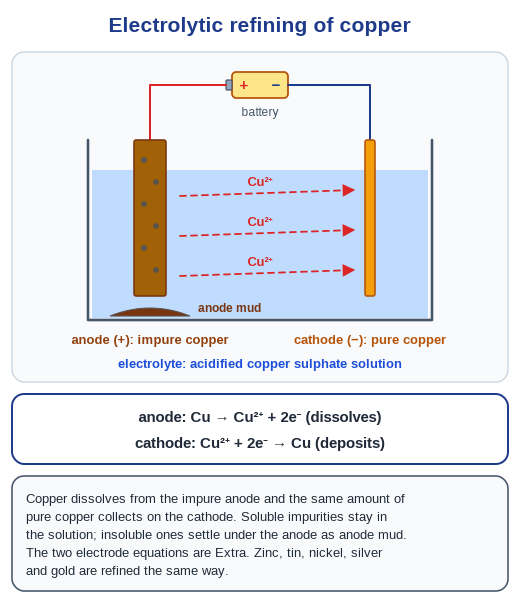
Metals from these processes still contain impurities. The most widely used method to purify them is electrolytic refining, used for copper, zinc, tin, nickel, silver and gold. The impure metal is the anode, a thin strip of pure metal is the cathode, and a solution of a salt of the metal is the electrolyte; for copper, acidified copper sulphate. When the current flows, metal dissolves from the anode and an equal amount of pure metal deposits on the cathode. Soluble impurities stay in the solution; insoluble ones settle below the anode as anode mud.
A tip for the board exam
For each method, learn one example equation and the reason it suits that group of metals. Exercises 8 and 12(d) and the Questions box on page 53 ask about this; see the NCERT solutions.
Back to ionic compounds or the chapter notes.
Practice
-
Which of these metals is found in the free state in nature?
Show answer
Answer: (b) gold
-
In electrolytic refining, the impure metal is made the:
Show answer
Answer: (b) anode
-
Which gas is given off when zinc sulphide, ZnS, is roasted?
Show answer
Answer: (b) sulphur dioxide
-
Write the balanced equation for the calcination of zinc carbonate.
Show answer
Answer: ZnCO₃ → ZnO + CO₂ on strong heating. Check: Zn 1 = 1, C 1 = 1, O 3 = 1 + 2.
-
In 3MnO₂ + 4Al → 3Mn + 2Al₂O₃, which substance is reduced?
Show answer
Answer: Manganese dioxide, MnO₂, is reduced: it loses oxygen and becomes manganese. Aluminium gains oxygen, so it is oxidised.
Questions students ask
What is the difference between a mineral and an ore?
Every naturally occurring element or compound in the earth’s crust is a mineral. Only a mineral with a high enough percentage of a metal to extract it profitably is called an ore. So all ores are minerals, but not all minerals are ores.
Why are sulphide and carbonate ores changed into oxides?
It is easier to get a metal from its oxide than from its sulphide or carbonate. So sulphide ores are roasted and carbonate ores calcined before the oxide is reduced.
Why is electrolysis used for sodium and aluminium?
These metals are high in the reactivity series and hold oxygen more strongly than carbon does, so heating with carbon cannot reduce their oxides. Their molten compounds are electrolysed instead, and the metal collects at the cathode.
What is anode mud?
During electrolytic refining, impurities that do not dissolve settle at the bottom below the anode. This deposit is called anode mud; soluble impurities stay in the solution.
Stuck on a question?
Take a photo and Lagnever AI explains it step by step. Try it for 7 days for ₹2.
Get it on Google Play Open in browser
For parents: after the trial, the plan renews monthly by UPI or card autopay. You can cancel anytime in the app.