
What is the reactivity series of metals?
Answer in short
The reactivity series arranges metals from the most reactive to the least: K, Na, Ca, Mg, Al, Zn, Fe, Pb, [H], Cu, Hg, Ag, Au. It comes from how fast metals react with oxygen, water and acids, and from displacement: a metal pushes any metal below it out of its salt solution.
Stuck on a question? Take a photo and Lagnever AI explains it step by step. Try it for 7 days for ₹2. Get it on Google Play
How do metals react with oxygen?
Nearly every metal joins with oxygen to give a metal oxide. Copper heated in air turns black as copper(II) oxide forms: 2Cu + O₂ → 2CuO. Aluminium forms aluminium oxide: 4Al + 3O₂ → 2Al₂O₃. But the speed differs a lot. Sodium and potassium react so vigorously that they catch fire in the open, so they are stored under kerosene. Magnesium burns with a dazzling white flame. Aluminium, zinc and lead get a thin oxide layer that protects them from further oxidation. Iron filings burn in a flame, a lump of iron does not, and silver and gold do not react even when very hot.
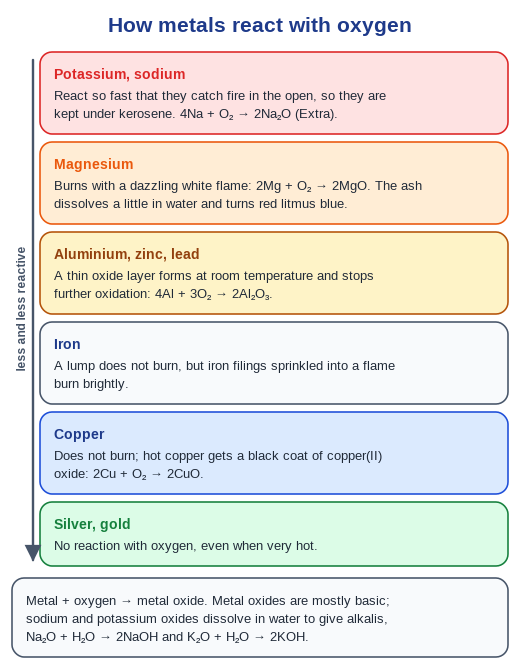
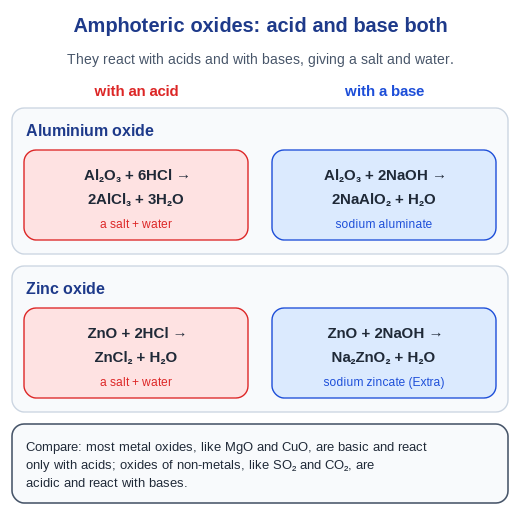
Most metal oxides are basic: copper oxide reacts with an acid, as in Chapter 2. Sodium oxide and potassium oxide even dissolve in water to give alkalis: Na₂O + H₂O → 2NaOH. A few oxides, aluminium oxide and zinc oxide, react with acids and with bases. They are called amphoteric oxides.
How do metals react with water?
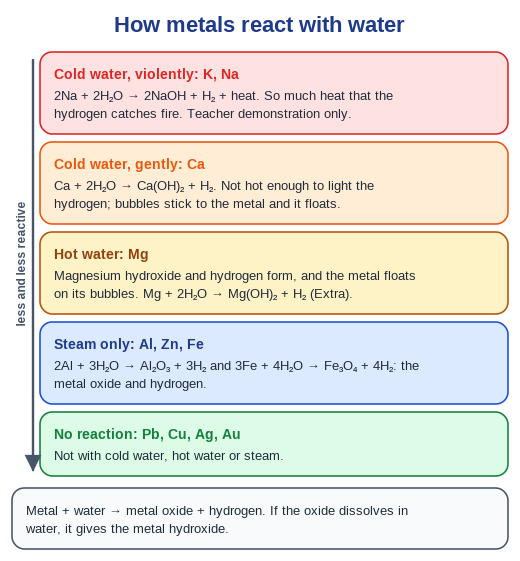
A reactive metal with water gives a metal oxide and hydrogen; if the oxide dissolves, it becomes a hydroxide. With cold water, potassium and sodium react violently, and so much heat is given out that the hydrogen catches fire:
2Na(s) + 2H₂O(l) → 2NaOH(aq) + H₂(g) + heat
Calcium reacts more gently, Ca + 2H₂O → Ca(OH)₂ + H₂, and floats because hydrogen bubbles cling to it. Magnesium needs hot water. Aluminium, zinc and iron react only with steam, giving the oxide: 3Fe + 4H₂O → Fe₃O₄ + 4H₂. Lead, copper, silver and gold show no reaction with water at all. Sodium and potassium in water are shown only by your teacher, with a tiny piece.
How do metals react with dilute acids?
Metals above hydrogen in the series give a salt and hydrogen with dilute hydrochloric or sulphuric acid. Put magnesium, aluminium, zinc, iron and copper in dilute HCl, with your teacher, and magnesium fizzes fastest and warms the acid most. The order is Mg > Al > Zn > Fe. Copper shows no bubbles and no warming, so it does not react with dilute HCl.
Zn + 2HCl → ZnCl₂ + H₂
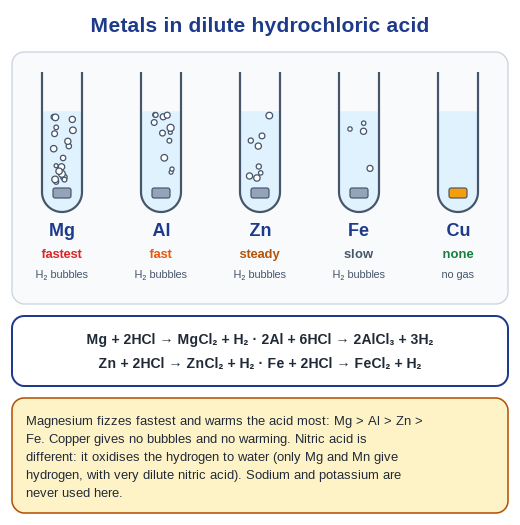
Nitric acid is an exception. It is a strong oxidising agent, so it turns the hydrogen into water and is itself reduced to nitrogen oxides. Only magnesium and manganese give hydrogen, with very dilute nitric acid. A freshly made 3:1 mixture of concentrated hydrochloric and nitric acids, aqua regia, can dissolve even gold and platinum. It is highly corrosive and never handled by students.
How do metals react with salt solutions?
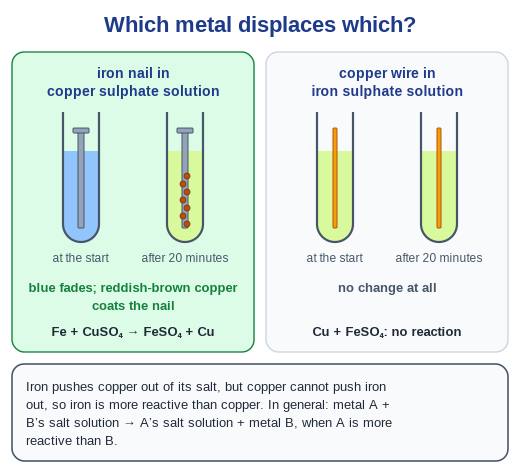
Put an iron nail in blue copper sulphate solution. After about 20 minutes a reddish-brown coat of copper forms on the nail and the blue colour fades: Fe + CuSO₄ → FeSO₄ + Cu. A copper wire in iron sulphate solution shows no change. So iron is more reactive than copper. In general, if metal A displaces metal B from a solution of its salt, A is more reactive than B. Displacement gives the clearest evidence, because it works even for metals that hardly react with water or acids.
What does the full series look like?
All these results, together with displacement experiments, give the reactivity series (also called the activity series):
K > Na > Ca > Mg > Al > Zn > Fe > Pb > [H] > Cu > Hg > Ag > Au
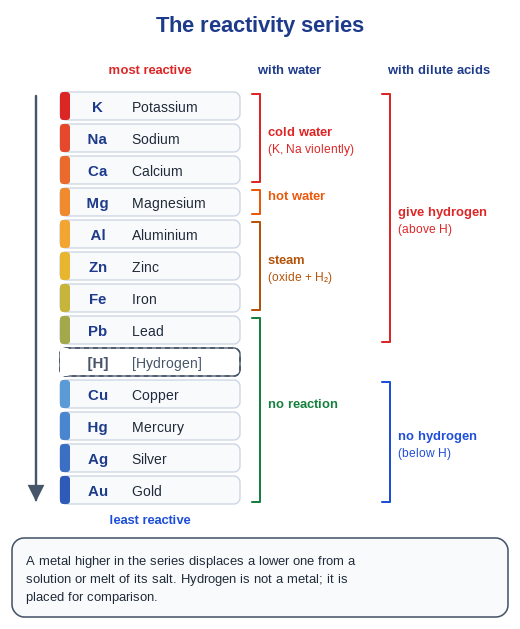
The series predicts reactions. Zinc is above iron, so zinc added to iron(II) sulphate solution displaces iron: Zn + FeSO₄ → ZnSO₄ + Fe, and the pale green colour fades. Silver is below copper, so silver in copper sulphate does nothing. The series also decides which method is used to get a metal out of its ore, which the topic on extraction of metals explains.
A tip for the board exam
Write the series down from memory, then mark next to each group what it does with water and with dilute acids. Questions on pages 46 and 55, and Exercises 1, 4 and 7, test exactly this; see the NCERT solutions.
Next: ionic compounds, or back to the chapter notes.
Practice
-
Which metal floats on water as hydrogen bubbles stick to it, without the hydrogen catching fire?
Show answer
Answer: (c) calcium
-
Which gas forms when iron reacts with steam?
Show answer
Answer: (b) hydrogen
-
Zinc is added to copper sulphate solution. What happens?
Show answer
Answer: (b) zinc displaces copper
-
Write the balanced equation for aluminium with steam.
Show answer
Answer: 2Al + 3H₂O → Al₂O₃ + 3H₂. Check: Al 2 = 2, H 6 = 6, O 3 = 3.
-
Why does aluminium oxide count as an amphoteric oxide?
Show answer
Answer: It reacts with an acid and with a base, giving a salt and water both times: Al₂O₃ + 6HCl → 2AlCl₃ + 3H₂O and Al₂O₃ + 2NaOH → 2NaAlO₂ + H₂O.
Questions students ask
How do you remember the reactivity series?
Learn it in groups: K, Na, Ca (cold water), Mg (hot water), Al, Zn, Fe (steam), Pb, then hydrogen, then Cu, Hg, Ag, Au. Saying the groups aloud with what each does is easier than memorising thirteen symbols at once.
Why is hydrogen in the reactivity series?
Hydrogen is not a metal, but it is placed in the list for comparison. Metals above it can push hydrogen out of dilute acids; metals below it, like copper, cannot.
Why is sodium kept under kerosene?
Sodium reacts so vigorously with oxygen and water that it can catch fire in the open air. Kerosene keeps air and moisture away. Potassium is stored the same way.
Why doesn’t nitric acid give hydrogen with metals?
Nitric acid is a powerful oxidising agent: it turns the hydrogen into water and is itself reduced to oxides of nitrogen. Only magnesium and manganese give hydrogen with very dilute nitric acid.
Stuck on a question?
Take a photo and Lagnever AI explains it step by step. Try it for 7 days for ₹2.
Get it on Google Play Open in browser
For parents: after the trial, the plan renews monthly by UPI or card autopay. You can cancel anytime in the app.