
NCERT Solutions Class 10 Science Chapter 4: Carbon and its Compounds
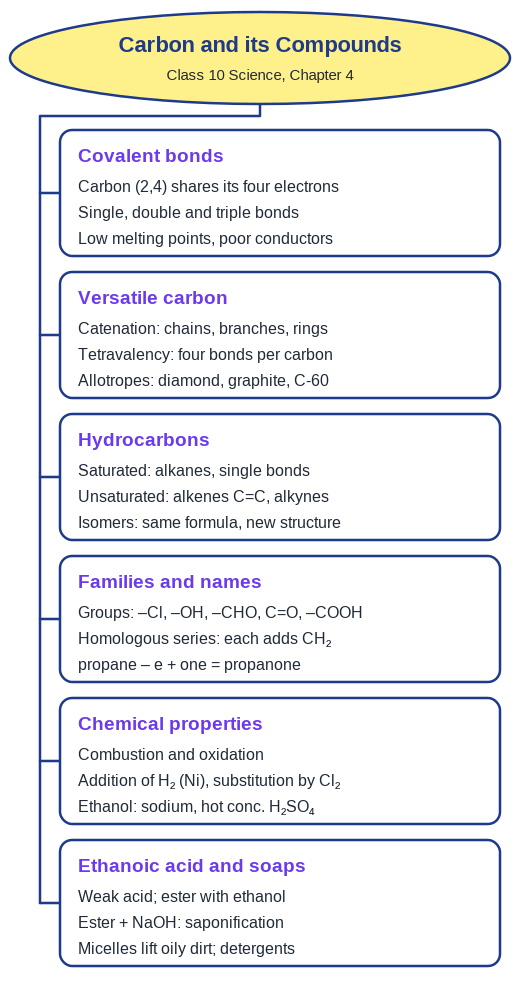
Answers to the five Questions boxes inside Chapter 4, Carbon and its Compounds, the other questions the chapter asks along the way, Activities 4.1–4.12 and the Group Activity, and all fifteen end-of-chapter exercises, from Science, the Class 10 NCERT textbook. Page numbers follow the 2026-27 reprint (pages 58–78). The exercises are quoted from the book; the in-chapter questions are restated in short. Every equation below was checked atom by atom, and every electron-dot structure electron by electron. Short notes: Chapter 4 notes.
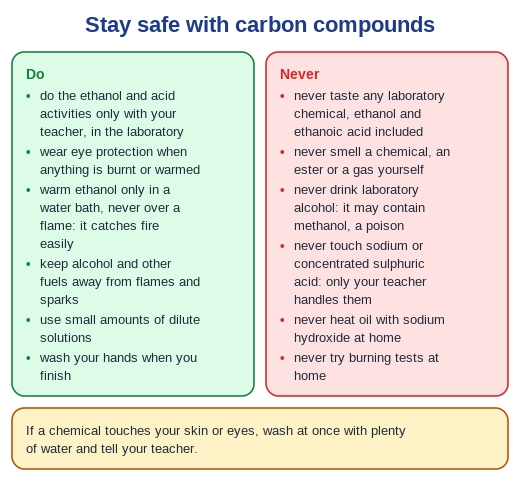
Stay safe. Do the ethanol and acid activities only in the laboratory with your teacher, and wear eye protection when anything is burnt or warmed. Ethanol catches fire easily, so it is warmed only in a water bath. Sodium and concentrated sulphuric acid are handled only by the teacher. Never taste or smell a chemical, even where an activity asks you to smell the result, and wash any splash at once with plenty of water.
Questions, page 61
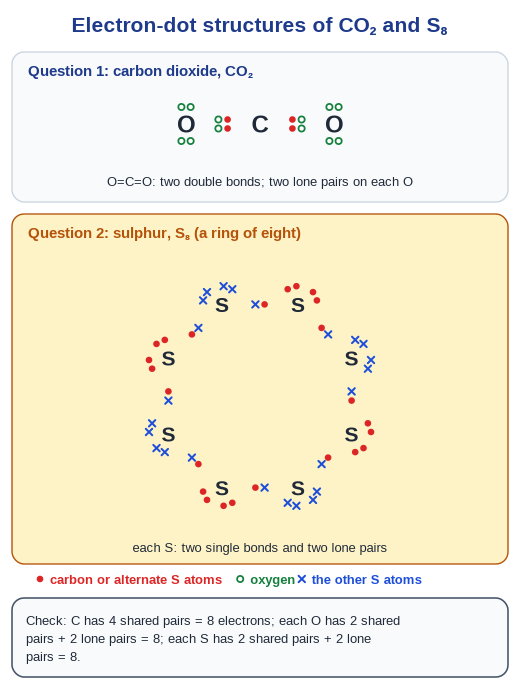
Question 1 (page 61): the electron-dot structure of carbon dioxide, CO₂. Carbon (2,4) has four outer electrons and each oxygen (2,6) has six. Carbon shares two pairs with each oxygen, so the molecule has two double bonds: O=C=O. Each oxygen keeps two lone pairs. Check: carbon has 4 shared pairs = 8 electrons; each oxygen has 2 shared pairs + 2 lone pairs = 8.
Question 2 (page 61): the electron-dot structure of a sulphur molecule of eight atoms joined in a ring. Sulphur (2,8,6) has six outer electrons and needs two more. In S₈, each sulphur atom shares one pair with each of its two neighbours in the ring (two single bonds) and keeps two lone pairs. Check: 2 shared pairs + 2 lone pairs = 8 electrons around every atom. (The ring is puckered like a crown; Extra.)
Questions, pages 68–69
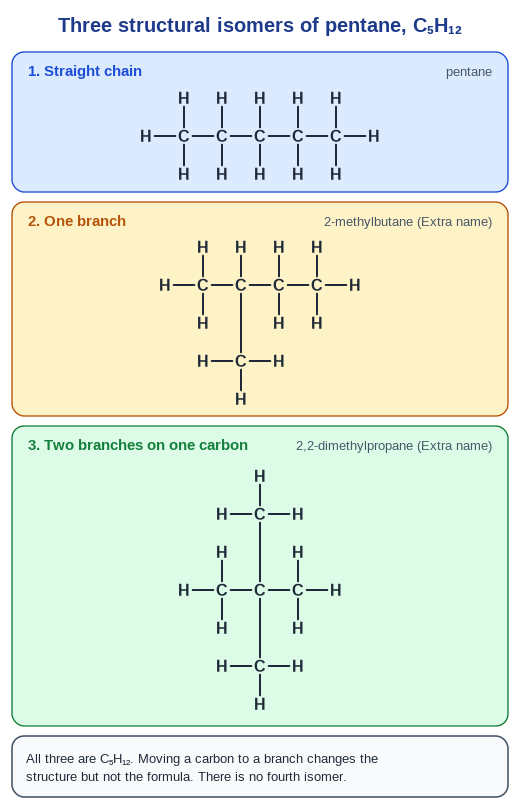
Question 1 (page 68): how many structural isomers can be drawn for pentane? Three. All are C₅H₁₂: a straight chain of five carbons (pentane); a chain of four with one carbon branch on the second carbon (2-methylbutane); and a chain of three with two carbon branches on the middle carbon (2,2-dimethylpropane). The numbered names are Extra.
Question 2 (page 68): the two properties of carbon behind its huge number of compounds. (i) Catenation: carbon atoms bond to one another to form long chains, branched chains and rings, with single, double or triple bonds. (ii) Tetravalency: with a valency of four, carbon bonds to four other atoms, of carbon or of elements such as H, O, N, S and Cl. Carbon’s small size also makes these bonds strong, so the compounds are stable.
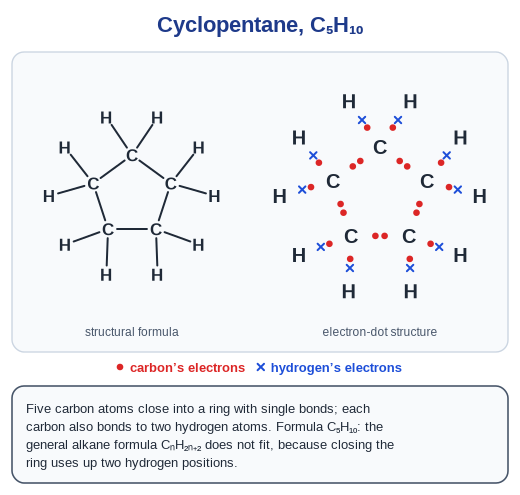
Question 3 (page 68): cyclopentane, its molecular formula and its electron-dot diagram. C₅H₁₀. Five carbon atoms form a ring with single bonds; each carbon shares one pair with each of its two ring neighbours and one pair with each of two hydrogen atoms. That is 5 C–C and 10 C–H shared pairs, and every carbon has eight electrons around it.
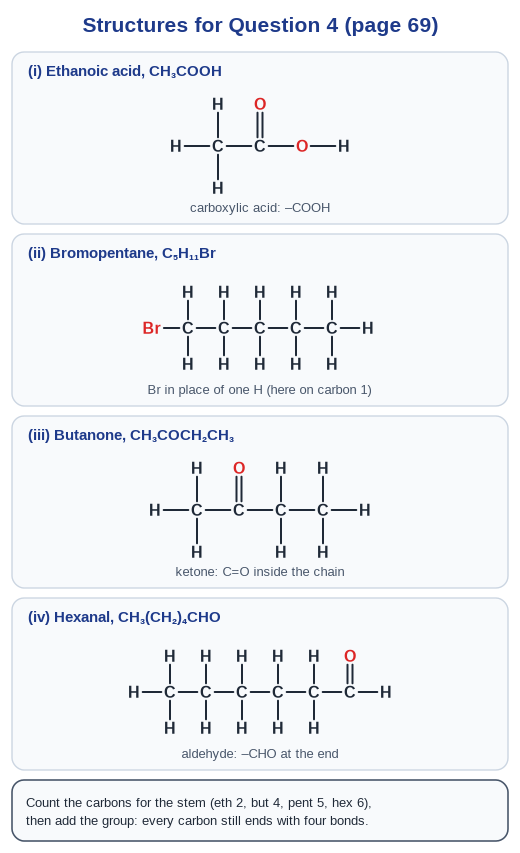
Question 4 (page 69): draw ethanoic acid, bromopentane, butanone and hexanal, and say whether bromopentane can have structural isomers.
(i) Ethanoic acid, CH₃COOH: a CH₃ group joined to a carbon that has a double bond to one oxygen and a single bond to an –OH group.
(ii) Bromopentane, C₅H₁₁Br: a chain of five carbons with one hydrogen replaced by bromine, for example CH₃CH₂CH₂CH₂CH₂Br.
(iii) Butanone, CH₃COCH₂CH₃: four carbons with a C=O on the second carbon.
(iv) Hexanal, CH₃CH₂CH₂CH₂CH₂CHO: six carbons with the –CHO group at the end.
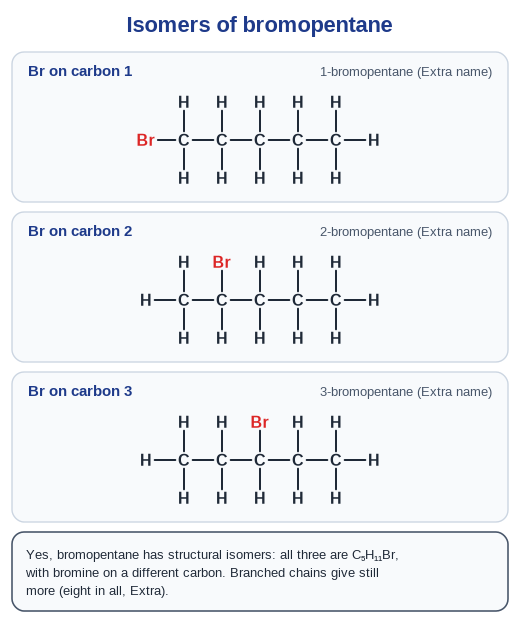
Yes, bromopentane has structural isomers. Bromine can sit on carbon 1, 2 or 3 of a straight chain (1-, 2- and 3-bromopentane), and the branched chains of pentane give more; all are C₅H₁₁Br. (The numbered names, and the total of eight isomers, are Extra.)
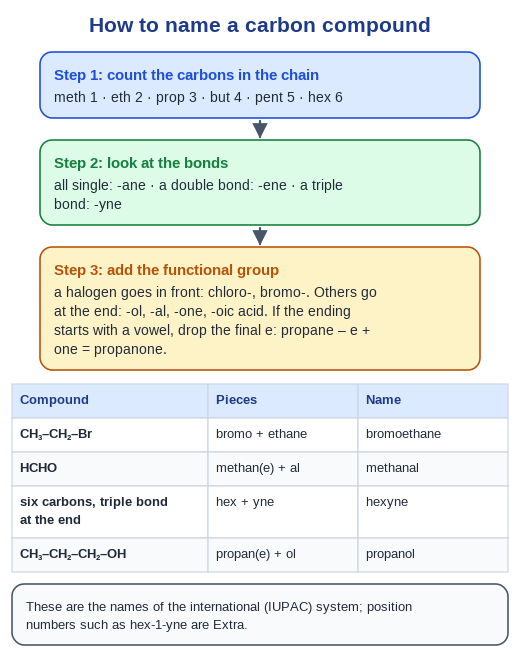
Question 5 (page 69): name the three compounds drawn in the book. (i) CH₃–CH₂–Br: two carbons, single bonds, a bromine prefix: bromoethane. (ii) The one-carbon compound with a C=O group and two hydrogens, HCHO: an aldehyde on one carbon: methane – e + al = methanal. (iii) The six-carbon chain CH₃CH₂CH₂CH₂C≡CH, with a triple bond at the end: hexyne (hex-1-yne in full, Extra).
Questions, page 71
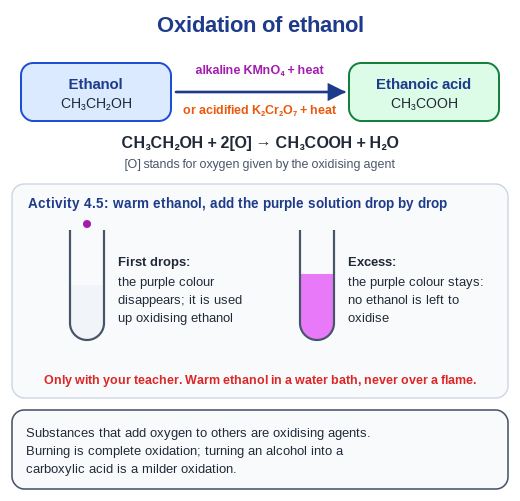
Question 1 (page 71): why is changing ethanol to ethanoic acid an oxidation? Oxygen is added to the ethanol, and hydrogen is taken away: CH₃CH₂OH (C₂H₆O) becomes CH₃COOH (C₂H₄O₂). The oxygen comes from an oxidising agent, alkaline potassium permanganate or acidified potassium dichromate: CH₃CH₂OH + 2[O] → CH₃COOH + H₂O, where [O] is oxygen from the oxidising agent.
Question 2 (page 71): why is ethyne burnt with oxygen, not air, for welding? Welding needs a very hot flame to melt metal. Air is mostly nitrogen (Extra: only about a fifth of it is oxygen), so ethyne burning in air gets too little oxygen: combustion is incomplete, the flame is sooty and not hot enough. With pure oxygen, ethyne burns completely and gives a much hotter, clean flame: 2C₂H₂ + 5O₂ → 4CO₂ + 2H₂O + heat and light.
Questions, page 74
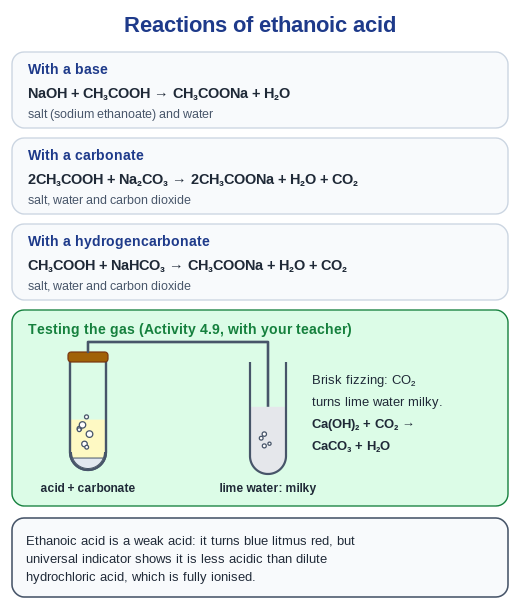
Question 1 (page 74): how do we tell an alcohol from a carboxylic acid by experiment? Add a little sodium hydrogencarbonate (or sodium carbonate) to each, with your teacher. The carboxylic acid fizzes briskly and gives carbon dioxide, which turns lime water milky: CH₃COOH + NaHCO₃ → CH₃COONa + H₂O + CO₂. The alcohol shows no change. Blue litmus also turns red in the acid but not in the alcohol. Never taste or smell them to decide.
Question 2 (page 74): what are oxidising agents? Substances that add oxygen to other substances, oxidising them. Alkaline potassium permanganate and acidified potassium dichromate are examples: they oxidise alcohols to carboxylic acids.
Questions, page 76
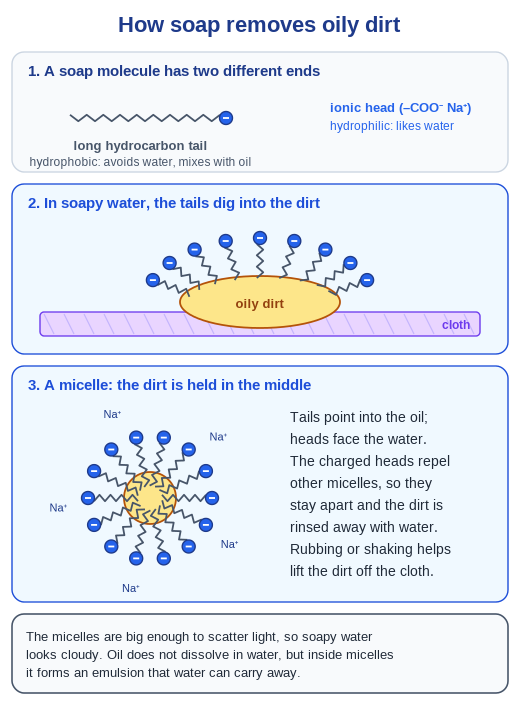
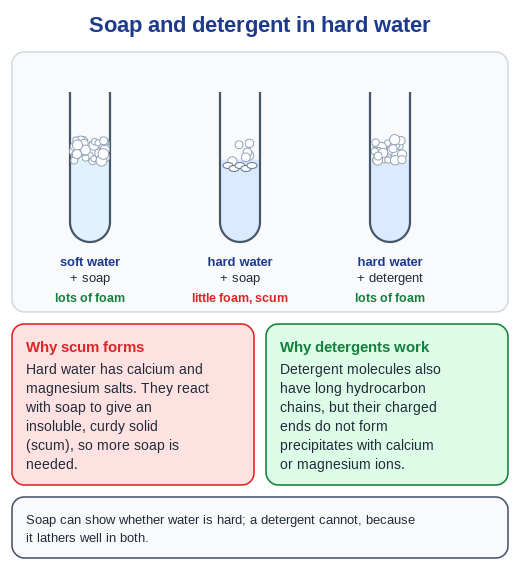
Question 1 (page 76): can a detergent show whether water is hard? No. A detergent lathers well in both hard and soft water, because its charged ends do not form insoluble solids with calcium and magnesium ions. Soap is the right test: in hard water it gives little foam and a white, curdy scum.
Question 2 (page 76): why does beating, scrubbing or a washing machine help clean clothes? Soap molecules form micelles around oily dirt, but the dirt is stuck to the cloth fibres. Agitation loosens it, brings fresh soap solution to every part of the cloth, and helps the micelles pull the dirt away into the water, from where rinsing removes it.
Other questions inside the chapter (pages 58–75)
Testing a carbon compound (page 58). Burn a little with your teacher: a compound containing carbon gives carbon dioxide, which turns lime water milky, and with too little air it leaves black soot (carbon).
Carbon’s electrons (page 59). Atomic number 6: 2, 4, so carbon has four valence electrons.
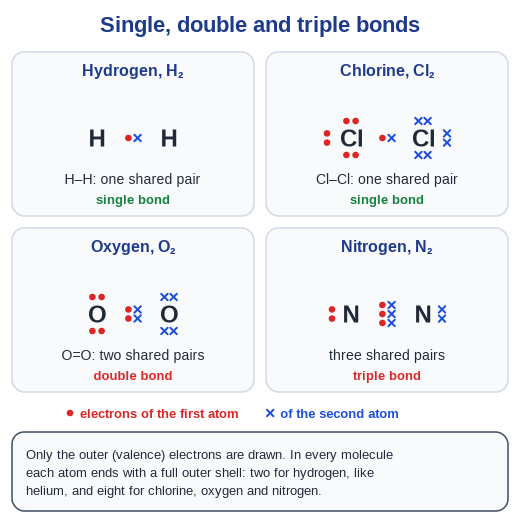
Chlorine, Cl₂ (page 60). Chlorine (2,8,7) has seven outer electrons and a valency of 1. Two chlorine atoms share one pair: a single bond, with three lone pairs on each atom.
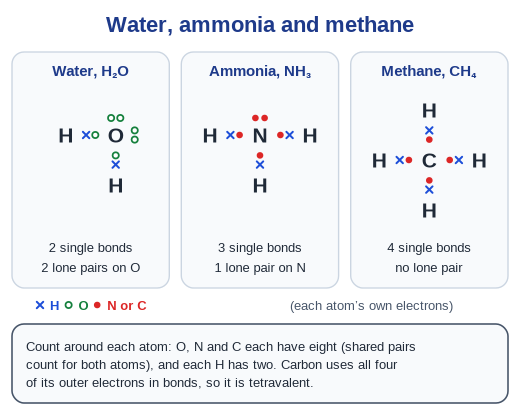
Water (page 60). Oxygen shares one pair with each of two hydrogen atoms: two single bonds, and two lone pairs stay on the oxygen.
Nitrogen, N₂ (page 60). Nitrogen is 2, 5, with a combining capacity of 3. Each atom gives three electrons, making three shared pairs: a triple bond.
Ammonia, NH₃ (page 60). Nitrogen shares one pair with each of three hydrogens: three single bonds, plus one lone pair on nitrogen. All four atoms reach a noble-gas arrangement: N eight electrons, each H two.
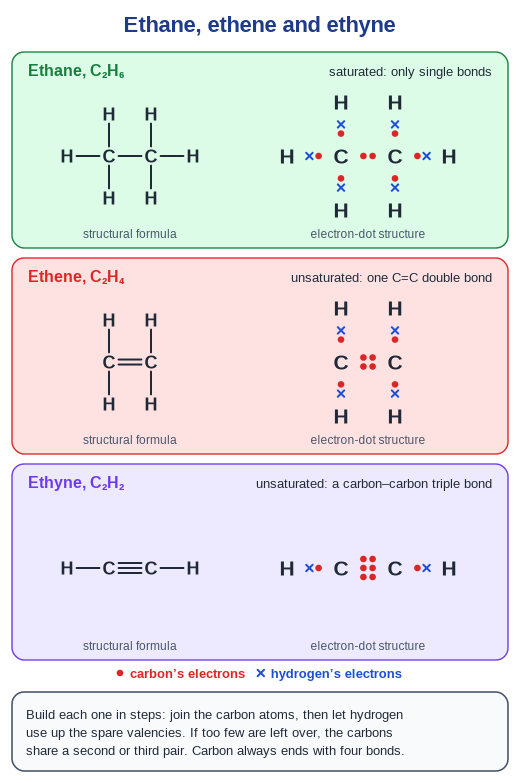
Propane, C₃H₈ (page 63). Join three carbons with single bonds, then add hydrogens: CH₃–CH₂–CH₃. Every bond is single, so propane is saturated.
Ethyne, C₂H₂ (page 64). Each carbon has one hydrogen, so three valencies of each carbon are left: the carbons share three pairs, a triple bond, H–C≡C–H.
Cyclohexane, C₆H₁₂ (page 65). Draw it like cyclopentane above, with six carbons in the ring: each carbon shares one pair with each ring neighbour and one pair with each of two hydrogens. That is 6 C–C and 12 C–H shared pairs.
Propane and butane (page 66). C₃H₈ and C₄H₁₀ also differ by –CH₂–. The molecular masses are CH₄ 16 u, C₂H₆ 30 u, C₃H₈ 44 u and C₄H₁₀ 58 u, so each pair differs by 14 u.
The alkene series (pages 66–67). Ethene is C₂H₄. C₃H₆, C₄H₈ and C₅H₁₀ each differ by –CH₂–, and the number of hydrogen atoms is twice the number of carbon atoms: CₙH₂ₙ. In the same way, alkanes are CₙH₂ₙ₊₂ and alkynes CₙH₂ₙ₋₂.
Balancing the combustion equations (page 69).
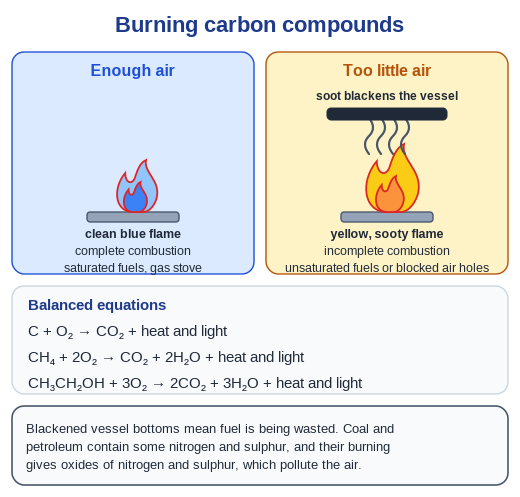
CH₄ + 2O₂ → CO₂ + 2H₂O + heat and light. Check: C 1 = 1, H 4 = 4, O 4 = 2 + 2.
CH₃CH₂OH + 3O₂ → 2CO₂ + 3H₂O + heat and light. Check: C 2 = 2, H 6 = 6, O 7 = 4 + 3.
Why a candle flame is yellow (page 70). The wax burns incompletely, and the tiny particles of unburnt carbon (soot) in the flame are heated until they glow yellow. (A copper wire held in a gas flame colours it bluish-green; Extra.)
Why coal and petroleum are fossil fuels (page 70). They formed over millions of years from the buried remains of plants and animals, just as fossils do.
Other substances that give hydrogen with metals (page 72). Dilute acids with reactive metals (Chapters 2 and 3), for example Zn + H₂SO₄ → ZnSO₄ + H₂, and very reactive metals with water.
A soap micelle in a hydrocarbon (page 75). It forms the other way round: the hydrocarbon tails point outwards into the hydrocarbon liquid, and the ionic heads cluster together in the middle.
What the activities show (Activities 4.1–4.12)
Do every activity with acids, ethanol or flames only with your teacher.
- 4.1, a list of things: most items in the “Others” column, such as food, cloth, paper, plastic and medicines, are carbon compounds (see page 58 above).
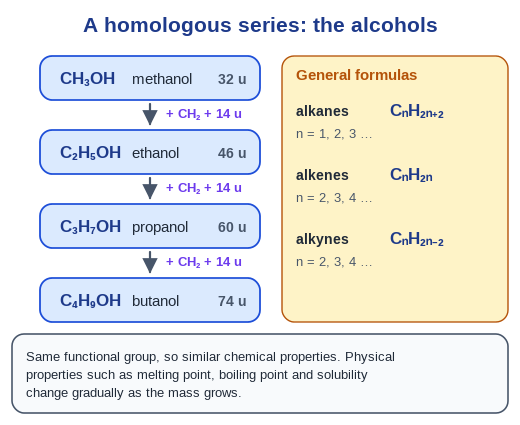
- 4.2, alcohols: (a) CH₃OH (32 u) and C₂H₅OH (46 u), (b) C₂H₅OH and C₃H₇OH (60 u), (c) C₃H₇OH and C₄H₉OH (74 u): each pair differs by –CH₂– and 14 u. All four have the –OH group. In order, methanol, ethanol, propanol and butanol form a homologous series. Series up to four carbons for the other groups: chloromethane, chloroethane, chloropropane, chlorobutane (CH₃Cl to C₄H₉Cl); methanal, ethanal, propanal, butanal (HCHO, CH₃CHO, CH₃CH₂CHO, CH₃CH₂CH₂CHO); propanone and butanone (CH₃COCH₃, CH₃COCH₂CH₃; a ketone needs at least three carbons); methanoic, ethanoic, propanoic and butanoic acid (HCOOH, CH₃COOH, CH₃CH₂COOH, CH₃CH₂CH₂COOH).
- 4.3, burning naphthalene, camphor and alcohol (teacher only): naphthalene and camphor burn with a yellow, smoky flame and leave black soot on the metal plate; alcohol burns with a clean, pale blue flame and leaves almost no deposit. (Expected result.)
- 4.4, the burner: with the air hole closed, the flame is yellow and sooty; with it open, enough air mixes in and the flame turns blue.
- 4.5, ethanol and permanganate: at first, the purple colour of alkaline potassium permanganate disappears, because it is used up oxidising the ethanol. Once all the ethanol has been oxidised to ethanoic acid, nothing is left to react, so extra drops stay purple. Warm the ethanol only in a water bath.
- 4.6, sodium in ethanol (teacher demonstration): the sodium fizzes and a gas comes off; a burning splinter brought near it makes it burn with a pop, so it is hydrogen: 2Na + 2CH₃CH₂OH → 2CH₃CH₂ONa + H₂.
- 4.7, acetic acid and hydrochloric acid: both turn blue litmus red, so litmus shows both are acids. Universal indicator gives dilute hydrochloric acid a colour for a lower pH than dilute acetic acid, so they are not equally strong: acetic acid is a weak acid.
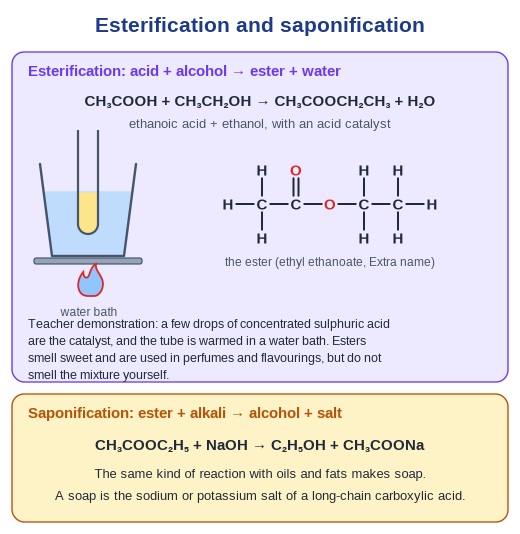
- 4.8, making an ester (teacher demonstration): the mixture poured into water has a sweet, fruity smell, the smell of an ester. Your teacher notes this; do not smell it yourself. CH₃COOH + CH₃CH₂OH → CH₃COOCH₂CH₃ + H₂O.
- 4.9, ethanoic acid and carbonates: brisk effervescence; the gas turns lime water milky, so it is carbon dioxide: 2CH₃COOH + Na₂CO₃ → 2CH₃COONa + H₂O + CO₂, and Ca(OH)₂ + CO₂ → CaCO₃ + H₂O. Sodium hydrogencarbonate gives the same result: CH₃COOH + NaHCO₃ → CH₃COONa + H₂O + CO₂.
- 4.10, oil, water and soap: right after shaking, both tubes look mixed. In tube A (no soap) the oil soon separates as a layer on top; in tube B the soap keeps the oil spread as tiny droplets for much longer. The oil layer separates first in tube A.
- 4.11, soap in soft and hard water: distilled or rain water gives more foam; hard water gives little foam and a white curdy precipitate.
- 4.12, soap and detergent in hard water: the detergent gives much more foam; the curdy solid forms in the tube with soap.
Group Activity (page 78). (I) With a molecular model kit, build methane, ethane, ethene, ethyne, the two isomers of butane, ethanol and ethanoic acid, and check that every carbon has four bonds. (II) Soap making is saponification: the oil is heated with sodium hydroxide solution until it thickens into soap, and common salt helps the soap separate out. Twenty per cent sodium hydroxide is corrosive and the mixture is hot, so this is done only in the school laboratory with your teacher, with eye protection, never at home.
Exercises 1 to 3: choose the answer
1. “Ethane, with the molecular formula C₂H₆ has (a) 6 covalent bonds. (b) 7 covalent bonds. (c) 8 covalent bonds. (d) 9 covalent bonds.”
(b) 7 covalent bonds: one C–C bond and six C–H bonds (each carbon bonds to three hydrogens).
2. “Butanone is a four-carbon compound with the functional group (a) carboxylic acid. (b) aldehyde. (c) ketone. (d) alcohol.”
(c) Ketone. The ending -one marks a ketone: CH₃COCH₂CH₃ has a C=O inside the chain.
3. “While cooking, if the bottom of the vessel is getting blackened on the outside, it means that (a) the food is not cooked completely. (b) the fuel is not burning completely. (c) the fuel is wet. (d) the fuel is burning completely.”
(b) The fuel is not burning completely. The black layer is soot, unburnt carbon from incomplete combustion; the stove’s air holes are probably blocked, and fuel is being wasted.
Exercises 4 to 7: bonds, structures and series
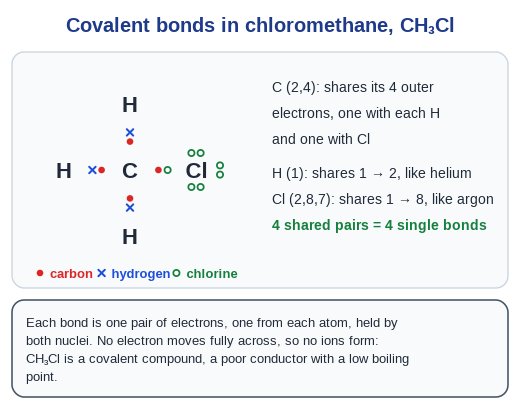
4. “Explain the nature of the covalent bond using the bond formation in CH₃Cl.”
- The atoms: carbon (2,4) has four outer electrons, hydrogen (1) has one, and chlorine (2,8,7) has seven.
- No transfer: none of them gives away or takes electrons completely, so no ions form.
- Sharing: carbon shares one electron pair with each of the three hydrogen atoms and one pair with the chlorine atom. In each pair, one electron comes from carbon and one from the partner atom.
- The bonds: each shared pair is one covalent bond. So CH₃Cl has four single covalent bonds.
- Stable shells: after sharing, carbon and chlorine each have eight outer electrons (like neon and argon), and each hydrogen has two (like helium).
Nature of the covalent bond: it is formed by sharing electrons, not by giving or taking them. The bonds inside the molecule are strong, but the forces between molecules are weak. So CH₃Cl has a low boiling point and does not conduct electricity.
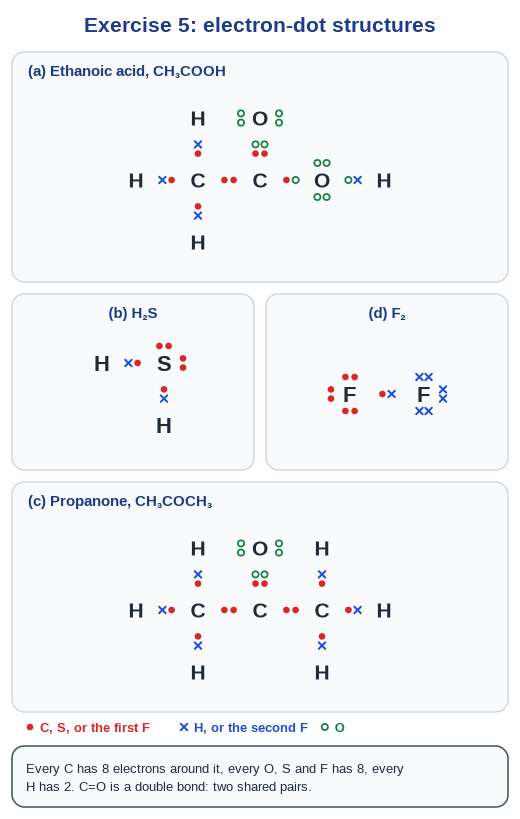
5. “Draw the electron dot structures for (a) ethanoic acid. (b) H₂S. (c) propanone. (d) F₂.”
(a) Ethanoic acid, CH₃COOH: the CH₃ carbon shares one pair with each of three hydrogens and one with the second carbon. The second carbon shares two pairs with one oxygen (C=O) and one pair with the other oxygen, which shares one pair with a hydrogen. Each oxygen keeps two lone pairs.
(b) H₂S: sulphur (2,8,6) shares one pair with each of two hydrogens and keeps two lone pairs.
(c) Propanone, CH₃COCH₃: the middle carbon shares two pairs with oxygen (C=O) and one pair with each CH₃ carbon; each CH₃ carbon shares a pair with each of its three hydrogens. Oxygen keeps two lone pairs.
(d) F₂: each fluorine (2,7) gives one electron to a shared pair (a single bond) and keeps three lone pairs.
In every structure, each C, O, S and F has eight electrons around it, and each H two.
6. “What is an homologous series? Explain with an example.”
A homologous series is a series of carbon compounds that have the same functional group, in which each member differs from the next by a –CH₂– unit (14 u). Example, the alcohols: CH₃OH (methanol, 32 u), C₂H₅OH (ethanol, 46 u), C₃H₇OH (propanol, 60 u), C₄H₉OH (butanol, 74 u). Because they share the –OH group, they have similar chemical properties; their physical properties, such as melting and boiling points, change gradually as the molecular mass rises. The alkanes CH₄, C₂H₆, C₃H₈ … (CₙH₂ₙ₊₂) are another homologous series.
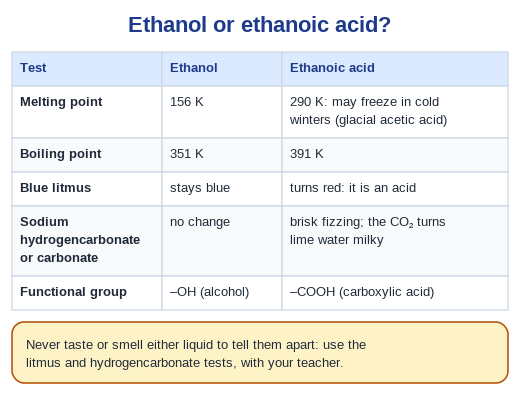
7. “How can ethanol and ethanoic acid be differentiated on the basis of their physical and chemical properties?”
| Property | Ethanol | Ethanoic acid |
|---|---|---|
| Melting point | 156 K | 290 K: freezes in cold winters |
| Boiling point | 351 K | 391 K |
| Blue litmus | no change | turns red |
| NaHCO₃ or Na₂CO₃ | no reaction | brisk fizzing, CO₂ |
Physical: ethanoic acid melts at 290 K, so in cold weather it may freeze (glacial acetic acid), while ethanol stays liquid down to 156 K; ethanoic acid also boils higher. Ethanoic acid in dilute form is vinegar, familiar from the kitchen. Chemical: ethanoic acid is an acid, so it turns blue litmus red and gives carbon dioxide with sodium hydrogencarbonate: CH₃COOH + NaHCO₃ → CH₃COONa + H₂O + CO₂; ethanol does neither. Never taste or smell them to tell them apart.
Exercises 8 to 11: soaps, fuels and scum
8. “Why does micelle formation take place when soap is added to water? Will a micelle be formed in other solvents such as ethanol also?”
A soap molecule has two different ends: an ionic head that is attracted to water (hydrophilic) and a long hydrocarbon tail that is repelled by water (hydrophobic). In water, the tails try to get away from the water, so the molecules cluster with their tails together inside and their heads on the outside, touching the water. These clusters are micelles, and oily dirt collects in their centre. No, micelles do not form in ethanol: the hydrocarbon tail mixes easily with ethanol, an organic solvent, so the soap simply dissolves and the tails have no reason to hide in a cluster.
9. “Why are carbon and its compounds used as fuels for most applications?”
They burn in air to give carbon dioxide and water with a large amount of heat and light. With enough air they burn completely with a clean flame, and their burning can be controlled, as in a gas stove. Many of them, such as coal, petroleum products, LPG, CNG, wood and biogas, are widely available and easy to store and carry. (Their burning does add carbon dioxide and, from coal and petroleum, polluting oxides of sulphur and nitrogen.)
10. “Explain the formation of scum when hard water is treated with soap.”
Hard water contains calcium and magnesium salts. Soap is the sodium or potassium salt of a long-chain carboxylic acid. The calcium and magnesium ions react with the soap and form calcium and magnesium salts of the long-chain acid, which do not dissolve in water. They separate as a white, curdy, insoluble solid: scum. Soap used up this way cannot clean, so more soap is needed. For example, with sodium stearate (Extra): 2C₁₇H₃₅COONa + CaCl₂ → (C₁₇H₃₅COO)₂Ca + 2NaCl.
11. “What change will you observe if you test soap with litmus paper (red and blue)?”
Soap solution is basic, because soap is the salt of a strong base (sodium or potassium hydroxide) and a weak carboxylic acid. Red litmus turns blue; blue litmus stays blue.
Exercises 12 to 15: reactions and cleaning
12. “What is hydrogenation? What is its industrial application?”
Hydrogenation is the addition of hydrogen to an unsaturated compound, in the presence of a catalyst such as nickel or palladium, to give a saturated compound: CH₂=CH₂ + H₂ → CH₃–CH₃. Industrial application: vegetable oils, which have long unsaturated carbon chains, are hydrogenated with a nickel catalyst to turn them into solid fats (vanaspati ghee, Extra).
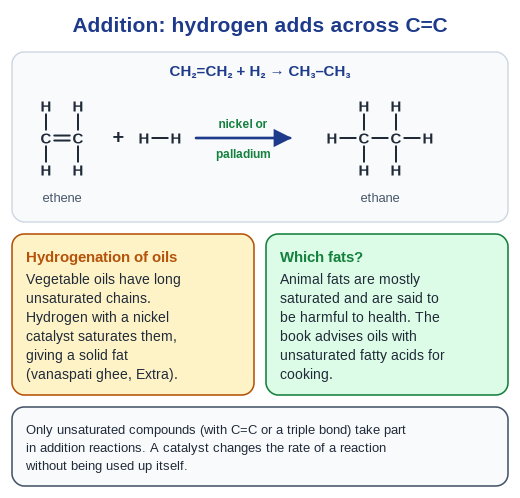
13. “Which of the following hydrocarbons undergo addition reactions: C₂H₆, C₃H₈, C₃H₆, C₂H₂ and CH₄.”
C₃H₆ and C₂H₂. C₃H₆ (propene) has a C=C double bond and C₂H₂ (ethyne) a triple bond, so both are unsaturated and can add hydrogen: C₃H₆ + H₂ → C₃H₈ and C₂H₂ + 2H₂ → C₂H₆ (nickel catalyst). C₂H₆, C₃H₈ and CH₄ fit CₙH₂ₙ₊₂: they are saturated alkanes and do not undergo addition.
14. “Give a test that can be used to differentiate between saturated and unsaturated hydrocarbons.”
Burn them (with your teacher). A saturated hydrocarbon generally burns with a clean blue flame; an unsaturated one burns with a yellow flame and lots of black smoke, leaving soot on a metal plate held above it. (Extra: unsaturated hydrocarbons also decolourise bromine water by addition, CH₂=CH₂ + Br₂ → CH₂Br–CH₂Br, while saturated ones do not.)
15. “Explain the mechanism of the cleaning action of soaps.”
- A soap molecule has an ionic head (–COO⁻ Na⁺) that is attracted to water and a long hydrocarbon tail that dissolves in oil but not in water.
- Most dirt is oily, and oil does not dissolve in water. In soapy water, the tails dig into the oily dirt while the heads stay in the water.
- The soap molecules gather around the dirt as micelles: the dirt is trapped in the centre, the tails point into it and the ionic heads face outwards into the water. This forms an emulsion of oil in water.
- The ionic heads on the surfaces of different micelles repel one another, so the micelles stay apart and do not settle out.
- Rubbing, beating or a washing machine helps lift the dirt from the cloth, and rinsing with water carries the micelles, with the dirt inside them, away.
Practice
-
How many covalent bonds are there in propane, C₃H₈?
Show answer
Answer: (b) 10
-
Which of these is the next member of the homologous series after C₂H₄?
Show answer
Answer: (b) C₃H₆
-
The name of CH₃COCH₂CH₃ is:
Show answer
Answer: (b) butanone
-
Write the balanced equation for the complete combustion of propane.
Show answer
Answer: C₃H₈ + 5O₂ → 3CO₂ + 4H₂O (+ heat and light). Check: C 3 = 3, H 8 = 8, O 10 = 6 + 4.
-
A compound C₂H₄O₂ gives brisk effervescence with sodium hydrogencarbonate. Name it and write the reaction.
Show answer
Answer: It is ethanoic acid, CH₃COOH, a carboxylic acid: CH₃COOH + NaHCO₃ → CH₃COONa + H₂O + CO₂. The carbon dioxide turns lime water milky.
Stuck on a question?
Take a photo and Lagnever AI explains it step by step. Try it for 7 days for ₹2.
Get it on Google Play Open in browser
For parents: after the trial, the plan renews monthly by UPI or card autopay. You can cancel anytime in the app.