
Class 10 Science Chapter 4: Carbon and its Compounds Notes
This chapter in five lines
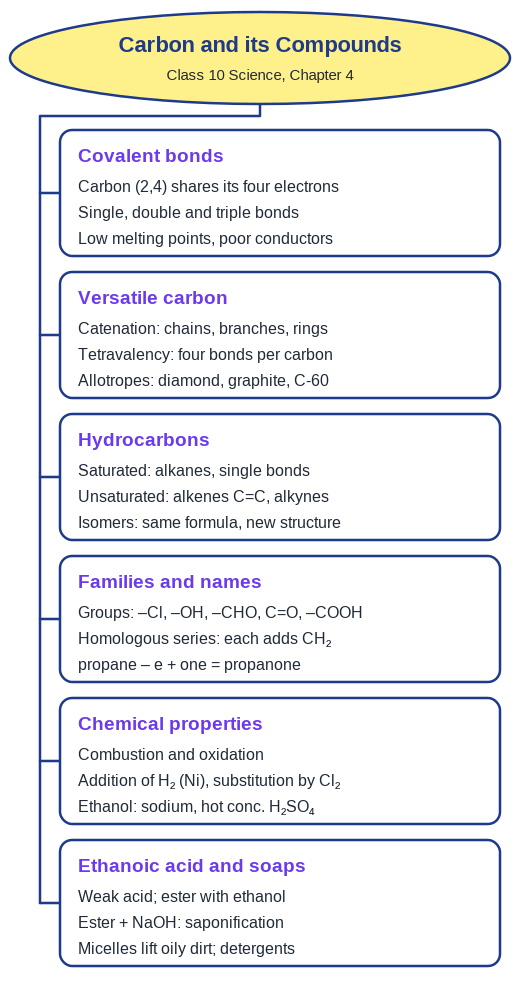
Carbon has four outer electrons and shares them, forming covalent bonds. It links to itself in chains, branches and rings (catenation) and makes four bonds (tetravalency), so it forms millions of compounds. Hydrocarbons are saturated or unsaturated; functional groups and homologous series sort them and give their names. Carbon compounds burn, oxidise, add and substitute. Ethanol, ethanoic acid and soaps are everyday examples.
What is this chapter about?
The LPG in the kitchen, the wax of a Diwali candle, the cooking oil in the kadhai, the vinegar in pickles, the sugar in tea, the cotton of a school shirt and the soap at the tap are all carbon compounds. So are we: every living thing is built from them. Yet carbon is scarce. The earth’s crust holds only about 0.02% carbon, in minerals, coal and petroleum, and the air only about 0.03% carbon dioxide. This chapter explains how so little carbon makes so many compounds, how they are named, how they react, and how two of them, ethanol and ethanoic acid, and soap fit into daily life.
How do we stay safe in this chapter’s activities?
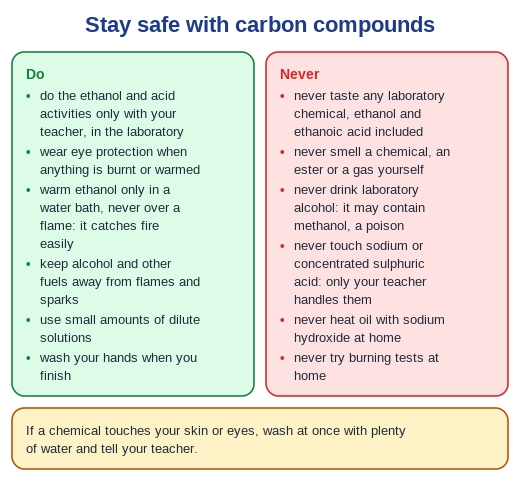
Ethanol catches fire easily, concentrated sulphuric acid burns skin, and sodium reacts violently. Do the ethanol and acid activities only in the laboratory with your teacher, and warm ethanol in a water bath, never over a flame. Never taste or smell any chemical, even where an activity asks you to smell the result: your teacher will tell you what is noticed.
Why does carbon form covalent bonds?
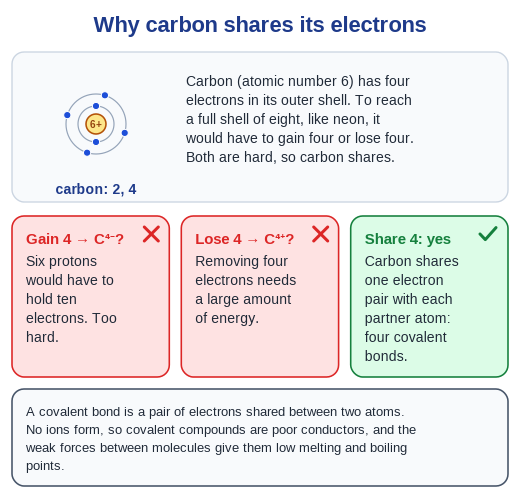
Carbon compounds such as methane and ethanol melt and boil at low temperatures and hardly conduct electricity, unlike the ionic compounds of Chapter 3. So their bonds give no ions. Carbon (atomic number 6, electrons 2,4) has four outer electrons. Gaining four, to make C⁴⁻, would ask six protons to hold ten electrons; losing four, to make C⁴⁺, would need a lot of energy. Instead, carbon shares its electrons. A shared pair of electrons, one from each atom, is a covalent bond. Read covalent bonding in carbon.
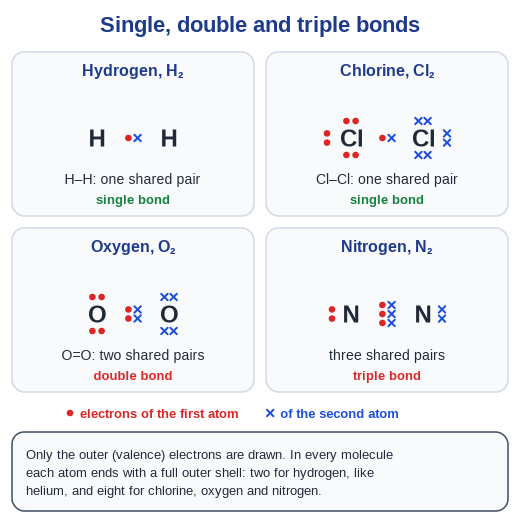
Two hydrogen atoms share one pair (a single bond, H–H). Two oxygen atoms share two pairs (a double bond, O=O), and two nitrogen atoms three pairs (a triple bond, N≡N). In methane, CH₄, carbon shares one pair with each of four hydrogen atoms. Inside a molecule the bonds are strong, but the forces between molecules are weak, which is why covalent compounds melt easily.
What are the allotropes of carbon?
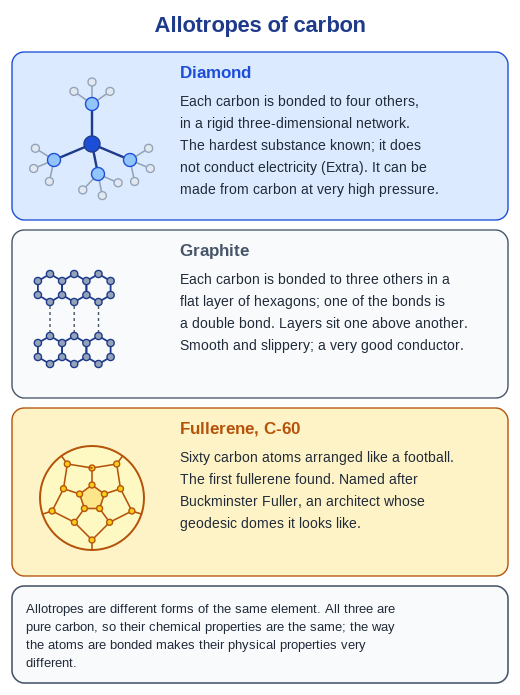
Pure carbon comes in different forms, its allotropes. In diamond, each carbon is bonded to four others in a rigid three-dimensional network, so diamond is the hardest substance known. In graphite, each carbon is bonded to three others in flat layers of hexagons, so graphite is slippery, and it conducts electricity well. Fullerenes such as C-60 are balls of carbon atoms shaped like a football.
Why does carbon form so many compounds?
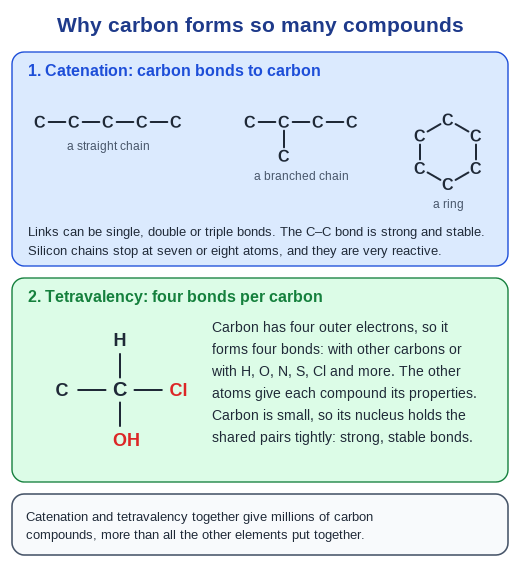
Two reasons. Catenation: carbon atoms bond to one another in long chains, branched chains and rings, joined by single, double or triple bonds. Silicon manages chains of only seven or eight atoms, and they are very reactive. Tetravalency: with four bonds per atom, carbon can join other carbons or hydrogen, oxygen, nitrogen, sulphur and chlorine. Carbon is small, so its nucleus holds the shared electrons tightly and the bonds are strong. Carbon compounds other than carbides, oxides of carbon, carbonates and hydrogencarbonates are studied as organic chemistry, a name from the old belief, which Friedrich Wöhler disproved in 1828 by making urea, that they could be made only in living things.
What are hydrocarbons, isomers and functional groups?
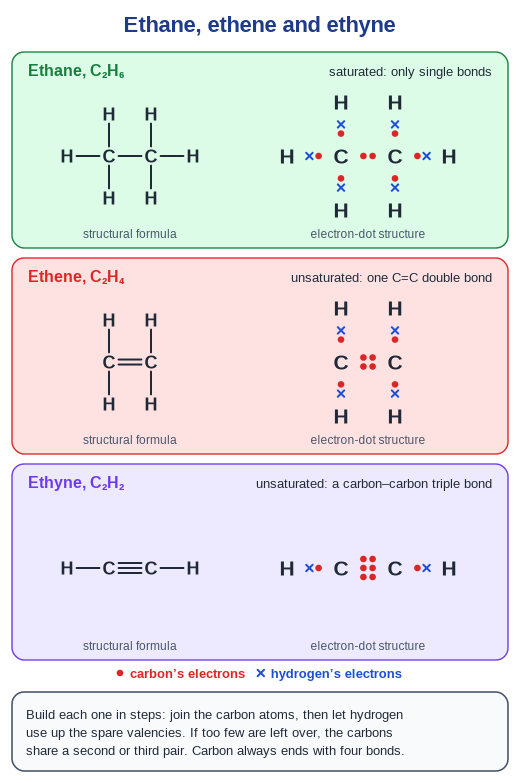
Compounds of carbon and hydrogen only are hydrocarbons. With only single bonds they are saturated (alkanes, such as ethane, C₂H₆); with a double bond they are alkenes (ethene, C₂H₄), and with a triple bond alkynes (ethyne, C₂H₂); both are unsaturated. Compounds with the same formula but different structures, like the straight and branched forms of C₄H₁₀, are structural isomers. Replacing a hydrogen by a functional group such as –OH or –COOH gives a family of compounds with its own properties. Read homologous series and naming.
What is a homologous series, and how are compounds named?
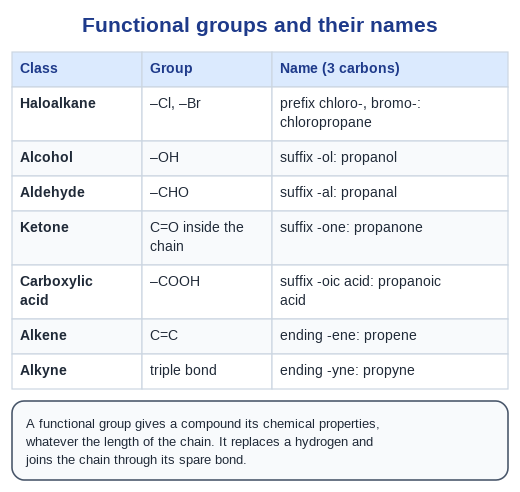
Members of a homologous series have the same functional group and differ by one –CH₂– unit, 14 u: CH₃OH, C₂H₅OH, C₃H₇OH and C₄H₉OH are one. They react alike, while melting and boiling points rise steadily. A name is built from the stem for the number of carbons (meth, eth, prop, but, pent, hex), an ending for the bonds (-ane, -ene, -yne) and a prefix or suffix for the group: three carbons with a ketone group is propane – e + one = propanone.
What are the chemical properties of carbon compounds?
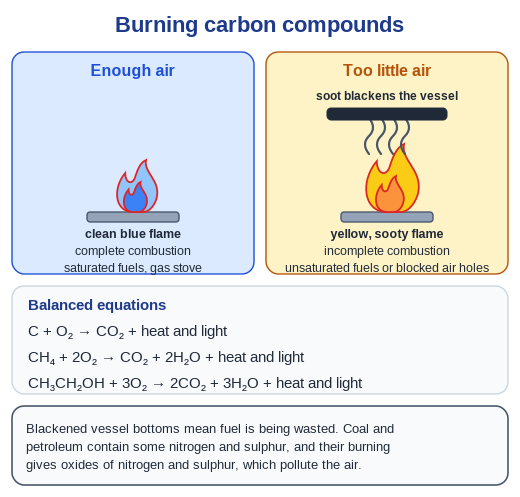
Combustion: carbon compounds burn in oxygen to give carbon dioxide and water with heat and light, which is why they are our main fuels. Saturated hydrocarbons burn with a clean blue flame; unsaturated ones, or any fuel short of air, give a sooty yellow flame. Oxidation: alkaline potassium permanganate or acidified potassium dichromate turns ethanol into ethanoic acid. Addition: unsaturated compounds add hydrogen with a nickel catalyst, which turns vegetable oils into solid fat. Substitution: in sunlight, chlorine replaces the hydrogen atoms of methane one by one. Read chemical properties of carbon compounds.
What are ethanol and ethanoic acid?
Ethanol (alcohol) is a liquid that mixes with water in all proportions and is a good solvent, used in tincture of iodine and cough syrups. Drinking it harms health; pure ethanol can kill, and methanol, even in tiny amounts, causes blindness or death. Ethanol reacts with sodium to give hydrogen, and hot concentrated sulphuric acid removes water from it to give ethene. Ethanoic acid (acetic acid) is a weak acid; a 5–8% solution in water is vinegar. It reacts with bases, carbonates and hydrogencarbonates, and with ethanol it forms a sweet-smelling ester. An ester with sodium hydroxide gives back the alcohol and a salt: saponification.
How do soaps and detergents clean?
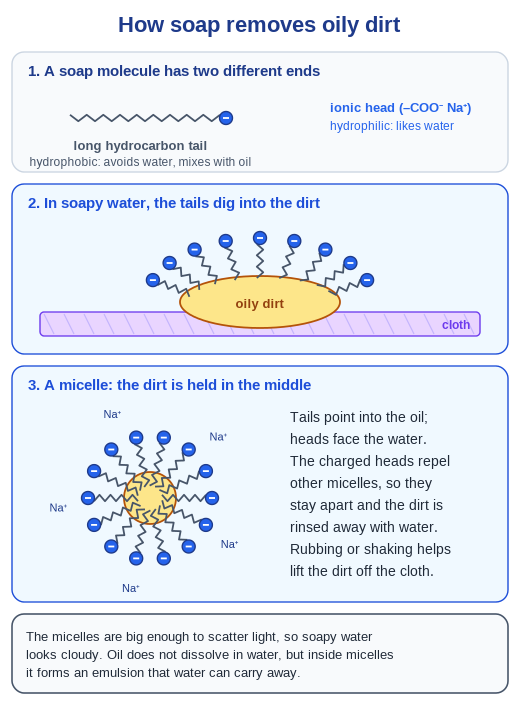
A soap molecule is the sodium or potassium salt of a long-chain carboxylic acid. Its ionic head is attracted to water; its long hydrocarbon tail avoids water and mixes with oil. In water, the tails bury themselves in oily dirt and the molecules gather into micelles, with the dirt in the middle and the heads outside. Rinsing carries the micelles away. In hard water, calcium and magnesium salts turn soap into an insoluble scum, so detergents, whose charged ends do not form such solids, work better there.
Before we move on
Practise electron-dot structures until every atom has its full shell, and write every reaction in this chapter as a balanced equation. Answers to the five Questions boxes, the activities and all fifteen exercises are in the NCERT solutions for Chapter 4.
Key terms
| Term | Meaning |
|---|---|
| Covalent bond | A bond formed when two atoms share a pair of electrons, one electron from each. |
| Single, double, triple bond | One, two or three shared pairs between two atoms, as in H–H, O=O and N≡N. |
| Allotropes | Different forms of the same element: diamond, graphite and fullerenes are all carbon. |
| Catenation | The ability of carbon atoms to bond to one another in long chains, branches and rings. |
| Tetravalency | Carbon’s valency of four: each carbon atom forms four bonds. |
| Saturated and unsaturated | Saturated compounds have only single C–C bonds; unsaturated ones have a C=C double or C≡C triple bond. |
| Hydrocarbon | A compound of carbon and hydrogen only: alkanes (single bonds), alkenes (C=C) and alkynes (C≡C). |
| Structural isomers | Compounds with the same molecular formula but different structures, like the two forms of C₄H₁₀. |
| Functional group | An atom or group, such as –OH, –CHO or –COOH, that gives a compound its chemical properties. |
| Homologous series | A family of compounds with the same functional group, each member differing from the next by –CH₂– (14 u). |
| Oxidising agent | A substance that adds oxygen to others, such as alkaline potassium permanganate or acidified potassium dichromate. |
| Addition and substitution | Addition: atoms join across a double or triple bond. Substitution: one atom or group takes the place of another. |
| Esterification | An acid and an alcohol react, with an acid catalyst, to give a sweet-smelling ester and water. |
| Saponification | An ester reacts with an alkali to give back the alcohol and the sodium salt of the acid; it is how soap is made. |
| Micelle | A cluster of soap molecules with their oily tails inside, around the dirt, and their ionic heads outside in the water. |
Topics in this chapter
Practice
-
How many covalent bonds are there in a molecule of methane, CH₄?
Show answer
Answer: (b) 4
-
Which of these is an unsaturated hydrocarbon?
Show answer
Answer: (c) C₂H₄
-
The functional group in propanal is:
Show answer
Answer: (b) –CHO
-
Ethanol is changed into ethanoic acid by heating with alkaline potassium permanganate. This is:
Show answer
Answer: (c) an oxidation
-
Which gas is given off when ethanoic acid reacts with sodium hydrogencarbonate?
Show answer
Answer: (c) carbon dioxide
-
In a soap micelle, the hydrocarbon tails point:
Show answer
Answer: (b) into the oily dirt in the middle
Questions students ask
What are the main topics of Class 10 Science Chapter 4?
Covalent bonding in carbon and electron-dot structures, allotropes, catenation and tetravalency, saturated and unsaturated hydrocarbons, isomers, functional groups, homologous series and naming, the chemical properties of carbon compounds, ethanol and ethanoic acid, and soaps and detergents.
Is Carbon and its Compounds in the 2026-27 NCERT book?
Yes. It is Chapter 4 of Science, the Class 10 NCERT textbook marked Reprint 2026-27, on pages 58 to 78. It builds on ionic compounds from Chapter 3 and the acids and bases of Chapter 2.
Which parts of this chapter should I practise for the board exam?
Practise electron-dot structures (CH₄, CO₂, N₂, ethane, ethene, ethyne, CH₃Cl, ethanoic acid), drawing isomers and naming compounds, and writing and balancing the reactions of combustion, oxidation, addition, substitution, ethanol and ethanoic acid. Be ready to draw a micelle and explain how soap cleans.
Why is carbon called a versatile element?
Because it forms a huge number of compounds. Carbon bonds to itself in chains, branches and rings (catenation), and with a valency of four it can bond to many other elements. Its small size makes these bonds strong, so the compounds are stable.
Stuck on a question?
Take a photo and Lagnever AI explains it step by step. Try it for 7 days for ₹2.
Get it on Google Play Open in browser
For parents: after the trial, the plan renews monthly by UPI or card autopay. You can cancel anytime in the app.