
What are the chemical properties of carbon compounds?
Answer in short
Carbon compounds burn in oxygen to give carbon dioxide, water, heat and light. Oxidising agents turn ethanol into ethanoic acid. Unsaturated compounds add hydrogen with a nickel catalyst, and saturated ones swap hydrogen for chlorine in sunlight. Ethanol gives hydrogen with sodium and ethene with hot concentrated sulphuric acid; ethanoic acid forms esters and salts.
Stuck on a question? Take a photo and Lagnever AI explains it step by step. Try it for 7 days for ₹2. Get it on Google Play
What happens when carbon compounds burn?
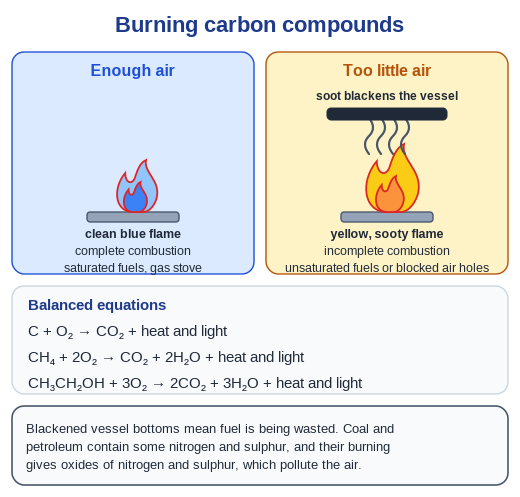
Carbon in any form burns in oxygen to give carbon dioxide with heat and light, and so do most carbon compounds. This is combustion, a kind of oxidation. Balanced:
C + O₂ → CO₂ + heat and light
CH₄ + 2O₂ → CO₂ + 2H₂O + heat and light
CH₃CH₂OH + 3O₂ → 2CO₂ + 3H₂O + heat and light
The flame tells you how well a fuel burns. Saturated hydrocarbons usually burn with a clean blue flame. Unsaturated compounds give a yellow, sooty flame, and so does any fuel without enough air. A gas stove has air holes so the gas burns completely; blackened pans mean the holes are blocked and fuel is wasted. A flame forms only when gases burn, which is why charcoal in an angithi often just glows. Coal and petroleum also contain nitrogen and sulphur, whose oxides pollute the air.
How is ethanol oxidised?
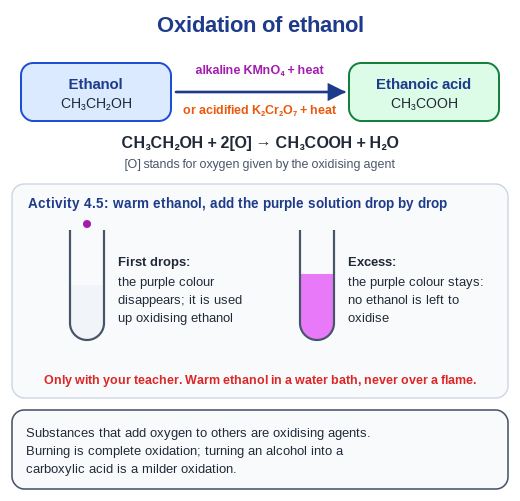
Burning is complete oxidation, but milder oxidation is possible. Warm ethanol with alkaline potassium permanganate or acidified potassium dichromate, and it becomes ethanoic acid. These substances add oxygen to others, so they are oxidising agents. Using [O] for oxygen from the oxidising agent:
CH₃CH₂OH + 2[O] → CH₃COOH + H₂O
When purple permanganate is added drop by drop to warm ethanol, the colour vanishes at first because it is used up. Once all the ethanol has been oxidised, extra drops stay purple.
What is an addition reaction?
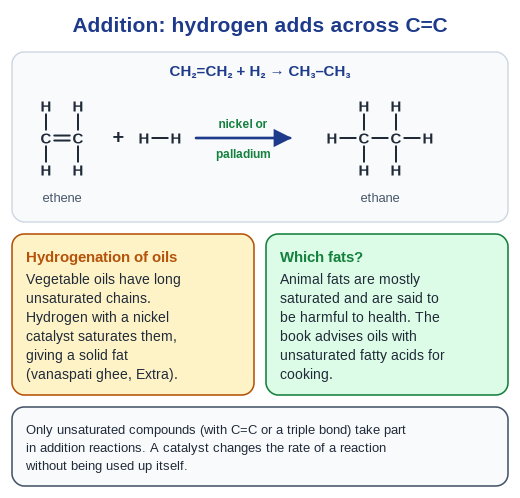
Unsaturated hydrocarbons add hydrogen across their double or triple bond when a catalyst such as nickel or palladium is present. A catalyst changes the rate of a reaction without being changed itself.
CH₂=CH₂ + H₂ → CH₃–CH₃ (nickel catalyst)
Vegetable oils have long unsaturated chains; hydrogenating them with nickel makes them solid. Animal fats are mostly saturated and are said to be harmful to health, so the book advises oils with unsaturated fatty acids for cooking.
What is a substitution reaction?
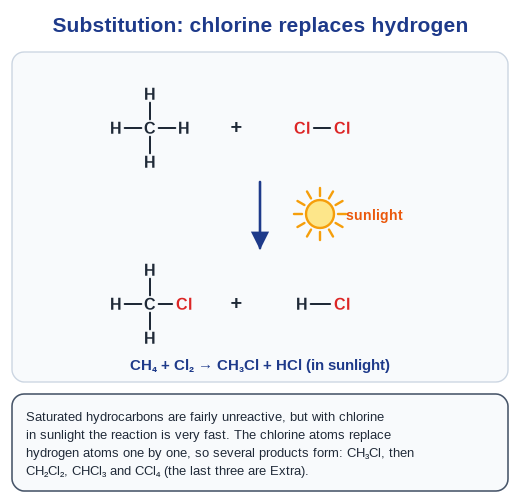
Saturated hydrocarbons ignore most reagents, but chlorine in sunlight reacts with them very fast. Chlorine atoms replace hydrogen atoms one at a time, so several products can form:
CH₄ + Cl₂ → CH₃Cl + HCl (in sunlight)
How does ethanol react?
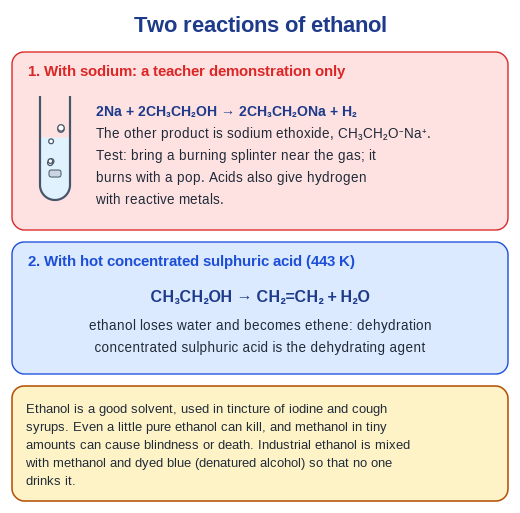
With sodium (only as a teacher demonstration), ethanol gives hydrogen and sodium ethoxide:
2Na + 2CH₃CH₂OH → 2CH₃CH₂ONa + H₂
With excess hot concentrated sulphuric acid at 443 K, ethanol loses water and becomes ethene. The acid is a dehydrating agent:
CH₃CH₂OH → CH₂=CH₂ + H₂O
How does ethanoic acid react?
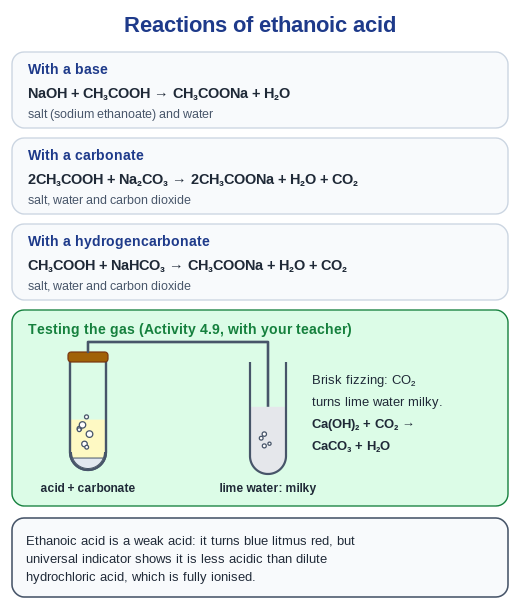
Ethanoic acid is a weak acid, unlike fully ionised hydrochloric acid, but it shows acid reactions:
NaOH + CH₃COOH → CH₃COONa + H₂O
2CH₃COOH + Na₂CO₃ → 2CH₃COONa + H₂O + CO₂
CH₃COOH + NaHCO₃ → CH₃COONa + H₂O + CO₂
The carbon dioxide turns lime water milky.
What are esterification and saponification?
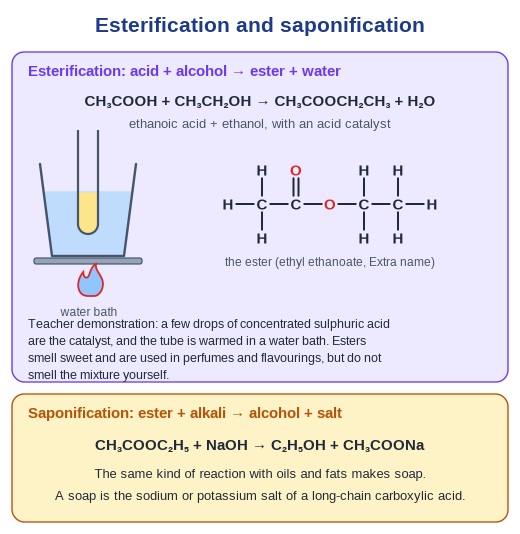
Warmed with ethanol and a little concentrated sulphuric acid as the catalyst, ethanoic acid forms an ester, a sweet-smelling compound used in perfumes and flavourings:
CH₃COOH + CH₃CH₂OH → CH₃COOCH₂CH₃ + H₂O
Heating an ester with sodium hydroxide reverses this, giving the alcohol and the sodium salt of the acid. This is saponification, because soap is made this way from oils and fats:
CH₃COOC₂H₅ + NaOH → C₂H₅OH + CH₃COONa
Stay safe
Ethanol catches fire easily, and concentrated sulphuric acid and sodium are dangerous. Do these reactions only with your teacher, and never taste or smell the products, the ester included. Answers to the activities and exercises are on the NCERT solutions page.
Next: NCERT solutions, or back to homologous series and naming and the chapter notes.
Practice
-
Which reaction turns a vegetable oil into a solid fat?
Show answer
Answer: (b) addition of hydrogen
-
Ethanol heated with excess hot concentrated sulphuric acid at 443 K gives:
Show answer
Answer: (b) ethene
-
Which gas turns lime water milky when ethanoic acid reacts with sodium carbonate?
Show answer
Answer: (c) carbon dioxide
-
Balance the burning of ethyne: C₂H₂ and O₂ give CO₂ and H₂O.
Show answer
Answer: 2C₂H₂ + 5O₂ → 4CO₂ + 2H₂O. Check: C 4 = 4, H 4 = 4, O 10 = 8 + 2.
-
Why does a sooty flame waste fuel?
Show answer
Answer: The soot is unburnt carbon. Burning stopped short of carbon dioxide (incomplete combustion), so part of the fuel’s heat was never released.
Questions students ask
What are the four main chemical properties of carbon compounds?
Combustion (burning in oxygen), oxidation (for example, ethanol to ethanoic acid), addition reactions (unsaturated compounds adding hydrogen) and substitution reactions (chlorine replacing hydrogen in alkanes, in sunlight).
What is the difference between addition and substitution reactions?
In addition, new atoms join across a double or triple bond and nothing leaves, so only unsaturated compounds do it. In substitution, an atom takes the place of another, for example chlorine replacing hydrogen in methane, which saturated compounds can do.
Why do we get a blue flame on a gas stove?
The stove’s air holes mix enough air with the gas for complete combustion, which gives a clean blue flame. If the holes are blocked, burning is incomplete, the flame turns yellow and soot blackens the vessels.
What is an esterification reaction?
It is the reaction of a carboxylic acid with an alcohol, in the presence of an acid catalyst, giving an ester and water. Ethanoic acid and ethanol give a sweet-smelling ester used in perfumes and flavourings.
Stuck on a question?
Take a photo and Lagnever AI explains it step by step. Try it for 7 days for ₹2.
Get it on Google Play Open in browser
For parents: after the trial, the plan renews monthly by UPI or card autopay. You can cancel anytime in the app.