
What is a homologous series, and how are carbon compounds named?
Answer in short
A homologous series is a family of carbon compounds with the same functional group, each member having one more –CH₂– unit (14 u) than the one before, like CH₃OH and C₂H₅OH. Members react alike. A name joins a stem for the number of carbons to an ending for the bonds or the group, as in propanone.
Stuck on a question? Take a photo and Lagnever AI explains it step by step. Try it for 7 days for ₹2. Get it on Google Play
What are saturated and unsaturated hydrocarbons?
A hydrocarbon contains only carbon and hydrogen. To draw one, join the carbon atoms first, then use hydrogen atoms to complete each carbon’s four bonds. For two carbons this gives ethane, C₂H₆, with only single bonds: a saturated compound, fairly unreactive. If only two hydrogens are attached to each carbon, the carbons must share a second pair: ethene, C₂H₄, with a double bond. With one hydrogen each, they share three pairs: ethyne, C₂H₂, with a triple bond. Ethene and ethyne are unsaturated and more reactive.
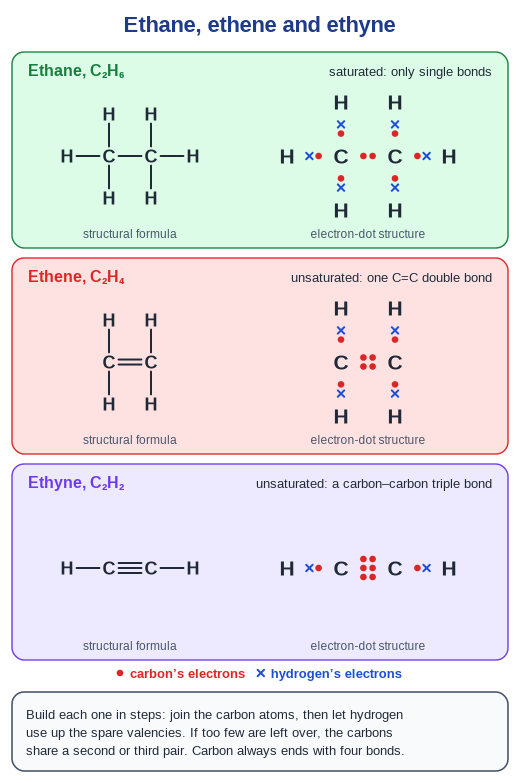
Saturated hydrocarbons are alkanes. Unsaturated ones with a double bond are alkenes, and those with a triple bond alkynes.
How long can a carbon chain be?
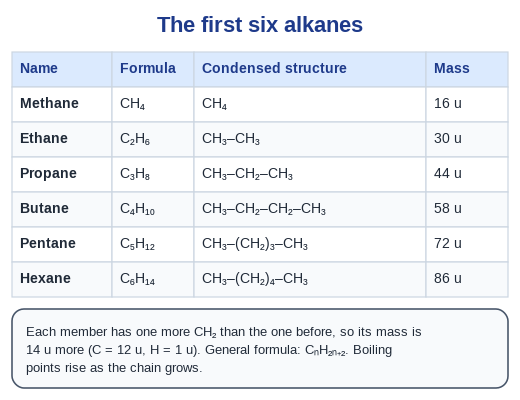
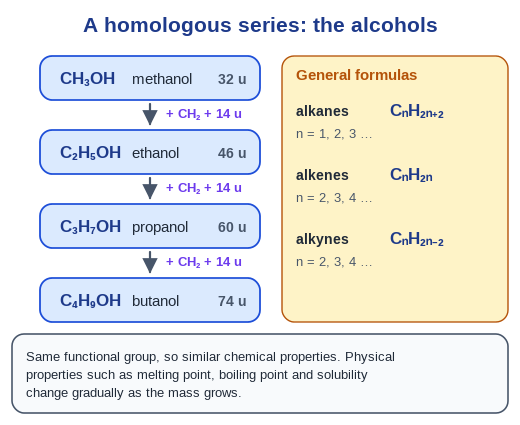
Very long. Adding one carbon at a time gives methane, ethane, propane, butane, pentane and hexane. Each step adds –CH₂–, and the formulas fit CₙH₂ₙ₊₂. Alkenes fit CₙH₂ₙ (ethene C₂H₄, propene C₃H₆, butene C₄H₈) and alkynes CₙH₂ₙ₋₂.
What are structural isomers?
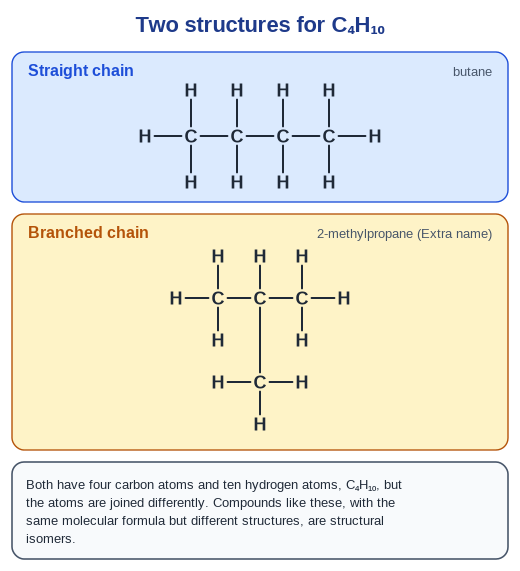
Four carbon atoms can be joined in two ways: a straight chain of four, or a chain of three with the fourth carbon on the middle one. Filling in the hydrogens gives C₄H₁₀ both times. Compounds with the same molecular formula but different structures are structural isomers. Pentane, C₅H₁₂, has three.
Can carbon atoms form rings?
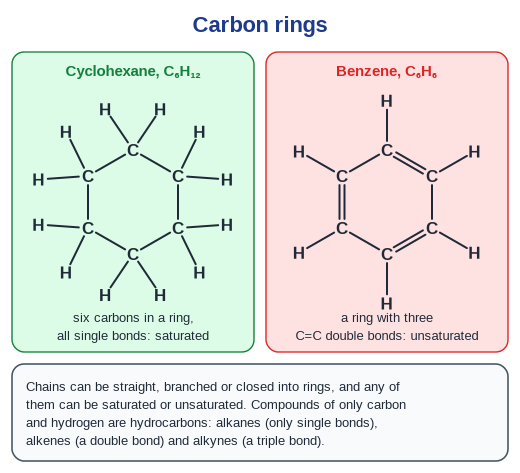
Yes. Six carbons joined in a closed ring with single bonds make cyclohexane, C₆H₁₂. Benzene, C₆H₆, is a six-carbon ring with alternating single and double bonds. Chains and rings, straight or branched, can all be saturated or unsaturated.
What is a functional group?
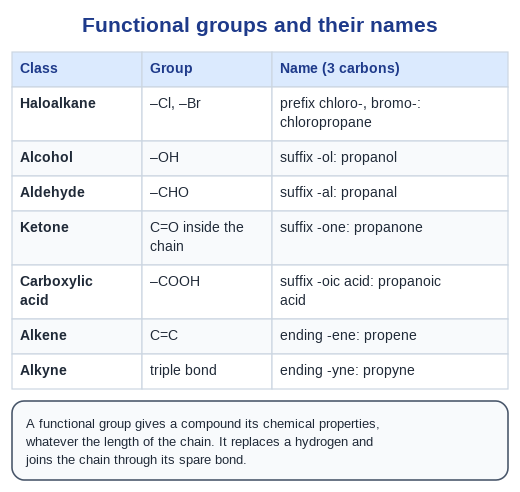
Carbon also bonds to halogens, oxygen, nitrogen and sulphur. When such an atom replaces a hydrogen in a chain it is called a heteroatom, and the atom or group that carries it is a functional group. The group decides the chemical properties, whatever the chain length. The main ones: halo (–Cl, –Br), alcohol (–OH), aldehyde (–CHO), ketone (C=O inside the chain) and carboxylic acid (–COOH).
What is a homologous series?
Put a functional group on chains of growing length and you get a family. CH₃OH, C₂H₅OH, C₃H₇OH and C₄H₉OH all carry –OH and react alike. Each differs from the next by –CH₂–, so the molecular masses (C = 12 u, H = 1 u, O = 16 u) go 32, 46, 60 and 74 u, rising by 14 u each time. Such a family is a homologous series. Physical properties change step by step: melting and boiling points rise with mass, and solubility changes gradually too.
How do I name a carbon compound?
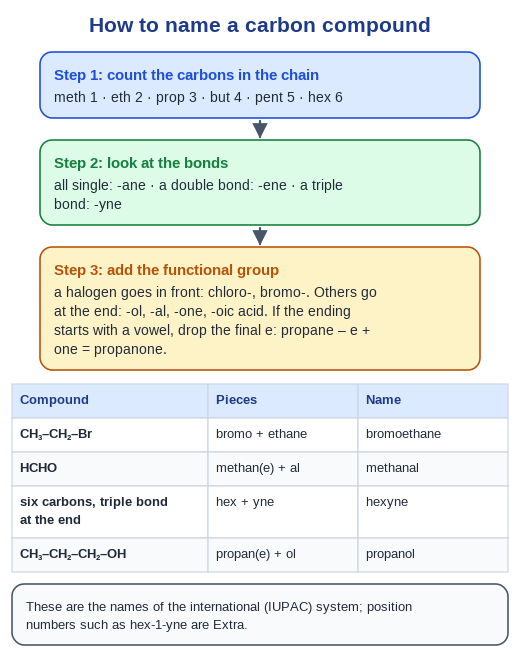
- Count the carbons in the chain: meth (1), eth (2), prop (3), but (4), pent (5), hex (6). Three carbons with single bonds is propane.
- Unsaturated? Change -ane to -ene for a double bond (propene) or -yne for a triple bond (propyne).
- Add the group. Halogens go in front: chloropropane, bromopropane. The others are endings: propanol (-ol), propanal (-al), propanone (-one) and propanoic acid (-oic acid). When the ending begins with a vowel, drop the final e: propane – e + one = propanone.
So CH₃–CH₂–Br is bromoethane and HCHO is methanal.
A tip for the board exam
Practise drawing the isomers of pentane and naming compounds in both directions: from a structure to a name, and from a name to a structure. Worked answers to the page 68–69 Questions box are on the NCERT solutions page.
Next: chemical properties of carbon compounds, or back to covalent bonding in carbon and the chapter notes.
Practice
-
What is the molecular formula of the alkane with five carbon atoms?
Show answer
Answer: (b) C₅H₁₂
-
Which suffix shows a carboxylic acid?
Show answer
Answer: (d) -oic acid
-
By how much do the molecular masses of C₂H₅OH and C₃H₇OH differ?
Show answer
Answer: (b) 14 u
-
Name CH₃CH₂CH₂Cl and CH₃CH₂COOH.
Show answer
Answer: Chloropropane (prefix chloro- on a three-carbon chain) and propanoic acid (propane – e + oic acid). (Chlorine on the end carbon makes it 1-chloropropane, Extra.)
-
Is C₃H₆ an alkane, an alkene or an alkyne?
Show answer
Answer: An alkene: it fits CₙH₂ₙ with n = 3. It is propene, CH₃–CH=CH₂, with one double bond.
Questions students ask
What is a homologous series with an example?
It is a series of carbon compounds with the same functional group whose successive members differ by –CH₂–. The alcohols methanol, ethanol, propanol and butanol are an example; so are the alkanes methane, ethane, propane and butane.
Why do members of a homologous series have similar chemical properties?
Chemical properties depend mainly on the functional group, and every member has the same one. The chain length changes physical properties, such as melting and boiling points, which rise gradually with mass.
What is the difference between an aldehyde and a ketone?
Both have a C=O group. In an aldehyde it is at the end of the chain, as –CHO (propanal); in a ketone it sits between two carbons inside the chain (propanone).
Is this the IUPAC system of naming?
Yes, the method in the book is the basis of the IUPAC names chemists use worldwide. Full IUPAC names also give positions, such as 2-methylpropane or hex-1-yne; those numbers are Extra for this chapter.
Stuck on a question?
Take a photo and Lagnever AI explains it step by step. Try it for 7 days for ₹2.
Get it on Google Play Open in browser
For parents: after the trial, the plan renews monthly by UPI or card autopay. You can cancel anytime in the app.