
How does carbon form covalent bonds?
Answer in short
Carbon has four electrons in its outer shell (2,4). Gaining or losing four electrons is too hard, so carbon shares them. Each shared pair, one electron from each atom, is a covalent bond. Carbon forms four such bonds. No ions form, so covalent compounds melt easily and hardly conduct electricity.
Stuck on a question? Take a photo and Lagnever AI explains it step by step. Try it for 7 days for ₹2. Get it on Google Play
Why can’t carbon simply form ions?
Methane boils at 111 K and ethanol at 351 K, far below any ionic compound, and neither conducts electricity. So the bonds inside them cannot be ionic. The reason lies in carbon’s electrons.
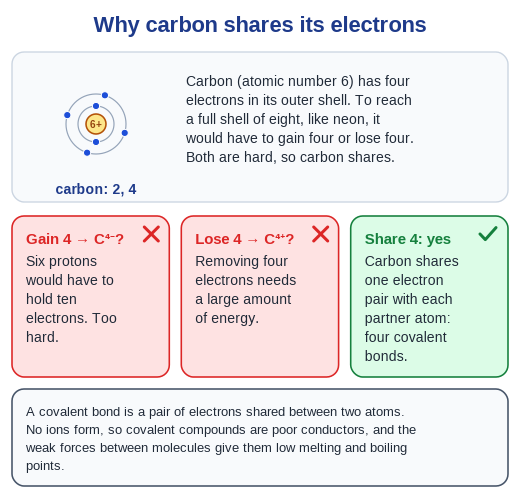
Carbon has atomic number 6: two electrons in the first shell and four in the second (2,4). To get a full outer shell of eight, like neon, it could:
- gain four electrons and become C⁴⁻, but six protons cannot easily hold ten electrons;
- lose four electrons and become C⁴⁺, but that needs a large amount of energy.
Neither works well, so carbon shares its four outer electrons with other atoms.
What is a covalent bond?
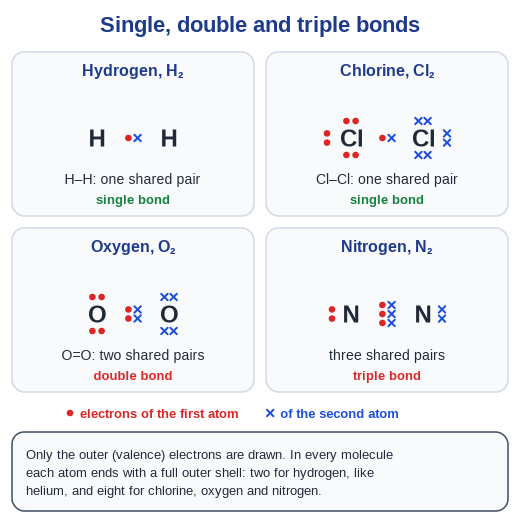
Start with hydrogen. Each hydrogen atom has one electron and wants two, like helium. Two hydrogen atoms each put one electron into a common pair. Both nuclei hold this pair, so each atom now counts two electrons. A shared pair like this is a covalent bond, drawn as a line: H–H.
Other atoms share more. Oxygen (2,6) needs two more electrons, so two oxygen atoms share two pairs: a double bond, O=O. Nitrogen (2,5) needs three, so two nitrogen atoms share three pairs: a triple bond, N≡N. Chlorine (2,8,7) needs one, so Cl₂ has a single bond.
How do I draw an electron-dot structure?
- Write each atom’s electron arrangement and count its outer electrons: H 1, C 4, N 5, O 6, Cl 7.
- Place the atoms next to each other, with carbon in the middle when there is one.
- Between two bonded atoms, put one electron from each: a dot for one atom, a cross for the other.
- Put the leftover outer electrons in pairs on the empty sides. These are lone pairs.
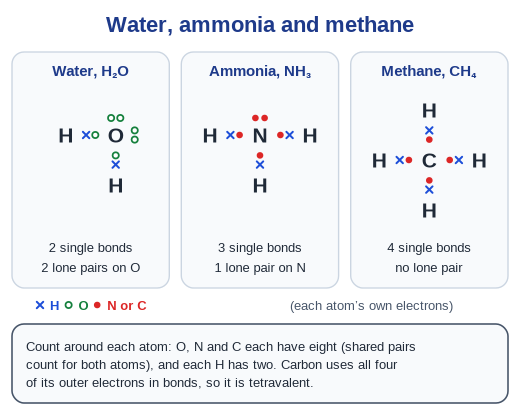
- Check: every atom has eight electrons around it (hydrogen two), counting shared pairs for both atoms.
In methane, CH₄, carbon shares one pair with each of four hydrogen atoms. Carbon is tetravalent: it uses all four outer electrons in bonds. In water, oxygen shares two pairs and keeps two lone pairs; in ammonia, nitrogen shares three and keeps one.
Why do covalent compounds melt so easily?
The bonds inside a molecule are strong, but the pull between separate molecules is weak. Melting and boiling only have to pull molecules apart, not break the bonds, so little heat is needed. The melting points in the book show this: methane 90 K, ethanol 156 K, chloroform 209 K and acetic acid 290 K. Since no charged particles form, these compounds are also poor conductors of electricity.
What are the allotropes of carbon?
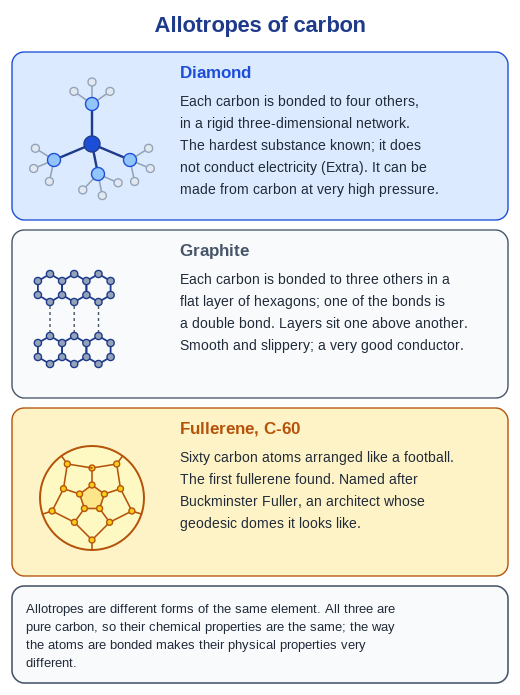
The same element can exist in forms with very different physical properties, called allotropes. In diamond, every carbon atom is bonded to four others in a rigid three-dimensional network, so diamond is extremely hard. In graphite, every carbon atom is bonded to three others in a flat layer of hexagons, with one of the three bonds a double bond; the layers lie on top of one another, so graphite is smooth and slippery, and it conducts electricity, unusual for a non-metal. Fullerenes, such as C-60, are balls of carbon atoms shaped like a football. All of them are pure carbon, so their chemical properties are the same.
Why does carbon form so many compounds?
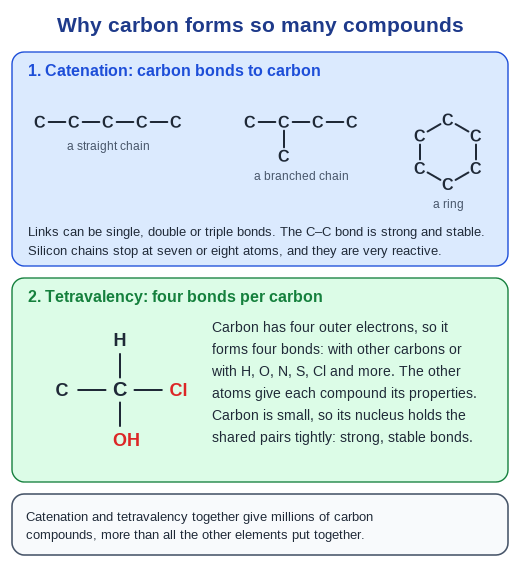
Chemists know the formulae of millions of carbon compounds, more than for all the other elements together. Two properties explain this. Catenation: carbon atoms join to one another in long chains, branched chains and rings. Tetravalency: each carbon makes four bonds, to carbon or to atoms such as hydrogen, oxygen, nitrogen, sulphur and chlorine. Because carbon atoms are small, their bonds are strong and the compounds are stable.
A tip for the board exam
Practise electron-dot structures of CH₄, CO₂, N₂, CH₃Cl and ethanoic acid, and count eight electrons around every atom before you move on. Worked answers are on the NCERT solutions page.
Next: homologous series and naming, or back to the chapter notes.
Practice
-
How many electrons are shared in a double bond?
Show answer
Answer: (c) 4
-
Which molecule has a triple bond?
Show answer
Answer: (c) N₂
-
Diamond and graphite are both pure carbon, yet diamond is very hard and graphite is slippery, because:
Show answer
Answer: (b) their carbon atoms are bonded differently
-
Why does carbon not form a C⁴⁺ ion?
Show answer
Answer: Removing all four outer electrons would need a large amount of energy, leaving six protons holding only two electrons. Sharing is far easier.
-
How many lone pairs does the oxygen atom in water have?
Show answer
Answer: Two. Oxygen has six outer electrons: two are shared with the hydrogens and four stay as two lone pairs, so oxygen ends with eight.
Questions students ask
What is a covalent bond in simple words?
It is a pair of electrons shared between two atoms, with each atom giving one electron. Both nuclei hold the pair, so both atoms reach a full outer shell.
Why are covalent compounds poor conductors of electricity?
Their electrons stay shared inside the molecules and no ions form. With no charged particles able to move, there is almost nothing to carry a current.
How many bonds does carbon form?
Four, because it has four outer electrons. They can be four single bonds, as in methane, or include double or triple bonds, as in ethene and ethyne.
What is the electron-dot structure of methane?
Write C in the middle with four H atoms around it. Between C and each H, put one dot for carbon’s electron and one cross for hydrogen’s. Carbon then has eight electrons around it and each hydrogen two.
Stuck on a question?
Take a photo and Lagnever AI explains it step by step. Try it for 7 days for ₹2.
Get it on Google Play Open in browser
For parents: after the trial, the plan renews monthly by UPI or card autopay. You can cancel anytime in the app.