
NCERT Solutions Class 10 Science Chapter 5: Life Processes
Answers to the five Questions boxes inside Chapter 5, Life Processes, the other questions the chapter asks along the way, Activities 5.1–5.8, and all thirteen end-of-chapter exercises, from Science, the Class 10 NCERT textbook. Page numbers follow the 2026-27 reprint (pages 79–99). The exercises are quoted from the book; the in-chapter questions are restated in short. Every equation below was checked atom by atom. Short notes: Chapter 5 notes.
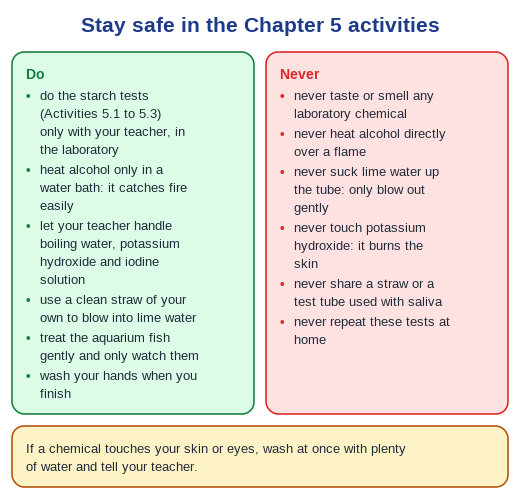
Stay safe. Do the starch tests and the lime-water activities only in the laboratory with your teacher. Alcohol catches fire easily, so it is heated only in a water bath; boiling water, iodine solution and potassium hydroxide are handled by the teacher. Never taste or smell a chemical, and when you blow into lime water, never suck it up.
Questions, page 81
Question 1 (page 81): why diffusion cannot meet the oxygen needs of many-celled organisms like us. In a large body most cells are deep inside, far from the surface that touches the air. Diffusion is a slow process and works only over very short distances, so oxygen would take far too long to reach these cells (the book estimates about three years from lungs to toes). We therefore need lungs to take in oxygen and blood, with haemoglobin, to carry it quickly.
Question 2 (page 81): how we decide whether something is alive. Visible movement, such as walking, breathing or growing, is the usual sign, but it is not enough: a sleeping animal or a plant may show none. The surer test is the invisible movement of molecules inside the body, which goes on as long as the organism carries out its life processes to maintain and repair itself.
Question 3 (page 81): what an organism uses outside raw materials for. Food supplies energy and the carbon-based materials for growth and repair. Oxygen is used to break down food and release that energy. Water is the medium for the reactions of the body (Extra), and plants also need carbon dioxide and minerals to build their food and their bodies.
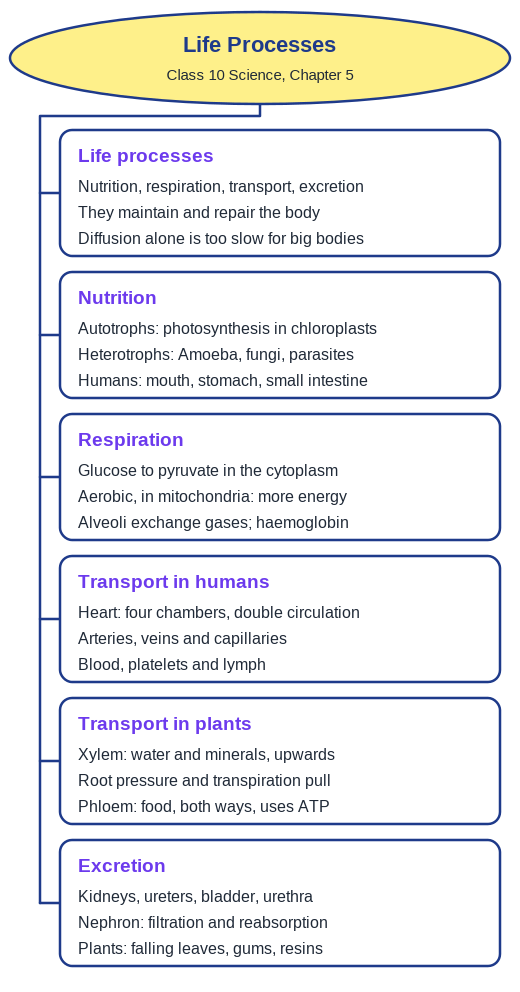
Question 4 (page 81): the processes essential for maintaining life. Nutrition, respiration, transportation of materials inside the body and excretion of wastes.
Questions, page 87
Question 1 (page 87): autotrophic and heterotrophic nutrition compared.
| Autotrophic nutrition | Heterotrophic nutrition | |
|---|---|---|
| Food | made by the organism itself from carbon dioxide and water | complex food made by other organisms is taken in |
| Needs | sunlight and chlorophyll | enzymes to break the food down |
| Seen in | green plants and some bacteria | animals and fungi |
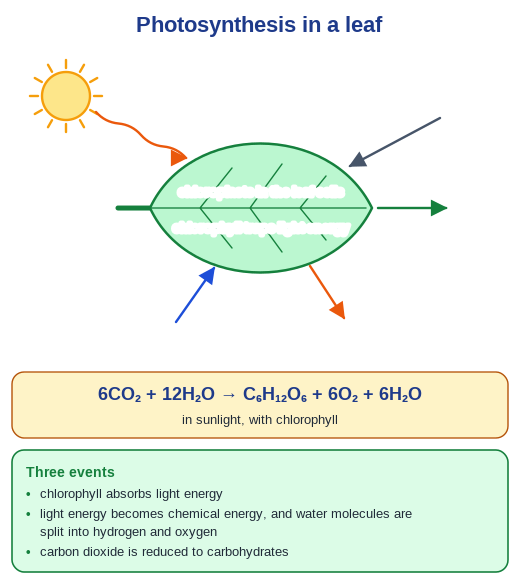
Question 2 (page 87): where plants get each raw material for photosynthesis. Carbon dioxide comes from the air through the stomata. Water is absorbed from the soil by the roots. Sunlight provides the energy, and chlorophyll in the chloroplasts traps it. Minerals such as nitrogen, phosphorus, iron and magnesium, needed to build the plant body, also come from the soil.
Question 3 (page 87): what the stomach’s acid does. Hydrochloric acid makes the medium in the stomach acidic, which the enzyme pepsin needs in order to digest proteins. It also kills many of the germs swallowed with food (Extra).
Question 4 (page 87): the function of digestive enzymes. Food molecules such as starch, proteins and fats are too large and complex to be absorbed. Digestive enzymes are biological catalysts that break them into small, simple molecules, namely glucose, amino acids, and fatty acids and glycerol, which can pass through the wall of the intestine into the blood.
Question 5 (page 87): how the small intestine is designed to absorb digested food. Its inner lining has a very large number of finger-like projections called villi, which make the absorbing surface far larger. Each villus has many blood vessels, and these take the absorbed food to all the cells of the body. It is also the longest part of the canal, coiled to fit into a small space.
Questions, page 91
Question 1 (page 91): the advantage of a land organism over a water organism in getting oxygen. Air contains far more oxygen than the small amount dissolved in water. A land animal can therefore get enough oxygen with a slower rate of breathing, while a fish has to pass water over its gills much faster.
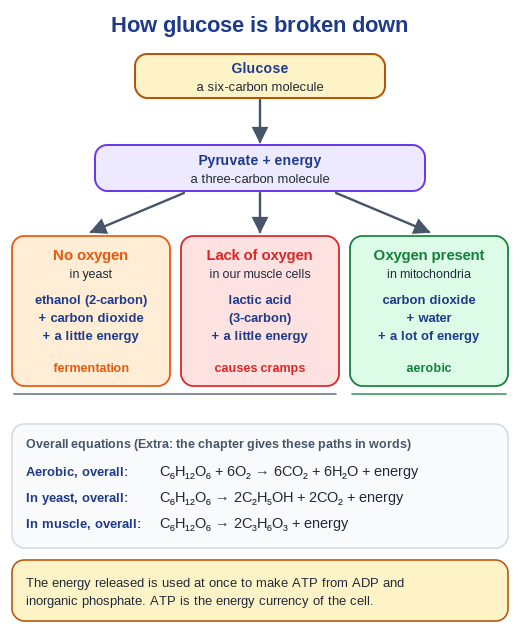
Question 2 (page 91): the pathways by which organisms oxidise glucose to get energy. In all organisms glucose is first broken in the cytoplasm into pyruvate, a three-carbon molecule. Then: (i) in yeast, without oxygen, pyruvate gives ethanol and carbon dioxide; (ii) in our muscle cells, when oxygen is short, it gives lactic acid; (iii) with oxygen, in the mitochondria, it is broken down completely to carbon dioxide and water. The third, aerobic path releases much more energy than the two anaerobic paths.
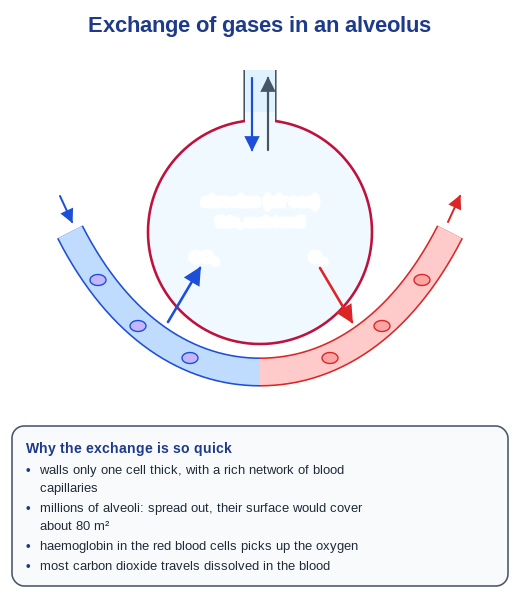
Question 3 (page 91): how oxygen and carbon dioxide are transported in human beings. Oxygen is carried by haemoglobin, the respiratory pigment of the red blood corpuscles, which picks it up in the lungs and releases it in the tissues. Carbon dioxide is more soluble in water, so it is carried mostly dissolved in the blood, from the tissues to the lungs.
Question 4 (page 91): how the lungs are designed to give the largest area for exchange of gases. Inside the lungs the air passage branches into ever finer tubes that end in millions of balloon-like alveoli. Together they give a huge surface, about 80 m² if spread out. Their walls are very thin and covered by a dense network of blood capillaries, so gases pass across quickly.
Questions, page 96
Question 1 (page 96): the parts of the human transport system and their jobs. The heart pumps the blood. Blood is the carrying fluid: plasma carries food, carbon dioxide and nitrogenous wastes, red blood corpuscles carry oxygen, and platelets help clotting. Blood vessels are the tubes: arteries carry blood away from the heart, veins bring it back, and capillaries exchange materials with the cells. Lymph carries absorbed fat and returns extra tissue fluid to the blood.
Question 2 (page 96): why oxygen-rich and oxygen-poor blood must be kept apart in mammals and birds. Mammals and birds keep their body temperature constant, which needs a great deal of energy all the time. Keeping the two kinds of blood apart means that the blood sent to the body is fully loaded with oxygen, so the cells get an efficient supply for respiration.
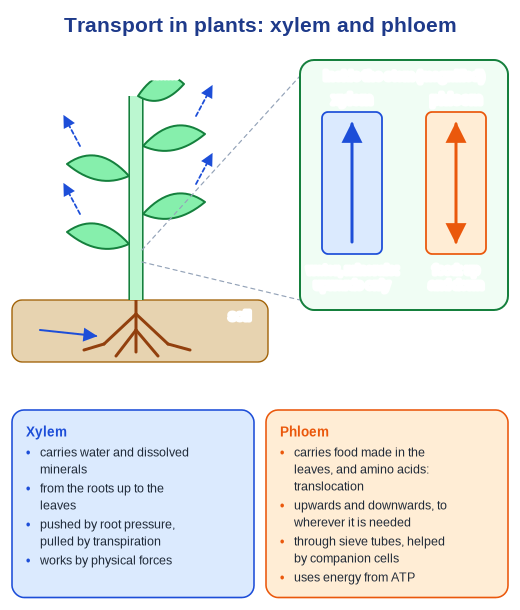
Question 3 (page 96): what makes up the transport system of well-organised plants. Xylem, with vessels and tracheids, carries water and minerals from the roots. Phloem, with sieve tubes and companion cells, carries the products of photosynthesis, amino acids and other substances from the leaves to the rest of the plant.
Question 4 (page 96): how water and minerals are transported in plants. Root cells take up ions from the soil, so water moves into the root and then into the xylem, and this root pressure pushes the water column upwards. In the daytime, water evaporating from the leaves through the stomata (transpiration) creates a suction that pulls water, with the minerals dissolved in it, up the continuous xylem tubes from the roots to the leaves.
Question 5 (page 96): how food is transported in plants. By translocation in the phloem. Sucrose made in the leaves is loaded into the sieve tubes using energy from ATP. This raises the osmotic pressure, water enters, and the pressure moves the food to parts where the pressure is lower: roots, fruits, seeds and growing buds. The movement can be upwards or downwards.
Questions, page 98
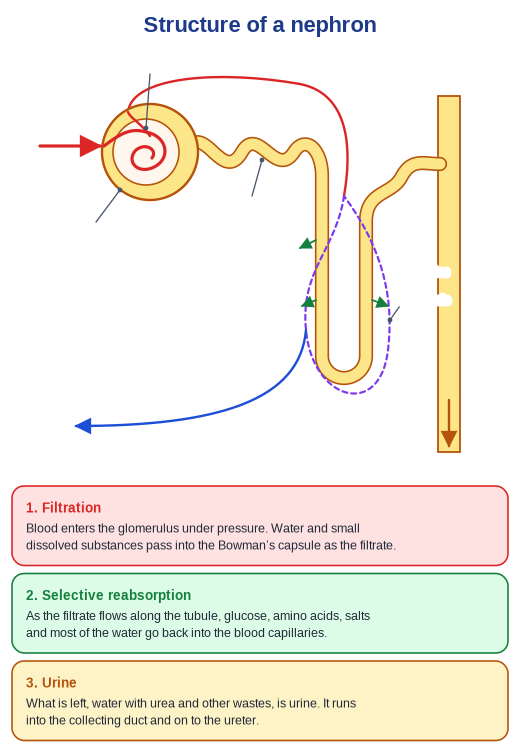
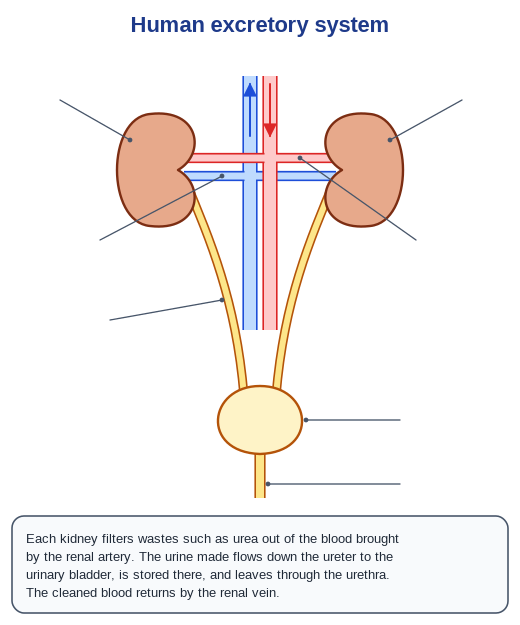
Question 1 (page 98): the structure and working of nephrons. A nephron is the filtering unit of the kidney. It has a knot of blood capillaries with very thin walls, the glomerulus, held in a cup-shaped Bowman’s capsule, and a long coiled tube that leads to a collecting duct. Blood is filtered in the glomerulus and the filtrate collects in the capsule. As the filtrate flows along the tube, useful substances, namely glucose, amino acids, salts and most of the water, are selectively reabsorbed into the capillaries around it. The liquid left is urine, which passes to the ureter.
Question 2 (page 98): how plants get rid of excretory products. Oxygen and carbon dioxide leave through the stomata, and extra water is lost by transpiration. Many wastes are stored in cell vacuoles or in leaves that fall off. Others are stored as gums and resins, especially in old xylem, and some are passed into the soil around the roots.
Question 3 (page 98): how the amount of urine is regulated. By reabsorption of water in the tubules of the nephrons. How much water is taken back depends on how much extra water the body has and how much dissolved waste has to be removed. With plenty of water in the body, less is reabsorbed and more, dilute urine is formed; when water is short, more is reabsorbed and the urine is less and more concentrated.
Other questions inside the chapter
An experiment to show that sunlight is needed (page 83). The book only asks you to design one; this design is ours (Extra). Keep a potted plant in the dark for three days. Cover part of one leaf on both sides with a strip of black paper and leave the plant in the sun for some six hours. Test the leaf for starch with your teacher: the covered part stays pale and the uncovered part turns blue-black, so starch forms only where light falls.
The other job of the stomach acid, and “acidity” (pages 85–86). The acid also kills many germs that come in with food (Extra). “Acidity” is the burning feeling when the stomach makes too much acid or the acid irritates the lining that mucus normally protects (Extra: the book only asks the question).
The surface area of your body (page 91). The skin of an adult covers less than 2 m² (Extra), so the alveoli, at about 80 m², offer a far larger surface for exchanging gases.
Activities 5.1 to 5.8
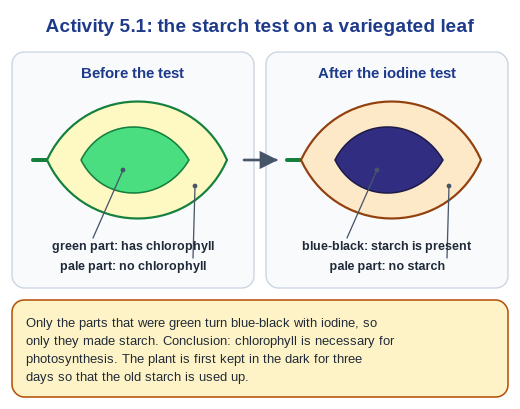
Activity 5.1 (page 82): is chlorophyll needed? With your teacher: a destarched variegated leaf is kept in sunlight, boiled in water, and then warmed in alcohol in a water bath. The leaf loses its green colour and the alcohol turns green, because chlorophyll dissolves in it. With dilute iodine, only the parts that were green turn blue-black. Starch forms only where chlorophyll is present.
Activity 5.2 (page 83): is carbon dioxide needed? Two destarched plants are sealed under bell jars; one jar also holds potassium hydroxide, which absorbs carbon dioxide (Extra, the equation: 2KOH + CO₂ → K₂CO₃ + H₂O). After two hours in sunlight, the leaf from the jar with potassium hydroxide shows no starch and the other turns blue-black. Carbon dioxide is necessary for photosynthesis.
Activity 5.3 (page 85): what does saliva do to starch? In test tube A, with saliva, iodine gives no blue-black colour: the starch is gone. In test tube B, without saliva, it turns blue-black. Salivary amylase has broken the starch down into sugar. Each student uses only their own saliva and test tube.
Activity 5.4 (page 87): air we breathe out. Lime water turns milky quickly when we blow into it, but takes much longer when room air is pushed through with a syringe or pichkari. Breathed-out air has much more carbon dioxide (Extra, the equation: Ca(OH)₂ + CO₂ → CaCO₃ + H₂O).
Activity 5.5 (page 87): fermentation. Sugar solution with yeast gives off a gas that turns lime water milky after some time. Fermentation produces carbon dioxide (and ethanol).
Activity 5.6 (page 89): fish in an aquarium. The fish opens its mouth and then its gill covers in turn: water enters by the mouth and leaves over the gills. It does this many more times in a minute than we breathe, because water holds little dissolved oxygen.
Activity 5.7 (page 91): haemoglobin levels. Ask at a health centre for the normal ranges; they differ between children and adults, and are usually somewhat higher in men than in women (Extra). Record the ranges you are given rather than copying numbers from elsewhere.
Activity 5.8 (page 95): transpiration. Drops of water collect inside the plastic sheet over the plant but not over the stick. The water came from the plant’s leaves, as vapour lost by transpiration.
Exercises 1 to 4: choose the correct option
1. “The kidneys in human beings are a part of the system for (a) nutrition. (b) respiration. (c) excretion. (d) transportation.”
(c) Excretion. The kidneys filter nitrogenous wastes out of the blood and form urine.
2. “The xylem in plants are responsible for (a) transport of water. (b) transport of food. (c) transport of amino acids. (d) transport of oxygen.”
(a) Transport of water. Xylem carries water and the minerals dissolved in it; food and amino acids travel in the phloem.
3. “The autotrophic mode of nutrition requires (a) carbon dioxide and water. (b) chlorophyll. (c) sunlight. (d) all of the above.”
(d) All of the above. Carbon dioxide and water are the raw materials, sunlight gives the energy and chlorophyll traps it.
4. “The breakdown of pyruvate to give carbon dioxide, water and energy takes place in (a) cytoplasm. (b) mitochondria. (c) chloroplast. (d) nucleus.”
(b) Mitochondria. Glucose is broken to pyruvate in the cytoplasm, but pyruvate is broken down with oxygen in the mitochondria.
Exercises 5 to 8: nutrition and respiration
5. “How are fats digested in our bodies? Where does this process take place?”
Fats are digested in the small intestine. They arrive as large globules on which enzymes cannot act well. Bile salts, from the liver, break them into tiny globules (emulsification), and bile also makes the food alkaline. Lipase in the pancreatic juice then breaks down the emulsified fats, and the enzymes of the intestinal juice complete the change to fatty acids and glycerol, which are absorbed by the villi.
6. “What is the role of saliva in the digestion of food?”
Saliva wets the food so that it passes smoothly along the soft lining of the canal. It contains the enzyme salivary amylase, which breaks down starch, a complex molecule, into simple sugar. So the digestion of starch begins in the mouth.
7. “What are the necessary conditions for autotrophic nutrition and what are its by-products?”
Conditions: carbon dioxide and water as raw materials, sunlight as the source of energy, and chlorophyll to absorb it. By-products: oxygen, and water, as the equation shows: 6CO₂ + 12H₂O → C₆H₁₂O₆ + 6O₂ + 6H₂O. The main product is carbohydrate (glucose), stored as starch.
8. “What are the differences between aerobic and anaerobic respiration? Name some organisms that use the anaerobic mode of respiration.”
| Aerobic respiration | Anaerobic respiration | |
|---|---|---|
| Oxygen | needed | not needed |
| Breakdown of glucose | complete | incomplete |
| End products | carbon dioxide and water | ethanol and carbon dioxide, or lactic acid |
| Energy | a lot | much less |
| Place | cytoplasm, then mitochondria | cytoplasm only (Extra) |
Organisms: yeast respires anaerobically, and so do some bacteria (Extra). Our own muscle cells also do so for a short time when oxygen is short.
Exercises 9 to 11: breathing and blood
9. “How are the alveoli designed to maximise the exchange of gases?”
- They are tiny, balloon-like sacs, and there are millions of them, so the total surface is enormous: about 80 m² if spread out.
- Their walls are extremely thin, so gases have only a very short distance to cross.
- The walls carry an extensive network of blood capillaries, so blood is always close to the air.
- The lungs always hold some air, so exchange goes on throughout the breathing cycle.
10. “What would be the consequences of a deficiency of haemoglobin in our bodies?”
Haemoglobin carries oxygen from the lungs to the tissues. With too little of it, the blood carries less oxygen, so the cells cannot release enough energy from food. The person feels tired and weak, becomes breathless quickly and looks pale. This condition is called anaemia (Extra).
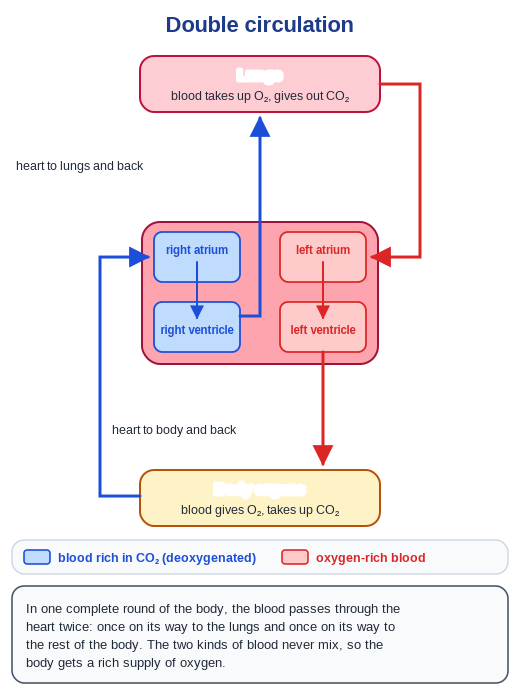
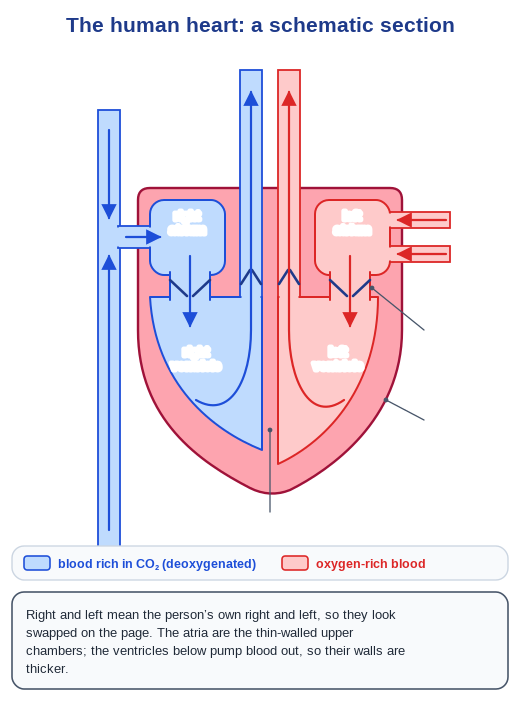
11. “Describe double circulation of blood in human beings. Why is it necessary?”
In human beings the blood passes through the heart twice in one complete round of the body.
- Heart to lungs and back: blood rich in carbon dioxide goes from the right ventricle to the lungs, takes up oxygen there and returns to the left atrium.
- Heart to body and back: the oxygen-rich blood moves into the left ventricle, is pumped to all parts of the body, gives up its oxygen and returns to the right atrium.
Why it is necessary: the right and left sides of the heart are separate, so oxygen-rich blood does not mix with blood rich in carbon dioxide. The body therefore gets a highly efficient supply of oxygen. Human beings, like other mammals and birds, need this because they use energy all the time to keep their body temperature constant.
Exercises 12 and 13: comparisons
12. “What are the differences between the transport of materials in xylem and phloem?”
| Xylem | Phloem | |
|---|---|---|
| What is carried | water and dissolved minerals | products of photosynthesis, amino acids and other substances |
| Direction | upwards, from roots to leaves | both upwards and downwards |
| Conducting cells | vessels and tracheids | sieve tubes with companion cells |
| Driving force | root pressure and transpiration pull: physical forces | energy from ATP raises the osmotic pressure |
13. “Compare the functioning of alveoli in the lungs and nephrons in the kidneys with respect to their structure and functioning.”
| Alveoli (lungs) | Nephrons (kidneys) | |
|---|---|---|
| Structure | thin-walled, balloon-like air sacs at the ends of the smallest air tubes | a cup-shaped Bowman’s capsule around a cluster of capillaries, joined to a long tubule |
| Blood supply | surrounded by a dense network of capillaries | the glomerulus inside the capsule, and capillaries around the tubule |
| What is removed from the blood | carbon dioxide | nitrogenous wastes such as urea and uric acid |
| How | diffusion of gases across the thin wall; oxygen enters the blood | filtration, then selective reabsorption of useful substances |
| Surface | very large because the units are tiny and very many | very large because the units are tiny and very many |
Both are the working units of their organs, both bring blood very close to a thin surface, and both clean the blood: the alveoli of a gaseous waste, the nephrons of dissolved wastes.
Practice
-
Which of these is a parasite?
Show answer
Answer: (b) cuscuta (amar-bel)
-
In which form is most of the carbon dioxide carried in our blood?
Show answer
Answer: (b) dissolved in the blood
-
Which vessel carries blood from the right ventricle to the lungs?
Show answer
Answer: (c) pulmonary artery
-
Write the balanced equation of photosynthesis and name the two conditions written on the arrow.
Show answer
Answer: 6CO₂ + 12H₂O → C₆H₁₂O₆ + 6O₂ + 6H₂O, with sunlight and chlorophyll on the arrow. Check: C 6 = 6; H 24 = 12 + 12; O 12 + 12 = 6 + 12 + 6.
-
A healthy adult forms about 180 L of filtrate in the kidneys each day but passes only 1 to 2 L of urine. Where does the rest go?
Show answer
Answer: It is reabsorbed. As the filtrate flows along the tubules of the nephrons, most of the water, along with glucose, amino acids and salts, is taken back into the blood capillaries around the tubules.
Stuck on a question?
Take a photo and Lagnever AI explains it step by step. Try it for 7 days for ₹2.
Get it on Google Play Open in browser
For parents: after the trial, the plan renews monthly by UPI or card autopay. You can cancel anytime in the app.