
Class 10 Science Chapter 5: Life Processes Notes
This chapter in five lines
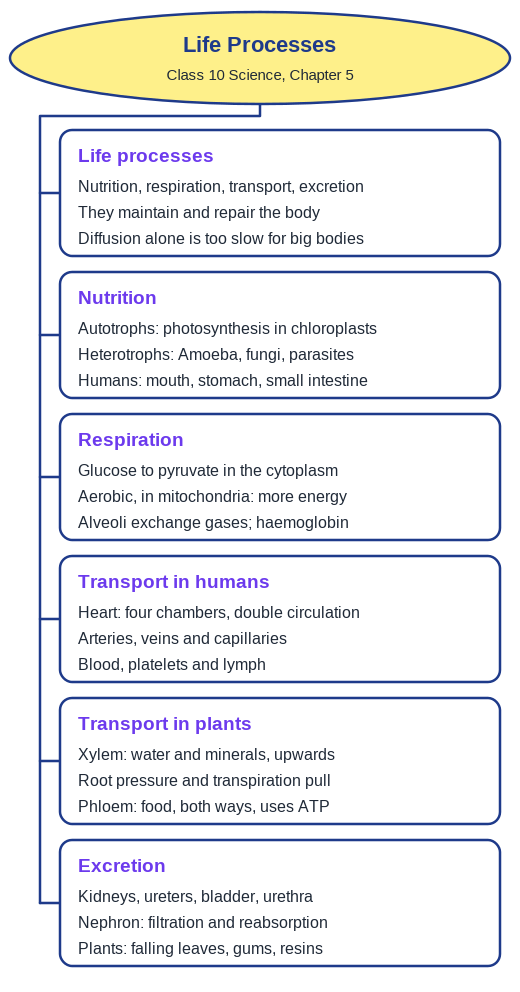
Life processes are the jobs that keep a living body maintained: nutrition, respiration, transportation and excretion. Plants make food by photosynthesis; animals digest food made by others. Respiration releases energy from glucose as ATP. The heart, blood and blood vessels, or xylem and phloem in plants, carry materials. Kidneys filter wastes out of the blood as urine.
What is this chapter about?
A sleeping dog does not move, yet we know it is alive, because it breathes. A neem tree does not walk, yet it grows. Movement that we can see is not a sure sign of life, but inside every living body molecules are always on the move. A living body is a highly organised structure, and the surroundings keep wearing that order down. So the body must keep repairing and maintaining itself, every minute, even in sleep. This chapter studies the jobs that do this maintenance in plants and in human beings.
How do we stay safe in this chapter’s activities?
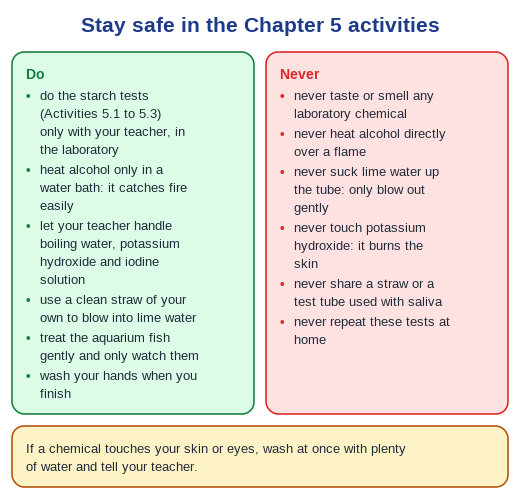
Some activities use boiling water, hot alcohol, iodine solution and potassium hydroxide. Do them only in the laboratory with your teacher. Alcohol catches fire easily, so it is heated only in a water bath. Never taste or smell any chemical, and blow only gently into lime water without sucking it up.
What are life processes?
The processes that together keep a body maintained are life processes. Maintenance needs energy, and the energy comes from food taken from outside: this is nutrition. Food is broken down inside the cells, mostly with the help of oxygen, to release its energy: this is respiration. A single-celled organism touches its surroundings all over, so diffusion can bring in food and oxygen and take away wastes. In a large, many-celled body most cells are far from the surface and diffusion is too slow. Such bodies need special organs to take things in, a transportation system to carry them, and a way to remove harmful wastes, called excretion.
How do plants make their food?
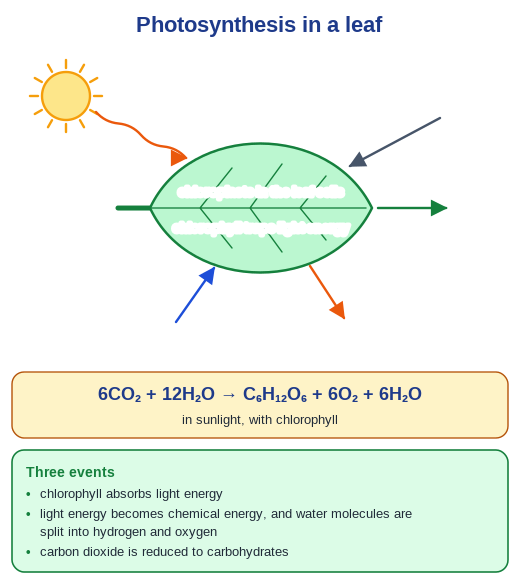
Autotrophs, the green plants and some bacteria, make food from simple inorganic materials. In photosynthesis, chlorophyll absorbs light energy; the energy is used to split water into hydrogen and oxygen; and carbon dioxide is reduced to carbohydrates:
6CO₂ + 12H₂O → C₆H₁₂O₆ + 6O₂ + 6H₂O (in sunlight, with chlorophyll)
Carbohydrate that is not used at once is stored as starch, just as we store some energy as glycogen. Read nutrition in plants and humans.
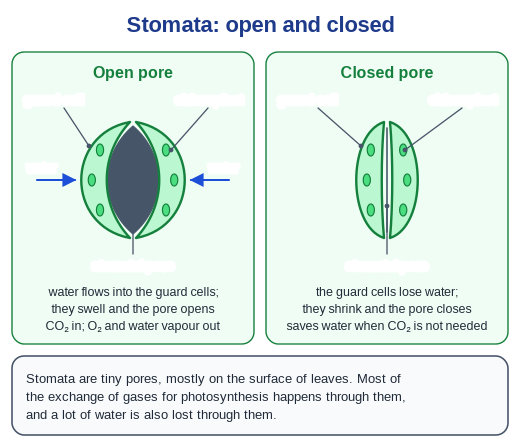
Carbon dioxide enters through stomata, tiny pores on the leaf. Each pore lies between two guard cells. When water flows into the guard cells they swell and the pore opens; when they lose water they shrink and it closes. When no carbon dioxide is needed the plant shuts the pores, because a lot of water escapes through them. Water, and minerals such as nitrogen, phosphorus, iron and magnesium, come from the soil through the roots. Nitrogen, needed for proteins, is taken up as nitrates or nitrites, or as organic compounds made by bacteria from the nitrogen of the air.
How do heterotrophs such as Amoeba get food?
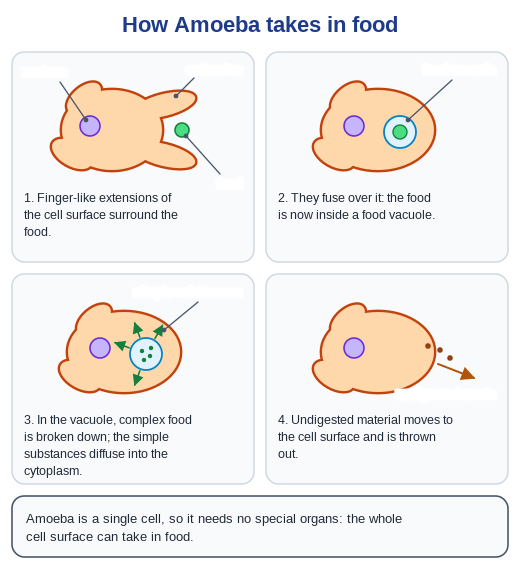
Heterotrophs depend, directly or indirectly, on autotrophs. Fungi such as bread mould, yeast and mushrooms break food down outside the body and then absorb it. Animals such as cows and lions take food in and break it down inside. Parasites, such as cuscuta (amar-bel), ticks, lice, leeches and tapeworms, take nutrition from a living plant or animal without killing it. Amoeba surrounds a food particle with finger-like extensions of its surface, which fuse to form a food vacuole. There the food is broken into simple substances that diffuse into the cytoplasm; the undigested part is thrown out at the surface. Paramoecium has a fixed shape and takes food in at one spot, swept there by its cilia.
How is food digested in human beings?
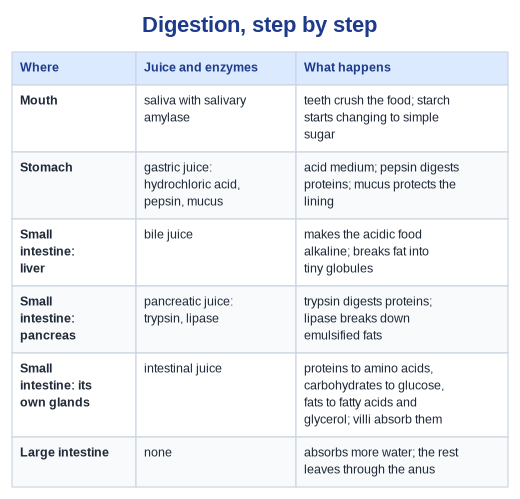
The alimentary canal is a long tube from the mouth to the anus. Teeth crush the food and saliva wets it; the enzyme salivary amylase begins to change starch into simple sugar. Rhythmic contractions of the canal wall, called peristaltic movements, push the food along. In the stomach, gastric glands release hydrochloric acid, the protein-digesting enzyme pepsin, and mucus that protects the stomach lining. A sphincter muscle lets the food into the small intestine a little at a time.
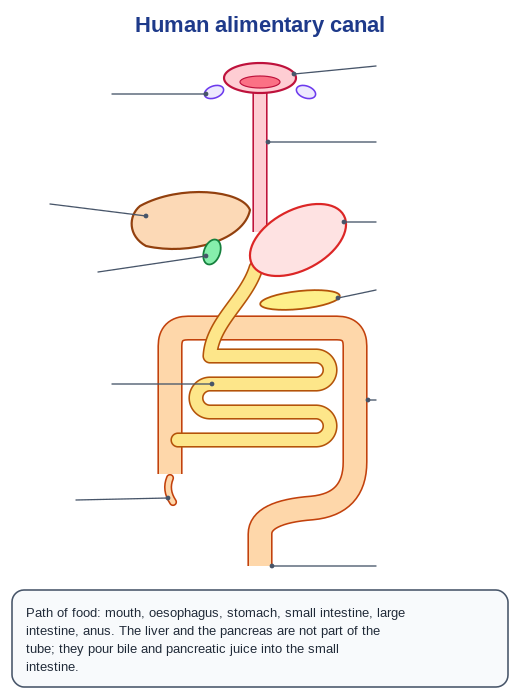
The small intestine is the longest part of the canal and the place where carbohydrates, proteins and fats are completely digested. Bile juice from the liver makes the acidic food alkaline and breaks fats into tiny globules (emulsification). Pancreatic juice brings trypsin for proteins and lipase for fats. The intestinal juice finishes the work: proteins become amino acids, carbohydrates become glucose, and fats become fatty acids and glycerol. Finger-like villi absorb the digested food into the blood. The large intestine absorbs more water, and the rest leaves through the anus. Herbivores that eat grass need a longer small intestine than carnivores such as tigers, because cellulose is hard to digest.
Tooth decay (dental caries) starts when bacteria act on sugars and make acids that soften the enamel. Brushing after meals removes the plaque before the acid forms.
How do cells release energy from food?
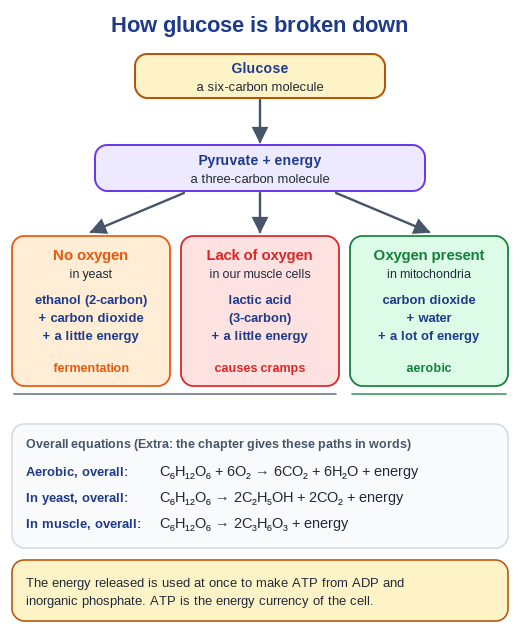
In every organism the first step is the same: in the cytoplasm, glucose (six carbons) is broken into pyruvate (three carbons). What follows depends on oxygen. Yeast, without oxygen, turns pyruvate into ethanol and carbon dioxide (fermentation). Our muscle cells, when short of oxygen during sudden activity, turn it into lactic acid, whose build-up causes cramps. Both are anaerobic. With oxygen, pyruvate is broken down in the mitochondria to carbon dioxide and water: aerobic respiration, which releases far more energy. The energy is used to make ATP; breaking the end phosphate link of ATP with water gives 30.5 kJ/mol. Read respiration.
How do we breathe?
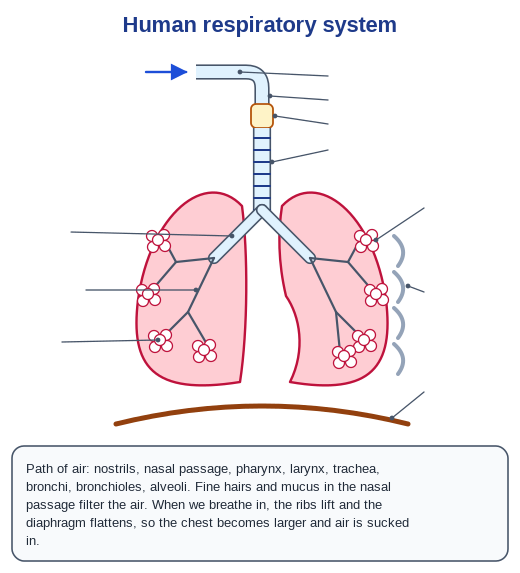
Plants exchange gases by diffusion through their stomata. Fishes take in the oxygen dissolved in water through their gills; because water holds much less oxygen than air, they breathe faster than land animals. In human beings air goes through the nostrils, where fine hairs and mucus filter it, then through the throat, past rings of cartilage that keep the windpipe open, and into the lungs. There the tubes divide again and again and end in balloon-like alveoli.
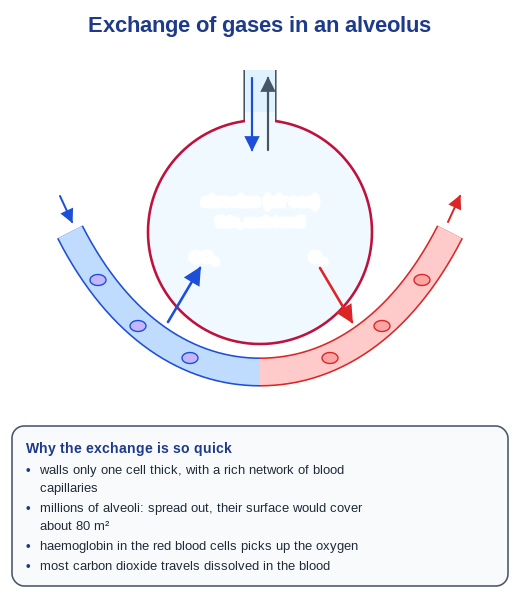
The thin walls of the alveoli carry a dense network of blood capillaries. Oxygen passes into the blood and carbon dioxide passes out. Haemoglobin, the red pigment in red blood corpuscles, picks up the oxygen and carries it to the tissues. Carbon dioxide dissolves more easily in water, so most of it travels dissolved in the blood. Tobacco and smoking damage this system: smoke destroys the cilia that clean the air passage and can lead to lung cancer.
How does blood move around our body?
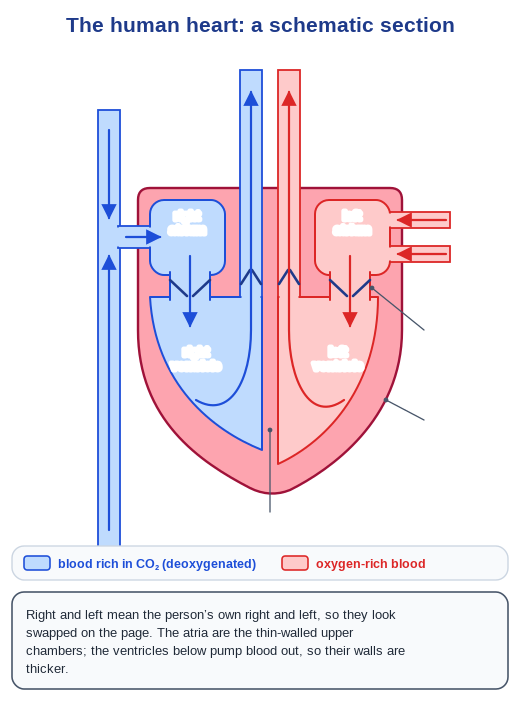
Blood is a fluid connective tissue. Its liquid part, plasma, carries food, carbon dioxide and nitrogenous wastes in solution; red blood corpuscles carry oxygen. The heart, about the size of a fist, has four chambers so that oxygen-rich blood does not mix with blood rich in carbon dioxide. The left atrium receives oxygen-rich blood from the lungs and passes it to the left ventricle, which pumps it to the body. The right atrium receives blood from the body and passes it to the right ventricle, which pumps it to the lungs. Valves stop any backward flow. Read transportation in human beings and plants.
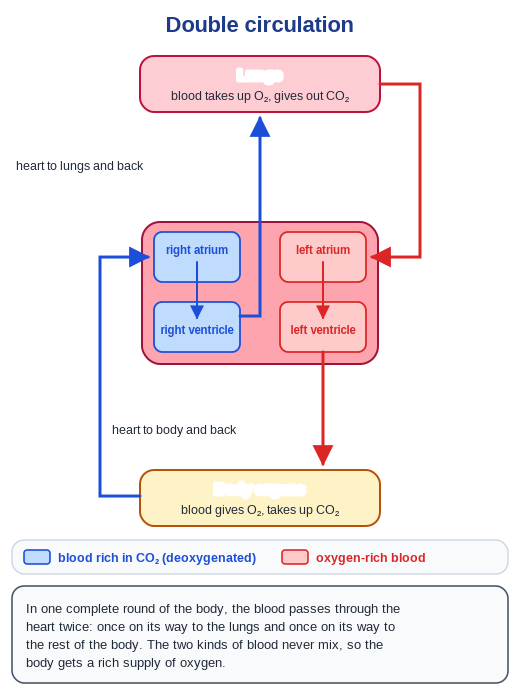
Since the blood goes through the heart twice in one round of the body, this is double circulation. It suits birds and mammals, which use much energy to keep their body temperature steady. Amphibians and many reptiles manage with a heart of three chambers, in which the two kinds of blood mix a little; fishes have two chambers and the blood passes through the heart only once.
What do blood vessels, platelets and lymph do?
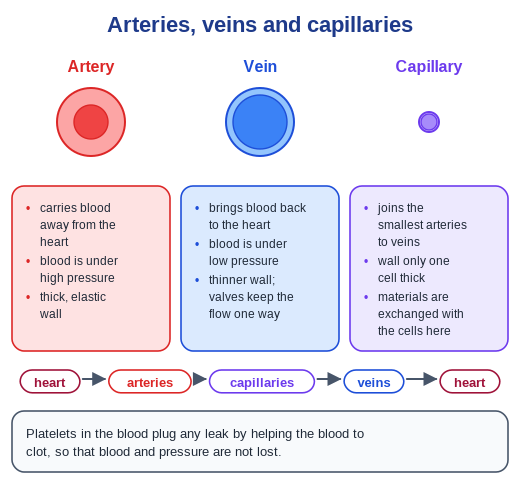
Arteries carry blood away from the heart under high pressure, so their walls are thick and elastic. Veins bring it back under low pressure; their walls are thinner and they have valves. Between them, capillaries with walls one cell thick let materials pass between blood and cells. Normal blood pressure is about 120 mm of Hg when the ventricles contract (systolic) and 80 mm of Hg when they relax (diastolic). Platelets plug leaks by helping the blood to clot. Lymph, the colourless tissue fluid that escapes from capillaries, carries digested fat from the intestine and drains extra fluid back into the blood.
How do plants transport water and food?
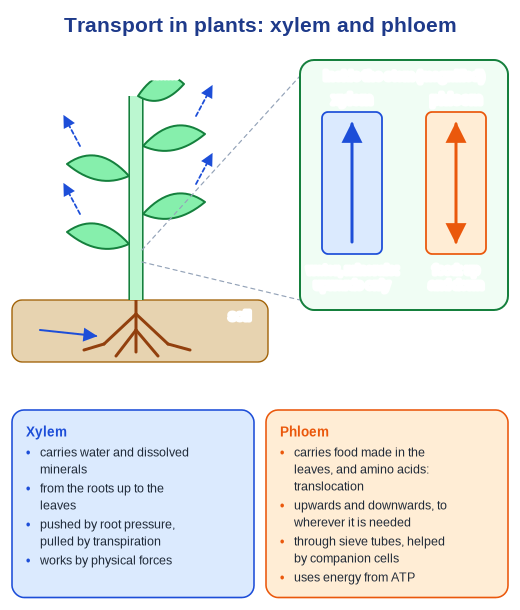
Xylem carries water and minerals from the roots to the leaves. Root cells take up ions from the soil, water follows, and this root pressure pushes the water column up, mostly at night. By day, transpiration, the loss of water vapour through the stomata, pulls water up from the roots and also cools the plant. Phloem carries the soluble products of photosynthesis from the leaves to the roots, fruits, seeds and growing buds. This translocation runs both upwards and downwards through sieve tubes and their companion cells, and it uses energy from ATP.
How do human beings remove wastes?
The excretory system has two kidneys, two ureters, a urinary bladder and a urethra. The kidneys take nitrogenous wastes such as urea and uric acid out of the blood.
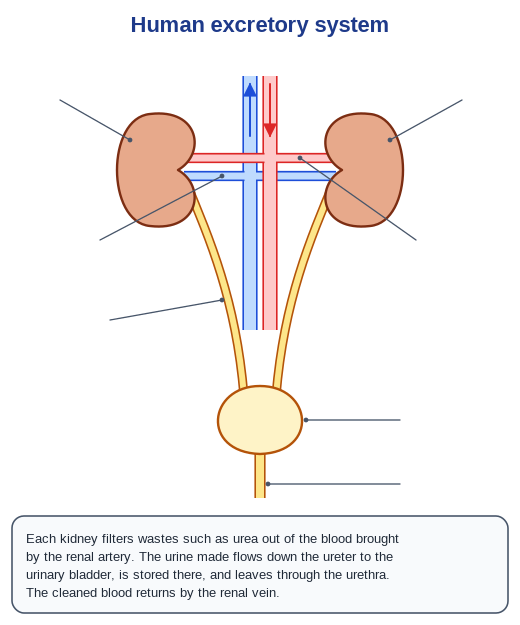
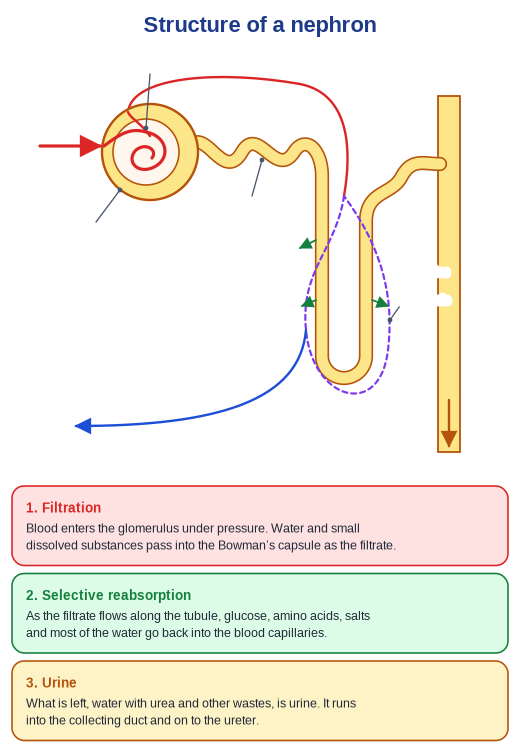
Each kidney is packed with filtering units called nephrons. In a nephron, a cluster of thin-walled capillaries sits in the cup-shaped Bowman’s capsule, which collects the filtrate. As the filtrate flows along the tubule, glucose, amino acids, salts and most of the water are taken back into the blood. A healthy adult makes about 180 L of filtrate a day but passes only a litre or two of urine. Urine flows down the ureter and is stored in the bladder until it is passed out through the urethra. When the kidneys fail, an artificial kidney cleans the blood by dialysis, and a donated kidney can be transplanted.
How do plants get rid of wastes?
Plants have no excretory organs. Oxygen, a by-product of photosynthesis, and carbon dioxide leave through the stomata, and extra water is lost by transpiration. Other wastes are stored in cell vacuoles, in leaves that later fall off, or as gums and resins in old xylem; some are passed into the soil.
Before we move on
Draw each labelled diagram of this chapter from memory at least twice, and write the equation of photosynthesis until it balances every time. Answers to the five Questions boxes, the activities and all thirteen exercises are in the NCERT solutions for Chapter 5.
Key terms
| Term | Meaning |
|---|---|
| Life processes | The processes that together maintain a living body: nutrition, respiration, transportation and excretion. |
| Autotrophic nutrition | Making one’s own food from carbon dioxide and water, using sunlight and chlorophyll, as green plants do. |
| Heterotrophic nutrition | Taking in complex food made by other organisms and breaking it down, as animals and fungi do. |
| Photosynthesis | The process in which chlorophyll uses light energy to turn carbon dioxide and water into carbohydrates, giving out oxygen. |
| Stomata | Tiny pores, mostly on leaves, opened and closed by guard cells, through which gases and water vapour pass. |
| Enzymes | Biological catalysts that break complex food into simpler substances, such as salivary amylase, pepsin, trypsin and lipase. |
| Villi | Finger-like projections of the inner lining of the small intestine that give a large surface for absorbing digested food. |
| Aerobic respiration | Breakdown of glucose using oxygen, completed in the mitochondria, giving carbon dioxide, water and a lot of energy. |
| Anaerobic respiration | Breakdown of glucose without oxygen, giving ethanol and carbon dioxide (yeast) or lactic acid (muscles) and little energy. |
| ATP | The energy currency of the cell, made from ADP and inorganic phosphate with the energy released in respiration. |
| Alveoli | Balloon-like air sacs at the ends of the smallest air tubes in the lungs, where gases are exchanged with the blood. |
| Haemoglobin | The red respiratory pigment in red blood corpuscles; it has a very high affinity for oxygen and carries it to the tissues. |
| Double circulation | Blood passing through the heart twice in one complete round of the body: once for the lungs, once for the rest of the body. |
| Xylem and phloem | The two conducting tissues of plants: xylem carries water and minerals upwards; phloem carries food in both directions. |
| Transpiration | The loss of water as vapour from the aerial parts of a plant, mainly through the stomata. |
| Translocation | The transport of soluble products of photosynthesis through the phloem, using energy from ATP. |
| Nephron | The filtering unit of the kidney: a cluster of capillaries (glomerulus) in a Bowman’s capsule, joined to a long tubule. |
Topics in this chapter
Practice
-
Which of these is NOT needed for photosynthesis?
Show answer
Answer: (c) oxygen
-
Bile juice helps digestion by:
Show answer
Answer: (b) breaking fats into tiny globules
-
In which part of the cell is glucose first broken down to pyruvate?
Show answer
Answer: (d) cytoplasm
-
Which chamber of the human heart pumps oxygen-rich blood to the whole body?
Show answer
Answer: (d) left ventricle
-
The products of photosynthesis are moved from the leaves to other parts of the plant through the:
Show answer
Answer: (b) phloem
-
The cup-shaped end of a nephron that collects the filtrate is the:
Show answer
Answer: (c) Bowman’s capsule
Questions students ask
What are the main topics of Class 10 Science Chapter 5?
What life processes are; autotrophic and heterotrophic nutrition, with photosynthesis and human digestion; aerobic and anaerobic respiration and the human respiratory system; transportation by the heart, blood, blood vessels and lymph, and by xylem and phloem in plants; and excretion by the kidneys and in plants.
Is Life Processes in the 2026-27 NCERT book?
Yes. It is Chapter 5 of Science, the Class 10 NCERT textbook marked Reprint 2026-27, on pages 79 to 99. It is the first biology chapter of the book.
Which diagrams of this chapter should I practise for the board exam?
Practise drawing and labelling the open and closed stomata, the human alimentary canal, the human respiratory system, the sectional view of the heart, the excretory system and the nephron. Also learn the flow chart for the breakdown of glucose and the balanced equation of photosynthesis.
What is the difference between breathing and respiration?
Breathing is moving air in and out of the lungs. Respiration is the chemical breakdown of food, such as glucose, inside the cells to release energy, usually using the oxygen that breathing brings in.
Stuck on a question?
Take a photo and Lagnever AI explains it step by step. Try it for 7 days for ₹2.
Get it on Google Play Open in browser
For parents: after the trial, the plan renews monthly by UPI or card autopay. You can cancel anytime in the app.