
How are materials transported in human beings and plants?
Answer in short
In human beings the heart pumps blood through arteries, capillaries and veins. The four-chambered heart keeps oxygen-rich blood apart from blood rich in carbon dioxide, and the blood passes through it twice in one round: double circulation. In plants, xylem carries water and minerals upwards, and phloem carries food in both directions using energy.
Stuck on a question? Take a photo and Lagnever AI explains it step by step. Try it for 7 days for ₹2. Get it on Google Play
Why does a large body need a transport system?
In a big, many-celled body, food is absorbed in the intestine and oxygen in the lungs, but every cell from the scalp to the toes needs both. Wastes made in the cells must also reach the organs that remove them. Diffusion is far too slow over such distances. Human beings therefore need three things: a pump, a network of tubes that reaches every tissue, and a way to repair the network if it leaks.
What does blood carry?
Blood is a fluid connective tissue. Its liquid part, plasma, carries food, carbon dioxide, nitrogenous wastes and salts in dissolved form. Red blood corpuscles carry oxygen with the help of haemoglobin.
How does the heart pump blood?
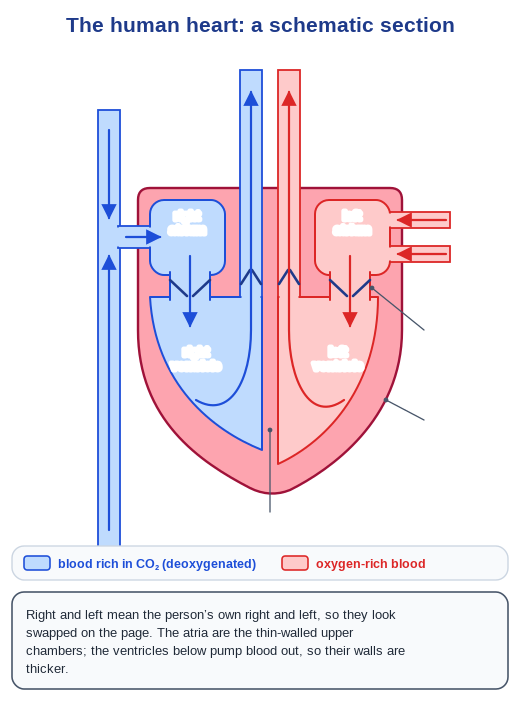
The heart is a muscular organ about as big as a fist. It has four chambers, two upper atria and two lower ventricles, so that oxygen-rich blood never mixes with blood rich in carbon dioxide.
- Oxygen-rich blood from the lungs enters the left atrium, which relaxes as it fills.
- The left atrium contracts and the left ventricle relaxes, so the blood moves down into it.
- The muscular left ventricle contracts and pumps the blood out to the body.
- Blood that has given up its oxygen returns from the body to the right atrium.
- The right atrium contracts, the right ventricle expands and receives the blood, and then pumps it to the lungs for oxygen.
Ventricles pump blood to distant organs, so their walls are thicker than those of the atria. Valves make sure the blood does not flow backwards when a chamber contracts.
What is double circulation?
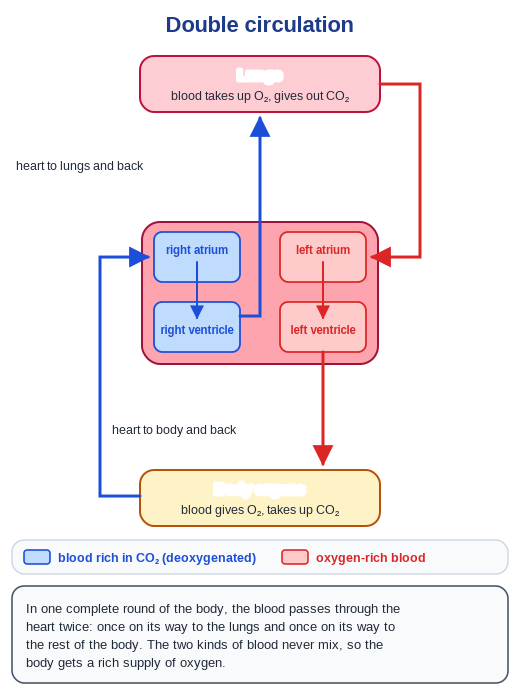
Trace one drop of blood. It leaves the right ventricle, goes to the lungs, returns to the left side of the heart, is pumped to the body and comes back to the right side. In one complete round it has passed through the heart twice. This is double circulation.
Keeping the two kinds of blood apart gives a very efficient supply of oxygen. That matters for birds and mammals, which spend energy all the time to keep their body temperature constant. Amphibians and many reptiles do not, so they manage with three-chambered hearts and some mixing. A fish heart has only two chambers: blood goes to the gills, picks up oxygen and passes straight to the body, so it goes through the heart only once in each round.
How are arteries, veins and capillaries different?
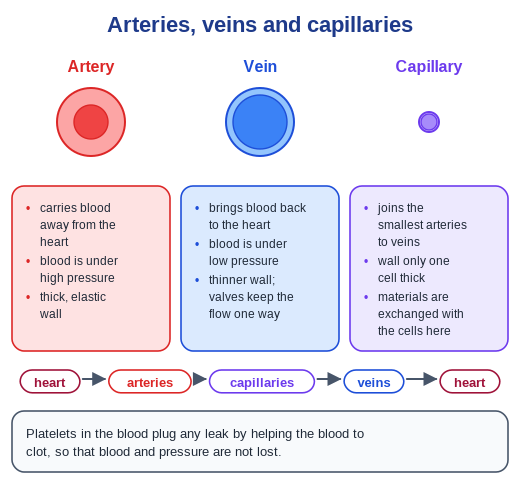
Arteries carry blood away from the heart. The blood comes out under high pressure, so the wall of an artery is thick and elastic. Veins gather blood from the organs and return it to the heart. The pressure is now low, so their walls are thinner, and they have valves that keep the blood moving in one direction. In an organ, an artery divides again and again into capillaries, whose walls are only one cell thick. Through this thin wall, materials pass between the blood and the cells. The capillaries then unite into veins.
The force of blood on the wall of a vessel is blood pressure. In an artery it is normally about 120 mm of Hg when the ventricles contract (systolic) and 80 mm of Hg when they relax (diastolic). It is measured with a sphygmomanometer.
What do platelets and lymph do?
If a vessel is cut, blood is lost and the pressure drops, so the pump works less well. Platelets circulate in the blood and plug the leak by helping the blood to clot at the injury.
Some plasma, proteins and blood cells escape through pores in the capillary walls into the spaces between the cells. This colourless fluid, with less protein than plasma, is lymph or tissue fluid. It drains into lymph capillaries, which join into larger lymph vessels that open into the larger veins. Lymph brings the fat absorbed in the intestine and returns extra fluid to the blood.
How do plants move water and minerals?
Plants do not move about and many of their tissues are made of dead cells, so they need less energy and can use slower transport. But in a tall tree the distance from root to leaf is large. Plants have two separate sets of conducting tubes.
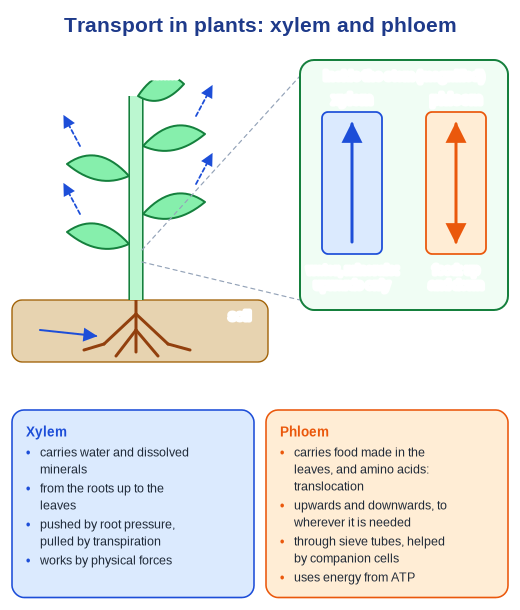
Xylem carries water and minerals. Its vessels and tracheids in the roots, stem and leaves are joined into one continuous system. Root cells touching the soil use energy to take in ions. The ion concentration inside becomes higher than in the soil, so water moves in. This steady entry of water pushes the water column upwards: root pressure, which matters more at night.
By day the stomata are open and water evaporates from the leaf cells. This loss of water vapour from the aerial parts is transpiration. It creates a suction that pulls water up through the xylem from the roots, and it also helps to cool the plant.
How do plants move food?
Phloem carries the soluble products of photosynthesis, along with amino acids and other substances, from the leaves to storage organs in roots, fruits and seeds and to growing parts. This is translocation. It takes place in sieve tubes with the help of neighbouring companion cells, both upwards and downwards.
Unlike transport in xylem, translocation needs energy. Sucrose is loaded into the phloem using ATP. This raises the osmotic pressure there, so water moves in, and the pressure pushes the material towards tissues where the pressure is lower. In spring, for example, sugar stored in the root or stem is sent to the buds that need energy to grow.
A tip for the board exam
Practise the sectional view of the heart with arrows for the direction of flow, and a two-loop sketch for double circulation. Worked answers are on the NCERT solutions page.
Back to the chapter notes, or revise respiration.
Practice
-
Which chamber of the heart receives oxygen-rich blood from the lungs?
Show answer
Answer: (c) left atrium
-
Which blood vessels have valves and bring blood back to the heart?
Show answer
Answer: (b) veins
-
The loss of water as vapour from the aerial parts of a plant is called:
Show answer
Answer: (b) transpiration
-
Why do ventricles have thicker walls than atria?
Show answer
Answer: Atria only pass blood to the ventricles just below them. Ventricles have to pump blood out to the lungs or to the organs of the whole body, which needs much more force, so their muscular walls are thicker.
-
Normal blood pressure is written as 120/80. What do the two numbers mean?
Show answer
Answer: 120 mm of Hg is the systolic pressure, the pressure in the artery when the ventricles contract. 80 mm of Hg is the diastolic pressure, the pressure in the artery when the ventricles relax.
Questions students ask
What is double circulation?
In one complete round of the body, the blood goes through the heart twice: once when it is sent to the lungs to pick up oxygen and once when the oxygen-rich blood is sent to the rest of the body.
Why must oxygen-rich blood be kept apart from blood rich in carbon dioxide?
Keeping them apart gives the body a highly efficient supply of oxygen. Birds and mammals need this because they use a lot of energy all the time to keep their body temperature steady.
What is the difference between xylem and phloem?
Xylem carries water and dissolved minerals from the roots upwards, driven by physical forces such as root pressure and transpiration pull. Phloem carries food made in the leaves, and amino acids, both upwards and downwards, and this needs energy from ATP.
What is lymph?
Lymph, or tissue fluid, forms when some plasma, proteins and blood cells escape through pores in the capillary walls into the spaces between cells. It is colourless, has less protein than plasma, carries digested fat from the intestine and drains extra fluid back into the blood.
Stuck on a question?
Take a photo and Lagnever AI explains it step by step. Try it for 7 days for ₹2.
Get it on Google Play Open in browser
For parents: after the trial, the plan renews monthly by UPI or card autopay. You can cancel anytime in the app.