
How does respiration take place in living things?
Answer in short
Respiration is the breakdown of food, such as glucose, inside cells to release energy. Glucose is first split into pyruvate in the cytoplasm. With oxygen, pyruvate is broken down in the mitochondria to carbon dioxide and water, releasing much energy. Without oxygen, yeast forms ethanol and carbon dioxide, and muscle cells form lactic acid.
Stuck on a question? Take a photo and Lagnever AI explains it step by step. Try it for 7 days for ₹2. Get it on Google Play
Is respiration the same as breathing?
No. Breathing only moves air in and out of the body. Respiration is what the cells do with the oxygen: they break down food, usually glucose, to release the energy locked in it. Every living cell respires all the time, whether it belongs to a banyan tree, a yeast cell in bread dough or a sprinter’s leg muscle.
How is glucose broken down?
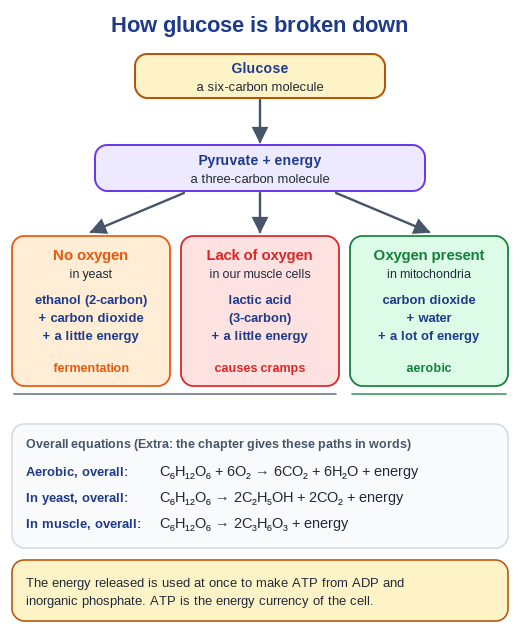
The first step is the same in all organisms. In the cytoplasm, a molecule of glucose, which has six carbon atoms, is broken into pyruvate, a molecule with three carbon atoms, and a little energy is released. After that there are three possible paths.
- In yeast, without oxygen. Pyruvate is changed into ethanol and carbon dioxide. This is fermentation, and because no air is needed it is anaerobic respiration. (Extra: this carbon dioxide is what makes bread dough rise.)
- In our muscle cells, when oxygen is short. During sudden hard activity the muscles cannot get oxygen quickly enough. Pyruvate is then changed into lactic acid, another three-carbon molecule. Its build-up causes cramps.
- With oxygen, in the mitochondria. Each three-carbon pyruvate molecule is broken down completely to three molecules of carbon dioxide, and water is also formed. This is aerobic respiration, and it releases far more energy than the other two paths.
Overall, for aerobic respiration (Extra: the chapter gives this path in words only): C₆H₁₂O₆ + 6O₂ → 6CO₂ + 6H₂O + energy.
Where does the energy go?
The cell does not use this energy directly. It uses it at once to build a molecule called ATP from ADP and inorganic phosphate. ATP is the cell’s energy currency. When the end phosphate link of ATP is broken with water, energy equal to 30.5 kJ/mol is released. Just as one battery can run a torch, a radio or a toy, ATP can power muscle contraction, protein synthesis, nerve impulses and many other activities.
How do plants and water animals exchange gases?
Plants exchange gases through their stomata, and large spaces between the cells keep every cell in touch with air. The gases move by diffusion. At night there is no photosynthesis, so plants mainly give out carbon dioxide. During the day the carbon dioxide from respiration is used up in photosynthesis, so oxygen is mainly given out.
Fishes take water in through the mouth and force it past their gills, where the blood picks up the dissolved oxygen. Water contains much less oxygen than air, so water animals breathe faster than land animals.
Land animals use the oxygen of the air. Their breathing surface is large, very thin and delicate, so it is kept inside the body, with passages to bring air to it and a way to move the air in and out.
How does air reach our lungs?
Air enters through the nostrils. Fine hairs and mucus lining the passage filter out dust. The air then goes through the throat into the windpipe. Rings of cartilage keep this air passage from collapsing. In the lungs the passage branches into ever finer tubes, and these end in balloon-like sacs called alveoli (singular: alveolus).
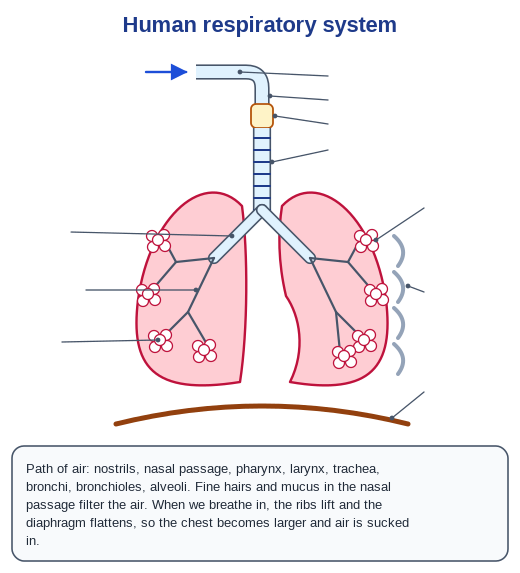
When we breathe in, the ribs lift and the diaphragm flattens. The chest cavity becomes larger and air is sucked into the lungs, filling the alveoli. When we breathe out, the reverse happens. Some air always stays behind in the lungs, so there is enough time for the gases to be exchanged.
What happens in the alveoli?
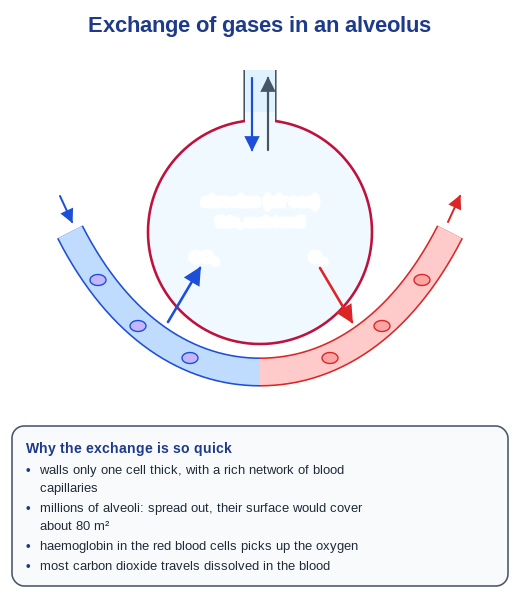
The walls of the alveoli hold a dense network of blood capillaries. Blood coming from the body brings carbon dioxide, which passes into the alveoli to be breathed out. Oxygen from the air in the alveoli passes into the blood. If the surface of all the alveoli were spread out flat, it would cover about 80 m², which is why so much gas can be exchanged so quickly.
How are oxygen and carbon dioxide carried?
In a large body, diffusion alone cannot deliver oxygen: the book estimates that a molecule of oxygen would take about three years to diffuse from our lungs to our toes. So the blood uses a respiratory pigment. In human beings it is haemoglobin, found in the red blood corpuscles. It binds oxygen very readily, takes it up in the lungs and gives it up to tissues that are short of it. Carbon dioxide dissolves in water more readily than oxygen does, so most of it is carried dissolved in the blood.
Why should we stay away from tobacco?
The upper part of the air passage is lined with tiny hair-like cilia that sweep out germs and dust. Smoking destroys them, so smoke and harmful chemicals reach the lungs. The result can be infection, coughing and even lung cancer. Chewing tobacco, as gutkha, is a major cause of oral cancer in India.
A tip for the board exam
Draw the three-path flow chart of glucose and label where each step happens: cytoplasm or mitochondria. In a “differences” answer, compare oxygen, end products, energy and place. Worked answers are on the NCERT solutions page.
Next: transportation in human beings and plants, or back to the chapter notes.
Practice
-
The breakdown of glucose to pyruvate takes place in the:
Show answer
Answer: (b) cytoplasm
-
Which substance builds up in our muscles and causes cramps during sudden hard exercise?
Show answer
Answer: (c) lactic acid
-
Rings of cartilage in the throat:
Show answer
Answer: (b) keep the air passage from collapsing
-
Why do fishes breathe faster than land animals?
Show answer
Answer: Water holds much less dissolved oxygen than air does. To get enough oxygen, a fish must pass water over its gills more often, so its rate of breathing is higher.
-
Why do the lungs always keep some air inside, even after we breathe out?
Show answer
Answer: This residual volume of air gives enough time for oxygen to be absorbed into the blood and for carbon dioxide to be released, during the whole breathing cycle.
Questions students ask
What is the difference between aerobic and anaerobic respiration?
Aerobic respiration uses oxygen, breaks glucose down completely to carbon dioxide and water in the mitochondria and releases a lot of energy. Anaerobic respiration happens without oxygen, breaks glucose down only partly, to ethanol and carbon dioxide or to lactic acid, and releases much less energy.
What is ATP?
ATP is the energy currency for most processes in the cell. The energy released in respiration is used to make ATP from ADP and inorganic phosphate, and ATP is later broken down to drive activities such as muscle contraction and protein synthesis.
How is oxygen carried in our blood?
By haemoglobin, the red respiratory pigment in red blood corpuscles. It has a very high affinity for oxygen, picks it up in the lungs and releases it in tissues that are short of oxygen.
Why are alveoli so good at exchanging gases?
They are tiny balloon-like sacs with very thin walls and a dense network of blood capillaries, and there are so many that their total surface, spread out, would cover about 80 m².
Stuck on a question?
Take a photo and Lagnever AI explains it step by step. Try it for 7 days for ₹2.
Get it on Google Play Open in browser
For parents: after the trial, the plan renews monthly by UPI or card autopay. You can cancel anytime in the app.