
How do plants and human beings get their nutrition?
Answer in short
Green plants are autotrophs: in photosynthesis they use sunlight and chlorophyll to turn carbon dioxide and water into carbohydrates, giving out oxygen. Human beings are heterotrophs: food is broken down by enzymes in the mouth, stomach and small intestine, absorbed by the villi of the small intestine, and carried by the blood to every cell.
Stuck on a question? Take a photo and Lagnever AI explains it step by step. Try it for 7 days for ₹2. Get it on Google Play
What is nutrition, and what are its two kinds?
Every living thing needs energy to keep its body in order, and materials to grow and repair itself. Both come from food, and the process of getting and using food is nutrition.
- Autotrophic nutrition: the organism makes its own food from simple inorganic materials, carbon dioxide and water. Green plants and some bacteria do this.
- Heterotrophic nutrition: the organism takes in complex food made by others and breaks it down with enzymes, which are biological catalysts. Animals and fungi do this, so they depend on autotrophs directly or indirectly.
What happens in photosynthesis?
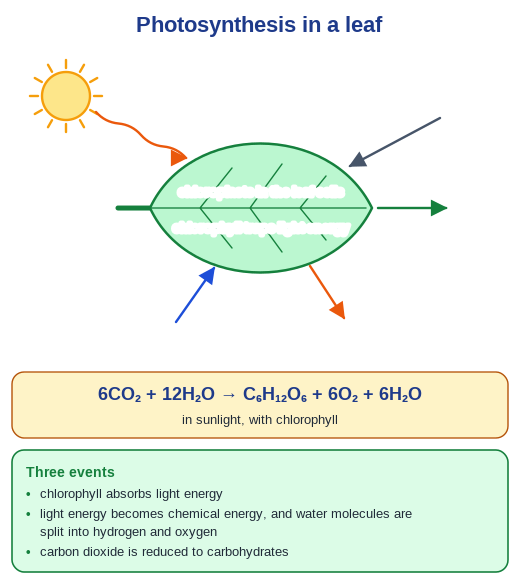
A mango leaf in the sun is a small food factory. Its cells contain green dots called chloroplasts, and the chloroplasts hold chlorophyll. Three events take place:
- Chlorophyll absorbs light energy.
- The light energy is changed into chemical energy, and water molecules are split into hydrogen and oxygen.
- Carbon dioxide is reduced to carbohydrates.
6CO₂ + 12H₂O → C₆H₁₂O₆ + 6O₂ + 6H₂O (in sunlight, with chlorophyll)
The steps need not follow one another at once. Desert plants take in carbon dioxide at night and make an intermediate, which is acted on by the energy that chlorophyll absorbs during the day. Carbohydrate that the plant does not use immediately is stored as starch. That is why a leaf kept in sunlight turns blue-black with iodine, and only in its green parts.
Where do the raw materials come from?
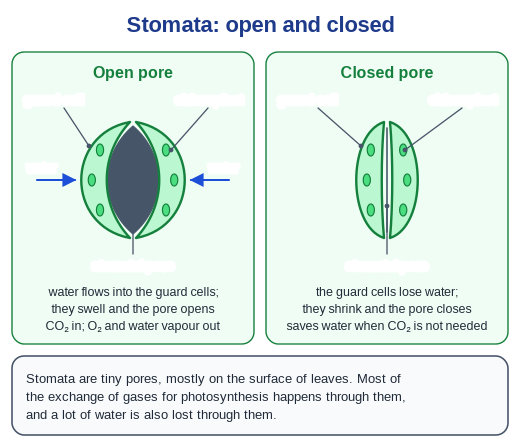
- Carbon dioxide enters from the air through stomata, tiny pores on the leaf surface. Each pore lies between two guard cells. When water flows into the guard cells they swell and the pore opens; when they shrink the pore closes. Closing saves water when no carbon dioxide is needed.
- Water: the roots absorb it from the soil.
- Minerals such as nitrogen, phosphorus, iron and magnesium also come from the soil. Nitrogen, needed to build proteins, is absorbed as nitrates or nitrites, or as organic compounds that bacteria make from the nitrogen of the air.
- Sunlight supplies the energy, and chlorophyll traps it.
How do heterotrophs feed?
How an organism feeds depends on its food and its body design. Fungi such as bread mould, yeast and mushrooms digest food outside the body and absorb it. Most animals take the food in and digest it inside. Parasites such as cuscuta (amar-bel), lice, leeches and tapeworms draw nutrition from a living host without killing it.
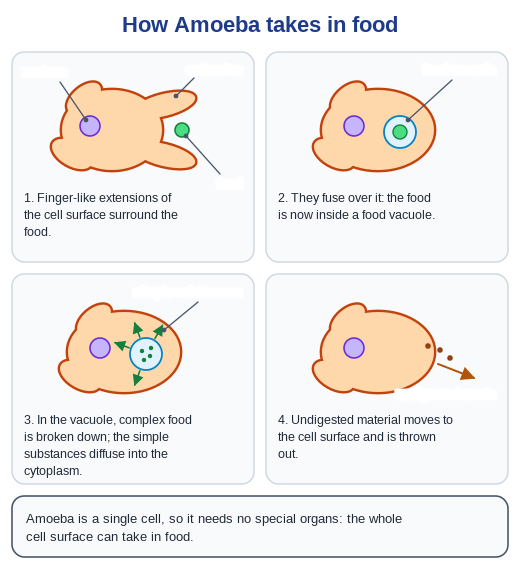
Amoeba, a single cell, pushes out temporary finger-like extensions around a food particle. They fuse and trap the food in a food vacuole, where it is broken into simple substances that diffuse into the cytoplasm. Undigested matter is moved to the surface and thrown out.
What happens to a roti in our alimentary canal?
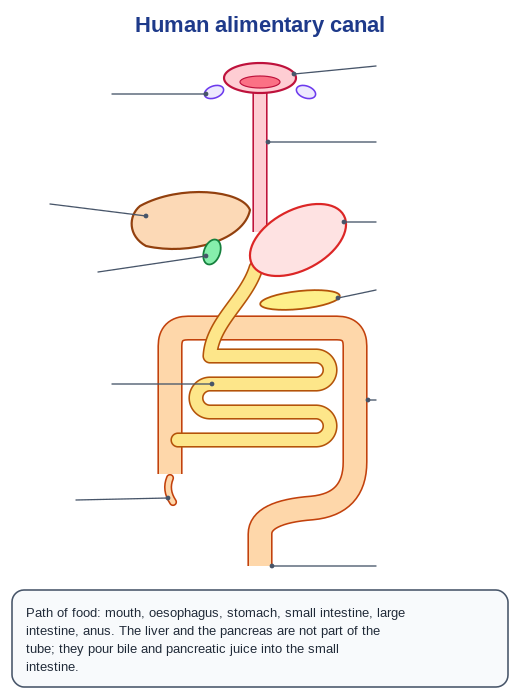
Follow one bite of roti and dal along the alimentary canal, the long tube from the mouth to the anus.
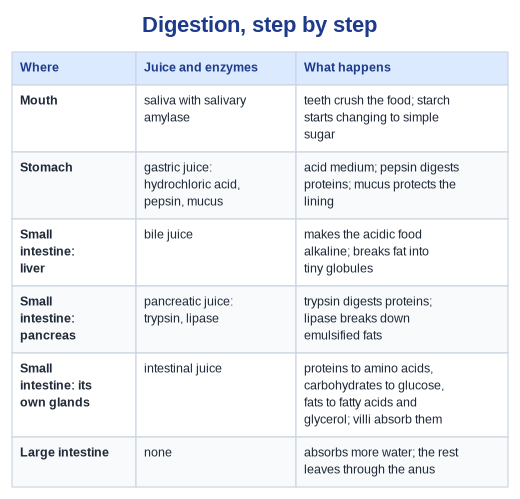
Mouth. Teeth crush the food into small pieces. Saliva from the salivary glands wets it, and its enzyme salivary amylase starts changing starch into simple sugar. The tongue mixes the food.
Oesophagus. The muscles of the canal wall contract in waves, called peristaltic movements, and push the food to the stomach. These movements go on all along the gut.
Stomach. The muscular walls churn the food with gastric juice, which has three parts: hydrochloric acid, which makes the medium acidic; pepsin, which digests proteins and works in acid; and mucus, which protects the stomach lining from the acid. A sphincter muscle then releases the food in small amounts.
Small intestine. It is the longest stretch of the canal, coiled to fit in a small space, and digestion is completed here. Bile juice from the liver makes the acidic food alkaline and breaks large fat globules into small ones, much as soap emulsifies grease. Pancreatic juice contains trypsin, which digests proteins, and lipase, which breaks down the emulsified fats. Glands in the intestinal wall add intestinal juice, whose enzymes finish the job:
- proteins → amino acids
- complex carbohydrates → glucose
- fats → fatty acids and glycerol
How is the digested food absorbed?
Inside, the small intestine is lined with countless finger-like villi. They give a very large surface for absorption and are rich in blood vessels. The blood carries the absorbed food to every cell, where it is used for energy, for building new tissue and for repair. The unabsorbed part passes into the large intestine, whose walls take back more water. The rest is removed through the anus, and its exit is controlled by the anal sphincter.
A tip for the board exam
Learn the enzymes as pairs of “enzyme and food”: amylase and starch, pepsin and trypsin with proteins, lipase and fats. Practise the labelled diagrams of the stomata and the alimentary canal. Worked answers are on the NCERT solutions page.
Next: respiration, or back to the chapter notes.
Practice
-
Where is the chlorophyll of a leaf cell found?
Show answer
Answer: (b) in the chloroplasts
-
Which enzyme starts the digestion of proteins in the stomach?
Show answer
Answer: (c) pepsin
-
The opening and closing of a stomatal pore is controlled by:
Show answer
Answer: (b) guard cells
-
Why do herbivores have a longer small intestine than carnivores?
Show answer
Answer: Grass contains cellulose, which is hard to digest and needs more time and length. Meat is easier to digest, so carnivores such as tigers manage with a shorter small intestine.
-
What would happen to fat digestion if no bile reached the small intestine?
Show answer
Answer: The fat would stay as large globules, and lipase could act only on their surface, so fat digestion would be slow and incomplete. The acidic food from the stomach would also not be made alkaline for the pancreatic enzymes.
Questions students ask
What is the difference between autotrophic and heterotrophic nutrition?
Autotrophs make their own food from carbon dioxide and water using sunlight and chlorophyll. Heterotrophs cannot; they take in complex food made by other organisms and break it down with enzymes.
What are the three events of photosynthesis?
Chlorophyll absorbs light energy; the light energy is changed into chemical energy and water molecules are split into hydrogen and oxygen; and carbon dioxide is reduced to carbohydrates.
What is the role of hydrochloric acid in the stomach?
It makes the medium acidic, which the enzyme pepsin needs in order to act on proteins. Extra: it also kills many of the germs that enter with food.
What are villi?
Villi are finger-like projections of the inner lining of the small intestine. They increase the surface area for absorption and are richly supplied with blood vessels that carry the absorbed food away.
Stuck on a question?
Take a photo and Lagnever AI explains it step by step. Try it for 7 days for ₹2.
Get it on Google Play Open in browser
For parents: after the trial, the plan renews monthly by UPI or card autopay. You can cancel anytime in the app.