
NCERT Solutions Class 10 Science Chapter 7: How do Organisms Reproduce?
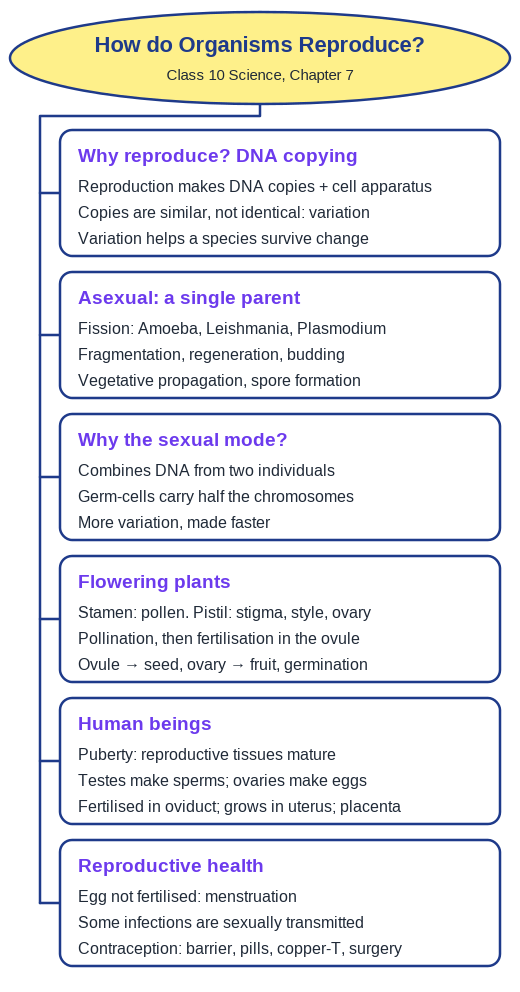
Answers to the three Questions boxes inside Chapter 7, How do Organisms Reproduce?, the other questions the chapter asks along the way, Activities 7.1–7.7, and all eleven end-of-chapter exercises, from Science, the Class 10 NCERT textbook. Page numbers follow the 2026-27 reprint (pages 113–127). The exercises are quoted from the book; the in-chapter questions are restated in short. Points that go beyond the chapter are marked “Extra”. Short notes: Chapter 7 notes.
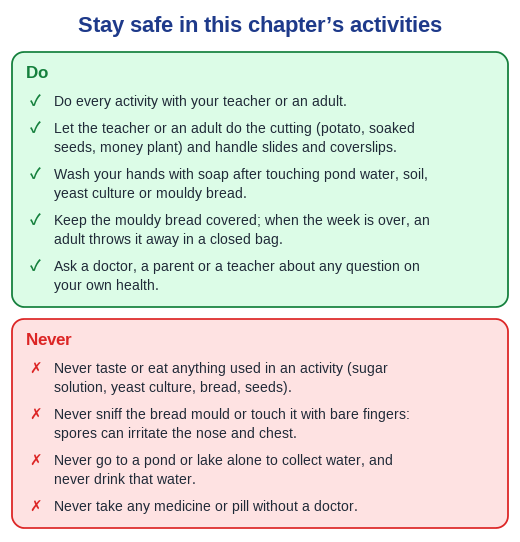
Stay safe. Do the activities with your teacher or an adult, and let an adult do the cutting and handle the glass slides. Never taste anything used in an activity, never sniff or touch the bread mould, and wash your hands with soap after handling pond water, yeast culture or mouldy bread.
Questions, page 114
Question 1 (page 114): why DNA copying matters in reproduction. DNA in the nucleus carries the information for making proteins, and so for the body design. When a cell reproduces, it copies its DNA so that the new cell receives the same information. That is why offspring have the body design of their parents. The copying is also slightly inexact, and this gives the small variations on which the survival of the species depends.
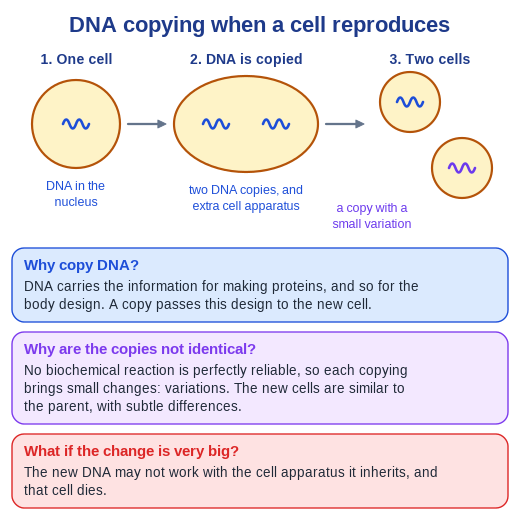
Question 2 (page 114): why variation helps the species but not always the individual. A population is suited to its niche. If the niche changes sharply, for example if the water warms, individuals that are all alike could all die. If a few variants are present, such as heat-resistant bacteria, they survive and multiply, so the species continues. For one individual, however, a variation may be of no use, and a drastic one can stop its DNA from working with the cell apparatus, so that the cell dies.
Questions, page 119
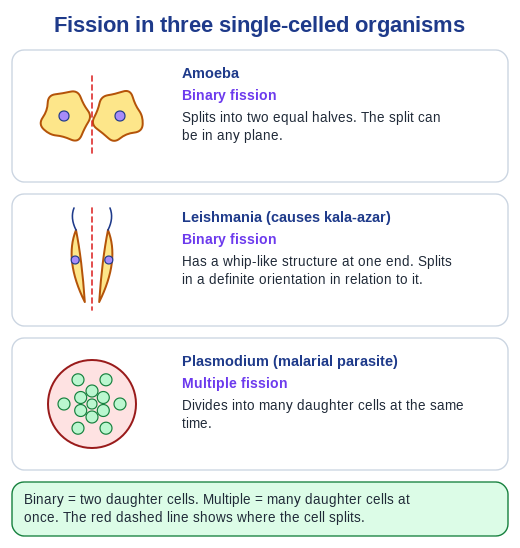
Question 1 (page 119): binary fission and multiple fission.
| Binary fission | Multiple fission | |
|---|---|---|
| Number of daughter cells | two | many |
| How | the cell splits into two halves | the cell divides into many cells at the same time |
| Examples | Amoeba, Leishmania, many bacteria | Plasmodium (the malarial parasite) |
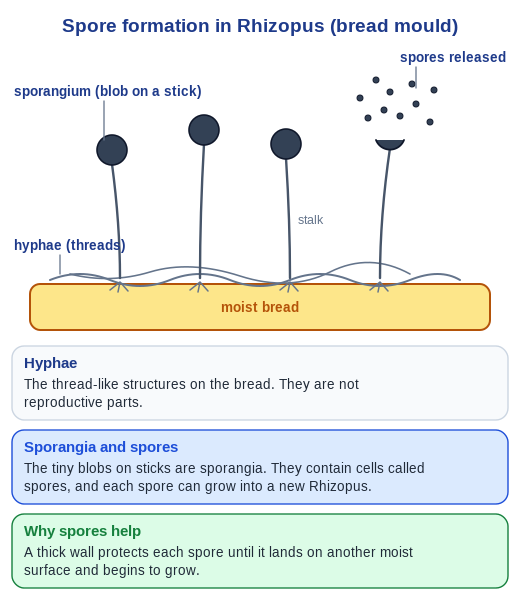
Question 2 (page 119): how reproducing by spores helps an organism. Spores are covered by thick walls, which protect them until they reach another moist surface where they can grow. A sporangium holds many spores, so one individual can give rise to many new ones. Spores are also very light and are carried far by air, so the organism spreads to new places (the last point is Extra).
Question 3 (page 119): why complex organisms cannot reproduce by regeneration. A complex organism is not a loose collection of cells. Its specialised cells form tissues, the tissues form organs, and the organs are placed at definite positions in the body. A piece cut from such a body does not have the cells that can grow into all these tissues and organs in the right places. Only simple animals such as Hydra and Planaria have the specialised cells that can do this. And even for them regeneration is not the normal way to reproduce, since an animal does not depend on being cut up.
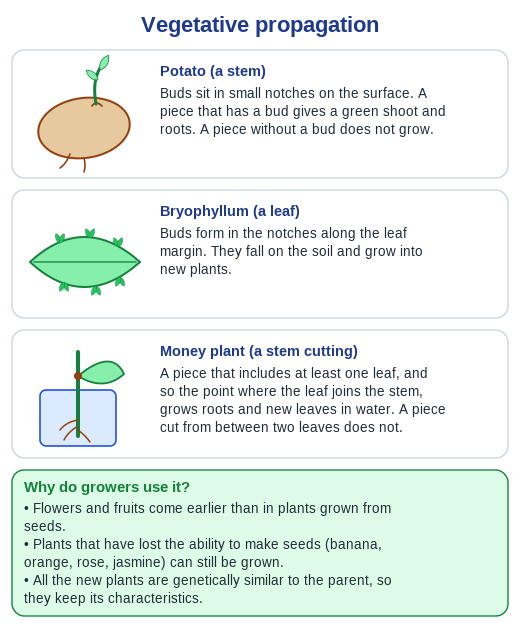
Question 4 (page 119): why some plants are grown by vegetative propagation.
- They bear flowers and fruits earlier than plants raised from seeds.
- Plants that have lost the capacity to produce seeds, such as banana, orange, rose and jasmine, can be propagated.
- All the plants produced are genetically similar to the parent, so they have all its characteristics.
Question 5 (page 119): why DNA copying is essential to reproduction. The body design of an organism depends on the information in its DNA. Reproduction must hand this information to the new individual, so a copy of the DNA has to be made, along with extra cellular apparatus. Without the DNA copy, the new cell would have no instructions for making its proteins and could not have the body design of its kind.
Questions, page 126
Question 1 (page 126): pollination and fertilisation.
| Pollination | Fertilisation | |
|---|---|---|
| What it is | transfer of pollen from the stamen to the stigma | fusion of the male germ-cell with the female germ-cell (egg) |
| Where | on the stigma | inside the ovule, in the ovary |
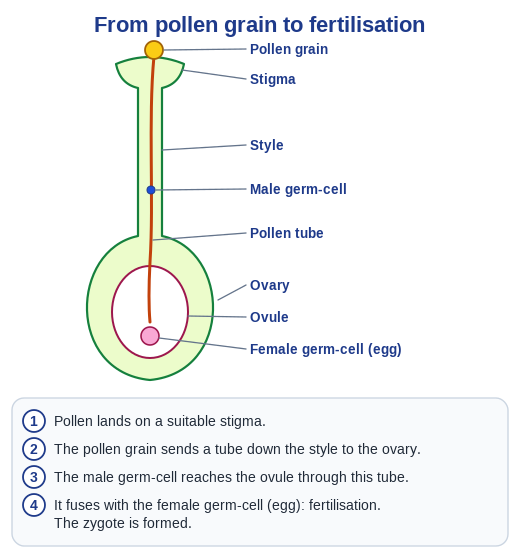
| How | by wind, water or animals, or within the same flower | the male germ-cell arrives through the pollen tube |
| Result | pollen reaches the stigma | the zygote is formed |
Pollination comes first; fertilisation follows it.
Question 2 (page 126): the seminal vesicles and the prostate gland. They lie along the path of the vas deferens and add their secretions to the sperms. The sperms then travel in a fluid; it helps them move and also nourishes them.
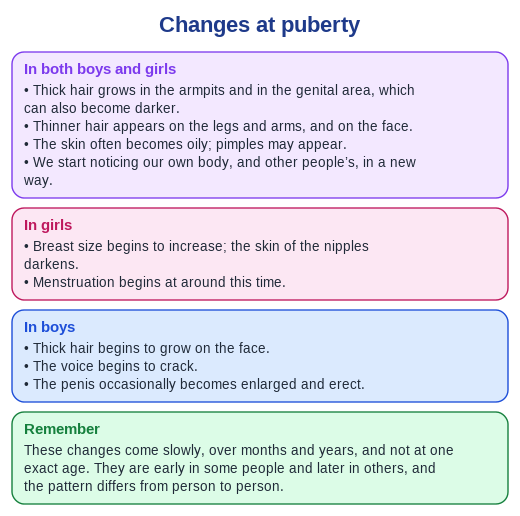
Question 3 (page 126): changes in girls at puberty. Breast size begins to increase and the skin of the nipples darkens. Menstruation begins. As in boys, thick hair grows in the armpits and the genital area, thinner hair appears on the legs, arms and face, and the skin often becomes oily, sometimes with pimples.
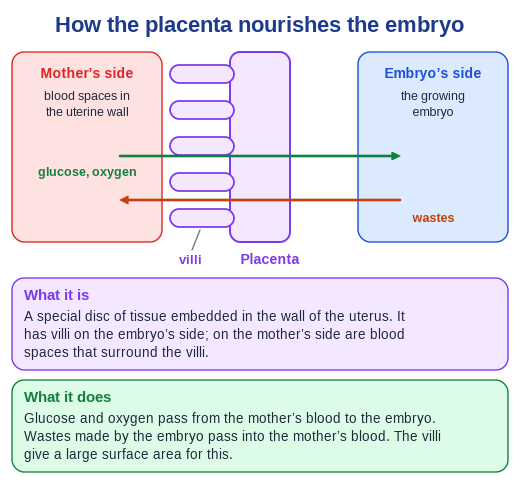
Question 4 (page 126): how the embryo is nourished in the mother’s body. Through the placenta, a disc of special tissue embedded in the wall of the uterus. It has villi on the embryo’s side, and on the mother’s side there are blood spaces around the villi. This gives a large surface area across which glucose and oxygen pass from the mother’s blood to the embryo. The wastes made by the embryo pass through the placenta into the mother’s blood.
Question 5 (page 126): does a copper-T protect against sexually transmitted diseases? No. A copper-T is placed in the uterus and only prevents pregnancy. It does not stop the contact through which infections pass from one person to another. The chapter names the condom as the covering that helps to prevent the transmission of many such infections, to some extent.
Other questions inside the chapter (pages 113–125)
Why do organisms reproduce at all? (page 113) The book leaves this for class discussion. One answer from the chapter itself: an individual does not need reproduction to stay alive, but without it its kind would not continue. Reproduction keeps populations of a species going from one generation to the next.
How do we know two organisms belong to the same species? (page 113) Usually because they look similar: their body designs are alike.
Why can Spirogyra reproduce by fragmentation? (page 116) Under the microscope the filament shows no different tissues: it is a simple row of similar cells. So any piece of it can grow into a complete new filament.
How can a body with many cell types reproduce from one cell type? (page 116) It must have one cell type that can grow, multiply and, under the right conditions, make all the other cell types.
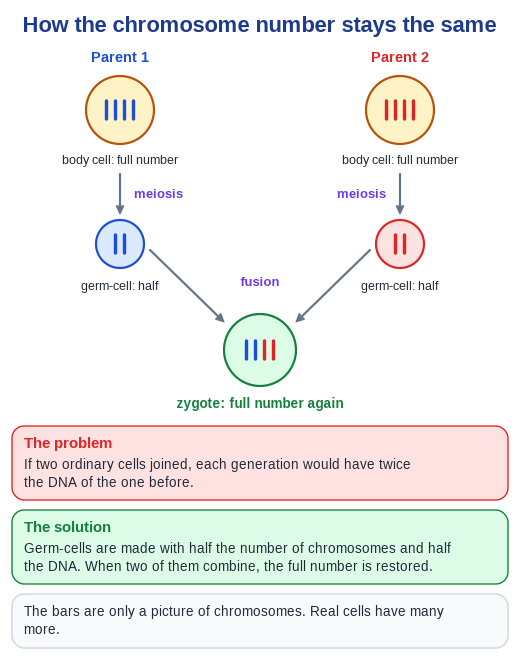
How is the doubling of DNA in each generation avoided? (page 120) By making germ-cells with half the number of chromosomes and half the DNA, through meiosis. When two germ-cells combine, the normal number is restored.
What could the petals and sepals do? (page 120) Sepals cover and protect the flower in the bud. Brightly coloured petals attract insects, which carry pollen (Extra: the chapter does not answer this).
Does any flower part stay on the fruit? What is the advantage of seeds? (page 121) In brinjal and tomato the sepals stay on as the green cap (Extra). A seed protects the embryo in a tough coat, carries a food store for it, and lets it wait until conditions are suitable for germination (Extra).
How do we decide whether the body and the mind are ready? (page 124) The book asks this without giving one answer. It points out that sexual maturation is gradual, that being partly mature does not make the body or the mind ready for sex or for raising children, and that pressures from friends, families and others make such choices difficult. Discuss it with your teacher or parents.
What is the main reason for poor living standards? (page 125) This too is a discussion question. The chapter gives two views: a growing population makes it more difficult to raise everyone’s standard of living; but if the real cause is inequality in society, population size matters much less.
What the activities show (Activities 7.1–7.7)
Do these only with your teacher.
- 7.1, yeast in sugar solution: under the microscope, small buds are seen on the yeast cells, sometimes in short chains. Yeast multiplies by budding.
- 7.2, moist bread: after a few days a white, cottony growth appears and later tiny black dots. The threads are hyphae and the dots are sporangia with spores. Yeast grows by budding of single cells; the mould grows as threads and multiplies by spores. Keep the bread covered and do not sniff it.
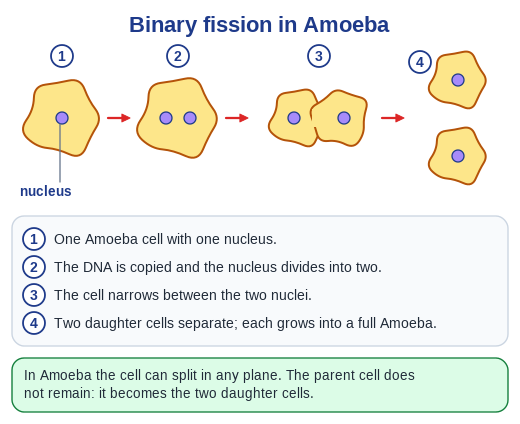
- 7.3, slides of Amoeba: the first slide shows one cell with one nucleus. The second shows the nucleus divided and the cell narrowing into two daughter cells: binary fission.
- 7.4, Spirogyra filaments: each filament is a row of similar cells with green contents. No different tissues can be made out.
- 7.5, potato pieces on wet cotton: only the pieces with a notch (a bud) give green shoots and roots. The buds grow into new plants.
- 7.6, money plant pieces in water: the pieces that have at least one leaf grow roots and new leaves; the portions cut from between two leaves do not. A cutting needs the point where a leaf joins the stem, where a bud lies (this point is called a node; Extra).
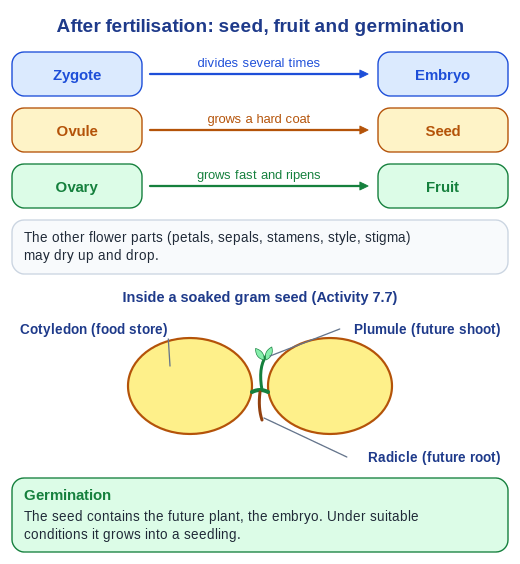
- 7.7, soaked gram seeds: the seed opens into two cotyledons (food store) with a small plumule (future shoot) and radicle (future root) between them.
Exercises 1 to 3: choose the answer
1. “Asexual reproduction takes place through budding in (a) Amoeba. (b) Yeast. (c) Plasmodium. (d) Leishmania.”
(b) Yeast. Amoeba and Leishmania divide by binary fission and Plasmodium by multiple fission.
2. “Which of the following is not a part of the female reproductive system in human beings? (a) Ovary (b) Uterus (c) Vas deferens (d) Fallopian tube”
(c) Vas deferens. It is the tube that carries sperms in the male reproductive system.
3. “The anther contains (a) sepals. (b) ovules. (c) pistil. (d) pollen grains.”
(d) Pollen grains. The anther is the part of the stamen that produces them.
These three answers match the answer key at the back of the book.
Exercises 4 to 7: sexual reproduction
4. “What are the advantages of sexual reproduction over asexual reproduction?”
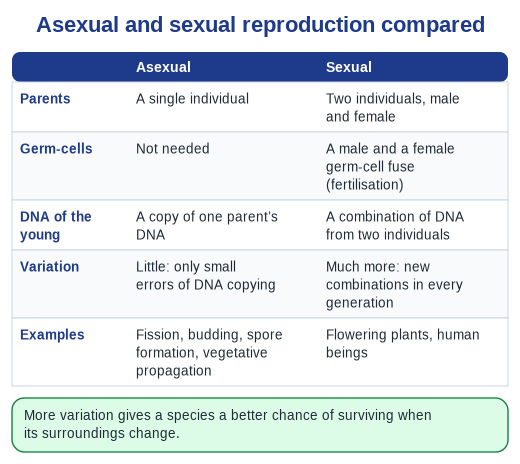
- Sexual reproduction combines the DNA of two different individuals, so each generation gets new combinations of variations. Asexual reproduction gives only the small variations of DNA copying.
- More variation appears, and it appears faster. Since the variations being combined already exist in living individuals, they are not harmful ones.
- With more variation, some individuals are likely to survive when the niche changes, so the species has a better chance of surviving over time.
5. “What are the functions performed by the testis in human beings?”
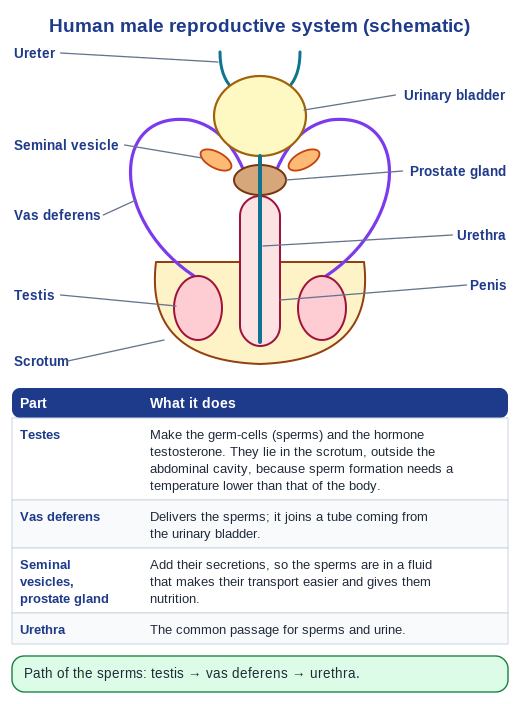
- The testes form the male germ-cells, the sperms.
- They secrete the hormone testosterone, which regulates the formation of sperms and brings about the changes in appearance seen in boys at puberty.
6. “Why does menstruation occur?”
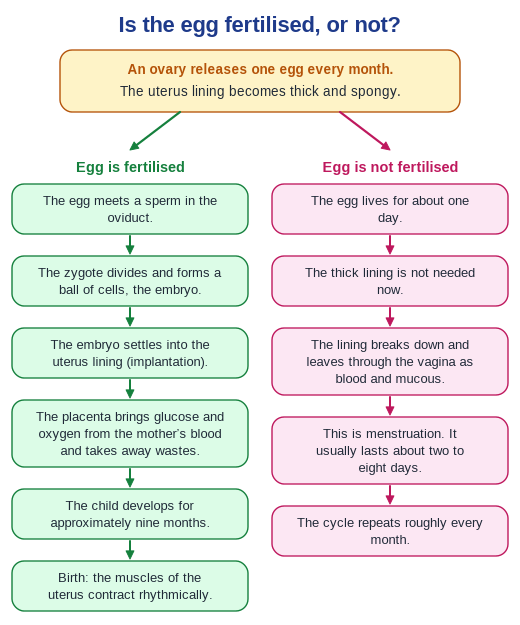
An ovary releases one egg every month, and the uterus prepares every month to receive a fertilised egg: its lining becomes thick and spongy, with a rich blood supply, to nourish an embryo. An egg that is not fertilised survives only about a day, and then this lining is no longer needed. The lining breaks down gradually and leaves through the vagina as blood and mucous. This is menstruation. It happens roughly every month and usually lasts about two to eight days.
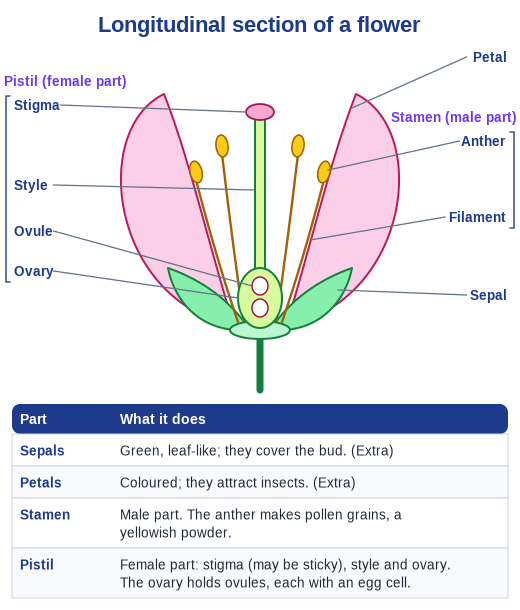
7. “Draw a labelled diagram of the longitudinal section of a flower.”
Draw the flower as shown below and label the sepal, petal, stamen (anther and filament) and pistil (stigma, style and ovary).
Exercises 8 to 11: contraception, modes and populations
8. “What are the different methods of contraception?”
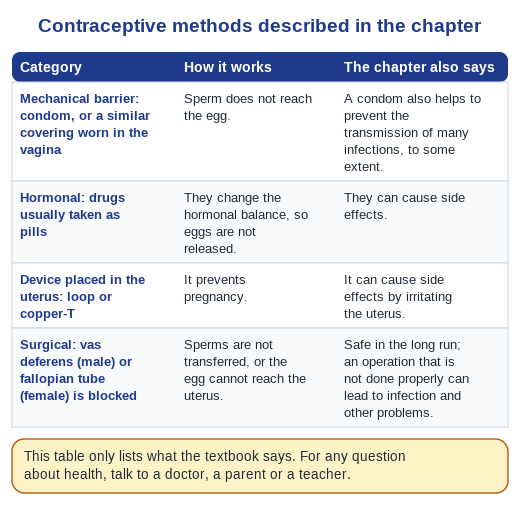
The chapter describes four categories.
- Mechanical barrier: a condom on the penis, or a similar covering worn in the vagina, so that the sperm does not reach the egg.
- Hormonal: drugs, usually taken by mouth as pills, that alter the body’s hormone balance, so that no egg is released. They can cause side effects.
- Devices placed in the uterus: the loop or the copper-T. They can cause side effects because they irritate the uterus.
- Surgical methods: blocking the vas deferens in the male, so that sperms are not transferred, or the fallopian tube in the female, so that the egg cannot reach the uterus. These are safe in the long run, but surgery can cause infections and other problems if it is not performed properly.
9. “How are the modes for reproduction different in unicellular and multicellular organisms?”
| Unicellular organisms | Multicellular organisms | |
|---|---|---|
| What divides | the whole organism is one cell, and cell division itself makes new individuals | only particular cells or parts take part in reproduction |
| Modes | fission (binary or multiple); budding in yeast | simple bodies: fragmentation, budding, spore formation, vegetative propagation; complex bodies: sexual reproduction |
| Special reproductive parts | none | present, for example sporangia, flowers, testes and ovaries |
| Why | the body is a single cell | cells are organised into tissues and organs at definite positions, so cell-by-cell division is impractical |
10. “How does reproduction help in providing stability to populations of species?”
Each species fills a niche in the ecosystem, using its ability to reproduce. Reproduction copies the DNA with great consistency, so the body design that suits the niche is kept from one generation to the next. It also replaces the individuals that die, so the population continues (the chapter notes that birth and death rates decide its size). At the same time the small variations of DNA copying let some individuals survive if the niche changes. In these ways reproduction keeps the populations of a species stable over time.
11. “What could be the reasons for adopting contraceptive methods?”
From the chapter:
- To avoid a pregnancy for which the woman is not ready. Pregnancy makes major demands on her body and mind, and her health is adversely affected if she is not ready for it.
- A barrier such as the condom also helps to prevent the transmission of many sexually transmitted infections, to some extent.
- To keep the size of the population in check, since a growing population makes it more difficult to raise everyone’s standard of living.
Practice
-
Which of these is not a mode of asexual reproduction?
Show answer
Answer: (c) Fertilisation
-
The part of a seed that stores food is the:
Show answer
Answer: (c) cotyledon
-
Which gland adds its secretion to the sperms along the path of the vas deferens?
Show answer
Answer: (a) Prostate gland
-
Name the three parts of a pistil, from top to bottom.
Show answer
Answer: Stigma at the top (it may be sticky), style in the middle, and the swollen ovary at the bottom. The ovary contains the ovules.
-
A potato is cut into pieces and kept on wet cotton. Which pieces grow, and what does this show?
Show answer
Answer: Only the pieces that have a bud (in a notch on the surface) give green shoots and roots. It shows that a new potato plant grows from the buds of the stem: vegetative propagation.
Stuck on a question?
Take a photo and Lagnever AI explains it step by step. Try it for 7 days for ₹2.
Get it on Google Play Open in browser
For parents: after the trial, the plan renews monthly by UPI or card autopay. You can cancel anytime in the app.