
Class 10 Science Chapter 7: How do Organisms Reproduce? Notes
This chapter in five lines
Reproduction makes new individuals of the same kind. At its base is the copying of DNA, which is never perfectly exact, so variations arise. A single parent reproduces asexually by fission, fragmentation, regeneration, budding, vegetative propagation or spores. In sexual reproduction, germ-cells from two individuals fuse, which gives more variation. Flowering plants and human beings reproduce sexually.
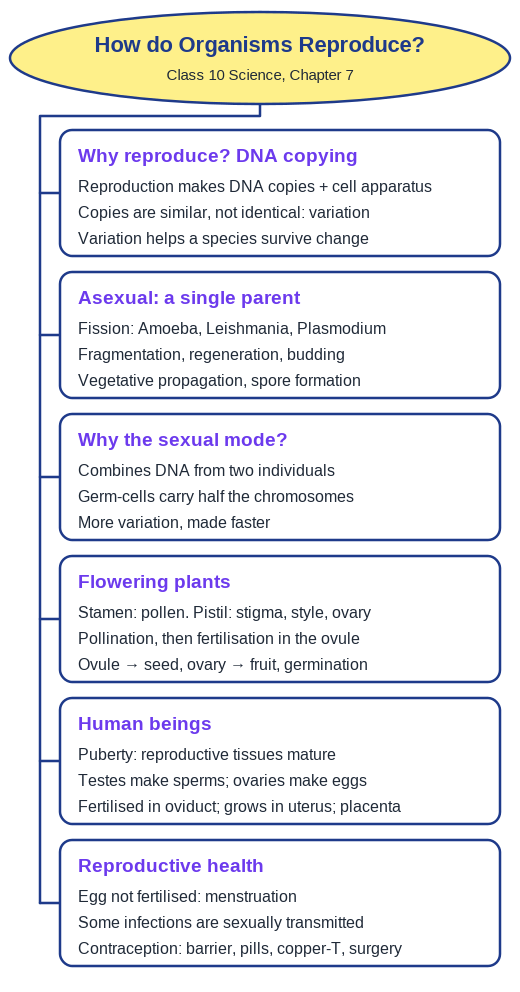
What is this chapter about?
Nutrition, respiration and excretion keep an organism alive. Reproduction does not: an organism can live without it, and it costs a lot of energy. Yet every kind of living thing reproduces, because that is how a species continues and how we come to notice it at all: there are many of each kind, and they look alike. This chapter explains what is copied when organisms reproduce, the many ways a single parent can do it, and why two parents are often needed. It ends with reproduction in flowering plants and in human beings, and with reproductive health.
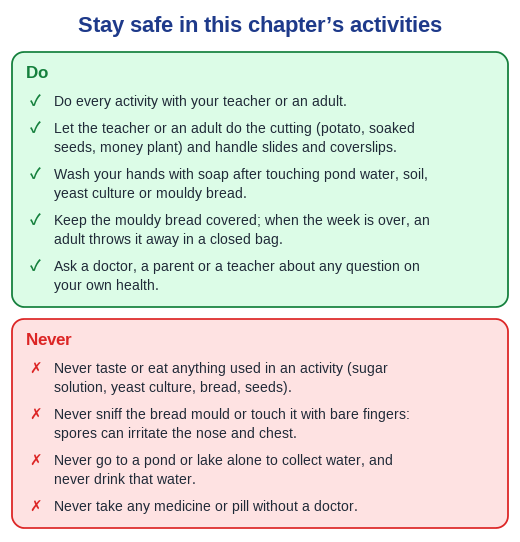
How do we stay safe in this chapter’s activities?
Do the activities with your teacher or an adult. Let an adult do the cutting and handle the glass slides. Wash your hands after touching pond water, yeast culture or mouldy bread; never taste anything from an activity, and never sniff the mould.
Do organisms make exact copies of themselves?
Offspring resemble their parents because their body designs are similar, and the plan for a body design lies in the DNA of the chromosomes in the cell nucleus. DNA is the source of information for making proteins; different information would give different proteins and, in the end, a different body design. So the basic event in reproduction is making a copy of the DNA. The cell also builds a second set of cellular apparatus, because a bare DNA copy pushed out of the cell could not keep itself alive. Then the two DNA copies separate, each with its own apparatus: one cell has become two.
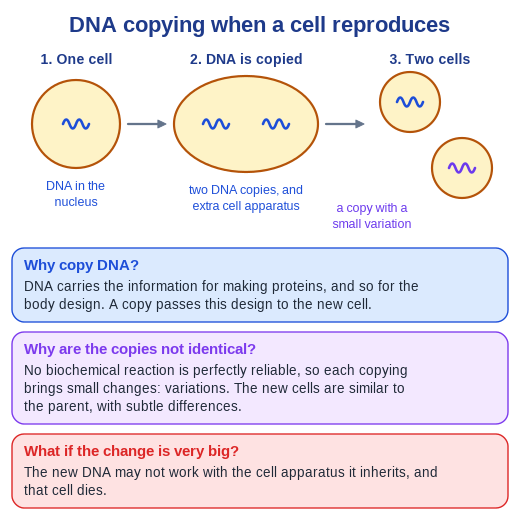
No biochemical reaction is perfectly reliable, so the copies are similar but not always identical. A very large change kills the new cell. Smaller changes survive, so the cells of the next generation are alike with subtle differences. This built-in variation is the basis of evolution, which the next chapter, Heredity, takes up.
Why is variation important?
A population lives in a particular place and way of life, its niche. Accurate DNA copying keeps the body design that suits this niche, so reproduction gives a species stability. But a niche can change: the temperature may rise or fall, water levels may change, a meteorite may hit. If all individuals were exactly alike, such a change could wipe out the whole population. If a few are different, some may survive. The chapter’s example is bacteria in temperate water: if the water warms, most die, but the few heat-resistant variants live and multiply. Variation may not help one individual, but it helps the species to survive over time.
How does a single organism reproduce?
When one individual produces the next generation, it is asexual reproduction. The mode depends on the body design.
- Fission. A single-celled organism divides. Amoeba splits into two in any plane; Leishmania splits in a definite orientation; Plasmodium divides into many cells at once (multiple fission).
- Fragmentation. Spirogyra, a simple filament, breaks into pieces when mature, and each piece grows into a new filament.
- Regeneration. Pieces of a cut Hydra or Planaria grow into whole animals.
- Budding. A bud grows on the parent Hydra or yeast cell and separates.
- Vegetative propagation. A root, stem or leaf grows into a new plant, as in potato and Bryophyllum.
- Spore formation. Rhizopus, the bread mould, makes thick-walled spores in sporangia.
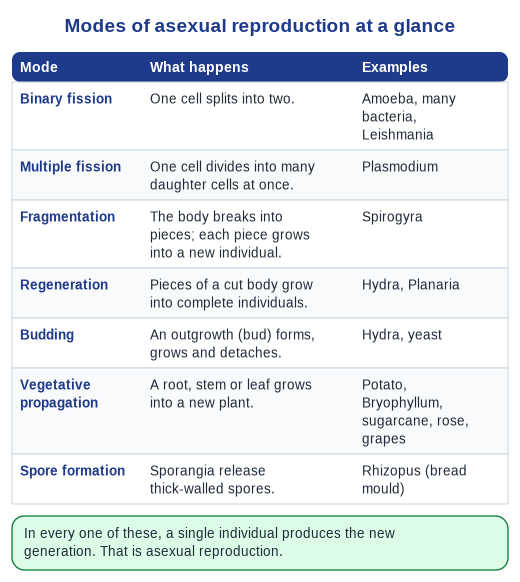
Organisms with many kinds of tissues and organs cannot simply divide cell by cell. In them reproduction is the job of a particular cell type. Read asexual reproduction for each mode with its diagram.
Why did sexual reproduction arise?
Variation helps a species, but accurate DNA copying makes new variations appear slowly. There is a quicker way. Two individuals of a population carry different sets of variations built up over generations, all of them tested in living bodies. Combining the DNA of two individuals gives new combinations at once. That is the sexual mode.
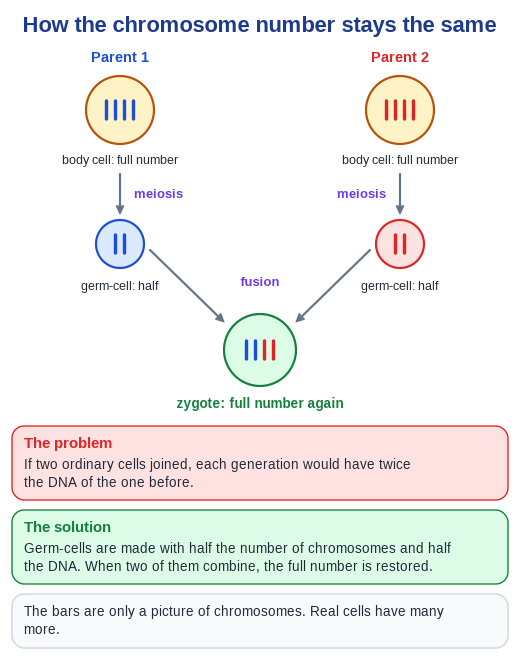
One problem follows: if two ordinary cells joined, each generation would have twice the DNA of the last. So special cells in the reproductive organs divide by meiosis to make germ-cells (gametes) with half the number of chromosomes and half the DNA. When two germ-cells fuse, the zygote has the full number again. In complex organisms the two gametes differ: the small, motile one is the male gamete, and the large one with stored food is the female gamete.
How do flowering plants reproduce sexually?
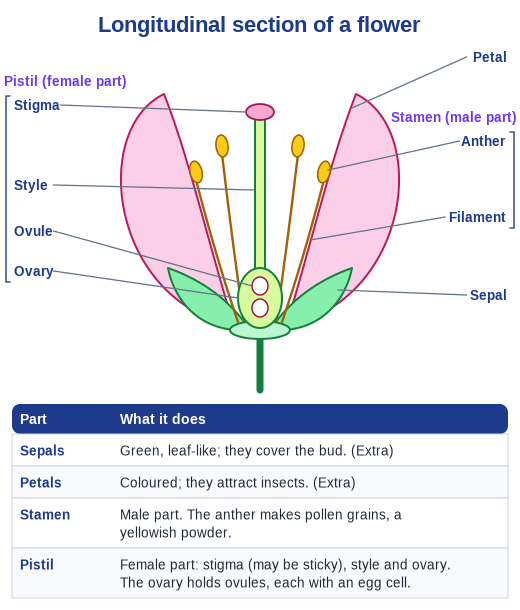
The reproductive parts of a flower are the stamens (male) and the pistil (female). The anther of a stamen makes pollen grains. The pistil has a stigma, a style and an ovary with ovules, and each ovule has an egg cell. A flower with only stamens or only a pistil is unisexual (papaya, watermelon); one with both is bisexual (Hibiscus, mustard).
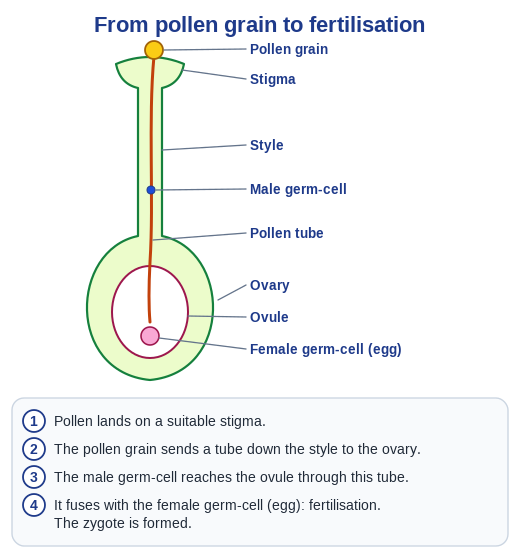
Pollination carries pollen to the stigma: within the same flower (self-pollination) or to another flower by wind, water or animals (cross-pollination). A pollen tube then grows down the style and takes the male germ-cell to the ovule, where it fuses with the egg: fertilisation. The zygote becomes the embryo, the ovule becomes the seed and the ovary ripens into the fruit. Later the seed germinates into a seedling. Read sexual reproduction in flowering plants.
How do human beings reproduce?
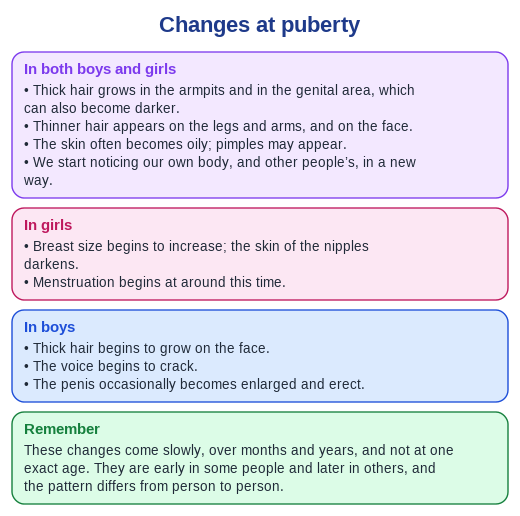
Human beings reproduce sexually. In the early teenage years, as general body growth slows down, the reproductive tissues begin to mature. This period is puberty. The body’s appearance changes slowly, over months and years, and not at the same age or in the same pattern for everyone.
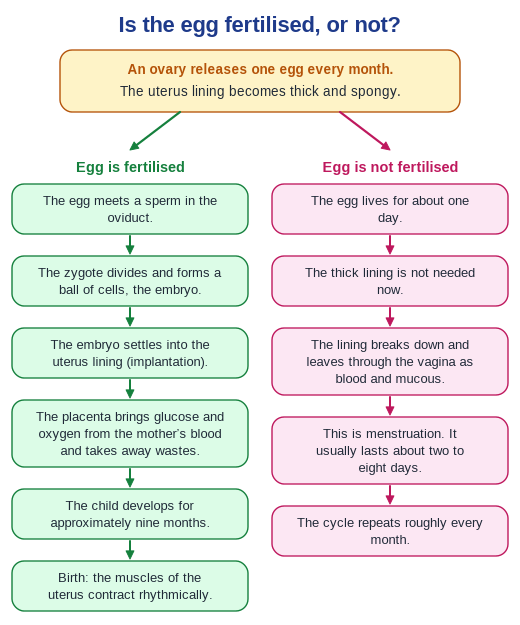
In the male reproductive system, the testes make sperms and the hormone testosterone. The sperms pass through the vas deferens, receive the secretions of the seminal vesicles and the prostate gland, and leave through the urethra. In the female reproductive system, the ovaries make eggs and some hormones. One egg is released every month and is carried along the oviduct (fallopian tube) to the uterus, which opens through the cervix into the vagina.
If the egg meets a sperm in the oviduct it is fertilised. The zygote divides into an embryo, which is implanted in the thick lining of the uterus and is nourished through the placenta. The child develops for approximately nine months. If the egg is not fertilised, the lining breaks down and comes out as blood and mucous: menstruation. Read reproduction in human beings.
What does the chapter say about reproductive health?
Sexual maturation is gradual and happens while the body is still growing. The chapter stresses that being partly mature does not make a person’s body or mind ready for sex, or for having children and raising them. It names three matters:
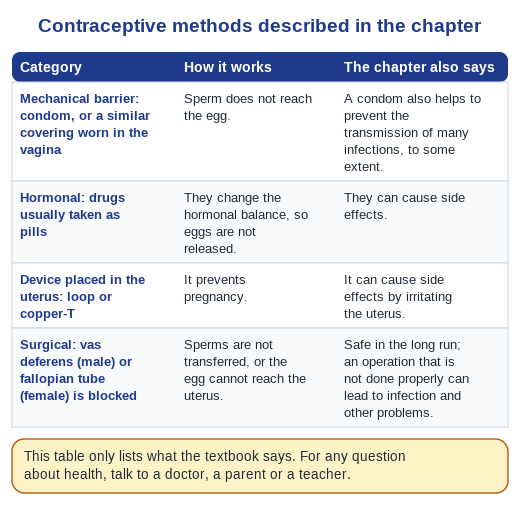
- Infections. Many diseases can be sexually transmitted: bacterial ones such as gonorrhoea and syphilis, and viral ones such as warts and HIV-AIDS. A condom helps, to some extent, to stop many of them from being passed on.
- Contraception. Pregnancy makes major demands on a woman’s body and mind, and her health suffers if she is not ready. Contraceptive methods avoid pregnancy: mechanical barriers, hormonal pills, devices such as the loop or copper-T, and surgical methods.
- Sex ratio. Surgery can also remove an unwanted pregnancy, and this is misused for illegal sex-selective abortion of female foetuses. Prenatal sex determination is prohibited by law, and a healthy society needs its female-male sex ratio maintained.
The size of a population depends on its birth and death rates. The chapter adds that a growing population makes it more difficult to raise everyone’s standard of living, but that if inequality is the main cause of poor living standards, population size matters much less.
Before we move on
Practise the four diagrams (flower, pollen tube, male system, female system) until you can label them from memory, and learn one example for each asexual mode. Answers to the three Questions boxes, the activities and all eleven exercises are in the NCERT solutions for Chapter 7.
Key terms
| Term | Meaning |
|---|---|
| Reproduction | The process by which organisms produce new individuals of their own kind. It is not needed to keep one individual alive. |
| DNA copying | The making of a second copy of a cell’s DNA by chemical reactions. It is the basic event in reproduction. |
| Variation | The small differences between individuals of a species. They arise because DNA copying is not perfectly accurate. |
| Asexual reproduction | Reproduction in which a single individual produces the new generation. |
| Fission | The division of a single-celled organism into two (binary fission) or many (multiple fission) daughter cells. |
| Regeneration | The growth of complete individuals from pieces of the body, as in Hydra and Planaria. |
| Budding | The growth of a new individual as an outgrowth (bud) on the parent, as in Hydra and yeast. |
| Vegetative propagation | The growth of new plants from a root, stem or leaf of the parent plant. |
| Spore | A thick-walled reproductive cell, as in Rhizopus, that grows into a new individual on a moist surface. |
| Germ-cell (gamete) | A reproductive cell with half the number of chromosomes. The motile one is the male gamete; the one with stored food is the female gamete. |
| Pollination | The transfer of pollen from the stamen to the stigma of a flower. |
| Fertilisation | The fusion of a male germ-cell with a female germ-cell. It gives the zygote. |
| Puberty | The period during adolescence when the reproductive tissues begin to mature. |
| Placenta | A disc of special tissue in the wall of the uterus through which the embryo gets glucose and oxygen and gives up wastes. |
| Menstruation | The breaking down of the thick lining of the uterus, which comes out as blood and mucous when the egg is not fertilised. |
| Contraception | Methods used to avoid pregnancy, such as condoms, oral pills, the copper-T and surgical methods. |
Topics in this chapter
Practice
-
Which organism reproduces by multiple fission?
Show answer
Answer: (b) Plasmodium
-
The thread-like structures of bread mould that are not reproductive parts are the:
Show answer
Answer: (c) hyphae
-
Germ-cells have half the number of chromosomes because of a cell division called:
Show answer
Answer: (c) meiosis
-
After fertilisation in a flower, the ovule develops into the:
Show answer
Answer: (b) seed
-
In human beings, fertilisation takes place in the:
Show answer
Answer: (c) oviduct (fallopian tube)
-
The testes lie outside the abdominal cavity because sperm formation needs:
Show answer
Answer: (b) a lower temperature than the body’s
Questions students ask
What are the main topics of Class 10 Science Chapter 7?
Why organisms reproduce and why DNA copying matters, the importance of variation, the modes of asexual reproduction (fission, fragmentation, regeneration, budding, vegetative propagation and spore formation), why sexual reproduction exists, sexual reproduction in flowering plants, and reproduction in human beings with reproductive health.
Is How do Organisms Reproduce? in the 2026-27 NCERT book?
Yes. It is Chapter 7 of Science, the Class 10 NCERT textbook marked Reprint 2026-27, on pages 113 to 127. It has three Questions boxes inside the chapter and eleven exercises at the end.
Which diagrams of this chapter should I practise for the board exam?
Practise drawing and labelling the longitudinal section of a flower, the germination of pollen on the stigma, and the human male and female reproductive systems. Simple sketches of binary fission in Amoeba, budding in Hydra and spore formation in Rhizopus are also useful.
What is the difference between asexual and sexual reproduction?
In asexual reproduction a single individual produces the young, which carry copies of its DNA, so variation is small. In sexual reproduction germ-cells from two individuals fuse, so the DNA of two individuals is combined and far more variation appears in each generation.
Stuck on a question?
Take a photo and Lagnever AI explains it step by step. Try it for 7 days for ₹2.
Get it on Google Play Open in browser
For parents: after the trial, the plan renews monthly by UPI or card autopay. You can cancel anytime in the app.