
How do flowering plants reproduce sexually?
Answer in short
The flower holds the reproductive parts. Stamens make pollen grains, and the pistil has a stigma, a style and an ovary with ovules. Pollination carries pollen to the stigma. A pollen tube then takes the male germ-cell to the egg in the ovule, where they fuse: fertilisation. The ovule becomes a seed, the ovary a fruit, and the seed germinates.
Stuck on a question? Take a photo and Lagnever AI explains it step by step. Try it for 7 days for ₹2. Get it on Google Play
Why is there a sexual mode of reproduction?
Asexual reproduction passes on copies of one parent’s DNA. New variations come only from small copying errors, and they build up slowly. Sexual reproduction is faster at making variation, because it combines the DNA of two individuals, each carrying its own set of variations collected over many generations.
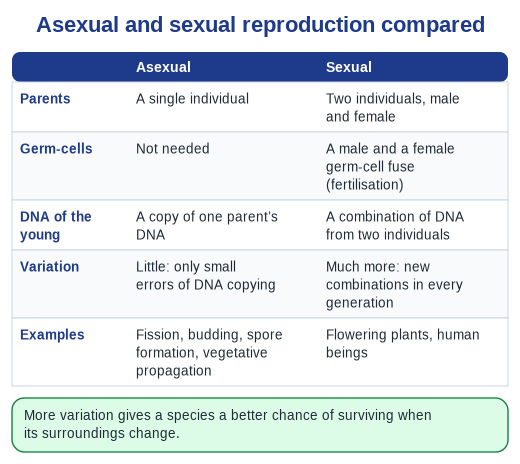
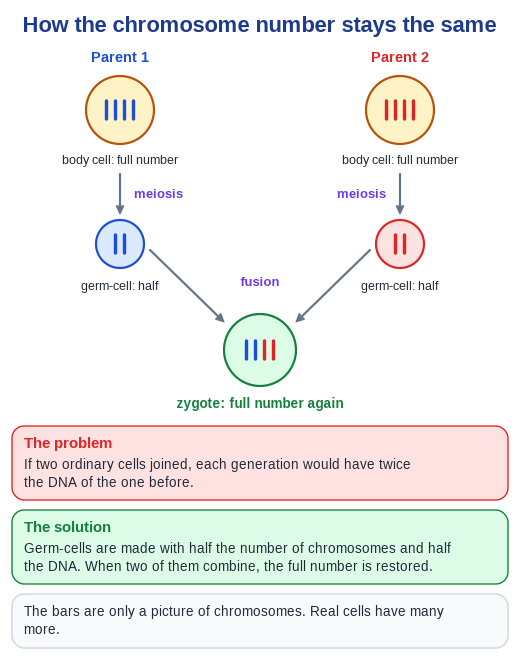
If two ordinary cells joined, the amount of DNA would double in every generation. So cells in the reproductive organs divide by meiosis to give germ-cells with half the number of chromosomes. When a male and a female germ-cell fuse, the full number returns.
What are the parts of a flower?
In flowering plants (angiosperms) the reproductive parts are in the flower. A flower has sepals, petals, stamens and a pistil. The stamens and the pistil are the reproductive parts, and they contain the germ-cells.
- The stamen is the male part. Its anther, held on a thin filament, produces pollen grains, the yellowish powder that sticks to your fingers when you touch it.
- The pistil, in the centre of the flower, is the female part. Its swollen base is the ovary, the long middle part is the style, and the tip is the stigma, which is often sticky. Inside the ovary are ovules, each with one egg cell.
A flower that has either stamens or a pistil is unisexual, as in papaya and watermelon. A flower that has both is bisexual, as in Hibiscus and mustard.
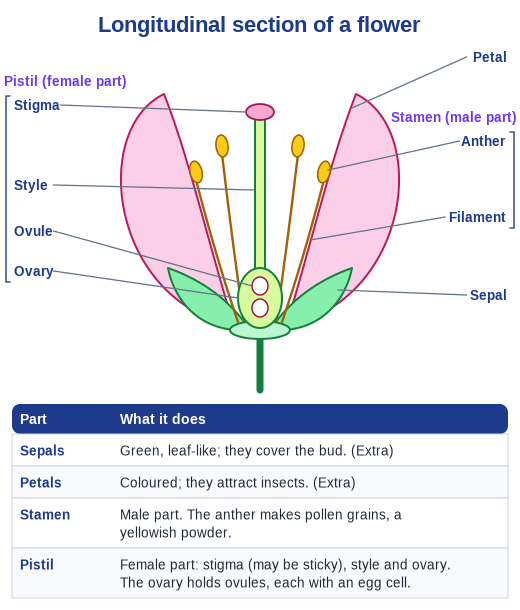
The book asks what the sepals and petals might do. Sepals cover and protect the bud, and coloured petals attract insects (Extra).
What is pollination?
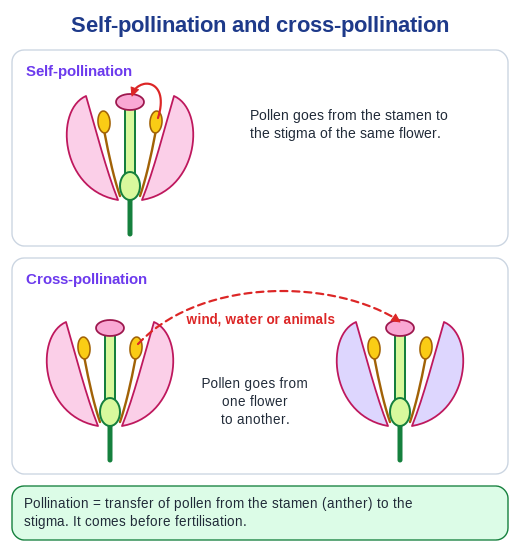
The male germ-cell is made by the pollen grain, and the egg lies deep in the ovary. So the pollen must first reach the stigma. This transfer is pollination.
- Self-pollination: the pollen lands on the stigma of the same flower.
- Cross-pollination: the pollen is carried from one flower to another by agents such as wind, water or animals.
How does fertilisation happen?
Landing on the stigma is not enough: the male germ-cell still has to reach the ovule. A pollen tube grows out of the pollen grain, passes down the style and reaches the ovary. The male germ-cell travels along it into the ovule and fuses with the egg. This fusion of the germ-cells is fertilisation, and the cell it forms is the zygote, which can grow into a new plant.
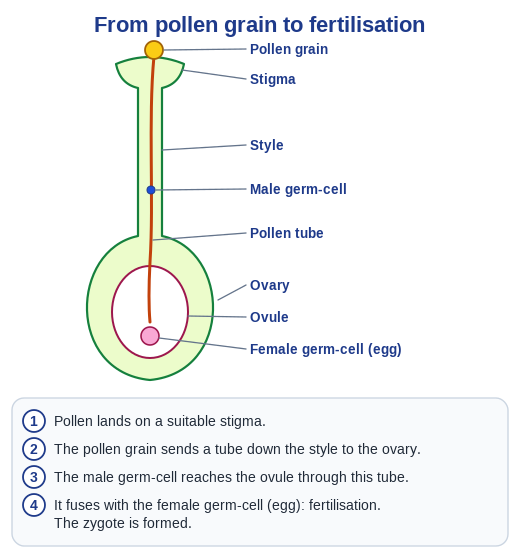
The growth of the pollen tube towards the ovule is an example of chemotropism, which you met in Chapter 6, Control and Coordination.
| Pollination | Fertilisation | |
|---|---|---|
| What it is | transfer of pollen from the stamen to the stigma | fusion of the male germ-cell with the egg |
| Where | on the stigma, outside the ovary | inside the ovule, in the ovary |
| How | by wind, water or animals, or within the same flower | through the pollen tube |
| Order | comes first | follows pollination |
| Result | pollen reaches the stigma | a zygote is formed |
What happens after fertilisation?
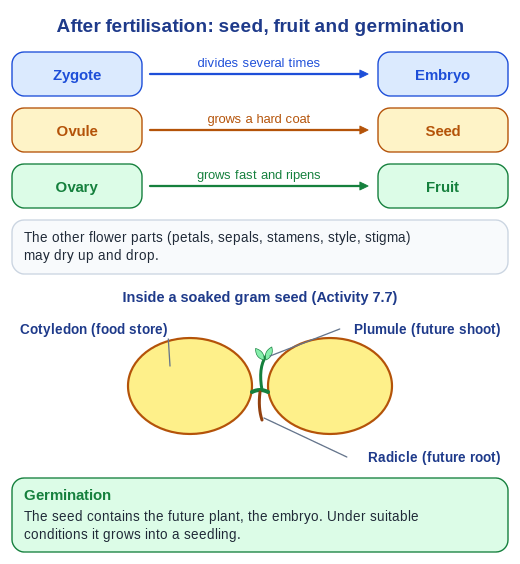
The zygote divides several times and forms an embryo inside the ovule. The ovule grows a hard coat and slowly turns into a seed. The ovary grows quickly and ripens into a fruit. The other parts of the flower (petals, sepals, stamens, style and stigma) may dry up and drop. In some fruits a flower part stays on: the green cap on a brinjal or a tomato is made of its sepals (Extra).
The book asks you to work out how seeds help the plant. One answer: the embryo stays protected inside a tough coat, with its own food store, until conditions are suitable for it to grow (Extra).
What is inside a seed?
Soak a few gram (chana) seeds overnight, keep them under a wet cloth for a day, and ask an adult to open one. The seed splits into two thick halves, the cotyledons, which store food. Between them lies the tiny future plant: the plumule is the future shoot and the radicle is the future root. Under suitable conditions this embryo develops into a seedling. The process is germination.
More questions on this topic are solved in the NCERT solutions for Chapter 7. Go back to the Chapter 7 notes.
Practice
-
Which of these flowers is unisexual?
Show answer
Answer: (c) Papaya
-
The part of the pistil that receives the pollen is the:
Show answer
Answer: (c) stigma
-
The future shoot in a seed is the:
Show answer
Answer: (b) plumule
-
Name three agents of cross-pollination.
Show answer
Answer: Wind, water and animals carry pollen from one flower to another.
-
What happens to the petals, sepals and stamens after fertilisation?
Show answer
Answer: They may dry up and drop, along with the style and stigma, while the ovary grows and ripens into the fruit.
Questions students ask
What is the difference between self-pollination and cross-pollination?
In self-pollination the pollen is transferred from the stamen to the stigma of the same flower. In cross-pollination it is carried from one flower to another by agents such as wind, water or animals.
Where does fertilisation take place in a flower?
Inside the ovule, which lies in the ovary. The male germ-cell reaches it through the pollen tube and fuses with the female germ-cell, the egg, to form the zygote.
What is germination?
The seed contains the future plant, the embryo. Under appropriate conditions the embryo develops into a seedling. This process is called germination.
Why do germ-cells have half the number of chromosomes?
If two ordinary cells fused, every generation would have double the DNA of the one before. Germ-cells are made by meiosis with half the chromosomes, so the zygote gets the full number back.
Stuck on a question?
Take a photo and Lagnever AI explains it step by step. Try it for 7 days for ₹2.
Get it on Google Play Open in browser
For parents: after the trial, the plan renews monthly by UPI or card autopay. You can cancel anytime in the app.