
What are the modes of asexual reproduction?
Answer in short
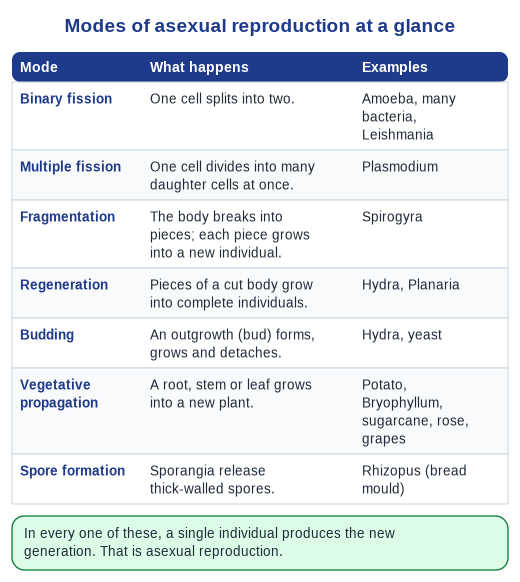
In asexual reproduction a single individual produces the new generation. Single-celled organisms divide by fission: binary in Amoeba and Leishmania, multiple in Plasmodium. Spirogyra breaks into fragments, Hydra and Planaria can regenerate from pieces, Hydra and yeast form buds, plants such as potato and Bryophyllum grow from vegetative parts, and Rhizopus makes spores.
Stuck on a question? Take a photo and Lagnever AI explains it step by step. Try it for 7 days for ₹2. Get it on Google Play
What is asexual reproduction?
When a single individual produces the new generation, it is asexual reproduction. No second parent and no fusion of germ-cells is needed. The cell copies its DNA, builds extra cellular apparatus and divides. How an organism does this depends on its body design: a single cell can simply split, a simple filament can break into pieces, and a plant can grow from one of its parts.
How do single-celled organisms divide?
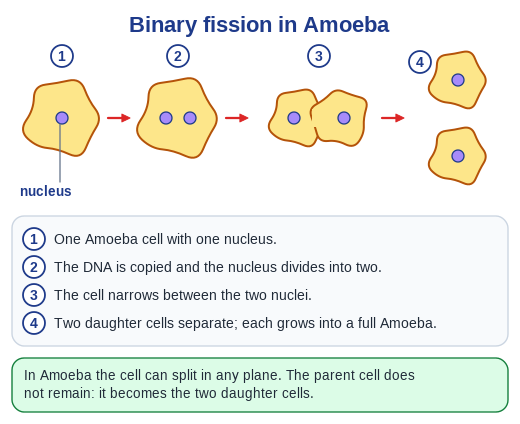
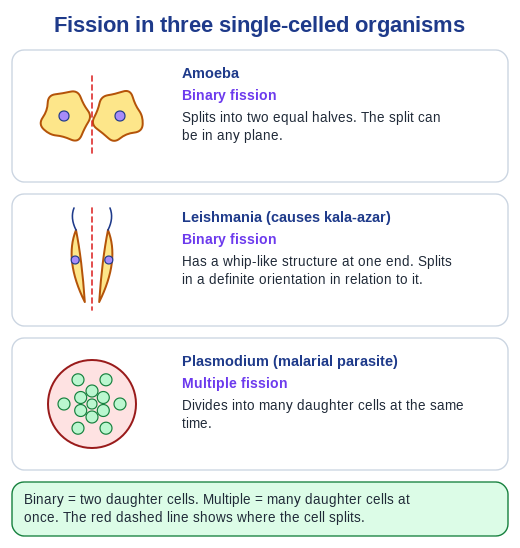
For a unicellular organism, cell division itself makes new individuals. It is called fission. Many bacteria and protozoa split into two equal halves: binary fission. In Amoeba the split can be in any plane.
Some single cells are more organised. Leishmania, which causes kala-azar, has a whip-like structure at one end, and its binary fission happens in a definite orientation in relation to that structure. Plasmodium, the malarial parasite, divides into many daughter cells at the same time: multiple fission.
What is fragmentation?
Spirogyra forms the dark green filaments seen in pond and lake water (it is an alga; Extra). When a filament matures it simply breaks into smaller pieces, and each piece, or fragment, grows into a new filament. This works because the body is simple: every cell of the filament is much like the next.
Most many-celled organisms cannot do this. Their specialised cells are arranged as tissues, the tissues as organs, and the organs sit at definite places in the body. Dividing cell by cell would not rebuild such a body. In them, reproduction is the work of a particular cell type that can grow, multiply and make the other cell types.
What are regeneration and budding?
Many fully differentiated organisms can grow new individuals from body parts. If a Hydra or a Planaria is cut into pieces, each piece grows into a complete animal. This is regeneration. Specialised cells multiply into a mass of cells, and these then change into the different cell types and tissues in an organised sequence called development.
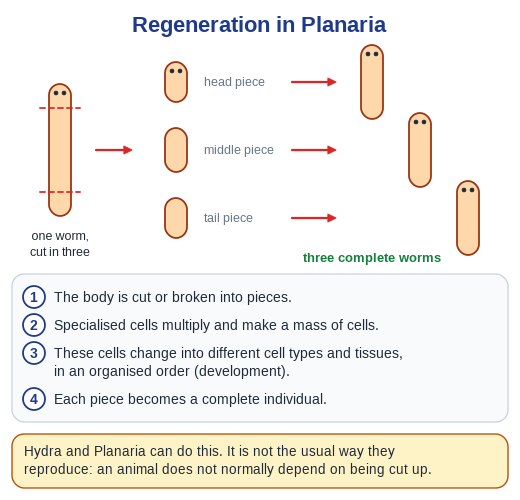
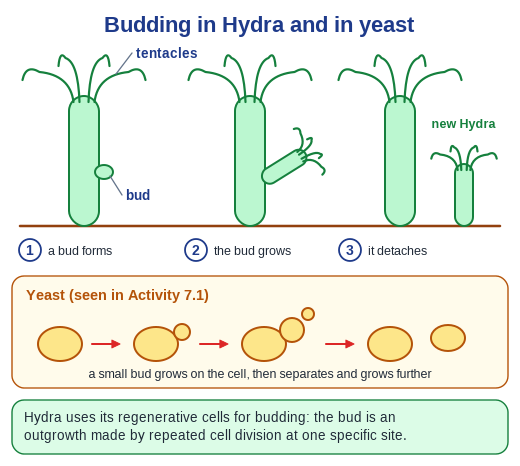
Regeneration is not the same as reproduction, because an animal does not normally wait to be cut. Hydra does, however, use its regenerative cells to reproduce by budding. Repeated cell division at one specific site makes an outgrowth, the bud. The bud develops into a tiny Hydra and, when fully mature, detaches and lives on its own. Yeast also puts out small buds that separate and grow.
How do plants grow from their own parts?
In many plants a root, a stem or a leaf can develop into a new plant under suitable conditions. This is vegetative propagation. A piece of potato with a bud sends out a shoot and roots. In Bryophyllum, buds form in the notches along the leaf margin, fall on the soil and grow into new plants. Growers use the same property in layering and grafting to raise sugarcane, roses and grapes.
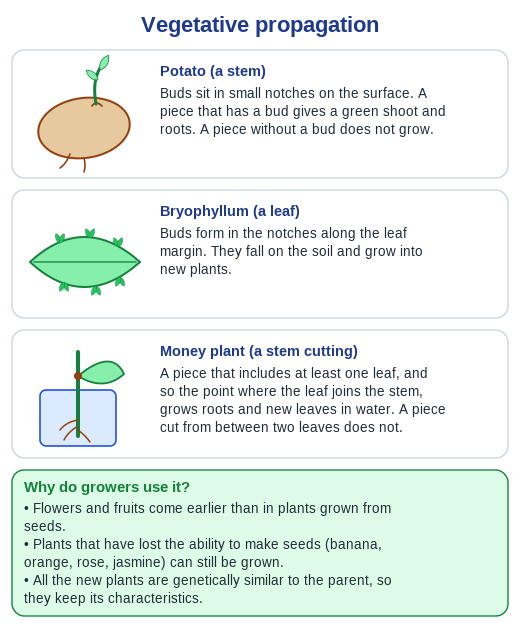
The chapter gives three advantages. Such plants flower and fruit sooner than seed-grown plants. Plants that have lost the capacity to make seeds, such as banana, orange, rose and jasmine, can still be multiplied. And all the new plants are genetically similar enough to the parent to have its characteristics.
Tissue culture takes this further. Tissue or cells from the growing tip of a plant are grown in an artificial medium. There they multiply fast into a small group of cells called a callus. The callus is moved to another medium that contains hormones for growth and differentiation, and the plantlets are then put in soil. Many plants can be raised from one parent, without disease. It is commonly used for ornamental plants.
How does Rhizopus use spores?
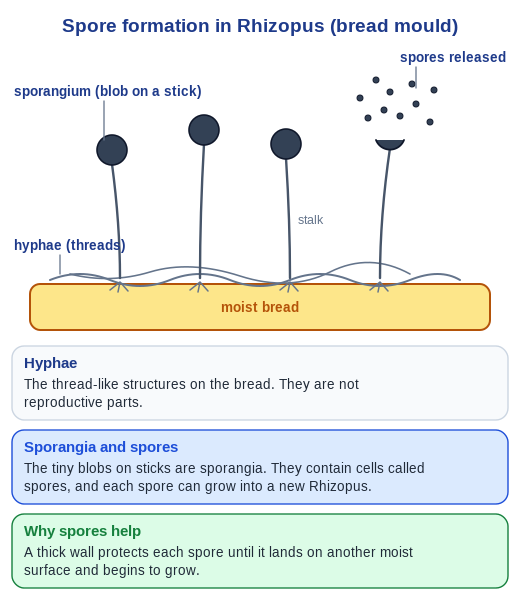
On moist bread kept for some days, a mould grows. Its thread-like structures are hyphae; they are not reproductive parts. The tiny blobs on sticks are sporangia, and they contain cells called spores. Each spore can develop into a new Rhizopus. A thick wall protects the spore until it reaches another moist surface.
Do the yeast, bread mould and pond-water activities only with your teacher: never taste anything, never sniff the mould, and wash your hands afterwards.
More questions on this topic are solved in the NCERT solutions for Chapter 7. Go back to the Chapter 7 notes.
Practice
-
In which organism does binary fission occur in a definite orientation?
Show answer
Answer: (b) Leishmania
-
Spirogyra reproduces by:
Show answer
Answer: (c) fragmentation
-
Buds on the leaf margin grow into new plants in:
Show answer
Answer: (d) Bryophyllum
-
Why are the spores of Rhizopus covered by thick walls?
Show answer
Answer: The thick wall protects the spore until it comes into contact with another moist surface, where it can begin to grow.
-
Give two advantages of vegetative propagation.
Show answer
Answer: Plants raised this way can bear flowers and fruits earlier than plants grown from seeds, and all of them are genetically similar to the parent, so they keep its characteristics. It also allows plants that have lost the capacity to produce seeds, such as banana, to be grown.
Questions students ask
What is asexual reproduction?
It is reproduction in which a single individual creates the new generation, without the fusion of germ-cells. Fission, fragmentation, budding, vegetative propagation and spore formation are asexual modes.
What is the difference between binary fission and multiple fission?
In binary fission the parent cell divides into two daughter cells, as in Amoeba and Leishmania. In multiple fission it divides into many daughter cells at the same time, as in Plasmodium, the malarial parasite.
Is regeneration the same as reproduction?
No. Regeneration is the ability of pieces of a body to grow into complete individuals, as in Hydra and Planaria. Most organisms do not normally depend on being cut up to reproduce, so the chapter does not count it as reproduction.
What is tissue culture?
It is a way of growing new plants from tissue or cells taken from the growing tip of a plant. The cells divide in an artificial medium into a callus, which is moved to a medium with hormones; the plantlets are then planted in soil.
Stuck on a question?
Take a photo and Lagnever AI explains it step by step. Try it for 7 days for ₹2.
Get it on Google Play Open in browser
For parents: after the trial, the plan renews monthly by UPI or card autopay. You can cancel anytime in the app.