
Class 10 Science Chapter 6: Control and Coordination Notes
This chapter in five lines
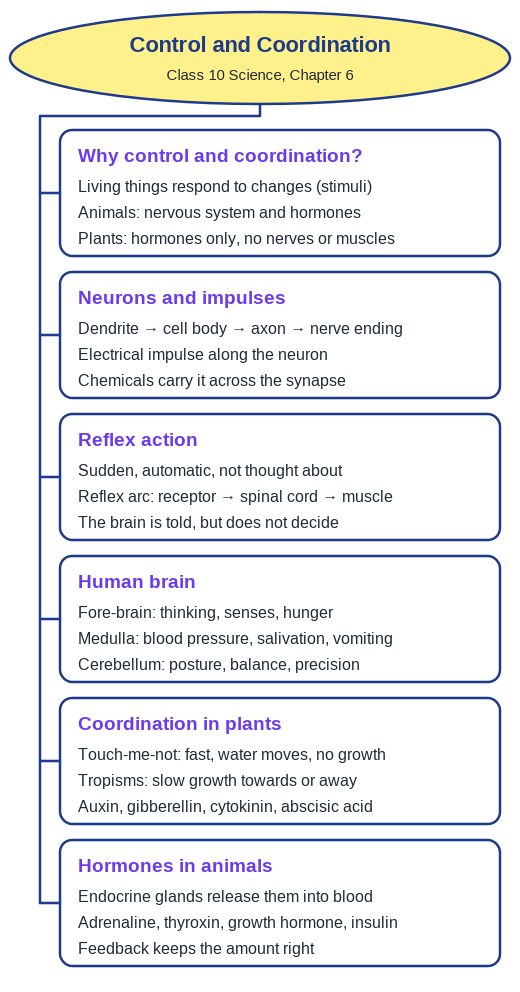
Living things detect changes around them and respond in a controlled way. In animals, the nervous system sends quick electrical impulses along neurons, and reflex arcs in the spinal cord give the quickest replies. The brain thinks and controls voluntary and involuntary actions. Hormones, carried by blood, give slower, wider control. Plants have no nerves; they use hormones, water movement and growth.
What is this chapter about?
A cat runs when it sees a mouse. You whisper in class but shout on the playground. A money plant on the windowsill leans towards the light. In each case a living thing notices a change around it, a stimulus, and makes the right movement in reply. The reply is never random: it fits the event. That needs systems for control and coordination. Animals have two, the nervous system and hormones. Plants have no nerves and no muscles, and manage with hormones, water and growth.
How do we stay safe in this chapter’s activities?
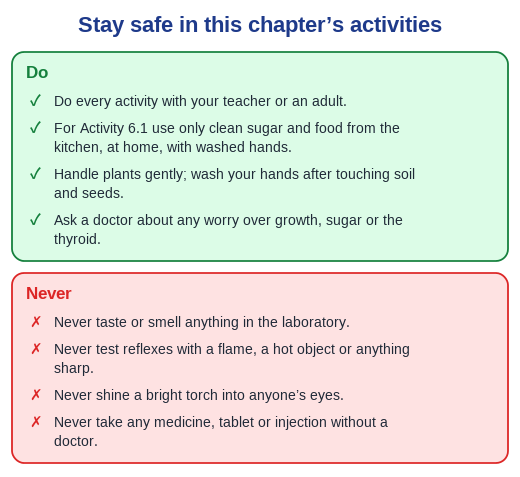
Do the activities with your teacher or an adult. Activity 6.1 uses sugar and your lunch: use only clean food from the kitchen, never anything kept in the laboratory, and never taste or smell a laboratory chemical. Do not test reflexes with flames, hot or sharp things, and do not shine a bright torch into anyone’s eyes.
How does a neuron carry a message?
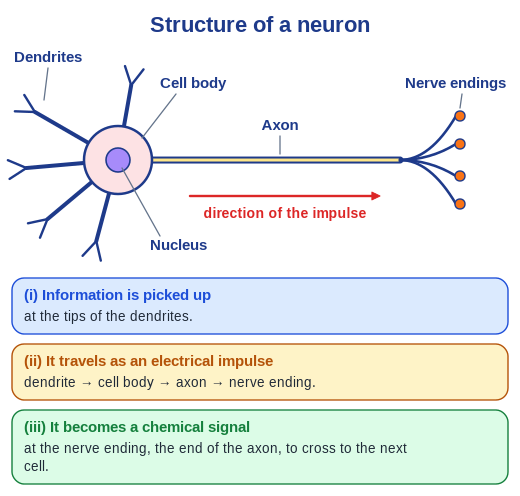
Information from the surroundings is detected by receptors, the specialised tips of some nerve cells, mostly in the sense organs. Gustatory receptors detect taste and olfactory receptors detect smell. At the tip of a dendrite, the information sets off a chemical reaction that makes an electrical impulse. The impulse runs through the dendrite to the cell body and along the axon to its end. There it makes the axon end release chemicals, which cross a gap called the synapse and start a new impulse in the next neuron. A similar junction hands the impulse to a muscle or a gland. Read the nervous system and reflex action.
What is a reflex action?
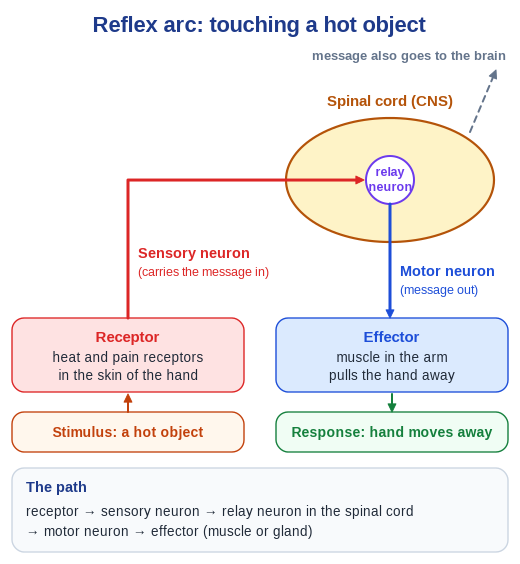
Touch a hot vessel and your hand jumps back before you have thought about it. That is a reflex action: sudden, automatic and protective. Thinking takes time, because many neurons in the brain must work together, and in that time the hand would burn. So the nerve that brings the message from the skin is joined to the nerve that moves the muscle at the first place they meet, the spinal cord. This short path is the reflex arc. The message also travels on to the brain, which is why you feel the pain a moment later.
What does each part of the brain do?
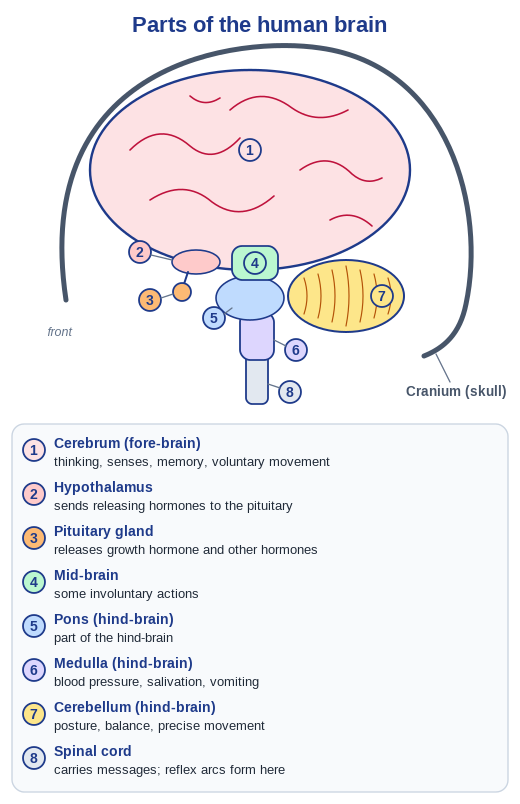
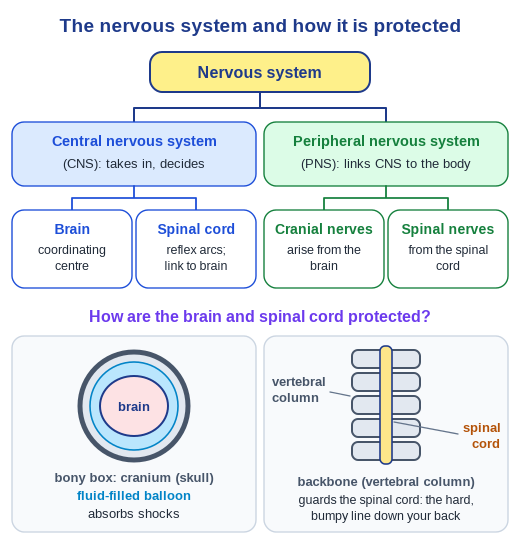
The brain is the main coordinating centre. With the spinal cord it forms the central nervous system; the cranial and spinal nerves form the peripheral nervous system. The brain has three regions. The fore-brain does most of the thinking: it has areas for hearing, smell and sight, areas that put information together, motor areas that move voluntary muscles, and a centre linked with hunger. The mid-brain and hind-brain control many involuntary actions. In the hind-brain, the medulla controls blood pressure, salivation and vomiting, and the cerebellum keeps posture and balance and makes voluntary actions, such as riding a bicycle, precise.
The brain sits in a bony box, the skull, inside a fluid-filled balloon that absorbs shocks. The spinal cord runs inside the vertebral column, the backbone.
How does nervous tissue make a muscle move?
Nervous tissue collects information, carries it, decides, and passes the decision to muscles. When an impulse reaches a muscle, the muscle cells must become shorter. They have special proteins that change their shape and their arrangement when the impulse arrives, and the new arrangement makes the cell shorter. That is how a muscle contracts.
How do plants respond without nerves?
Plants show two kinds of movement. The leaves of the chhui-mui (touch-me-not) fold within moments of a touch: a signal passes from cell to cell, some cells lose water and change shape, and no growth is involved. The other kind is slow and depends on growth: a shoot bends towards light and a root grows down. Such directional growth movements are tropisms: phototropism (light), geotropism (gravity), hydrotropism (water) and chemotropism (chemicals).
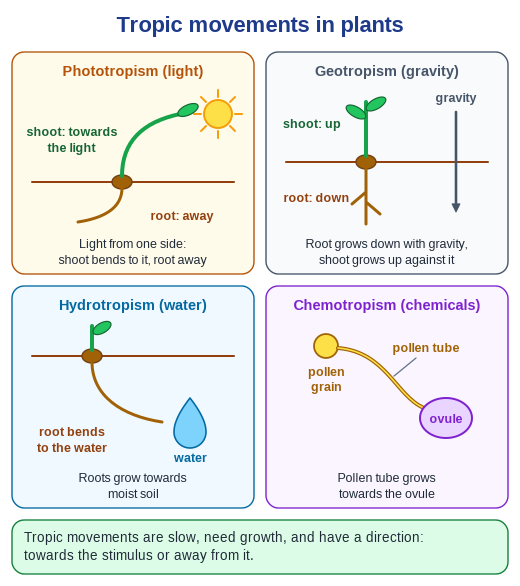
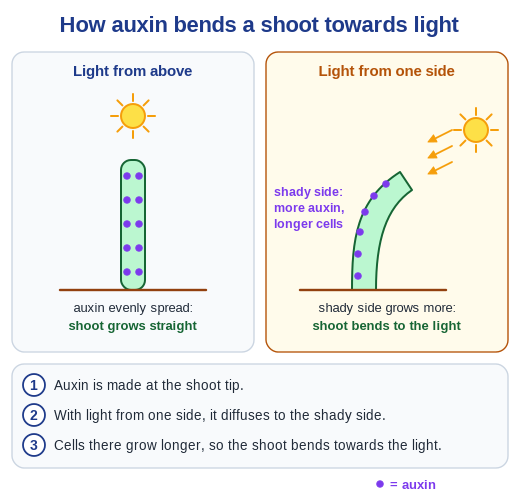
Growth is coordinated by plant hormones. Auxin, made at the shoot tip, moves to the shady side of a shoot and makes the cells there longer, so the shoot bends towards light. Gibberellins help the stem grow, cytokinins promote cell division, and abscisic acid inhibits growth. Read hormones in plants and animals.
What do hormones do in animals?
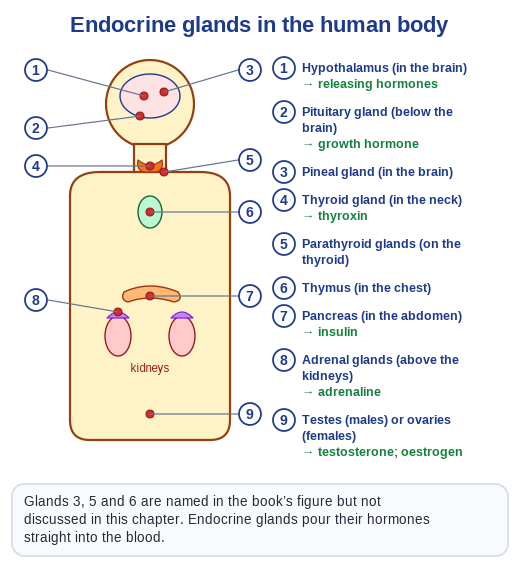
Electrical impulses are fast, but they reach only cells joined to nerves, and a cell must reset before it can send another. So animals also use chemical messengers, hormones, made by endocrine glands and carried by the blood to every part. When a squirrel is frightened, its adrenal glands release adrenaline: the heart beats faster, breathing quickens and blood is sent to the muscles, ready to fight or run. Thyroxin from the thyroid (which needs iodine) regulates the use of food for growth, growth hormone from the pituitary regulates growth, insulin from the pancreas helps regulate blood sugar, and testosterone and oestrogen bring the changes of puberty.
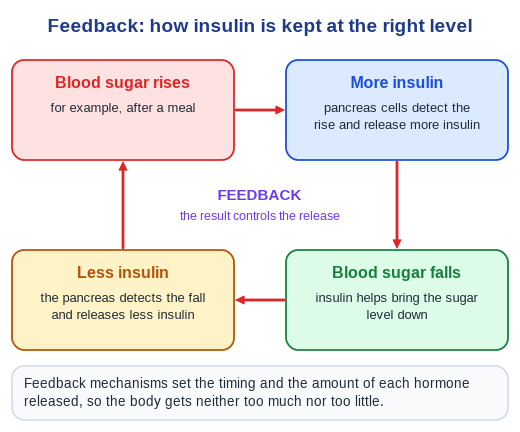
The amount of each hormone is set by feedback: when blood sugar rises, the pancreas releases more insulin; as the sugar level falls, it releases less.
Before we move on
Practise the three diagrams (neuron, reflex arc, brain) until you can label them from memory, and learn Table 6.1 as hormone, gland and function. Answers to the three Questions boxes, the activities and all twelve exercises are in the NCERT solutions for Chapter 6.
Key terms
| Term | Meaning |
|---|---|
| Stimulus | A change in the surroundings, such as heat, light or touch, to which a living thing responds. |
| Receptor | The specialised tip of a nerve cell, usually in a sense organ, that detects a stimulus. |
| Neuron | A nerve cell. It has dendrites, a cell body and an axon, and carries messages as electrical impulses. |
| Synapse | The tiny gap between the end of one neuron and the next cell. Chemicals carry the message across it. |
| Reflex action | A sudden, automatic response to a stimulus, done without thinking, such as pulling the hand from a flame. |
| Reflex arc | The short path of a reflex: receptor, sensory neuron, spinal cord, motor neuron, effector. |
| Central nervous system (CNS) | The brain and the spinal cord. They receive information from the whole body and put it together. |
| Peripheral nervous system (PNS) | The cranial nerves from the brain and the spinal nerves from the spinal cord, which link the CNS to the body. |
| Cerebellum | The part of the hind-brain that keeps posture and balance and makes voluntary actions precise. |
| Medulla | The part of the hind-brain that controls involuntary actions such as blood pressure, salivation and vomiting. |
| Tropism (tropic movement) | Slow growth of a plant part in a direction set by a stimulus: towards it or away from it. |
| Auxin | A plant hormone made at the shoot tip that helps cells grow longer and bends shoots towards light. |
| Hormone | A chemical messenger made in one part of an organism that acts on another part. |
| Endocrine gland | A gland, such as the thyroid or the adrenal, that pours its hormone straight into the blood. |
| Feedback mechanism | A control in which the effect of a hormone decides how much more of it is released. |
Topics in this chapter
Practice
-
The tiny gap where one neuron meets the next is the:
Show answer
Answer: (b) synapse
-
Which part of the brain keeps the posture and balance of the body?
Show answer
Answer: (c) Cerebellum
-
In a reflex arc, the impulse reaches the spinal cord through the:
Show answer
Answer: (b) sensory neuron
-
The folding of touch-me-not leaves when touched is caused by:
Show answer
Answer: (c) a change in the amount of water in some cells
-
Which plant hormone inhibits growth?
Show answer
Answer: (d) Abscisic acid
-
Iodine in our food is needed to make:
Show answer
Answer: (c) thyroxin
Questions students ask
What are the main topics of Class 10 Science Chapter 6?
The neuron and how nerve impulses travel, reflex action and the reflex arc, the human brain and its three regions, how the brain and spinal cord are protected, how nervous tissue makes muscles act, coordination in plants (the sensitive plant, tropisms and plant hormones), and hormones in animals with the feedback mechanism.
Is Control and Coordination in the 2026-27 NCERT book?
Yes. It is Chapter 6 of Science, the Class 10 NCERT textbook marked Reprint 2026-27, on pages 100 to 112. It has three Questions boxes inside the chapter and twelve exercises at the end.
Which parts of this chapter should I practise for the board exam?
Practise drawing and labelling a neuron, the reflex arc and the human brain, and learn the job of each part. Be able to explain phototropism with auxin, list the four plant hormones with their functions, and match each animal hormone to its gland and function, as in Table 6.1.
What is the difference between nervous and hormonal coordination?
Nervous coordination uses electrical impulses along neurons: it is very fast but reaches only the cells that nerves connect to. Hormonal coordination uses chemicals carried by the blood: it is slower but can reach every cell and act steadily for a long time.
Stuck on a question?
Take a photo and Lagnever AI explains it step by step. Try it for 7 days for ₹2.
Get it on Google Play Open in browser
For parents: after the trial, the plan renews monthly by UPI or card autopay. You can cancel anytime in the app.