
How do the nervous system and reflex actions work?
Answer in short
Receptors detect a stimulus and start an electrical impulse in a neuron. It travels from dendrite to cell body to axon, and chemicals carry it across the synapse. In a reflex action, the impulse takes a short path, the reflex arc, through the spinal cord to a muscle, giving a quick response. The brain handles thinking, voluntary and involuntary actions.
Stuck on a question? Take a photo and Lagnever AI explains it step by step. Try it for 7 days for ₹2. Get it on Google Play
Why do animals need a nervous system?
If your hand touches a hot tawa, three things must happen fast: the heat must be detected, a decision must be made, and the arm muscles must pull the hand back. In animals this work is shared by nervous tissue, which carries messages, and muscle tissue, which does the moving.
What is a neuron, and how does an impulse travel?
Nervous tissue is a well-ordered network of neurons (nerve cells). A neuron has three main parts: short, branched dendrites; a cell body with the nucleus; and one long fibre, the axon, which ends in fine nerve endings.
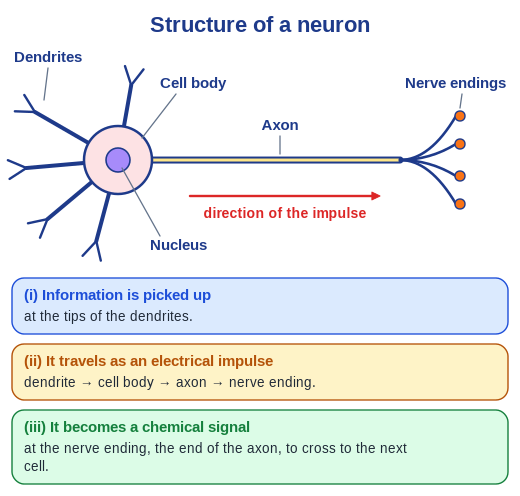
The story of one message:
- Receptors, the specialised tips of some nerve cells, detect the change. Most of them are in sense organs such as the nose, the tongue and the inner ear. Gustatory receptors detect taste; olfactory receptors detect smell.
- At the dendrite tip, a chemical reaction creates an electrical impulse.
- The impulse runs along the dendrite into the cell body and out along the axon, right to its tip.
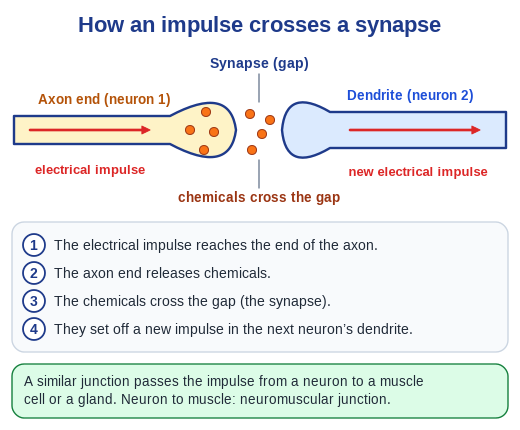
- At the end of the axon, the impulse makes the neuron release chemicals. They cross the gap, the synapse, and start a similar impulse in a dendrite of the next neuron.
The last neuron in the line hands the impulse to a muscle cell or a gland through a similar junction; with a muscle it is called a neuromuscular junction.
What happens in a reflex action?
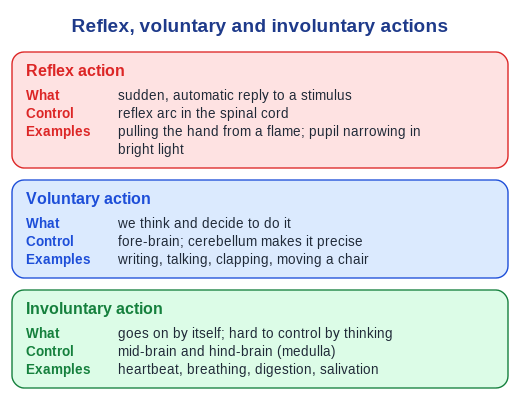
We say “I pulled my hand back by reflex.” A reflex action is a sudden response to something in the surroundings that we make without thinking and without feeling in control.
Why not think first? Thinking is done by dense networks of neurons in the front part of the skull. A message would have to travel to the brain, be worked on by many neurons, and return. By then the hand would be burnt.
The body’s answer is a shortcut. The nerve that detects the heat is connected to the nerve that moves the muscle at the point where they first meet: the spinal cord, where nerves from all over the body come together on their way to the brain. This connection is the reflex arc.
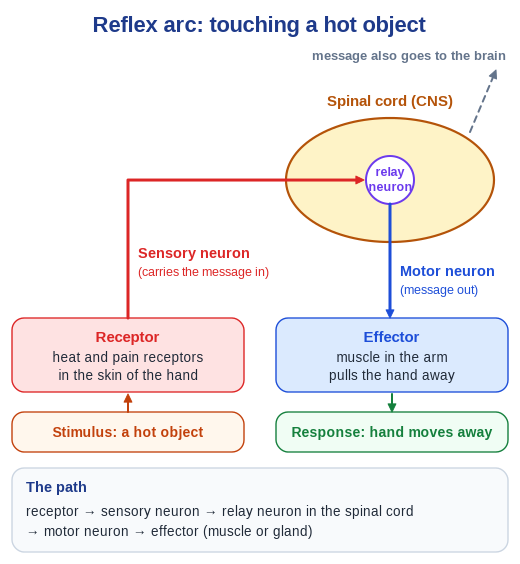
The information also goes on to the brain, so you know what happened, but the action does not wait for it. Reflex arcs probably evolved in animals that had little or no thinking tissue, and they remain the quicker route even in animals that can think.
What does the brain do?
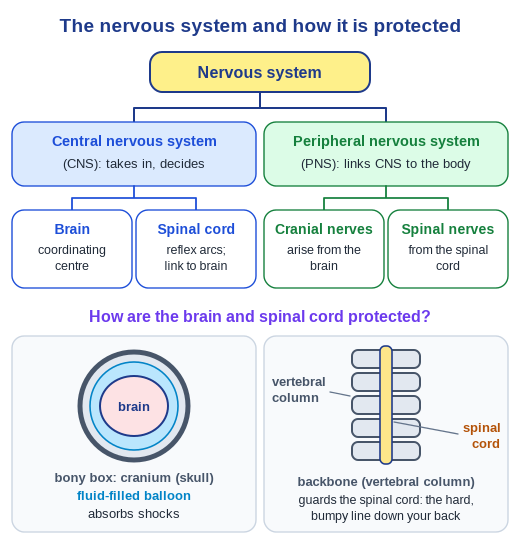
The spinal cord also carries information for the brain to think about. The brain and spinal cord form the central nervous system (CNS), which receives information from the whole body and puts it together. The peripheral nervous system (PNS), made of cranial nerves from the brain and spinal nerves from the spinal cord, connects the CNS with the rest of the body.
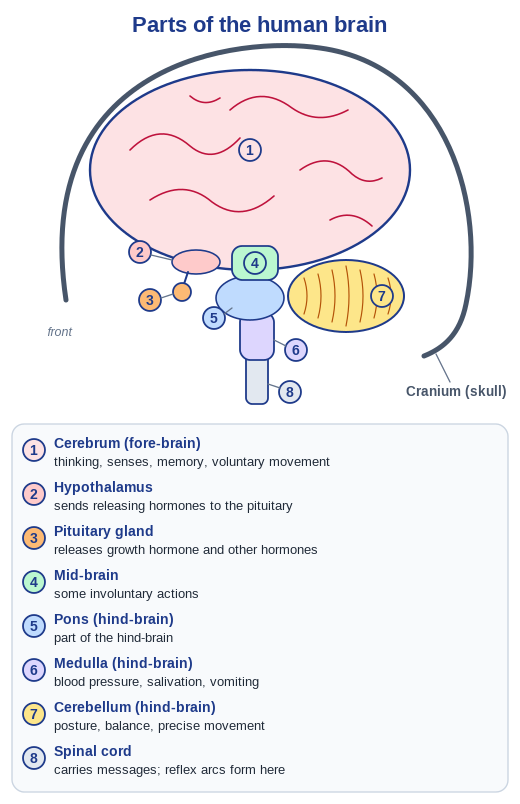
- Fore-brain: where most thinking is done. Separate areas receive impulses for hearing, smell, sight and so on; association areas interpret them using stored information; motor areas then instruct voluntary muscles. A centre linked with hunger, which tells us when we are full, is also here.
- Mid-brain and hind-brain: control many involuntary actions. The medulla in the hind-brain controls blood pressure, salivation and vomiting.
- Cerebellum (hind-brain): makes voluntary actions precise and keeps posture and balance, as in walking in a straight line or picking up a pencil.
So actions are of three kinds: reflex, voluntary and involuntary.
How are the brain and spinal cord protected?
The brain sits in a bony box and, inside it, in a fluid-filled balloon that absorbs shocks. The hard, bumpy line you feel down the middle of your back is the vertebral column, which guards the spinal cord.
How does a muscle carry out the order?
When the impulse reaches a muscle, the muscle cells must shorten. Muscle cells contain special proteins. In response to the impulse, these proteins change shape and rearrange themselves inside the cell, and the new arrangement gives the cell a shorter form. Many cells shortening together pull on the bone (Extra). Voluntary muscles, like those of the arm, act when we decide; involuntary muscles, like those of the food pipe, act on their own.
More questions on this topic are solved in the NCERT solutions for Chapter 6. Go back to the Chapter 6 notes.
Practice
-
Which part of a neuron picks up information?
Show answer
Answer: (b) Dendrite tip
-
Reflex arcs for the hand and leg are formed in the:
Show answer
Answer: (c) spinal cord
-
Salivation and vomiting are controlled by the:
Show answer
Answer: (c) medulla
-
Write the path of the impulse when you step on a thorn and lift your foot.
Show answer
Answer: Pain receptors in the skin of the foot → sensory neuron → relay neuron in the spinal cord → motor neuron → leg muscle (effector), which lifts the foot. The message also goes to the brain, so the pain is felt.
-
Why would walking be clumsy if the cerebellum were injured?
Show answer
Answer: The cerebellum makes voluntary actions precise and keeps posture and balance. Without it the person could still decide to walk, but could not keep steady or walk in a straight line.
Questions students ask
What is a synapse?
It is the tiny gap between the end of the axon of one neuron and the dendrite of the next. The electrical impulse cannot jump it; the axon end releases chemicals that cross the gap and start a new impulse on the other side.
Why are reflex actions faster than actions we think about?
Thinking needs many neurons in the brain to work together, which takes time. In a reflex, the incoming nerve is joined to the outgoing nerve in the spinal cord itself, so the path is much shorter.
What are the three main parts of the human brain?
The fore-brain, the mid-brain and the hind-brain. The fore-brain does most of the thinking; the mid-brain and hind-brain control many involuntary actions; the hind-brain includes the pons, the medulla and the cerebellum.
How is the brain protected?
It sits inside a bony box, the cranium or skull, and inside that it is held in a fluid-filled balloon that absorbs shocks. The spinal cord is protected by the vertebral column.
Stuck on a question?
Take a photo and Lagnever AI explains it step by step. Try it for 7 days for ₹2.
Get it on Google Play Open in browser
For parents: after the trial, the plan renews monthly by UPI or card autopay. You can cancel anytime in the app.