
NCERT Solutions Class 10 Science Chapter 6: Control and Coordination
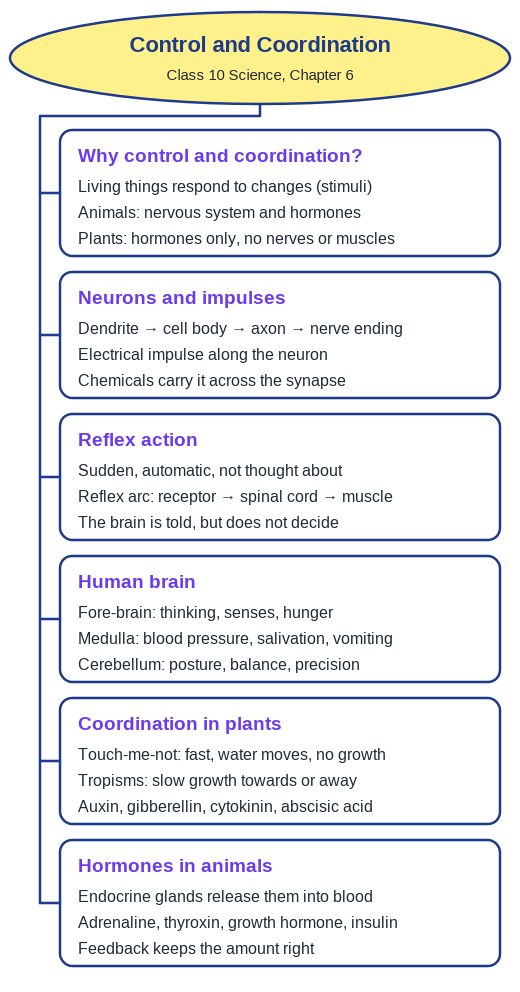
Answers to the three Questions boxes inside Chapter 6, Control and Coordination, the other questions the chapter asks along the way, Activities 6.1–6.4, and all twelve end-of-chapter exercises, from Science, the Class 10 NCERT textbook. Page numbers follow the 2026-27 reprint (pages 100–112). The exercises are quoted from the book; the in-chapter questions are restated in short. Points that go beyond the chapter are marked “Extra”. Short notes: Chapter 6 notes.
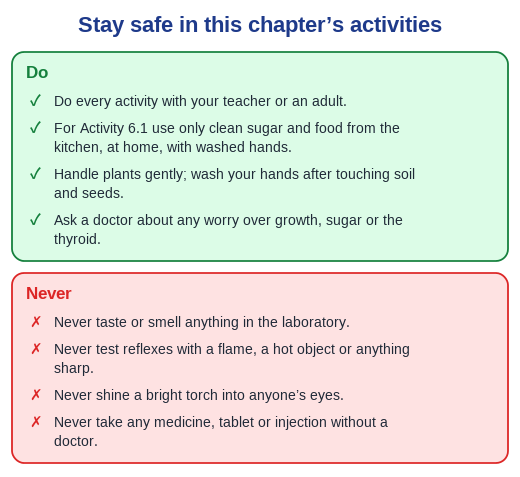
Stay safe. Do the activities with your teacher or an adult. For Activity 6.1 use only clean sugar and food from the kitchen, never anything kept in the laboratory, and never taste or smell a laboratory chemical. Do not test reflexes with a flame, a hot object or anything sharp, and do not shine a bright torch into anyone’s eyes.
Questions, page 105
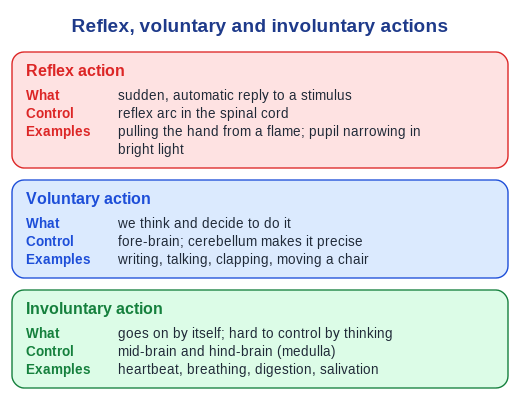
Question 1 (page 105): how a reflex action differs from walking.
| Reflex action | Walking | |
|---|---|---|
| Kind of action | sudden and automatic; we do not think about it | voluntary; we decide to do it |
| Controlled by | a reflex arc in the spinal cord | the brain: the fore-brain decides and the cerebellum keeps it precise and balanced |
| Speed | very quick | slower, because thinking is involved |
| Example | pulling the hand away from a flame | walking to school |
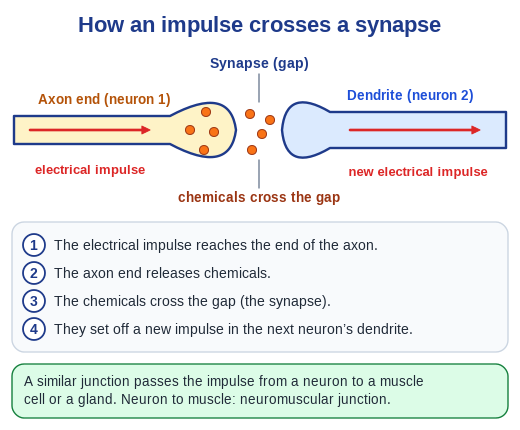
Question 2 (page 105): what goes on at a synapse. The electrical impulse reaches the end of the axon of the first neuron and makes it release chemicals. These chemicals cross the gap (the synapse) and set off a similar impulse in the next neuron’s dendrite. So the message crosses the synapse as a chemical signal.
Question 3 (page 105): the part of the brain that keeps posture and equilibrium. The cerebellum, a part of the hind-brain. It also makes voluntary actions precise.
Question 4 (page 105): how we detect the smell of an agarbatti. The smell reaches olfactory receptors in the nose. They set off electrical impulses, which travel along neurons to the fore-brain, where there is a separate area for smell. That area interprets the impulses, using what is already stored in the brain, and we recognise the smell of the agarbatti.
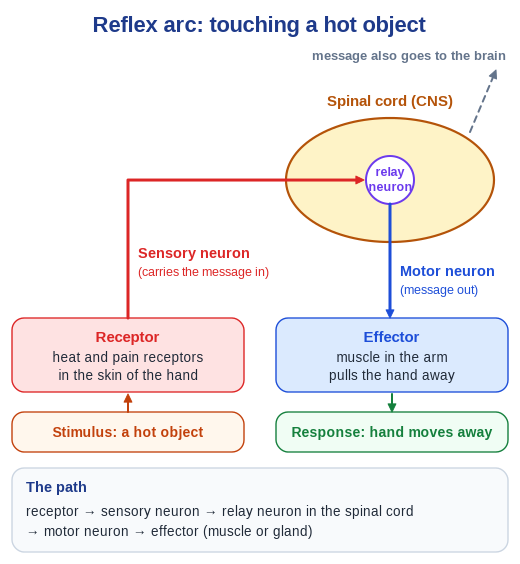
Question 5 (page 105): the role of the brain in a reflex action. The brain does not make the decision in a reflex. The reflex arc is completed in the spinal cord: the sensory neuron passes the impulse to the motor neuron there, and the muscle acts at once. The information also travels on to the brain, so the brain becomes aware of what happened (we feel the pain) a moment after the hand has already moved.
Questions, page 108
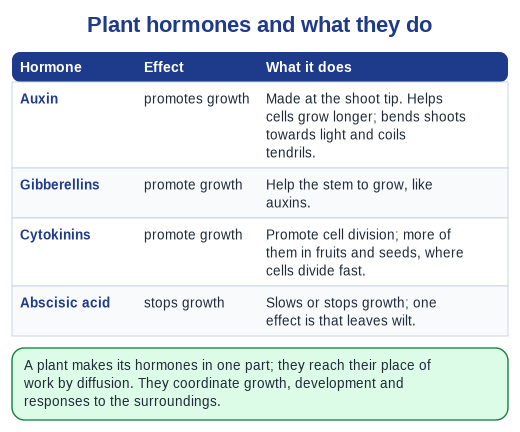
Question 1 (page 108): what plant hormones are. They are chemical compounds made in plants that help coordinate growth, development and responses to the surroundings. A plant makes them in one part, and they reach the part where they work by diffusion. Examples: auxins, gibberellins, cytokinins and abscisic acid.
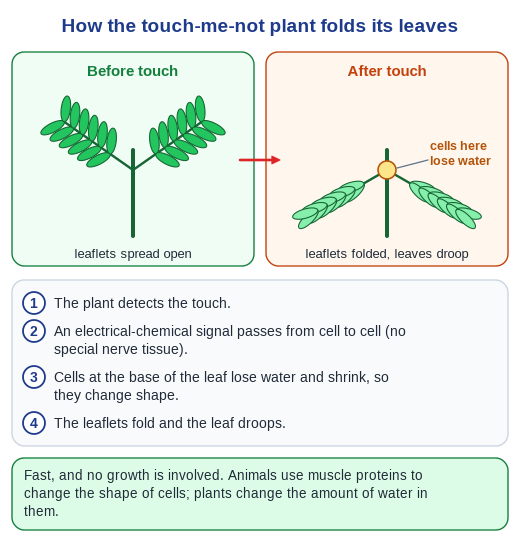
Question 2 (page 108): the movement of sensitive-plant leaves compared with a shoot moving towards light.
| Leaves of the sensitive plant | Shoot bending towards light | |
|---|---|---|
| Stimulus | touch | light |
| Speed | very quick | slow |
| Growth | not involved | caused by growth |
| How | cells change shape by losing or gaining water | auxin makes the cells on the shady side grow longer |
| Direction | does not depend on the direction of the touch | towards the light: a tropic movement |
Question 3 (page 108): one plant hormone that promotes growth. Auxin. (Gibberellins and cytokinins also promote growth.)
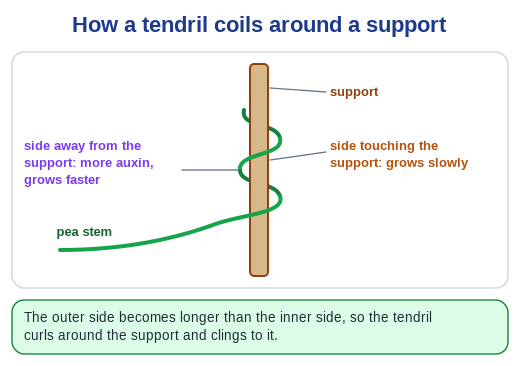
Question 4 (page 108): how auxins help a tendril grow around a support. A tendril is sensitive to touch. When it touches a support, the side in contact grows more slowly than the side away from the support. Auxin collects on the side away from the support and makes the cells there grow longer. The outer side becomes longer than the inner side, so the tendril curls round the support and clings to it. (The chapter describes the unequal growth; that auxin gathers on the far side is the usual explanation, Extra.)
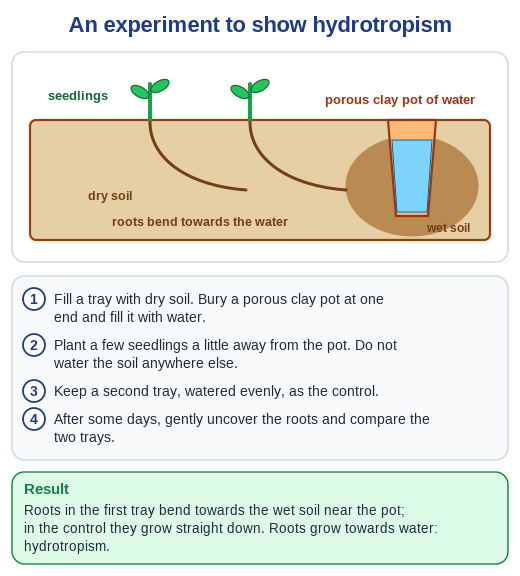
Question 5 (page 108): an experiment to show hydrotropism. Fill a tray with dry soil. Bury a porous clay pot at one end and fill it with water; water seeps slowly into the soil around it. Plant a few seedlings a little away from the pot and do not water the soil anywhere else. Keep a second tray, watered evenly, as the control. After some days, gently uncover the roots. In the first tray the roots have bent towards the wet soil near the pot instead of growing straight down; in the control they grow straight down. So roots grow towards water: hydrotropism. (This design is ours; any set-up with water on one side only will do.)
Questions, page 111
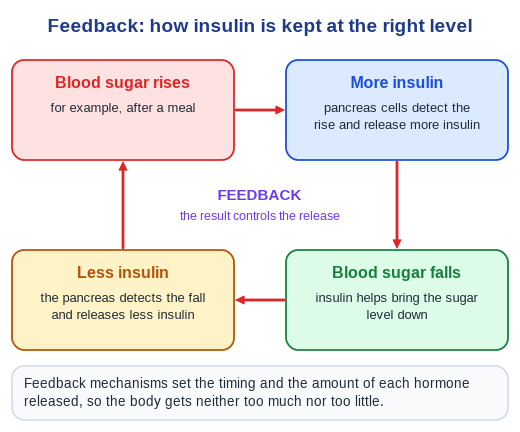
Question 1 (page 111): how chemical coordination takes place in animals. Through hormones. Endocrine glands secrete hormones straight into the blood, which carries them to all parts of the body. Each hormone acts on its target organs or tissues: adrenaline on the heart and other organs, thyroxin on metabolism, growth hormone on growth, insulin on blood sugar. The timing and amount of each hormone are regulated by feedback mechanisms.
Question 2 (page 111): why iodised salt is advisable. The thyroid gland needs iodine to make thyroxin, the hormone that regulates carbohydrate, protein and fat metabolism so that the body grows in a balanced way. If the diet is short of iodine, too little thyroxin is made and the person may suffer from goitre, one sign of which is a swollen neck. Iodised salt supplies the iodine.
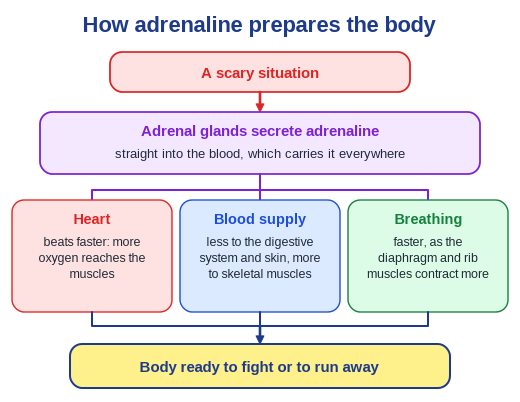
Question 3 (page 111): how the body responds when adrenaline enters the blood. The heart beats faster, so more oxygen reaches the muscles. Muscles around the small arteries of the digestive system and skin contract, so less blood goes there and more is diverted to the skeletal muscles. The breathing rate rises as the diaphragm and rib muscles contract more. Together these changes prepare the body to deal with the situation, by fighting or running away.
Question 4 (page 111): why some diabetes patients are given insulin injections. Insulin, made by the pancreas, helps regulate the blood sugar level. In such patients it is not secreted in proper amounts, so the sugar level in the blood rises and causes many harmful effects. Injections supply the missing insulin and bring the sugar level under control. Insulin is taken only as a doctor prescribes.
Other questions inside the chapter (pages 101–110)
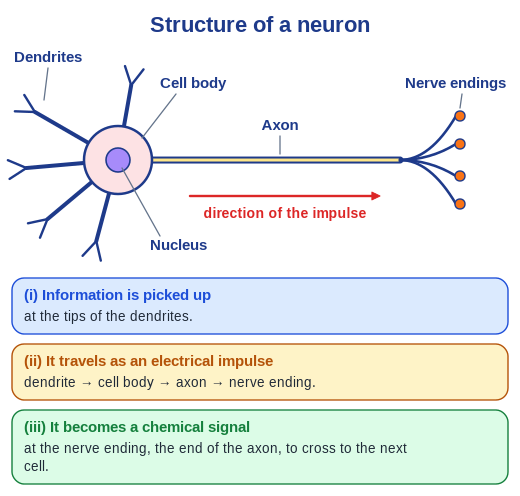
Parts of a neuron (page 101). (i) Information is acquired at the tip of a dendrite. (ii) It travels as an electrical impulse through the dendrite, the cell body and the axon. (iii) It is changed into a chemical signal at the end of the axon (the nerve ending), to cross the synapse.
Bright light on the eyes (page 103). Light receptors in the eye detect the bright light → a sensory neuron carries the impulse to the central nervous system → a relay neuron passes it to a motor neuron → the motor neuron carries it to muscles in the eye → the pupil becomes smaller, so less light enters. It is a reflex: we do not decide it. (For the eye, the connection is made in the brain itself, not in the spinal cord; Extra.)
How do we know we have eaten enough? (page 104) A hunger centre in another part of the fore-brain gives the feeling of being full.
Voluntary and involuntary muscles (page 105). Voluntary muscles, such as those of the arms and legs, act when the thinking part of the brain decides; they bring about voluntary actions. Involuntary muscles, such as those of the heart and the food canal, work on their own, under the mid-brain and hind-brain, without our thinking about them. In both, the cells shorten when their proteins change shape and arrangement.
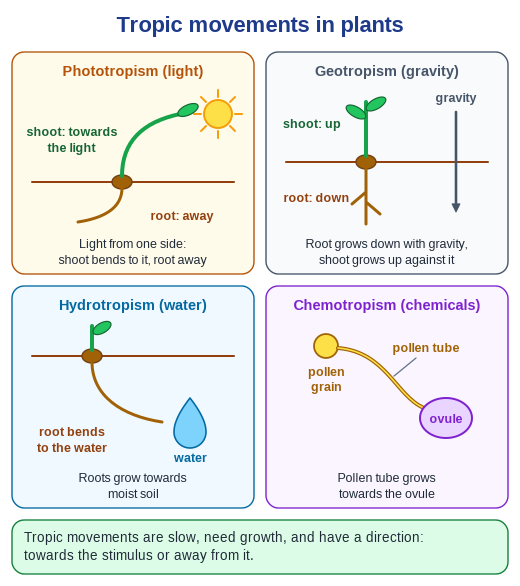
How does phototropism help the plant? (page 107) The shoot bends towards light, so the leaves get the light they need to make food. The root bends away from light, into the soil, where it finds water and minerals and holds the plant firm.
Hydrotropism and chemotropism (page 107). Hydrotropism is directional growth in response to water: roots grow towards moist soil. Chemotropism is directional growth in response to chemicals: a pollen tube grows towards the ovule.
Goitre and the thyroid (page 110). The thyroid gland lies in the neck. In goitre it is the thyroid that swells, so the swelling shows as a swollen neck.
What the activities show (Activities 6.1–6.4)
- 6.1, sugar with the nose blocked: the sugar still tastes sweet, but food seems to have less flavour when the nose is pinched shut. What we call the taste of food comes from the gustatory receptors of the tongue together with the olfactory receptors of the nose. With the nose blocked, the smell is missing. The same happens during a cold, when food seems tasteless. Use only clean food from the kitchen.
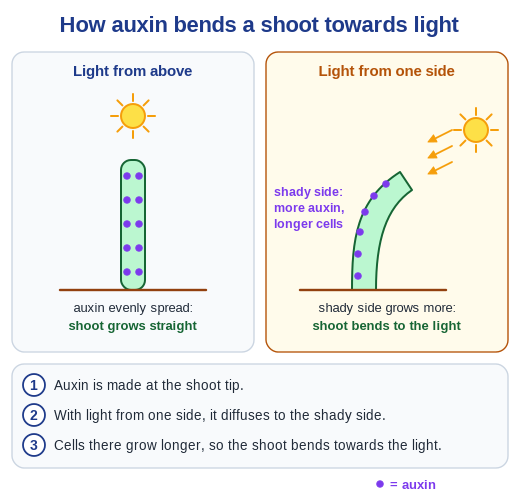
- 6.2, bean seedlings and light from one side: after a few days the shoots bend towards the light and the roots away from it. When the flask is turned, the old parts keep their direction; only the new growth bends, the shoot again towards the light and the root away. Conclusion: shoots grow towards light and roots away from it (positive and negative phototropism; these two terms are Extra), and the movement is caused by growth.
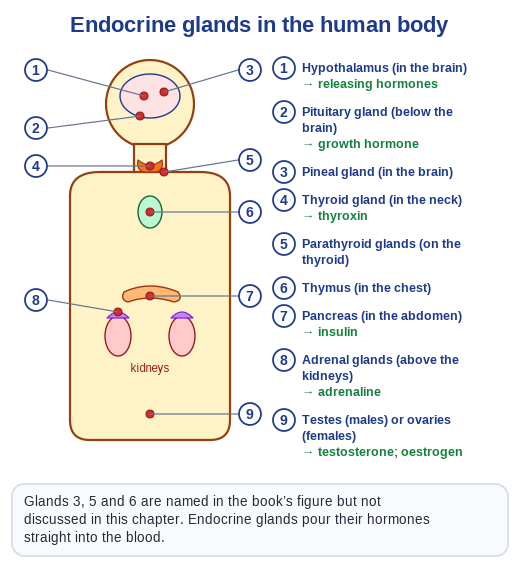
- 6.3, the endocrine glands in the figure: hypothalamus, pituitary, pineal, thyroid, parathyroid, thymus, pancreas, adrenal glands, and testes (in males) or ovaries (in females). The chapter discusses the hypothalamus, pituitary, thyroid, pancreas, adrenals, testes and ovaries; ask your teacher about the others.
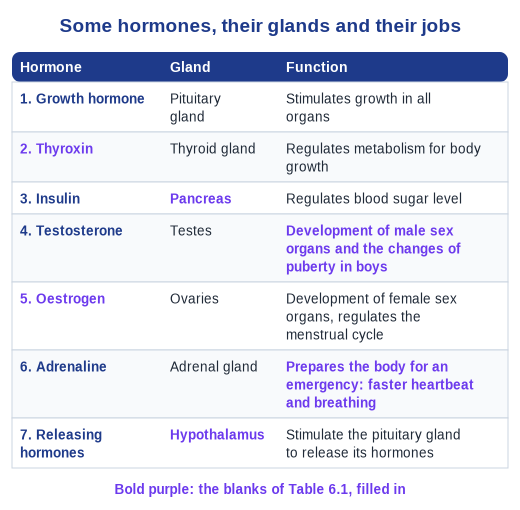
- 6.4, completing Table 6.1: 2. Thyroxin; 3. Pancreas; 4. testosterone: development of male sex organs and the changes of puberty in boys; 5. Oestrogen; 6. adrenaline: prepares the body for an emergency (faster heartbeat and breathing, more blood to the muscles); 7. Hypothalamus.
Exercises 1 to 3: choose the answer
1. “Which of the following is a plant hormone? (a) Insulin (b) Thyroxin (c) Oestrogen (d) Cytokinin.”
(d) Cytokinin. It promotes cell division in plants. Insulin, thyroxin and oestrogen are animal hormones.
2. “The gap between two neurons is called a (a) dendrite. (b) synapse. (c) axon. (d) impulse.”
(b) Synapse. Chemicals released by the axon end cross it.
3. “The brain is responsible for (a) thinking. (b) regulating the heart beat. (c) balancing the body. (d) all of the above.”
(d) All of the above. The fore-brain thinks, the medulla of the hind-brain controls involuntary actions such as the heartbeat, and the cerebellum keeps balance.
Exercises 4 to 8: receptors, neurons and plants
4. “What is the function of receptors in our body? Think of situations where receptors do not work properly. What problems are likely to arise?”
Receptors are the specialised tips of some nerve cells, usually in the sense organs. They detect information from the surroundings (light, sound, smell, taste, heat, pain, touch) and start the electrical impulse that carries it to the spinal cord and brain.
If receptors do not work properly, the stimulus is not detected and the body cannot respond in time. For example: with a cold, the olfactory receptors are blocked and we cannot smell or fully taste food; if the heat and pain receptors of the skin failed, we would not pull the hand away from a hot object and would get burnt; if the receptors of the eye or inner ear failed, we could not see or hear danger coming.
5. “Draw the structure of a neuron and explain its function.”
Draw the neuron as shown below and label the dendrites, cell body, nucleus, axon and nerve endings.
Function: a neuron conducts information as electrical impulses from one part of the body to another. Information is picked up at the dendrite tip, where a chemical reaction creates an electrical impulse. The impulse runs along the dendrite, through the cell body and out along the axon. At the end of the axon it makes the neuron release chemicals, which cross the synapse and start an impulse in the next neuron, or pass it to a muscle or gland.
6. “How does phototropism occur in plants?”
Phototropism is the growth of a plant part in response to the direction of light. The hormone auxin is made at the shoot tip and helps cells grow longer. When light falls on the shoot from one side, auxin diffuses towards the shady side. The higher concentration of auxin there makes the cells on the shady side grow longer than the cells on the lit side. Because one side grows more than the other, the shoot bends towards the light. Roots bend away from light.
7. “Which signals will get disrupted in case of a spinal cord injury?”
(i) Reflex actions, because reflex arcs are formed in the spinal cord. (ii) Signals coming in from receptors of the body to the brain through the spinal cord, so sensation is lost. (iii) Signals going out from the brain to the muscles through the spinal cord, so voluntary movement is lost. The parts of the body whose nerves join the cord at or below the injury are the ones affected (Extra).
8. “How does chemical coordination occur in plants?”
Plants have no nervous system, so they coordinate through hormones. A plant hormone is made in one part, diffuses to another, and controls growth there. Auxin helps cells to grow longer and causes bending towards light; gibberellins help the stem grow; cytokinins promote cell division; abscisic acid inhibits growth and causes wilting of leaves. By promoting growth in some places and stopping it in others, these hormones coordinate the plant’s growth, development and responses to light, gravity, water and touch.
Exercises 9 to 12: comparing systems
9. “What is the need for a system of control and coordination in an organism?”
A living thing must respond correctly to changes around it: move away from danger, move towards food or light. In a many-celled body, different organs do different jobs, and they must work together at the right time. A response such as running needs the eyes, brain, muscles, heart and lungs to act as one. A system of control and coordination detects the stimulus, carries the information, decides the response and makes all the parts act together. Animals use the nervous system and hormones; plants use hormones.
10. “How are involuntary actions and reflex actions different from each other?”
| Involuntary actions | Reflex actions | |
|---|---|---|
| What they are | actions that go on without our thinking, often all the time | sudden responses to a stimulus |
| Controlled by | the mid-brain and hind-brain (for example, the medulla) | reflex arcs, formed in the spinal cord |
| Speed | may be slow and steady | very quick |
| Examples | heartbeat, breathing, digestion, salivation | pulling the hand from a flame, the pupil narrowing in bright light |
Both happen without our deciding them.
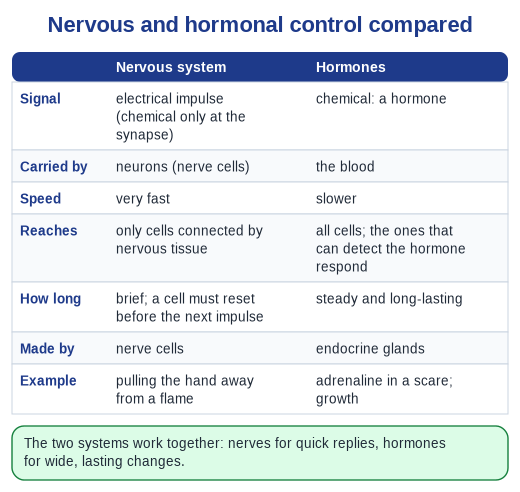
11. “Compare and contrast nervous and hormonal mechanisms for control and coordination in animals.”
Alike: both carry information from one part of the body to another and bring about a coordinated response, and both use chemicals at some stage (the nervous system at the synapse).
| Nervous mechanism | Hormonal mechanism | |
|---|---|---|
| Signal | electrical impulse | chemical (hormone) |
| Carried by | neurons | the blood |
| Speed | very fast | slower |
| Reach | only cells connected by nervous tissue | all cells of the body; target organs respond |
| Duration | brief; a cell must reset before the next impulse | steady and long-lasting |
12. “What is the difference between the manner in which movement takes place in a sensitive plant and the movement in our legs?”
| Sensitive plant | Our legs | |
|---|---|---|
| Stimulus and control | touch; no nervous system and no brain | controlled by the nervous system; voluntary |
| Message | passed from cell to cell by electrical-chemical means; no special conducting tissue | carried by neurons as electrical impulses |
| How cells change shape | plant cells swell or shrink as water moves in or out of them | muscle cells shorten when special proteins change their shape and arrangement |
| Tissue | no muscle tissue | muscle tissue |
Go back to the Chapter 6 notes, or read the nervous system and reflex action and hormones in plants and animals.
Practice
-
Which of these is a reflex action?
Show answer
Answer: (c) Blinking when dust flies towards the eye
-
Roots growing towards moist soil show:
Show answer
Answer: (b) hydrotropism
-
The hormone that prepares the body to fight or run is secreted by the:
Show answer
Answer: (c) adrenal glands
-
Name the two parts of the central nervous system and the two kinds of nerves in the peripheral nervous system.
Show answer
Answer: Central nervous system: the brain and the spinal cord. Peripheral nervous system: cranial nerves, which arise from the brain, and spinal nerves, which arise from the spinal cord.
-
A potted plant is laid on its side in a dark room. After some days, which way do the new shoot and root grow, and what is this called?
Show answer
Answer: The new part of the shoot grows upwards and the new part of the root grows downwards. This response to gravity is geotropism. The older parts do not change direction, because the movement is made by new growth.
Stuck on a question?
Take a photo and Lagnever AI explains it step by step. Try it for 7 days for ₹2.
Get it on Google Play Open in browser
For parents: after the trial, the plan renews monthly by UPI or card autopay. You can cancel anytime in the app.