
How do hormones coordinate plants and animals?
Answer in short
Hormones are chemical messengers made in one part of an organism that act in another. In plants, auxin, gibberellins and cytokinins promote growth and abscisic acid inhibits it; auxin causes bending towards light. In animals, endocrine glands release hormones such as adrenaline, thyroxin, growth hormone and insulin into the blood. Feedback mechanisms control the timing and amount released.
Stuck on a question? Take a photo and Lagnever AI explains it step by step. Try it for 7 days for ₹2. Get it on Google Play
How do plants respond to a stimulus at once?
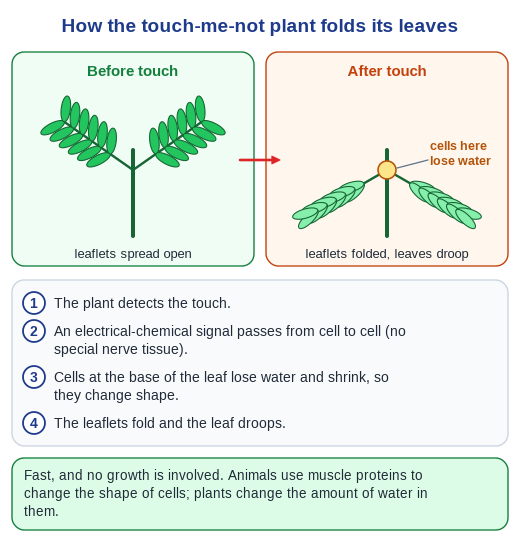
Plants have no nervous system and no muscles, yet touch the leaves of a chhui-mui (touch-me-not, the sensitive plant) and they fold and droop within moments. The leaf moves at a point away from where it was touched, so information must travel. Plants pass it from cell to cell by electrical-chemical means, though they have no special tissue for it. Then some cells take in or lose water, so they swell or shrink and their shape changes. This movement involves no growth.
What are tropic movements?
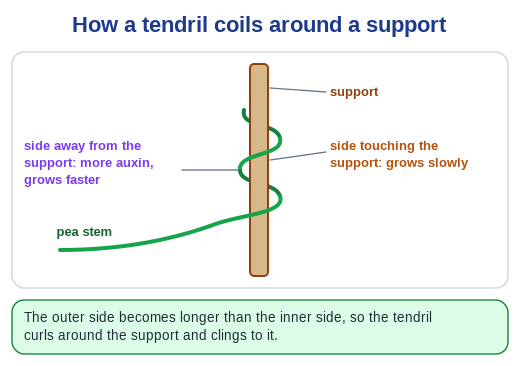
Most plant responses are slow, because they are made by growing in a particular direction. A pea tendril that touches a support grows less on the touching side than on the far side, so it circles the support and clings to it. (More auxin on the far side is the usual explanation; Extra.)
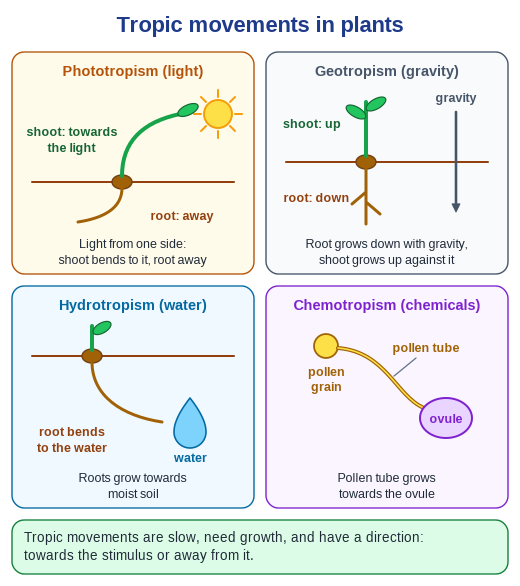
Directional growth movements are called tropic movements, or tropisms. They can be towards the stimulus or away from it.
| Tropism | Stimulus | Example |
|---|---|---|
| Phototropism | light | shoots bend towards light, roots away from it |
| Geotropism | gravity | roots grow down, shoots grow up |
| Hydrotropism | water | roots grow towards water |
| Chemotropism | chemicals | pollen tubes grow towards ovules |
Which hormones do plants use?
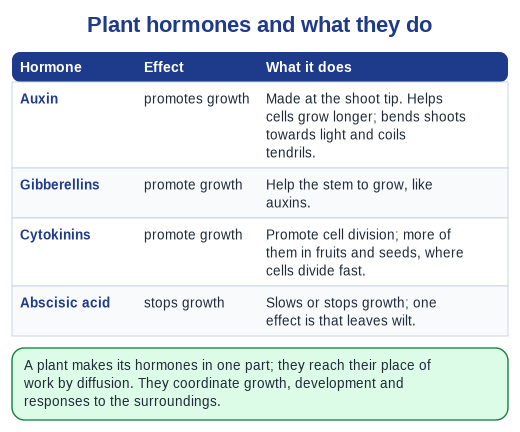
A stimulated cell can release a chemical compound instead of an electrical impulse. The compound diffuses to other cells, which detect it with special molecules on their surfaces. This is slower than an impulse, but it can reach every cell and keep acting steadily. Such compounds are hormones. A plant makes its hormones in one part, and they reach their place of work by diffusion.
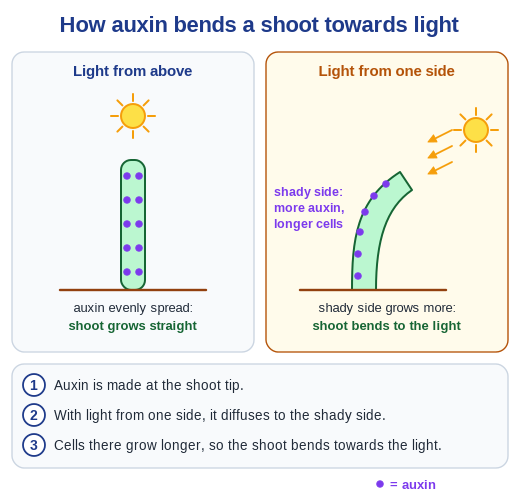
When light comes from one side, auxin, made at the shoot tip, diffuses to the shady side. The cells there grow longer than those on the lit side, and the shoot bends towards the light.
How do hormones work in animals?
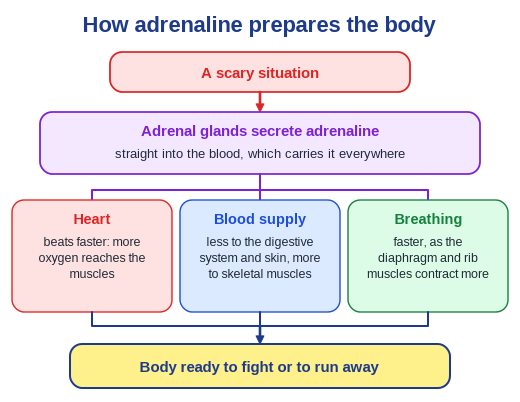
A frightened squirrel must get ready to fight or to run. Both need many tissues working together, more than nerve impulses alone can instruct. So the adrenal glands secrete adrenaline straight into the blood, which carries it everywhere. Its target organs respond: the heart beats faster, small arteries to the digestive system and skin narrow so that blood is diverted to the skeletal muscles, and breathing quickens.
Glands that release hormones into the blood form the endocrine system, our body’s second system of control and coordination.
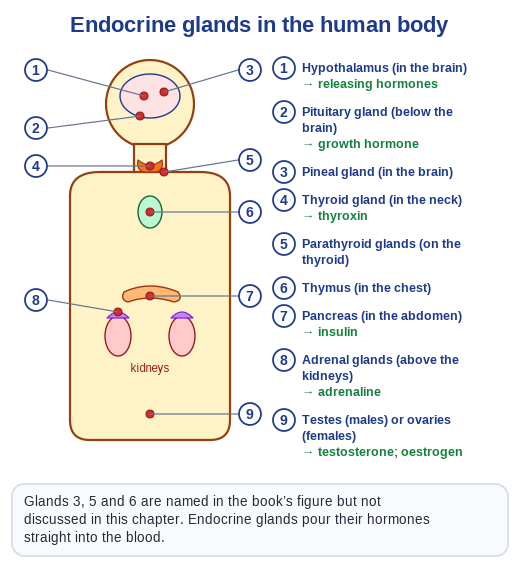
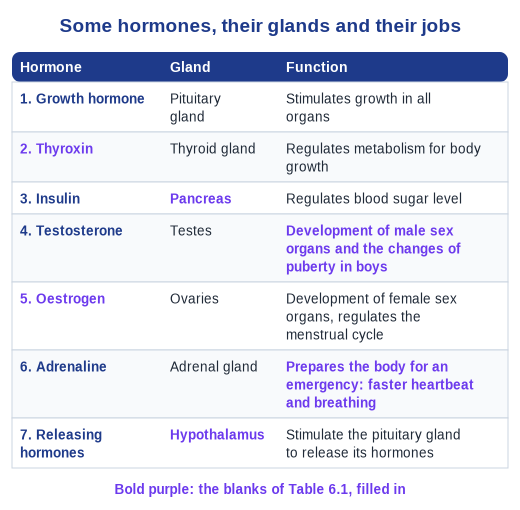
- Thyroxin (thyroid gland) regulates carbohydrate, protein and fat metabolism so that growth is balanced. The thyroid needs iodine to make it; a shortage may cause goitre, with a swollen neck.
- Growth hormone (pituitary gland) regulates growth and development. Too little in childhood leads to dwarfism.
- Testosterone in males and oestrogen in females cause the changes of puberty, around 10–12 years of age.
- Insulin (pancreas) regulates the blood sugar level. If too little is secreted, blood sugar rises and causes harm; this is diabetes, and some patients are treated with insulin injections.
- Releasing hormones from the hypothalamus make the pituitary release its hormones.
What is the feedback mechanism?
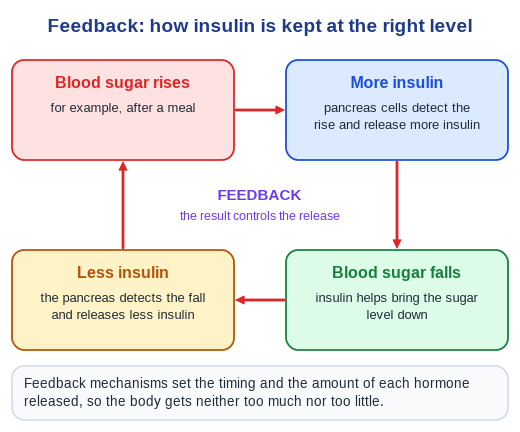
Hormones must be released in exact amounts. When the blood sugar level rises, the cells of the pancreas detect it and produce more insulin. As the level falls, insulin secretion is reduced. The result of the hormone’s action controls its own release: this is feedback.
How do nerves and hormones compare?
More questions on this topic are solved in the NCERT solutions for Chapter 6. Go back to the Chapter 6 notes.
Practice
-
A shoot bending towards light is an example of:
Show answer
Answer: (b) phototropism
-
Which hormone is present in greater amounts in fruits and seeds, where cells divide rapidly?
Show answer
Answer: (c) Cytokinin
-
Which gland secretes growth hormone?
Show answer
Answer: (b) Pituitary
-
Why does the heart beat faster when we are frightened?
Show answer
Answer: The adrenal glands release adrenaline into the blood. The heart is one of its target organs; it beats faster so that more oxygen reaches the muscles.
-
Give one example of chemotropism.
Show answer
Answer: The growth of a pollen tube towards the ovule.
Questions students ask
What are plant hormones?
They are chemical compounds that a plant makes in one part and that reach their place of work by diffusion. They help coordinate growth, development and responses to the surroundings. Examples are auxins, gibberellins, cytokinins and abscisic acid.
Why is iodised salt recommended?
The thyroid gland needs iodine to make thyroxin, which regulates carbohydrate, protein and fat metabolism for balanced growth. If iodine is short in the diet, a person may get goitre, in which the neck swells.
What is a feedback mechanism?
It is the way the body adjusts the timing and amount of a hormone. For example, when blood sugar rises, cells of the pancreas detect it and release more insulin; when the sugar level falls, less insulin is released.
Why do animals need hormones when they have nerves?
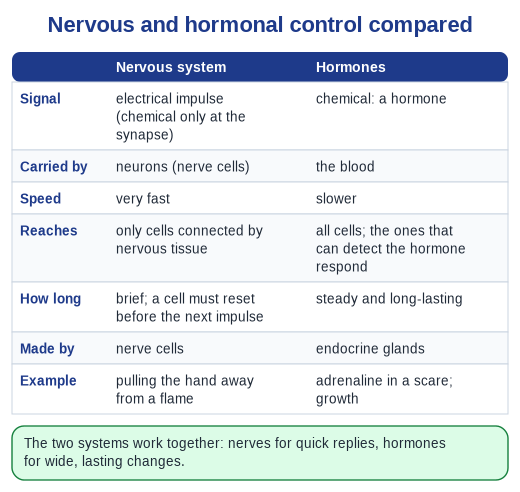
Electrical impulses reach only the cells that are connected by nervous tissue, and a cell needs time to reset before sending another impulse. A hormone carried in the blood can reach all cells and act steadily.
Stuck on a question?
Take a photo and Lagnever AI explains it step by step. Try it for 7 days for ₹2.
Get it on Google Play Open in browser
For parents: after the trial, the plan renews monthly by UPI or card autopay. You can cancel anytime in the app.