
How does reproduction take place in human beings?
Answer in short
Human beings reproduce sexually. At puberty the reproductive tissues mature. The testes make sperms and the ovaries release one egg every month. If a sperm fertilises the egg in the oviduct, the embryo is implanted in the uterus and is nourished through the placenta for about nine months. If not, the uterus lining is shed as menstruation.
Stuck on a question? Take a photo and Lagnever AI explains it step by step. Try it for 7 days for ₹2. Get it on Google Play
What changes at puberty?
Our bodies grow from early childhood, but in the early teenage years a different set of changes begins. The proportions and appearance of the body change. Some changes are common to boys and girls, and some are different.
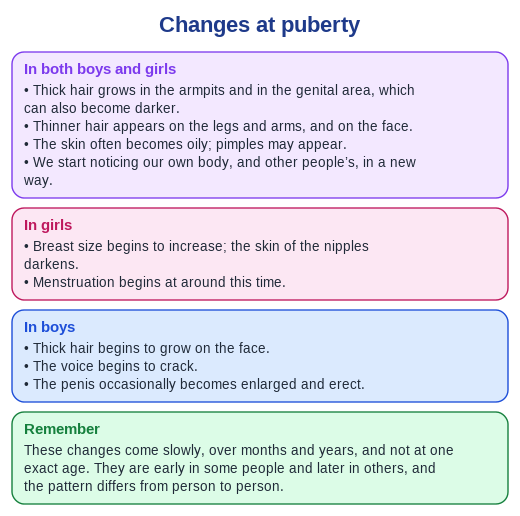
These changes are slow. They take months and years, do not start at one exact age, and do not follow the same pattern in every person, just as noses and fingers have different shapes.
Why now? While the body is growing to its adult size, its resources go mainly into growth. As that growth slows down, the reproductive tissues begin to mature. This period of adolescence is puberty. The new features are signs of sexual maturation. A human baby, like the young of other mammals, grows inside the mother for a long time and is breast-fed after birth, so the female reproductive organs and breasts also mature.
What are the parts of the male reproductive system?
The male system has parts that produce the germ-cells and parts that deliver them.
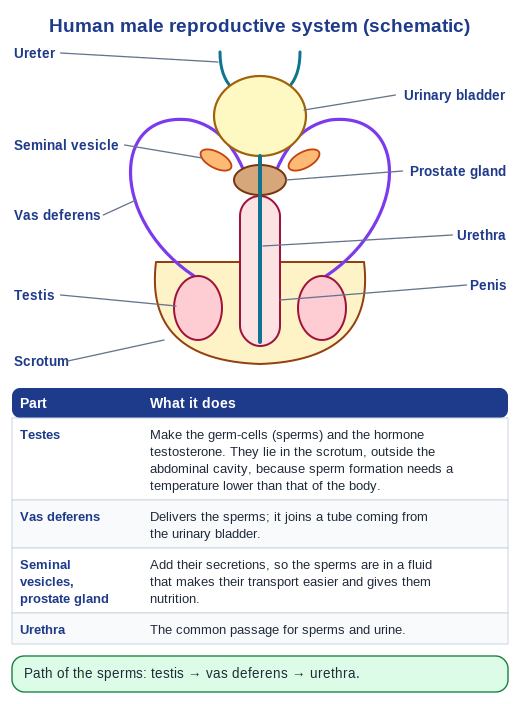
- The testes form the germ-cells, called sperms. They lie in the scrotum, outside the abdominal cavity, because sperm formation needs a temperature lower than normal body temperature. The testes also secrete testosterone, which regulates sperm formation and brings about the changes seen in boys at puberty.
- The vas deferens carries the sperms and joins a tube coming from the urinary bladder. So the urethra is a common passage for sperms and urine.
- The seminal vesicles and the prostate gland add their secretions along the way. The sperms are then in a fluid that makes their transport easier and gives them nutrition.
A sperm is tiny: mainly genetic material, with a long tail that helps it move towards the female germ-cell.
What are the parts of the female reproductive system?
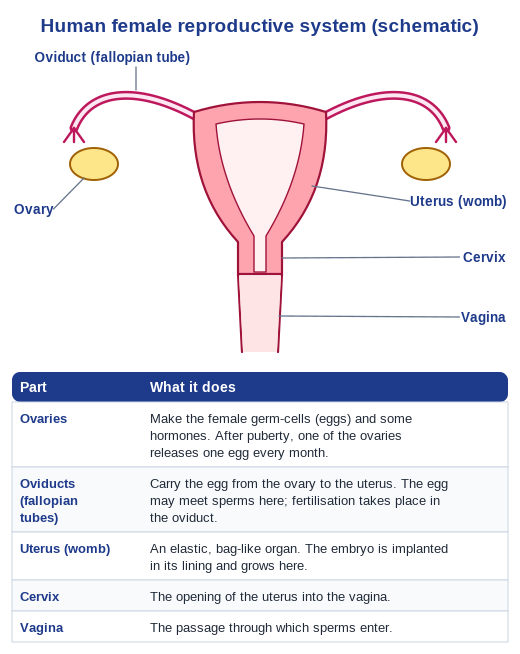
- The two ovaries make the female germ-cells, the eggs, and some hormones. A girl’s ovaries already hold thousands of immature eggs at birth. From puberty some of them begin to mature, and one of the ovaries produces one egg every month.
- A thin oviduct, or fallopian tube, carries the egg from the ovary towards the womb.
- The two oviducts join an elastic, bag-like organ, the uterus.
- The lower end of the uterus, the cervix, opens into the vagina.
What happens when the egg is fertilised?
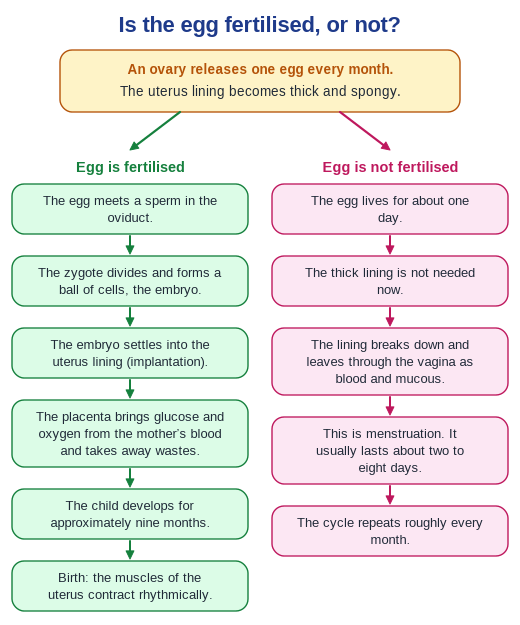
During sexual intercourse sperms enter the vagina. They move upwards to the oviduct, where one of them may meet the egg. The fertilised egg, the zygote, starts dividing and forms a ball of cells, the embryo. The embryo settles into the lining of the uterus (it is implanted), where it keeps growing and develops organs to become a foetus.
The uterus prepares for this every month: its lining thickens and gets a rich blood supply. The embryo is nourished from the mother’s blood through the placenta, a disc of special tissue embedded in the uterine wall. It has villi on the embryo’s side, surrounded on the mother’s side by blood spaces. This large surface lets glucose and oxygen pass to the embryo and lets the embryo’s wastes pass into the mother’s blood.
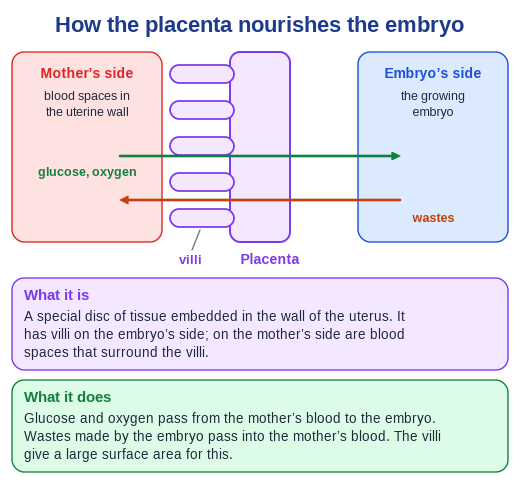
The child develops inside the mother’s body for approximately nine months and is born when the muscles of the uterus contract rhythmically.
What happens when the egg is not fertilised?
An unfertilised egg lives for about one day. The thick, spongy lining that the uterus prepared is then not needed. It breaks down gradually and leaves the body through the vagina as blood and mucous. This happens about once a month and is called menstruation. It usually lasts about two to eight days.
What does the chapter say about reproductive health?
Sexual maturation comes gradually, while the rest of the body is still growing. The chapter says plainly that being partly mature does not make a person’s body or mind ready for sex, or for having children and raising them. It also notes that young people face pressures of many kinds, from friends, families and others, which make choices hard.
Infections. Because the sexual act is a very close contact of bodies, many diseases can be transmitted sexually: gonorrhoea and syphilis, which are caused by bacteria, and warts and HIV-AIDS, which are caused by viruses. A condom helps, to some extent, to stop many of these from being passed on.
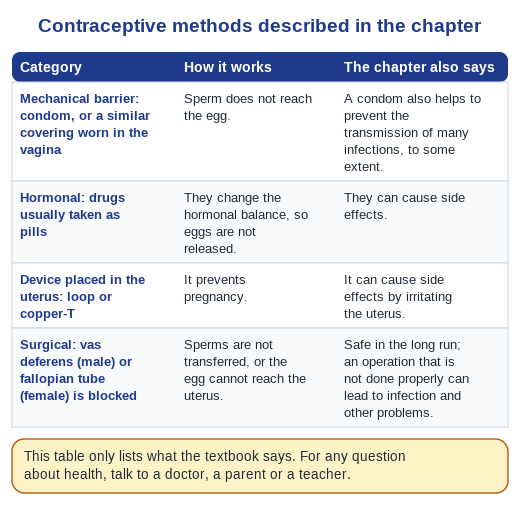
Contraception. The sexual act can always lead to pregnancy, which makes major demands on a woman’s body and mind; if she is not ready, her health is harmed. The methods devised to avoid pregnancy fall into the categories below.
Sex ratio. Surgery can also be used to remove unwanted pregnancies. The chapter warns that this is misused for illegal sex-selective abortion of female foetuses. Prenatal sex determination is prohibited by law, yet the child sex ratio is falling in some sections of society. A healthy society needs the female-male sex ratio maintained.
This page reports only what the textbook says. For any question about your own health, talk to a doctor, a parent or a teacher.
More questions on this topic are solved in the NCERT solutions for Chapter 7. Go back to the Chapter 7 notes.
Practice
-
Sperms are formed in the:
Show answer
Answer: (b) testes
-
After fertilisation, the embryo gets implanted in the lining of the:
Show answer
Answer: (c) uterus
-
Which contraceptive method works by changing the hormonal balance of the body?
Show answer
Answer: (c) Oral pills
-
Why are the testes located in the scrotum, outside the abdominal cavity?
Show answer
Answer: Sperm formation needs a temperature lower than the normal body temperature, and the scrotum, outside the abdominal cavity, provides it.
-
How long does an unfertilised egg live, and what happens to the lining of the uterus then?
Show answer
Answer: It lives for about one day. The thick, spongy lining of the uterus is no longer needed, so it breaks down gradually and leaves through the vagina as blood and mucous. This is menstruation.
Questions students ask
What is puberty?
It is the period during adolescence when the body’s overall growth starts slowing and its reproductive tissues start to mature. The changes in appearance at this time are signs of sexual maturation.
What is the function of the placenta?
The placenta is a disc of special tissue embedded in the wall of the uterus. Through it glucose and oxygen pass from the mother’s blood to the embryo, and the embryo’s wastes pass into the mother’s blood.
Why does the uterus lining become thick every month?
An ovary releases one egg every month, so the uterus prepares every month to receive and nourish a fertilised egg. Its lining becomes thick and spongy and is richly supplied with blood.
Which infections does the chapter name as sexually transmitted?
Gonorrhoea and syphilis, which are bacterial, and warts and HIV-AIDS, which are viral. The chapter says that a condom helps, to some extent, to stop many of these infections from being passed on.
Stuck on a question?
Take a photo and Lagnever AI explains it step by step. Try it for 7 days for ₹2.
Get it on Google Play Open in browser
For parents: after the trial, the plan renews monthly by UPI or card autopay. You can cancel anytime in the app.