
NCERT Solutions Class 10 Economics Chapter 1: Development
Answers to all 13 exercises of Chapter 1, Development, of Understanding Economic Development, the Class 10 Economics textbook, and to every “Let’s Work These Out” question, activity and example inside the chapter. Page numbers follow the 2026-27 reprint (pages 2–17), in the copy NCERT updated in August 2026. The exercises are quoted from the book; the questions inside the chapter are restated in short, in our own words. Many of them ask for your own view, so treat those answers as samples. Short notes: Chapter 1 notes.
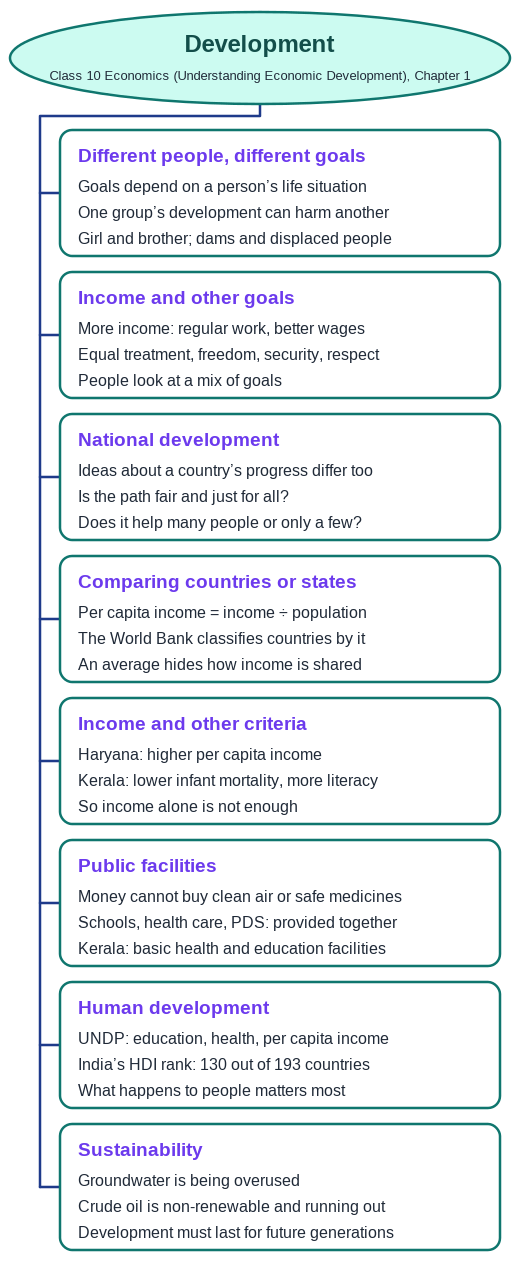
Questions and activities inside the chapter (pages 4–15)
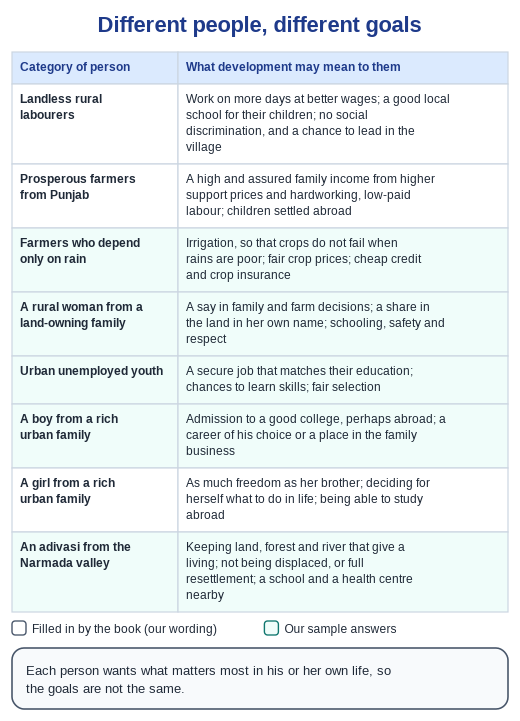
Table 1.1, page 4: complete the table of developmental goals for the categories left blank. The book fills in three rows; sample answers for the other five are shaded in the diagram. Farmers who depend only on rain: irrigation, fair crop prices, cheap credit and crop insurance. A rural woman from a land-owning family: a say in family and farm decisions, a share in the land, schooling, safety and respect. Urban unemployed youth: a secure job that matches their education, and chances to learn skills. A boy from a rich urban family: a good college, perhaps abroad, and a career of his choice. An adivasi from the Narmada valley: keeping the land, forest and river that give a living; not being displaced, or full resettlement; a school and a health centre nearby.
Let’s Work These Out, page 6
1. Why do people have different notions of development: because people are different, or because their life situations are different? Which matters more? Explanation (b), different life situations, is more important. People’s needs come from where they stand: a landless labourer needs work and wages, a farmer without irrigation needs water, an unemployed graduate needs a job. If their situations changed, their goals would change too. Saying “people are different” does not explain why a whole group, such as landless labourers, shares the same goals.
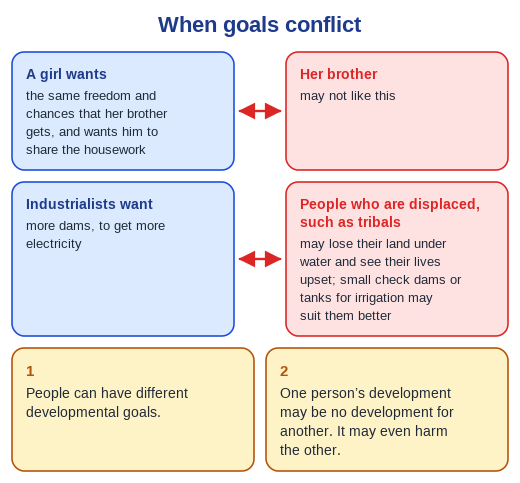
2. Do “people have different developmental goals” and “people have conflicting developmental goals” mean the same? No. Different goals can exist side by side: one person wants a better school, another a better price for crops, and neither harms the other. Conflicting goals clash: what one side gains, the other loses. More dams may give industrialists electricity but submerge the land of tribal people. So all conflicting goals are different, but not all different goals conflict.
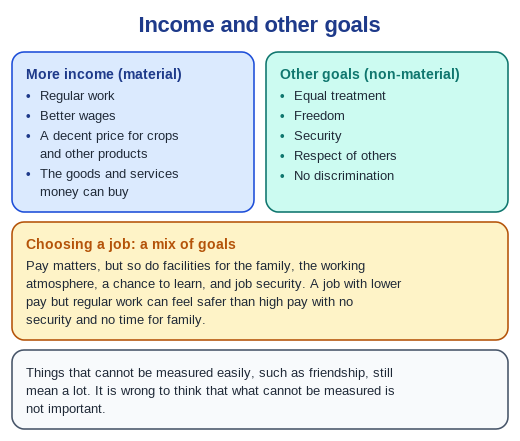
3. Give examples where things other than income matter in our lives. (i) Choosing a job: security, working atmosphere and time for family matter along with pay. (ii) Equal treatment: a person treated with discrimination is unhappy even with a good income. (iii) Safety: women can take up more kinds of work where the surroundings are safe. (iv) Freedom to decide what to study or which work to do. (v) Friendship and respect, which no income can buy.
4. Explain the main ideas of this section in your own words. Development means different things to different people, because their lives are different. One group’s development may not help another and may even harm it. Everyone wants more income, but people also value equal treatment, freedom, security and respect, and these can matter more than income. So people judge development by a mix of goals, not by money alone.
Let’s Work These Out, page 7
1. The picture shows a tall modern tower with a crowded settlement of huts at its foot. What should the developmental goals for such an area be? Proper housing for the families in the huts; clean drinking water, toilets and drainage; electricity; a school and a health centre nearby; regular work at fair wages; and no eviction without resettlement. The picture shows two kinds of lives side by side, so the main goal is that the area’s progress reaches everyone who lives there, not only those in the tower.
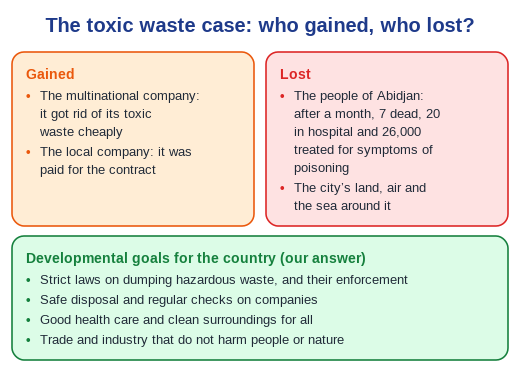
2. A newspaper report says a ship dumped 500 tonnes of liquid toxic waste in open-air dumps in Abidjan, a city in Ivory Coast, and in the sea around it, for a multinational company that had hired a local firm. (i) Who gained and who did not? (ii) What should the country’s developmental goal be? (i) The multinational company gained by getting rid of its waste, and the local company was paid for the job. The people of Abidjan lost: the fumes caused nausea, skin rashes, fainting and diarrhoea, and after a month seven people were dead, twenty were in hospital and twenty-six thousand had been treated for symptoms of poisoning. The land and the sea were polluted too. (ii) Development that protects people’s health and the environment: strict laws against dumping hazardous waste, proper checks on companies, safe disposal, and good health care for all.
3. What developmental goals would you set for the place where you live? Write about your own place. A sample list: safe drinking water in every home; all-weather roads and street lights; a well-run school up to Class 12, especially for girls; a health centre with a doctor and medicines; drainage and waste collection; regular electricity; work for young people; a clean pond, park or playground; and safety for everyone.
Activity 1, page 7: find a controversy about ways of developing, and collect the arguments of different people. This is a project. Pick one issue near you, such as a new road or flyover that needs trees to be cut, a factory near a river, a dam, or the widening of a market street. Talk to people on each side, or read newspaper and television reports, and make a table: who supports it and why; who opposes it and why; who gains; who loses; is there a middle path? Report the arguments fairly, without taking sides until the end.
Table 1.2, page 9
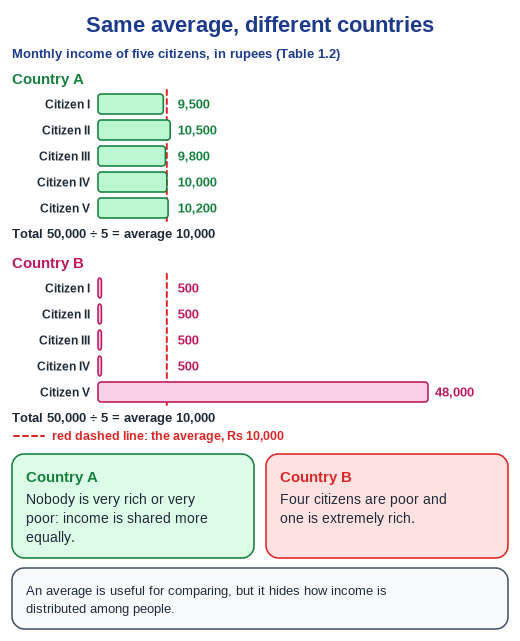
Calculate the average income of countries A and B. Would living in either make you equally happy? Country A: 9,500 + 10,500 + 9,800 + 10,000 + 10,200 = 50,000; 50,000 ÷ 5 = Rs 10,000. Country B: 500 + 500 + 500 + 500 + 48,000 = 50,000; 50,000 ÷ 5 = Rs 10,000. The averages are identical, but most people would prefer A, where incomes are nearly equal. In B, four of the five citizens are poor. Only someone sure of being the fifth citizen would choose B. So the two are not equally developed, although the average says they are.
Let’s Work These Out, page 9
1. Name three situations that are compared using an average. (i) Average marks of two sections of a class. (ii) A batter’s average runs across matches. (iii) Average rainfall of two districts, or the average yield of wheat per hectare in two states. (Also: average income of two countries.)
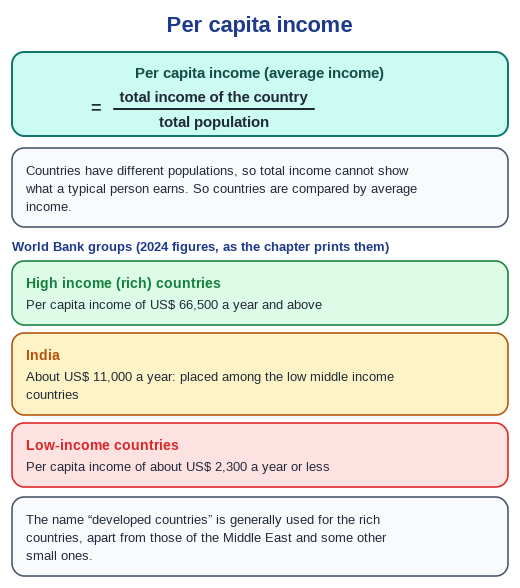
2. Why is average income an important criterion for development? Countries have different populations, so total income cannot show how well off an average person is. Average income, or per capita income, tells us roughly what each person would get if income were shared equally, and with more income people can buy more of the goods and services they need. It makes countries or states of different sizes comparable.
3. Besides its size, what other property of income matters when comparing societies? Its distribution: how equally or unequally income is shared among people. Two societies with the same per capita income can be very different if one has a few very rich people and many poor.
4. If a country’s average income has been rising over time, can we say all sections have become better off? No. The average can rise because a few people earn much more while others stay where they were or even fall behind. Example: five people earn Rs 5,000 each, so the average is Rs 5,000. Later, four still earn Rs 5,000 and the fifth earns Rs 30,000. The total is Rs 50,000 and the average has doubled to Rs 10,000, yet four of the five are no better off.
5. Find the per capita income level of low-income countries from the text. The text gives only the cut-off: countries with a per capita income of about US$ 2,300 a year or less (2024) are called low-income countries. It does not list them. To find 10–15 such countries and their incomes, look up the World Bank’s latest World Development Report or its website, and note the year of the data.
6. In a paragraph, say what India needs to do or achieve to count as a developed country. Sample answer: India should raise the income of ordinary families through more and better jobs, and see that the gains are shared fairly. Every child should finish school, and every person should have health care, clean water and enough nutritious food, so that infant deaths fall and life expectancy rises. Women should have equal opportunities and safety. Public facilities should work well in every state. And growth should not use up groundwater, forests and clean air that future generations will need.
Let’s Work These Out, page 12
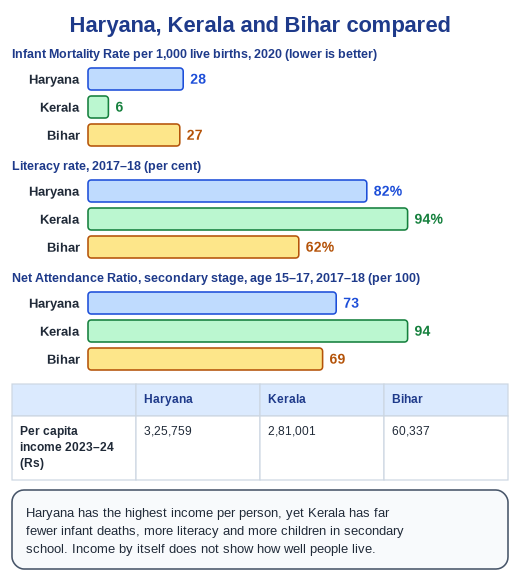
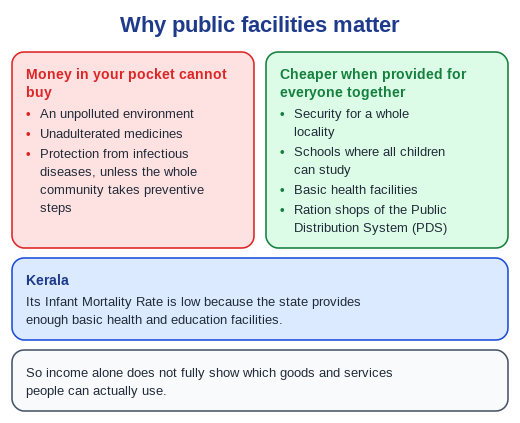
1. Haryana leads Kerala in per capita income. Do Tables 1.3 and 1.4 show it leading in literacy and the other measures too? No. Haryana’s per capita income (Rs 3,25,759) is higher than Kerala’s (Rs 2,81,001). But Kerala’s literacy rate is 94 per cent against Haryana’s 82, its Net Attendance Ratio is 94 against 73, and its Infant Mortality Rate is 6 against 28. Kerala is ahead on all three.
2. Give other examples where collective provision is cheaper than individual provision. A public bus or metro instead of a car for each family; a piped water supply instead of a borewell for each house; street lights; a public library; a community hall or park; a government hospital; a common sewage and waste-collection system.
3. Does the availability of good health and education facilities depend only on how much the government spends? What else matters? No. It also depends on how well the money is used: whether teachers and doctors are present, whether medicines and books reach the centres, whether the facilities are near enough for people to use, and whether they are open to everyone without discrimination. People’s awareness matters, as do the education of parents, especially mothers, and the community keeping watch on its school and health centre.
4. A study found that 90 per cent of rural people in Tamil Nadu used a ration shop, against 35 per cent in West Bengal. Where would people be better off, and why? In Tamil Nadu. Where most people use ration shops, the Public Distribution System is working well, so families get foodgrains and other essentials at a fair price. As the chapter says, the health and nutritional status of people in such states is likely to be better.
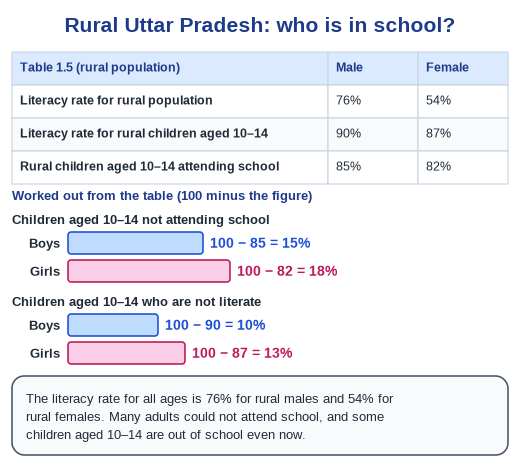
Activity 2, page 12 (Table 1.5)
Fill in the blanks from the table on the educational achievement of the rural population of Uttar Pradesh.
(a) The first two blanks are the literacy rates for all ages: 76% for rural males and 54% for rural females. The third blank is children (aged 10–14): besides the adults who missed school, some children are out of school right now.
(b) Not attending school: 18 per cent of rural girls (100 − 82) and 15 per cent of rural boys (100 − 85). Not literate in the 10–14 age group: 13 per cent of rural females (100 − 87) and 10 per cent of rural males (100 − 90).
(c) The blank is the 10–14 age group. The paragraph adds that the Constitution’s goal, schooling without fees and compulsory for every child up to the age of 14, was meant to be reached by 1960, and that many other states are also far from it.
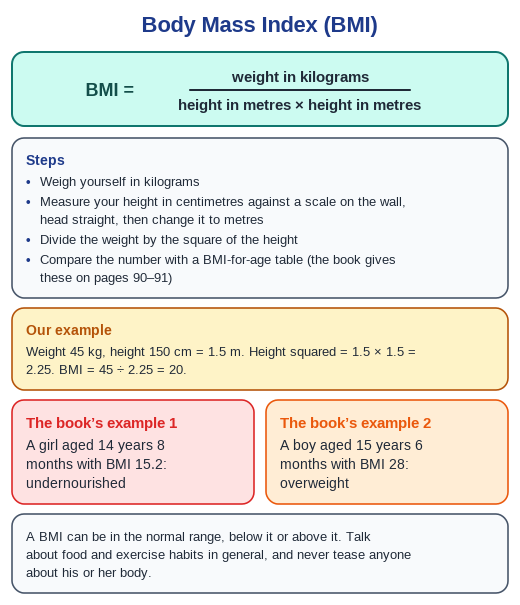
Activity 3, page 13
Calculate the Body Mass Index (BMI) of students in the class and compare it with the BMI-for-age tables. How to do it: take the weight in kilograms; measure the height in centimetres and change it to metres; divide the weight by the square of the height. Example (our numbers): weight 45 kg, height 150 cm = 1.5 m; 1.5 × 1.5 = 2.25; BMI = 45 ÷ 2.25 = 20. Then look up the BMI-for-age tables on pages 90–91 of the book, for boys or for girls, to see whether the value is in the normal range, below it or above it. Discuss food and exercise habits in general terms only, and never comment on any one student’s body.
Question, page 14
Should the measure of human development take in anything else? Yes; some that students often suggest: equality between women and men; how equally income is distributed; safe drinking water and sanitation; nutrition; a clean environment; safety and freedom from discrimination; and people’s say in decisions that affect them. (Extra: UNDP’s reports do publish some further measures of this kind alongside the HDI.)
Example 1, page 14: Groundwater in India
(a) Why is groundwater overused? Because more water is drawn out than rain puts back. Water-hungry crops are grown with tubewell irrigation in agriculturally prosperous regions such as Punjab and Western U.P.; fast-growing cities and industries draw more each year; and each user pumps as much as he or she can, since no one owns the water below the ground. (Extra: cheap or subsidised electricity for pumps adds to this.)
(b) Can there be development without overuse? Yes, if water is used with care: rainwater harvesting and recharge of wells; drip and sprinkler irrigation; crops suited to the local rainfall; reuse of treated water in cities and industry; and community rules on how much may be pumped. Development that empties the wells cannot last, so careful use is the only kind that can.
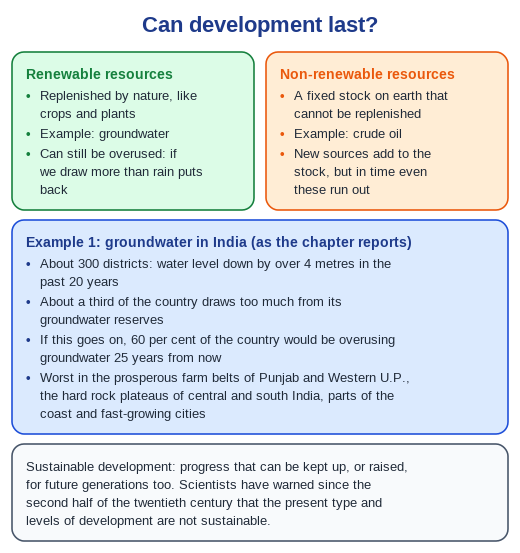
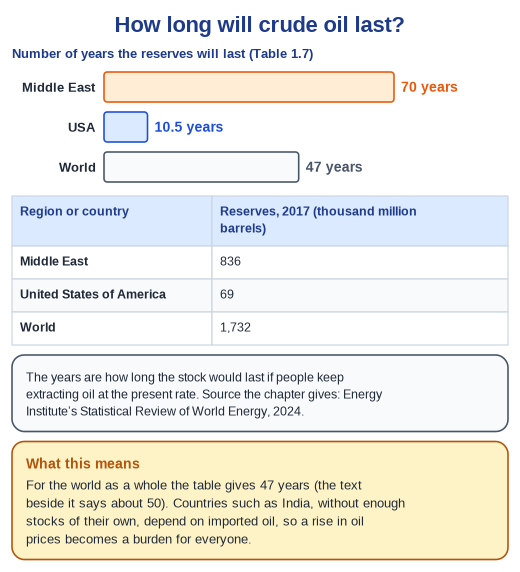
Example 2, page 15: Exhaustion of natural resources (Table 1.7)
(a) Does a country’s development need crude oil? At present, largely yes. Petrol, diesel and other oil products run most transport, many industries and farm machinery, and oil is a raw material for plastics, fertilisers and chemicals. But oil is non-renewable, and the world’s reserves would last only 47 years at the present rate. So a country’s development should depend on it less and less, by saving fuel and shifting to other sources of energy.
(b) India buys its crude oil from abroad. What problems can this cause? A large import bill; when world oil prices rise, transport and goods become costlier for everyone; supplies can be interrupted by events in other countries; and as reserves shrink, oil will become scarcer and dearer. This is why saving oil and developing other energy sources matter for India.
Exercises (pages 16–17)
1. “Development of a country can generally be determined by (i) its per capita income (ii) its average literacy level (iii) health status of its people (iv) all the above”
(iv) all the above. Income alone is not enough; the chapter shows that literacy and health must be looked at together with per capita income, as the Human Development Report does.
2. “Which of the following neighbouring countries has better performance in terms of human development than India? (i) Bangladesh (ii) Sri Lanka (iii) Nepal (iv) Pakistan”
(ii) Sri Lanka. In Table 1.6 its HDI rank is 89, against India’s 130, and it is ahead of India in income, life expectancy and schooling. (Bangladesh is shown at the same rank as India, 130; Nepal is at 145 and Pakistan at 168.)
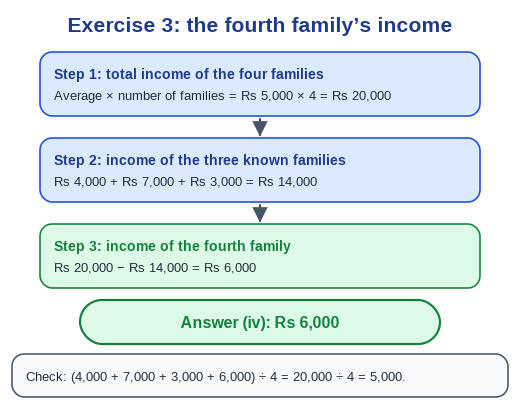
3. “Assume there are four families in a country. The average per capita income of these families is Rs 5000. If the income of three families is Rs 4000, Rs 7000 and Rs 3000 respectively, what is the income of the fourth family? (i) Rs 7500 (ii) Rs 3000 (iii) Rs 2000 (iv) Rs 6000”
(iv) Rs 6000. Total income of the four families = 5,000 × 4 = Rs 20,000. Income of the three known families = 4,000 + 7,000 + 3,000 = Rs 14,000. Fourth family = 20,000 − 14,000 = Rs 6,000.
4. “What is the main criterion used by the World Bank in classifying different countries? What are the limitations of this criterion, if any?”
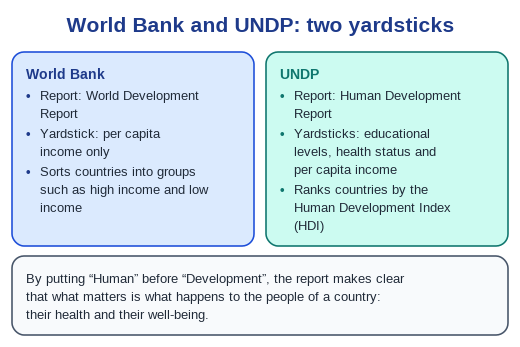
The World Bank’s main criterion is per capita income (average income). As the chapter prints it for 2024, countries with US$ 66,500 a year and above are high income countries and those with about US$ 2,300 or less are low-income countries.
Limitations:
- It is an average, so it hides how income is shared among people.
- It says nothing about health, education, or public facilities such as schools, hospitals and ration shops.
- It leaves out things money cannot buy, such as a clean environment, security, freedom and equal treatment.
- It does not show whether the development can last (be sustained).
5. “In what respects is the criterion used by the UNDP for measuring development different from the one used by the World Bank?”
The World Bank uses one yardstick, per capita income. UNDP, in its Human Development Report, uses three together: people’s educational levels, their health status (such as life expectancy at birth) and per capita income. So UNDP’s measure is broader: it looks at what is happening to people, not only at how much the country earns.
6. “Why do we use averages? Are there any limitations to their use? Illustrate with your own examples related to development.”
Answer: We use averages because they sum up many figures in one number, which makes comparison easy. Countries and states have different populations, so average (per capita) income lets us compare them fairly.
Limitation: an average hides inequality (big differences between people).
- Example 1: in a village of 10 families, nine earn Rs 8,000 a month and one earns Rs 1,28,000. The average is (9 × 8,000 + 1,28,000) ÷ 10 = Rs 20,000. This figure describes nobody in the village.
- Example 2: a state’s average literacy may be high while the literacy of its rural women is much lower. Table 1.5 shows this for rural Uttar Pradesh: 76 per cent for males but 54 per cent for females.
7. “Kerala, with lower per capita income has a better human development ranking than Haryana. Hence, per capita income is not a useful criterion at all and should not be used to compare states. Do you agree? Discuss.”
Answer: No, not fully.
- Per capita income is useful. It shows the average earning in a state, and more income lets people buy more goods and services.
- But it is not enough. Kerala has a lower per capita income than Haryana, yet it does better on health and education:
- Infant Mortality Rate: 6 in Kerala, 28 in Haryana.
- Literacy rate: 94 per cent in Kerala, 82 per cent in Haryana.
- Net Attendance Ratio: 94 in Kerala, 73 in Haryana.
- Why: Kerala has better public health and education facilities.
- Conclusion: we should not throw away per capita income. We should use it together with health and education indicators.
8. “Find out the present sources of energy that are used by the people in India. What could be the other possibilities fifty years from now?”
Present sources (Extra: this goes beyond the chapter): coal, mostly for electricity; petroleum products such as petrol, diesel, kerosene and LPG; natural gas; hydroelectricity; nuclear power; firewood, cow-dung cakes and crop waste in many homes; and growing amounts of solar and wind power.
Fifty years from now: since coal and oil are non-renewable, and Table 1.7 gives the world’s oil reserves 47 years, India will have to rely far more on renewable sources: solar and wind energy, small and large hydro projects, biogas and other biofuels, and possibly tidal and geothermal energy and hydrogen, along with nuclear power and much more careful use of energy.
9. “Why is the issue of sustainability important for development?”
Answer: Development is useful only if it can last.
- If we use up groundwater, soil, forests and fuels faster than they are replaced, future generations will have less. They may not even keep today’s standard of living.
- Groundwater is already being overused in about one-third of the country.
- Crude oil reserves are limited.
- Damage to the environment crosses state and national borders, so everyone’s future is linked.
Sustainable development meets today’s needs without taking away the chances of people who come after us.
10. ““The Earth has enough resources to meet the needs of all but not enough to satisfy the greed of even one person”. How is this statement relevant to the discussion of development? Discuss.”
The statement, which Geography Chapter 1 gives as Gandhiji’s, separates need from greed. The earth’s resources, used with care and shared fairly, are enough for everyone’s food, water, shelter and energy. But if a few people or countries use far more than they need, resources run out and others go without. This is the chapter’s point about sustainability: groundwater is overused, oil reserves are limited, and the present type of development cannot continue. Development should mean meeting everyone’s needs within what nature can renew, and leaving enough for future generations.
11. “List a few examples of environmental degradation that you may have observed around you.”
Sample answers: smoke from vehicles, factories and burning waste, making the air unhealthy; sewage, factory effluents and plastic in rivers, ponds and drains; heaps of garbage that are not collected; trees cut for roads and buildings; falling water levels in wells and handpumps; too much noise from horns and loudspeakers; and soil spoiled by heavy use of chemicals. Write the ones you have seen yourself.
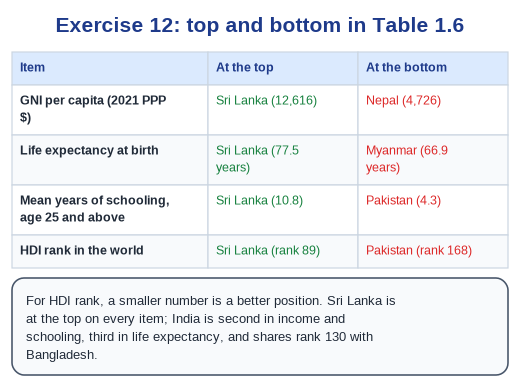
12. “For each of the items given in Table 1.6, find out which country is at the top and which is at the bottom.”
| Item | At the top | At the bottom |
|---|---|---|
| Gross National Income per capita (2021 PPP $) | Sri Lanka (12,616) | Nepal (4,726) |
| Life expectancy at birth | Sri Lanka (77.5 years) | Myanmar (66.9 years) |
| Mean years of schooling of people aged 25 and above | Sri Lanka (10.8) | Pakistan (4.3) |
| HDI rank in the world | Sri Lanka (89) | Pakistan (168) |
For HDI rank, a smaller number means a better position.
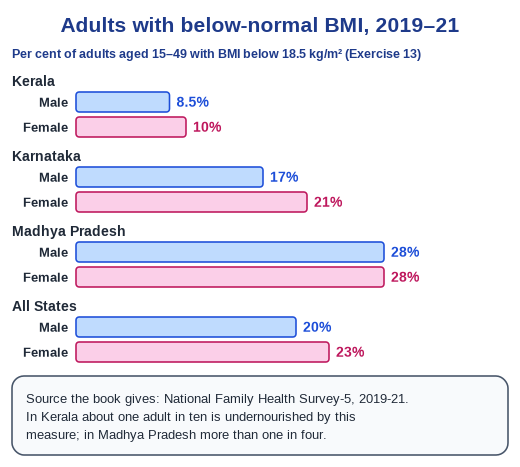
13. “The following table shows the proportion of adults (aged 15-49 years) whose BMI is below normal (BMI <18.5 kg/m2) in India. It is based on a survey of various states for the year 2019-21. Look at the table and answer the following questions.”
| State | Male (%) | Female (%) |
|---|---|---|
| Kerala | 8.5 | 10 |
| Karnataka | 17 | 21 |
| Madhya Pradesh | 28 | 28 |
| All States | 20 | 23 |
Source in the book: National Family Health Survey-5, 2019-21.
“(i) Compare the nutritional level of people in Kerala and Madhya Pradesh.”
People in Kerala are much better nourished. Only 8.5 per cent of men and 10 per cent of women in Kerala have a BMI below normal, against 28 per cent of both men and women in Madhya Pradesh. So the share of undernourished adults in Madhya Pradesh is about three times Kerala’s, and above the all-States figures (20 and 23 per cent), while Kerala is well below them.
“(ii) Can you guess why around one-fifth of people in the country are undernourished even though it is argued that there is enough food in the country? Describe in your own words.”
Having enough food in the country does not mean every family can get it. Many people are too poor to buy enough nutritious food. In some states ration shops do not work well, so cheap foodgrains do not reach those who need them. Food is not shared equally even within a family, and women often eat last and least, which the higher female figures suggest. Illness, unsafe water and lack of health care also stop the body from using the food eaten. So the problem lies in income, distribution and public facilities, not in the total amount of food.
Additional project or activity, page 17
Invite three speakers to talk about the development of your region, question them, and make a wall chart of the ideas you agree or disagree with. How to do it: invite people with different viewpoints, for example a farmer or shopkeeper, a teacher or health worker, and a panchayat or municipal member. Prepare questions on work, water, schools, health, roads and the environment. In groups, list each speaker’s ideas in three columns: the idea; whom it would help or harm; whether we agree, with a reason. Use the chapter’s tests: is it fair and just for all, does it help many or only a few, and can it be sustained?
Practice
-
Four families have an average income of Rs 5,000. Three of them earn Rs 4,000, Rs 7,000 and Rs 3,000. The fourth earns:
Show answer
Answer: (d) Rs 6,000
-
In Table 1.6, which country is at the bottom in mean years of schooling?
Show answer
Answer: (c) Pakistan
-
From Table 1.5, what percentage of rural girls aged 10–14 in Uttar Pradesh are not attending school?
Show answer
Answer: (c) 18
-
Why is total income not used to compare countries?
Show answer
Answer: Because countries have different populations. Total income cannot show what a typical person earns, so per capita income (total income divided by population) is used.
-
Give one reason why people in a state where 90 per cent of rural people use ration shops may be better off.
Show answer
Answer: A working Public Distribution System gives most families foodgrains and other essentials at a fair price, so their nutrition and health are likely to be better.
Stuck on a question?
Take a photo and Lagnever AI explains it step by step. Try it for 7 days for ₹2.
Get it on Google Play Open in browser
For parents: after the trial, the plan renews monthly by UPI or card autopay. You can cancel anytime in the app.