
Class 10 Economics Chapter 1: Development Notes
This chapter in five lines
Development means different things to different people, and one person’s development can even harm another. People want more income, but also equal treatment, freedom, security and respect. Countries are compared by per capita income, yet an average hides inequality, so health and education indicators and public facilities are used too, as in the Human Development Index. Development must also be sustainable.
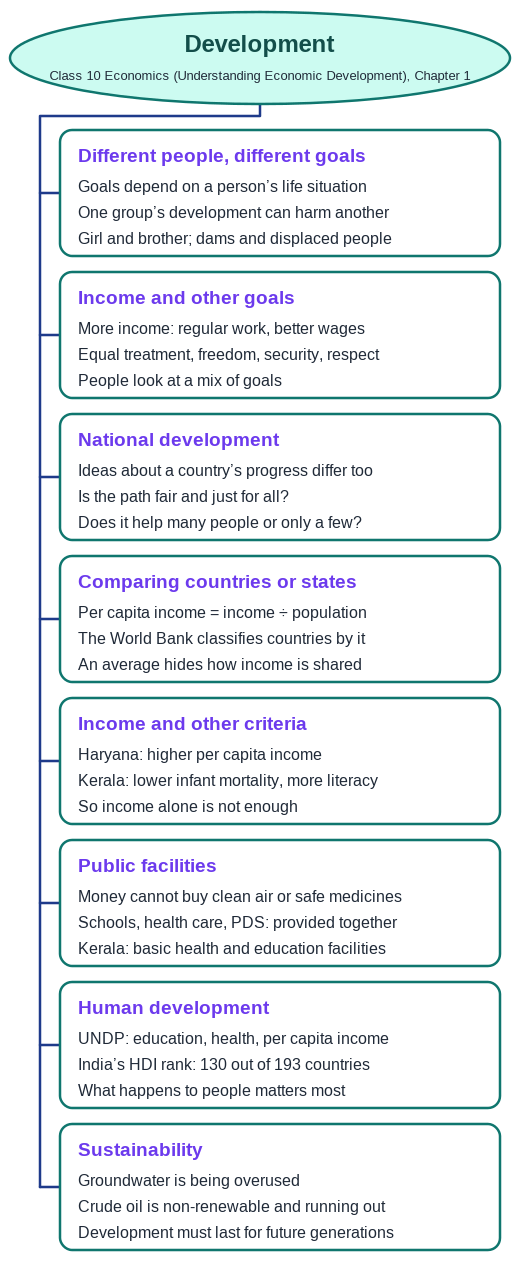
What is this chapter about?
Ask five people in your family what would make life better, and you may get five answers: a steady job, a pucca road, a girls’ high school nearby, cleaner water, more respect at work. All five are talking about development. This first chapter of Understanding Economic Development, the Class 10 Economics book, asks what development means, whose development we are talking about, and how we can compare countries or states. It starts with people’s own goals, moves to income as a yardstick, shows where that yardstick fails, and ends with a question about the future: can this development last?
Do all people want the same development?
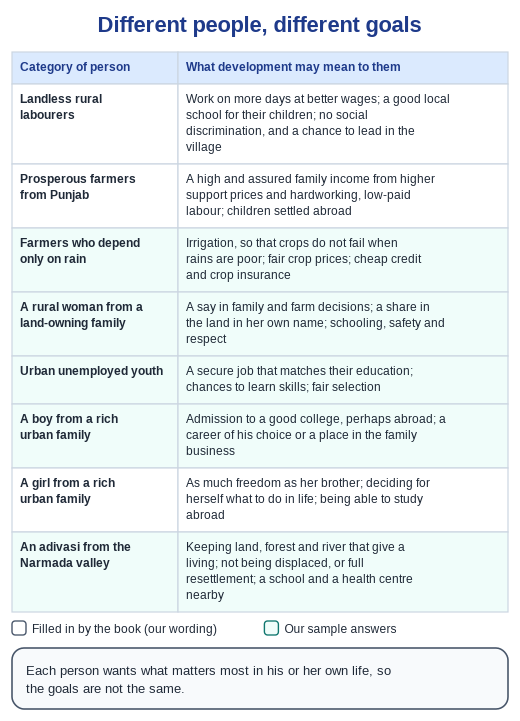
No. A landless labourer may want more days of work and better wages; a girl from a well-off city family may want the same freedom her brother gets. Each person wants what matters most in his or her own life. Goals can even clash: industrialists may want more dams for electricity, while the people whose land goes under water may prefer small check dams or tanks. So the chapter draws two conclusions: people can have different developmental goals, and one person’s development may be no development for another; it may even harm the other. Read Why do different people have different development goals?
Is more income the only goal?
Almost everyone in Table 1.1 wants regular work, better wages or a decent price for what they produce: in short, more income. But people also want equal treatment, freedom, security and the respect of others, and they resent discrimination. Sometimes these matter more than income. Think of choosing a job: you would look at the pay, but also at job security, the working atmosphere, the chance to learn and time for your family. For development too, people look at a mix of goals.
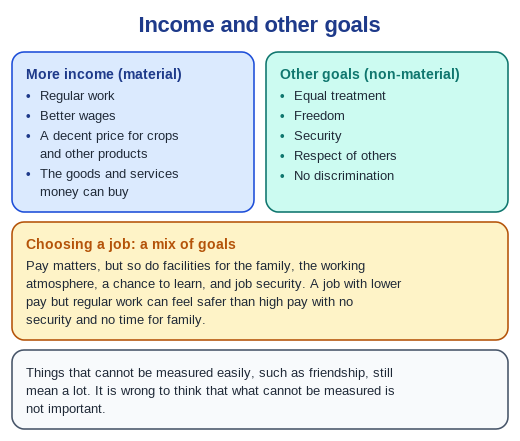
What is national development?
If individuals want different things, their ideas of what the country should do will differ as well, and may conflict. National development means thinking about these conflicts: Can all ideas be equally important? Which path would be fair and just for everyone? Would an idea help most people, or only a few? Could things be done in a better way?
How do we compare countries or states?
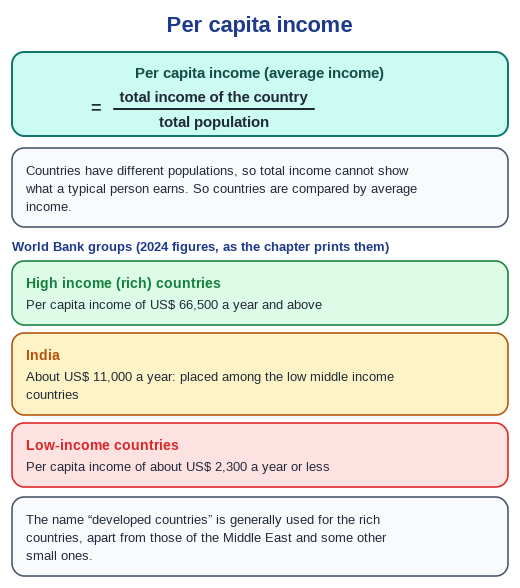
To compare students we pick a few important qualities; which ones depends on the purpose. For countries, income is taken as one of the most important attributes, on the understanding that more income lets people get more of what they need. But total income will not do, because countries have different populations. So we use per capita income, also called average income: total income divided by total population. The World Bank uses it to classify countries in its World Development Reports. As the chapter prints the figures for 2024, countries with US$ 66,500 a year and above are high income countries, those with about US$ 2,300 or less are low-income countries, and India, at about US$ 11,000, is a low middle income country. Read How are per capita income and human development used to compare countries?
What does an average hide?
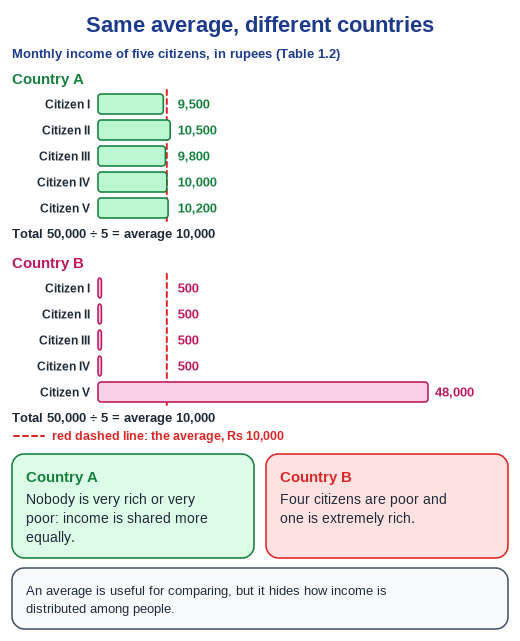
Table 1.2 imagines two countries with five citizens each. In country A the monthly incomes are close together; in country B four people earn Rs 500 and one earns Rs 48,000. Both have the same average, Rs 10,000. Most of us would rather live in A, where nobody is very rich or very poor. An average is useful for comparison, but it does not tell us how income is distributed.
Is income enough to compare states?
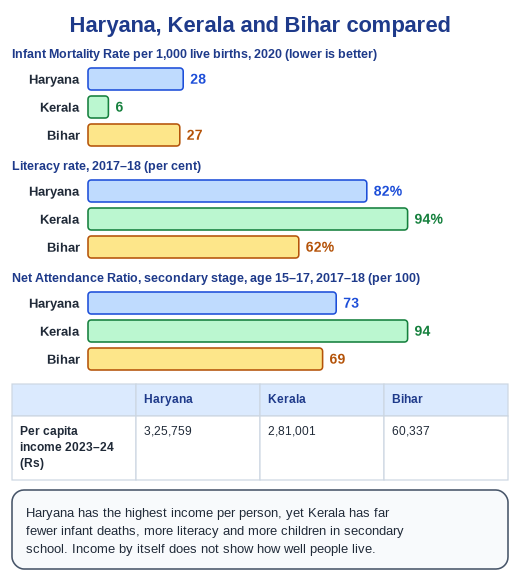
Take Haryana, Kerala and Bihar. By per capita income for 2023–24, Haryana (Rs 3,25,759) is ahead of Kerala (Rs 2,81,001), and Bihar (Rs 60,337) is far behind. Now look at other data. Out of 1,000 children born, 28 died before their first birthday in Haryana and 6 in Kerala (2020). Kerala’s literacy rate is 94 per cent against Haryana’s 82, and 94 of every 100 children aged 15–17 attend school in Kerala against 73 in Haryana. In Bihar the ratio is 69, so about one-third of that age group is missing from secondary classes.
Why do public facilities matter?
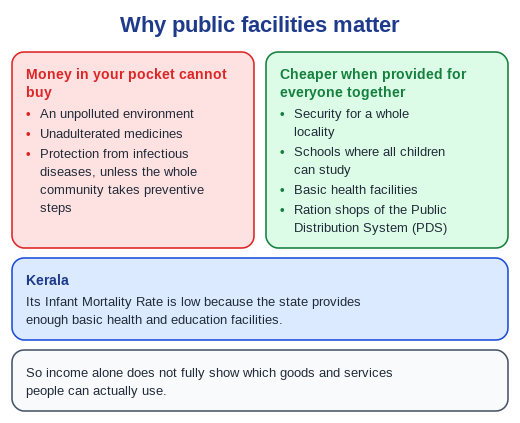
How can a state with more income lag behind in health and education? Because money in your pocket cannot buy everything you need to live well. It cannot, by itself, buy an unpolluted environment, make sure medicines are unadulterated, or protect you from infectious diseases unless your whole community takes preventive steps. Many important things are cheaper and work better when they are provided collectively: security for a locality, schools, health centres, ration shops. Kerala’s Infant Mortality Rate is low because the state provides enough basic health and education facilities. Where the Public Distribution System (PDS) works well, people’s health and nutrition are likely to be better too.
What is the Human Development Report?
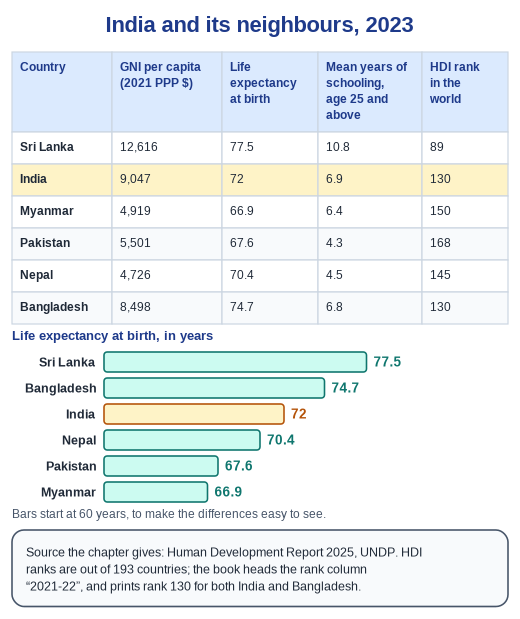
Since income alone is not enough, health and education indicators are now widely used along with it. UNDP’s Human Development Report compares countries by people’s education levels, their health and per capita income. Table 1.6 gives data for 2023 from the 2025 report: India’s HDI rank is 130 out of 193 countries, while Sri Lanka, a much smaller neighbour, is at rank 89 and ahead of India on every item in the table. The word “Human” in the title carries the message: what matters most is what happens to people, their health and their well-being.
Can development go on for ever?
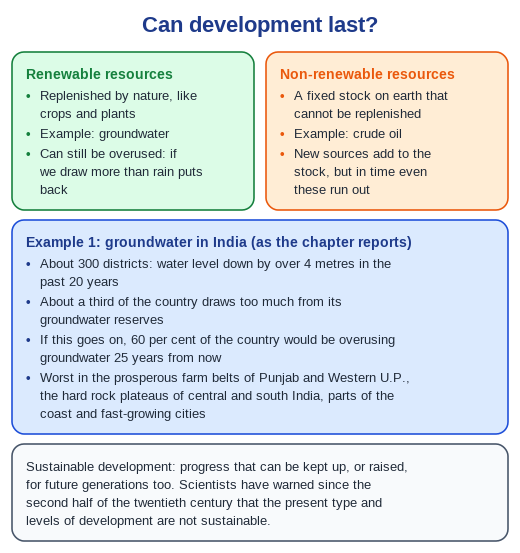
We would like today’s level of development to rise, or at least to be there for future generations. But from the middle of the twentieth century onwards, scientists have been warning that development of today’s kind, at today’s levels, is not sustainable. Groundwater, a renewable resource, is being drawn faster than rain refills it in many parts of India. Crude oil, a non-renewable resource, is a fixed stock: Table 1.7 shows that the world’s known reserves would last 47 years at the present rate of extraction. The effects of environmental damage do not stop at state or national borders, so our future is linked together. For more on resources and sustainable development, see Geography Chapter 1: Resources and Development.
Before we move on
The chapter ends by saying that the question of development never goes away: as individuals and as a society we keep asking where we want to go and what we wish to become. It also says such hopes become real only through a democratic political process, which your Political Science book takes up from Power-sharing onwards. Answers to every exercise and to the questions and activities inside the chapter are in the NCERT solutions for Chapter 1.
Key terms
| Term | Meaning |
|---|---|
| Development | Progress in people’s lives: more income, and also things such as equal treatment, freedom, security and respect. Different people can have different goals. |
| Developmental goals | The things a person or group wants most in order to live better, such as regular work, good schools or an end to discrimination. |
| National development | Thinking about which path is fair and just for the whole country, and whether an idea helps most people or only a few. |
| Total income | The income of all the residents of a country, added together. |
| Per capita income (average income) | The total income of a country divided by its total population. |
| Developed countries | The name generally given to rich (high income) countries, leaving out the countries of the Middle East and certain other small countries. |
| Infant Mortality Rate (IMR) | The number of children who die before the age of one year, out of 1,000 live children born in that year. |
| Literacy Rate | The proportion of people aged 7 and above who are literate. |
| Net Attendance Ratio | Children aged 15–17 years who attend school, as a percentage of all children of that age group. |
| Public facilities | Goods and services provided for everyone together, such as schools, health care, security and ration shops, usually by the government. |
| Public Distribution System (PDS) | The system of ration shops. Where it works well, people’s health and nutrition are likely to be better. |
| Body Mass Index (BMI) | Weight in kilograms divided by the square of the height in metres; one way to check whether a person is properly nourished. |
| Human Development Index (HDI) | The index in UNDP’s Human Development Report, which compares countries by people’s education levels, their health and per capita income. |
| Life expectancy at birth | The average length of life a person can expect at the time of birth. |
| Sustainable development | Development that can be kept up, or raised further, for future generations as well. |
| Renewable and non-renewable resources | Renewable resources, such as groundwater, are replenished by nature; non-renewable ones, such as crude oil, are a fixed stock that runs out with use. |
Topics in this chapter
Practice
-
Per capita income of a country is its total income divided by its:
Show answer
Answer: (b) total population
-
In Table 1.2, the average monthly income of country B is:
Show answer
Answer: (c) Rs 10,000
-
Which of the three states in Table 1.4 has the lowest Infant Mortality Rate?
Show answer
Answer: (b) Kerala
-
The Human Development Report is published by:
Show answer
Answer: (b) UNDP
-
Groundwater is an example of a:
Show answer
Answer: (b) renewable resource
-
Which of these can money in your pocket NOT buy by itself?
Show answer
Answer: (b) an unpolluted environment
Questions students ask
What are the main topics of Class 10 Economics Chapter 1?
Different people and their different developmental goals; income and other goals; national development; comparing countries or states by per capita income and the limits of averages; income and other criteria (Haryana, Kerala and Bihar); public facilities; the Human Development Report; and the sustainability of development.
Is Development in the 2026-27 NCERT book?
Yes. It is Chapter 1 of Understanding Economic Development, the Class 10 Economics textbook marked Reprint 2026-27, on pages 2 to 17. NCERT updated the book’s figures in August 2026, and these notes follow that current copy.
Why is per capita income not enough to measure development?
It is an average, so it hides how income is shared among people. It also says nothing about health, education or public facilities. Kerala has a lower per capita income than Haryana, yet far fewer infant deaths and more literacy.
What is the difference between the World Bank’s and UNDP’s way of comparing countries?
The World Bank classifies countries by per capita income alone. UNDP’s Human Development Report compares them by people’s education levels, their health and per capita income together.
Stuck on a question?
Take a photo and Lagnever AI explains it step by step. Try it for 7 days for ₹2.
Get it on Google Play Open in browser
For parents: after the trial, the plan renews monthly by UPI or card autopay. You can cancel anytime in the app.