
Class 10 Political Science Chapter 1: Power-sharing Notes
This chapter in five lines
Belgium and Sri Lanka are both democracies with more than one language community. Sri Lanka’s governments took majoritarian measures, and distrust ended in civil war; Belgium changed its constitution to share power and stayed united. Power sharing is desirable for prudential reasons (less conflict, more stability) and moral ones (it is the spirit of democracy). It takes four forms.
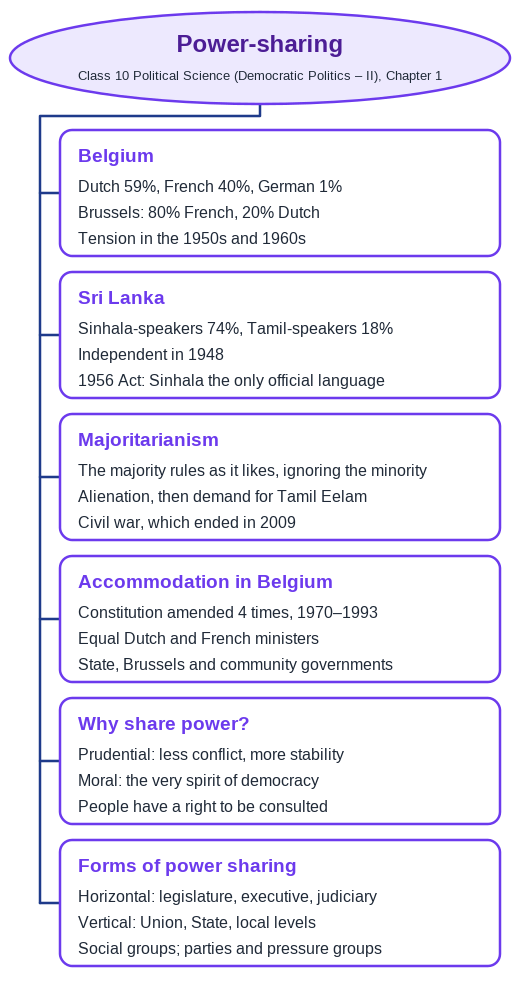
What is this chapter about?
Think of a school where one group of students decides everything: the monitor, the timetable, the games, even which language notices are written in. The others would soon stop caring about the school, or start quarrelling. Countries face the same question on a bigger scale: who holds power, and who gets a say? This first chapter of Democratic Politics – II, the Class 10 Political Science book, opens with two true stories, from Belgium and Sri Lanka, about how democracies respond when communities ask to share power. From them it draws general lessons on why power sharing is desirable and the forms it can take. The next two chapters, on federalism and on gender, religion and caste, take these ideas further.
Who lives in Belgium and Sri Lanka?
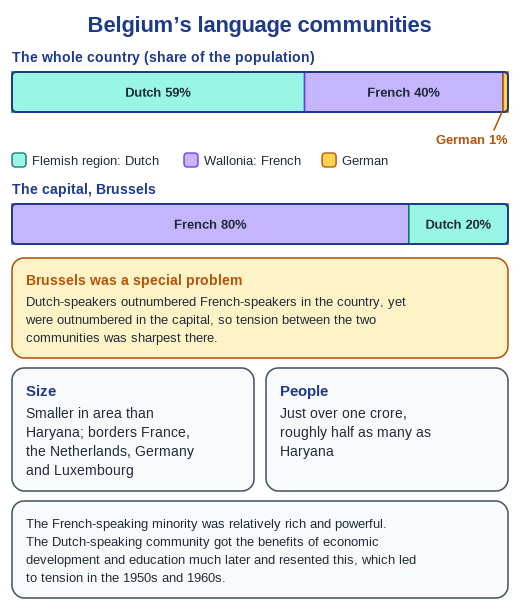
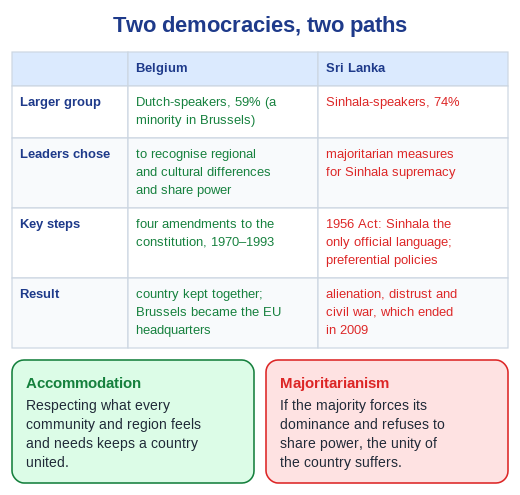
Belgium, a small European country smaller in area than Haryana, has three language groups. About 59 per cent of its people live in the Flemish region and speak Dutch, 40 per cent live in Wallonia and speak French, and 1 per cent speak German. In the capital, Brussels, the picture flips: 80 per cent speak French and 20 per cent Dutch. The French-speaking minority had long been richer and more powerful, and the Dutch-speakers, who gained from development and education later, resented it, so the two were in tension through the 1950s and 1960s. Read How did Belgium and Sri Lanka deal with power sharing?
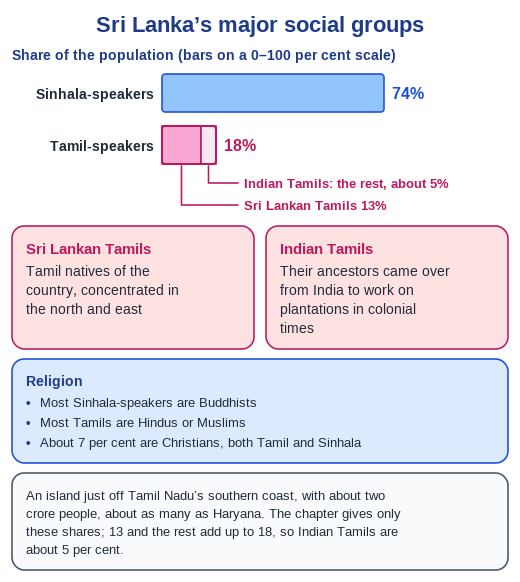
Sri Lanka, an island just off the coast of Tamil Nadu with about two crore people, has two major social groups: Sinhala-speakers (74 per cent) and Tamil-speakers (18 per cent). Among the Tamils, Sri Lankan Tamils (13 per cent) are natives of the country and live mostly in the north and east; Indian Tamils descend from plantation workers who came from India in colonial times. Most Sinhala-speakers are Buddhists, and most Tamils are Hindus or Muslims.
What happened in Sri Lanka?
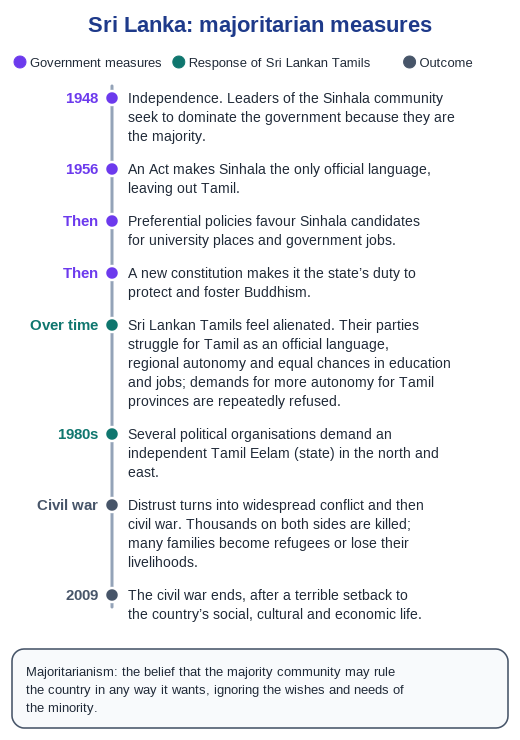
Sri Lanka became independent in 1948. The chapter says the leaders of the Sinhala community used their majority to secure dominance over government, a path it calls majoritarianism. In 1956 an Act made Sinhala the only official language. Preferential policies favoured Sinhala applicants for university places and government jobs, and a new constitution made protecting and fostering Buddhism a duty of the state. Sri Lankan Tamils came to feel shut out. Their parties campaigned for regional autonomy, for official status for Tamil, and for equal chances in education and jobs, but their demands for more autonomy were repeatedly turned down. By the 1980s several organisations wanted an independent Tamil Eelam in the north and east. Distrust became a civil war in which thousands on both sides died; it ended in 2009.
How did Belgium share power?
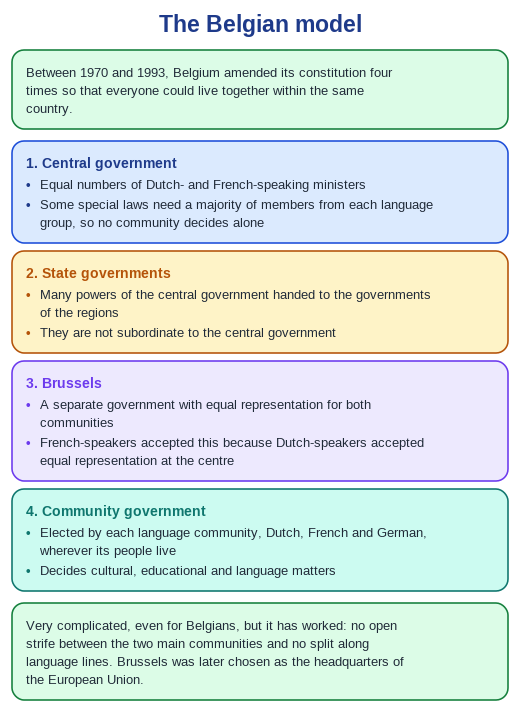
Belgium’s leaders accepted that the country’s regions and cultures were different. Between 1970 and 1993 they amended the constitution four times. Now the central government has equal numbers of Dutch- and French-speaking ministers, and some special laws need the support of most members from each language group. Many powers moved to the governments of the regions, which do not work under the centre. Brussels has its own government with equal representation for both communities. A third kind of government, the community government, is elected by each language community wherever its people live and handles culture, education and language. The system is complicated, but it has kept the peace and kept the country whole.
What do the two stories teach?
Both countries are democracies, yet they answered the power-sharing question in opposite ways. Belgium learnt that the country could stay united only if the feelings and interests of every community and region were respected. Sri Lanka shows the reverse: when a majority insists on dominance and refuses to share power, the unity of the country suffers.
Why is power sharing desirable?
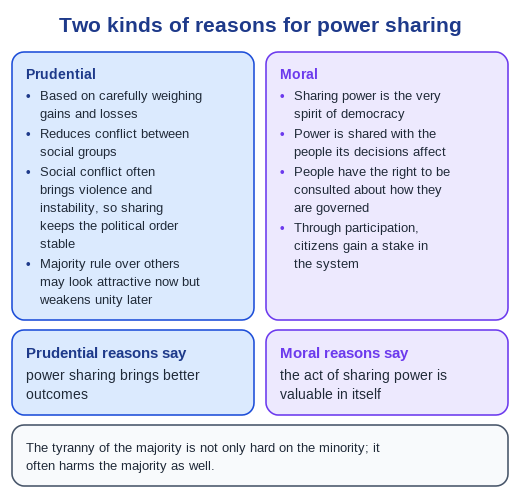
The chapter gives two kinds of reasons. Prudential reasons weigh gains and losses: sharing power lowers the chance of conflict between social groups, and since such conflict often leads to violence and instability, it keeps the political order steady. Forcing the majority’s will may look attractive in the short run, but over time it weakens the nation, and the tyranny of the majority often hurts the majority too. Moral reasons value the sharing itself: it is the very spirit of democracy, because people affected by decisions have a right to be consulted, and a government is legitimate when citizens take part and gain a stake in it. Read Why is power sharing desirable, and what forms does it take?
What forms can power sharing take?
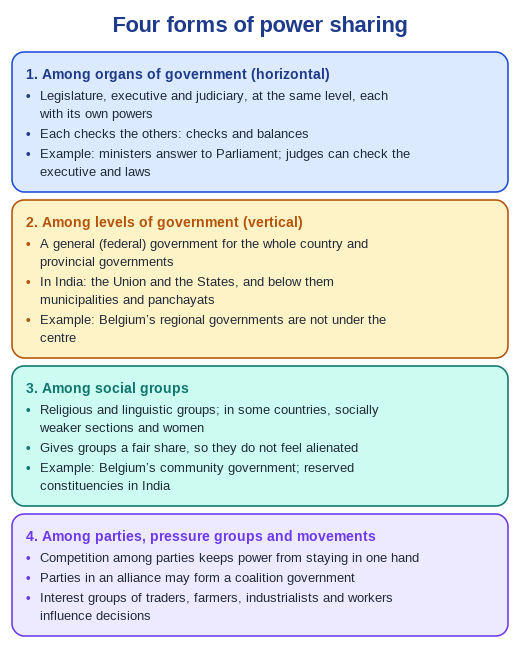
People once believed that all of a government’s power should stay with one person or group in one place. Democracy turned this round: power comes from the people, so it should be spread as widely as possible. Modern democracies share it in four main ways. Among organs of government, the legislature, executive and judiciary, which check one another. Among levels of government, such as the Union and the States in India, and further down municipalities and panchayats. Among social groups, as with Belgium’s community government or reserved constituencies in India. And among political parties, pressure groups and movements, through competition, alliances, coalition governments and the influence of interest groups.
Before we move on
This chapter sets up the next two: Chapter 2 studies federalism, the sharing of power between levels of government, and Chapter 3 the ways a democracy makes room for social differences. For an earlier look at how India’s legislature and executive work, see Class 8’s The Parliamentary System: Legislature and Executive. Answers to every exercise and to the activities inside the chapter are in the NCERT solutions for Chapter 1.
Key terms
| Term | Meaning |
|---|---|
| Power sharing | Spreading political power among organs of government, levels of government, social groups, and parties and other groups, so that no one holds all of it. |
| Ethnic group | A social group whose members share a culture and believe in a common descent because of similar physical type, culture or both; they need not share a religion or nationality. |
| Majoritarianism | The belief that the majority community may rule a country as it wishes, ignoring the wishes and needs of the minority. |
| Civil war | Violent conflict between opposing groups inside one country that grows so intense that it looks like a war. |
| Sri Lankan Tamils and Indian Tamils | Sri Lankan Tamils are Tamil natives of the country (13 per cent); Indian Tamils descend from plantation workers who came from India in the colonial period. |
| Tamil Eelam | The independent Tamil state in the north and east of Sri Lanka that several political organisations were demanding by the 1980s. |
| Community government | In Belgium, a government elected by one language community (Dutch, French or German) wherever its people live, with power over culture, education and language. |
| Prudential reasons | Reasons based on a careful weighing of gains and losses: power sharing reduces conflict and keeps the political order stable. |
| Moral reasons | Reasons that value power sharing for its own sake: it is the spirit of democracy, because people have the right to be consulted about how they are governed. |
| Horizontal distribution of power | Power shared among the legislature, executive and judiciary, organs at the same level, each with its own powers. |
| Checks and balances | The arrangement in which each organ of government can check the others, so that none of them uses unlimited power. |
| Federal (vertical) division of power | Power divided between a government for the whole country and governments at lower levels, with the constitution setting out the powers of each level. |
| Coalition government | A government formed by two or more parties that fought an election as an alliance and then share power. |
| Interest groups | Organised groups, such as traders, businessmen, industrialists, farmers and industrial workers, that influence government decisions through committees or pressure. |
Topics in this chapter
Practice
-
In Belgium, most people of the Flemish region speak:
Show answer
Answer: (b) Dutch
-
In which year did Sri Lanka pass an Act making Sinhala its only official language?
Show answer
Answer: (b) 1956
-
What share of the people of Brussels speak French?
Show answer
Answer: (d) 80 per cent
-
Belgium’s community government has power over:
Show answer
Answer: (b) cultural, educational and language matters
-
Power shared among the legislature, executive and judiciary is called:
Show answer
Answer: (b) horizontal distribution of power
-
Which of these is a moral reason for power sharing?
Show answer
Answer: (c) People have the right to a say in how they are governed
Questions students ask
What are the main topics of Class 10 Political Science Chapter 1?
Two stories, of Belgium and Sri Lanka, and how each handled demands for power sharing; majoritarianism in Sri Lanka and accommodation in Belgium; the prudential and moral reasons why power sharing is desirable; and the four forms of power sharing in modern democracies.
Is Power-sharing in the 2026-27 NCERT book?
Yes. It is Chapter 1 of Democratic Politics – II, the Class 10 Political Science textbook marked Reprint 2026-27, on pages 1 to 12. These notes follow the copy of the book now on NCERT’s website.
Is majority rule the same as majoritarianism?
No. In a democracy, those with the most votes form the government, and that is normal. Majoritarianism is the belief that the majority community may rule in whatever way it wants and ignore the minority’s wishes and needs, which is how the chapter describes Sri Lanka’s measures after 1948.
Did the Belgian model work?
The chapter says it is very complicated, even for people in Belgium, but that it has worked well so far. It has kept the two main communities from open strife and stopped the country from splitting along language lines.
Stuck on a question?
Take a photo and Lagnever AI explains it step by step. Try it for 7 days for ₹2.
Get it on Google Play Open in browser
For parents: after the trial, the plan renews monthly by UPI or card autopay. You can cancel anytime in the app.