
Why is power sharing desirable, and what forms does it take?
Answer in short
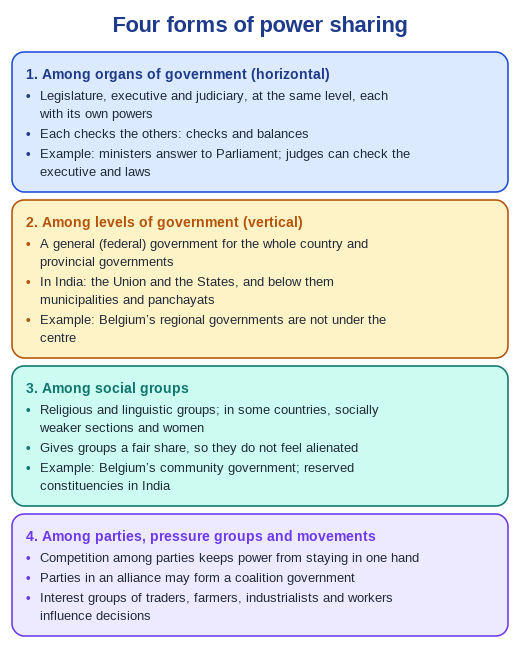
Power sharing is desirable for two kinds of reasons. Prudential reasons: it reduces conflict between social groups and keeps the political order stable. Moral reasons: it is the very spirit of democracy, because people have a right to be consulted. It takes four forms: among organs of government, levels of government, social groups, and parties and pressure groups.
Stuck on a question? Take a photo and Lagnever AI explains it step by step. Try it for 7 days for ₹2. Get it on Google Play
Why is power sharing good for a country?
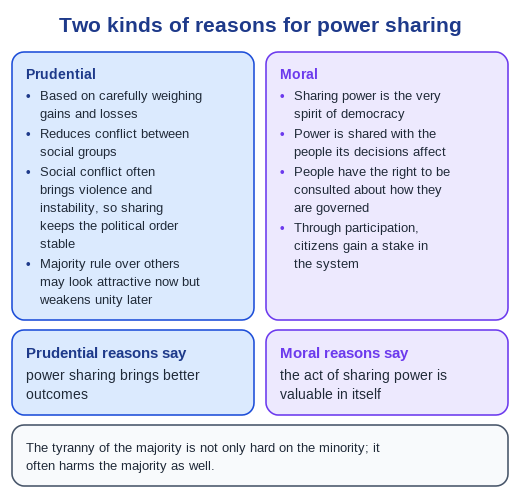
After the stories of Belgium and Sri Lanka, the chapter sets out two kinds of reasons in favour of power sharing.
The first is prudential, which means based on prudence, a careful calculation of gains and losses. Power sharing reduces the chance of conflict between social groups. Social conflict often brings violence and political instability, so sharing power is a good way to keep the political order stable. Making the majority’s will rule over everyone may look tempting at first, but over time it weakens the unity of the nation. The tyranny of the majority is not only hard on the minority; it often harms the majority as well, as Sri Lanka’s civil war hurt people of both communities.
What is the moral reason?
The second reason goes deeper. Sharing power is the very spirit of democracy. In a democracy, the government shares power with the people its decisions affect, who live with the results. People have the right to be consulted about how they are governed, and a government is legitimate when citizens take part and so gain a stake in the system.
So prudential reasons say that power sharing brings better outcomes, while moral reasons say that the act of sharing power is valuable in itself.
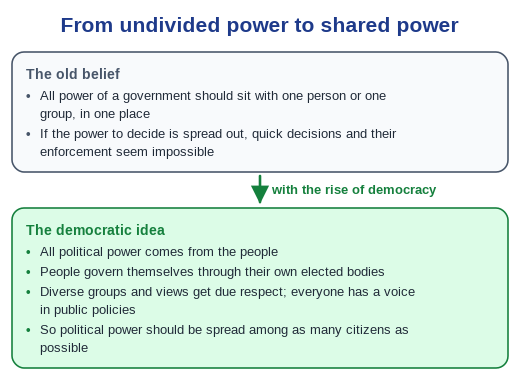
Wasn’t power once supposed to stay in one place?
Yes. For a long time people believed that all the power of a government should rest with one person or a group of persons in one place. Spreading the power to decide, they felt, would make it impossible to take quick decisions and enforce them. Democracy changed this belief. In a democracy, all political power comes from the people, who govern themselves through their own institutions. A good democratic government respects the different groups and views in society, and everyone has a voice in shaping public policies. So political power should be spread among as many citizens as possible.
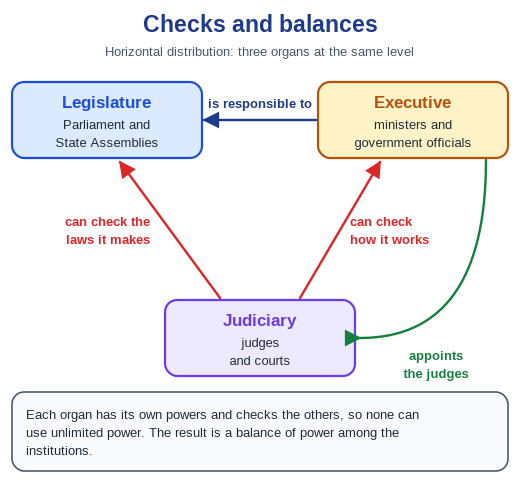
Form 1: how do organs of government share power?
Power is shared among the legislature, executive and judiciary. This is the horizontal distribution of power: organs placed at the same level use different powers, and none of them can use unlimited power. Each organ checks the others, which creates a balance of power. In India, ministers and officials use power but are answerable to Parliament or the State Assemblies, and judges, though appointed by the executive, can check how the executive works and the laws that legislatures make. This is the system of checks and balances.
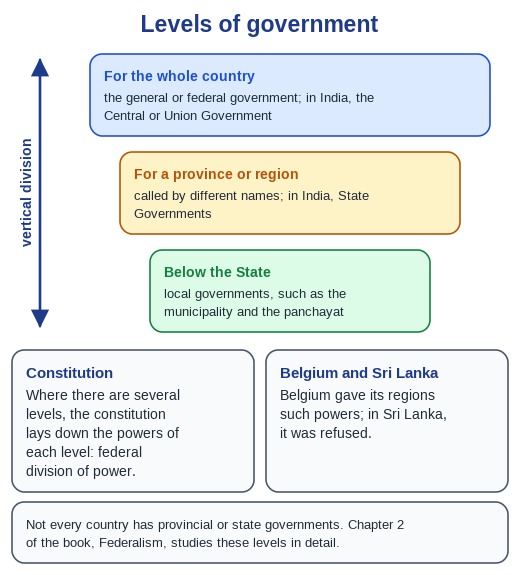
Form 2: how do levels of government share power?
Power can be shared between a general government for the whole country, usually called the federal government (in India, the Central or Union Government), and governments for each province or region (in India, the State Governments). Where such levels exist, the constitution clearly sets out the powers of each, which is called the federal division of power. Belgium did this; in Sri Lanka it was refused. The same idea reaches lower levels too, such as the municipality and the panchayat. Sharing between higher and lower levels is the vertical division of power, and Chapter 2, Federalism, studies it in detail.
Form 3: how do social groups share power?
Power may also be shared among social groups, such as religious and language groups. Belgium’s community government is a good example. Some countries have constitutional and legal arrangements so that women and socially weaker sections get seats in legislatures and posts in administration; India’s reserved constituencies in the assemblies and Parliament are one such arrangement. These give a fair share of power to groups that might otherwise feel alienated from the government.
Form 4: how do parties and pressure groups share power?
In a democracy, citizens must be able to choose among those competing for power, and today this means competition among parties. Competition stops power from staying in one hand; over time it passes among parties that stand for different ideas and social groups. Sometimes sharing is direct: two or more parties may join hands in an alliance to fight an election and, if elected, run a coalition government. Interest groups of farmers, traders, industrial workers, businessmen and industrialists also get a share, by sitting on government committees or by influencing decisions. Unit III of the book studies political parties.
Go back to how Belgium and Sri Lanka dealt with power sharing, the chapter notes or the NCERT solutions.
Practice
-
Which is a prudential reason for power sharing?
Show answer
Answer: (c) It reduces the possibility of conflict between social groups
-
Power shared between the Union government and the State governments is an example of:
Show answer
Answer: (b) vertical division
-
If several parties fight an election together as an alliance and win, they form a:
Show answer
Answer: (c) coalition government
-
What are checks and balances?
Show answer
Answer: An arrangement in which each organ of government checks the others. Ministers answer to Parliament or State Assemblies, and judges, though appointed by the executive, can check the executive and the laws the legislatures make, so no organ has unlimited power.
-
How do interest groups share power?
Show answer
Answer: Groups of farmers, traders, industrial workers, businessmen and industrialists take part in government committees or influence how decisions are made, so they too get a share in governmental power.
Questions students ask
What is the difference between prudential and moral reasons for power sharing?
Prudential reasons look at results: power sharing lowers conflict and keeps a country stable. Moral reasons value the act itself: in a democracy, those affected by power should share in it, whatever the results.
What are the four forms of power sharing?
Power is shared among organs of government (horizontal), among governments at different levels (vertical or federal), among social groups such as religious and language groups, and among political parties, pressure groups and movements.
Why was undivided power once preferred?
People believed that all power should sit with one person or group in one place, because spreading it out would make quick decisions and their enforcement impossible. Democracy changed this, since it holds that power comes from the people.
Stuck on a question?
Take a photo and Lagnever AI explains it step by step. Try it for 7 days for ₹2.
Get it on Google Play Open in browser
For parents: after the trial, the plan renews monthly by UPI or card autopay. You can cancel anytime in the app.