
How did Belgium and Sri Lanka deal with power sharing?
Answer in short
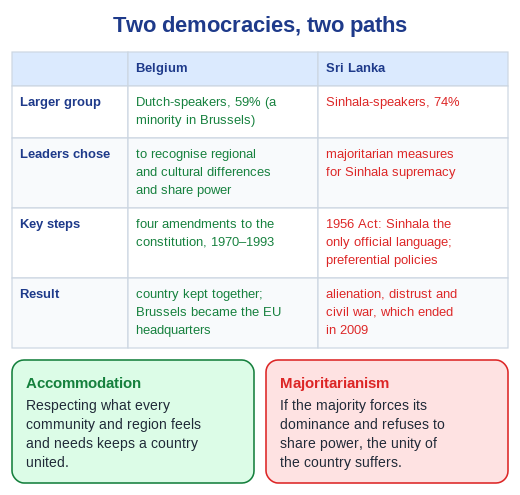
Belgium and Sri Lanka are both democracies with more than one language community, but they took opposite paths. Sri Lanka’s governments took majoritarian measures that alienated the Tamils, and distrust grew into a civil war that ended in 2009. Belgium amended its constitution four times between 1970 and 1993 to share power, and stayed united.
Stuck on a question? Take a photo and Lagnever AI explains it step by step. Try it for 7 days for ₹2. Get it on Google Play
Who lives in Belgium?
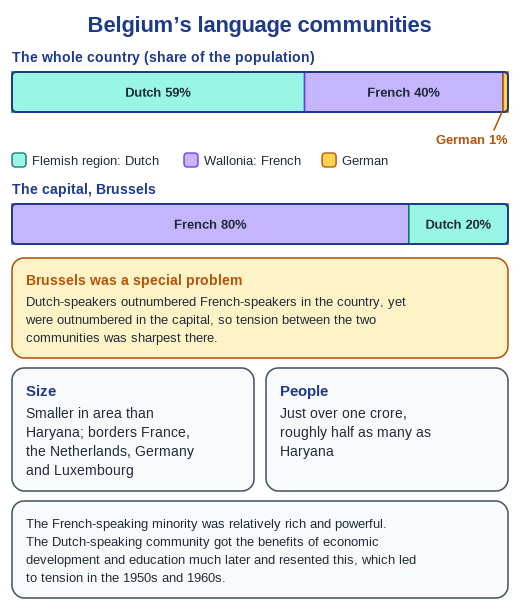
Belgium is a small country in Europe, bordering France, the Netherlands, Germany and Luxembourg. It is smaller in area than Haryana and has a little over one crore people. Its people are divided by language. About 59 per cent live in the Flemish region and speak Dutch, about 40 per cent live in Wallonia and speak French, and 1 per cent speak German. The capital, Brussels, is different: there 80 per cent speak French and 20 per cent Dutch.
For a long time the French-speaking minority was richer and more powerful. The Dutch-speakers got the benefits of economic development and education much later, and they resented this. The result was tension between the two communities in the 1950s and 1960s, sharpest in Brussels, where the country’s majority was a minority.
Who lives in Sri Lanka?
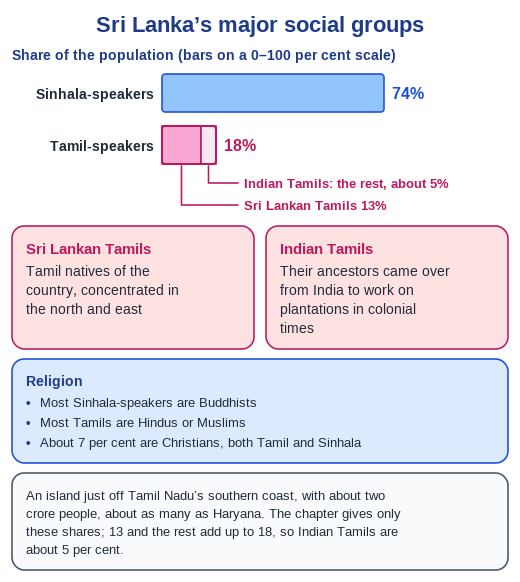
Sri Lanka is an island lying just off Tamil Nadu’s southern coast, with about two crore people. Two groups make up most of its people: Sinhala-speakers, 74 per cent, and Tamil-speakers, 18 per cent. The Tamils form two groups: Sri Lankan Tamils (13 per cent), natives of the island who live mostly in the north and east, and Indian Tamils, whose ancestors came over from India to work on plantations in colonial times. Most Sinhala-speakers are Buddhists and most Tamils are Hindus or Muslims; about 7 per cent of the people are Christians, from both groups.
What could have gone wrong in each country?
The chapter asks us to imagine the risks. In Belgium, the Dutch-speaking majority could have used its numbers to impose its wishes on the French- and German-speakers. That would have deepened the conflict and might have ended in a messy split of the country, with both sides claiming Brussels. In Sri Lanka, the Sinhala majority was larger still, and it could dictate to the whole country.
What is majoritarianism, and what happened in Sri Lanka?
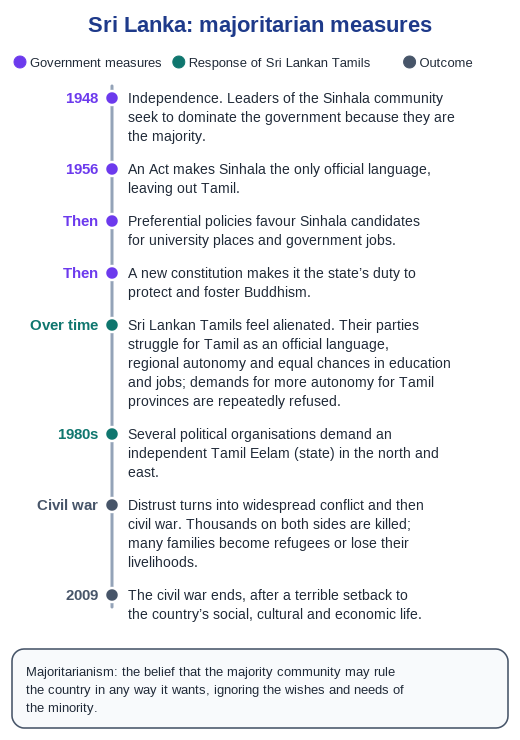
Majoritarianism is the belief that the majority community may rule a country however it likes, without regard for the wishes and needs of the minority. The chapter says this is the path Sri Lanka’s governments took after independence in 1948. The leaders of the Sinhala community sought dominance over the government because of their numbers. In 1956 an Act made Sinhala the only official language, leaving out Tamil. Governments gave Sinhala candidates preference for university places and government jobs, and a new constitution made it the state’s duty to protect and foster Buddhism.
How did the Sri Lankan Tamils respond?
One measure after another made Sri Lankan Tamils feel alienated. They felt that the major parties, led by Buddhist Sinhala leaders, ignored their language and culture, and that the constitution and policies denied them equal political rights and fair chances at jobs. They formed parties and campaigned for three things: official status for Tamil, regional autonomy, and equal opportunity in education and jobs. Their demand for more autonomy for the provinces where Tamils lived was turned down again and again. By the 1980s, several political organisations were demanding an independent Tamil Eelam (state) in the north and east. Distrust between the two communities grew into a civil war: thousands of people of both communities were killed, many families had to flee the country, and many more people lost their means of earning. The war ended in 2009.
How did Belgium accommodate its communities?
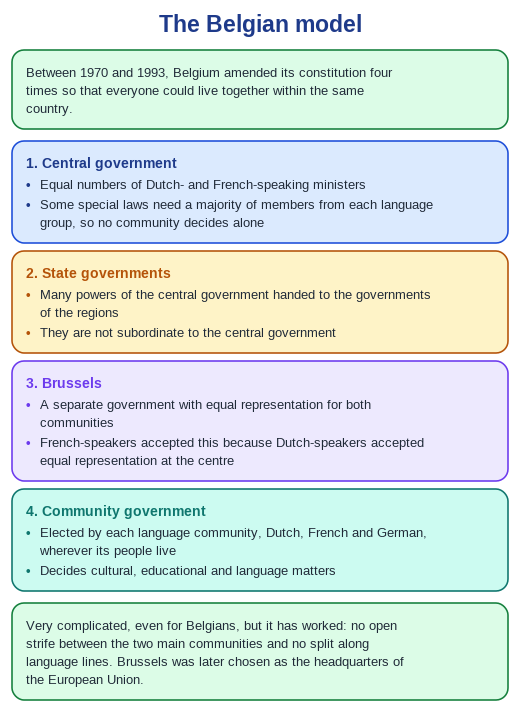
Belgium’s leaders chose a different path. They accepted regional differences and cultural diversity, and between 1970 and 1993 they amended the constitution four times. Their model has four parts:
- Central government: equal numbers of Dutch- and French-speaking ministers; some special laws need the support of most members from each language group, so no community can decide alone.
- State governments: many central powers moved to the governments of the regions, which are not subordinate to the centre.
- Brussels: a separate government with equal representation for both communities. French-speakers accepted this in Brussels because Dutch-speakers accepted equality in the central government.
- Community government: elected by each language community, Dutch, French or German, wherever its people live, with power over culture, education and language.
The model is complicated even for Belgians, but it has kept the peace between the two major communities and prevented a split on language lines. When the European Union was formed, Brussels became its headquarters.
What do the two stories teach?
Both countries are democracies, yet they handled power sharing in opposite ways. Belgium shows that a country stays united when the feelings and interests of every community and region are respected. Sri Lanka shows that when a majority insists on dominance and will not share power, the unity of the country is at risk.
Next, see why power sharing is desirable and the forms it takes. Go back to the chapter notes or the NCERT solutions.
Practice
-
Which community in Belgium was relatively rich and powerful?
Show answer
Answer: (b) the French-speaking minority
-
By the 1980s, some political organisations in Sri Lanka demanded:
Show answer
Answer: (b) an independent Tamil Eelam
-
Why did French-speakers accept equal representation in the Brussels government?
Show answer
Answer: (b) Dutch-speakers accepted equal representation in the central government
-
Name two majoritarian measures taken in Sri Lanka after 1948.
Show answer
Answer: Any two: an Act of 1956 made Sinhala the only official language; preferential policies gave Sinhala candidates an edge for university places and government jobs; a new constitution made protecting and fostering Buddhism a duty of the state.
-
What is a community government in Belgium?
Show answer
Answer: A government elected by the people of one language community, Dutch, French or German, wherever they live in the country. It has power over cultural, educational and language matters.
Questions students ask
Why did the chapter compare Belgium with Haryana?
To give a sense of size. Belgium is smaller in area than Haryana and has a little over one crore people, about half of Haryana’s population; Sri Lanka’s population, about two crore, is close to Haryana’s.
What was special about Brussels?
Dutch-speakers were a majority in Belgium as a whole but a minority in the capital, where 80 per cent of people speak French. So the tension between the two communities was sharpest there, and Brussels got its own government with equal representation for both.
When did the Sri Lankan civil war end?
In 2009. The chapter says it killed thousands of people of both communities, forced many families to leave the country as refugees and caused a terrible setback to the country’s social, cultural and economic life.
Stuck on a question?
Take a photo and Lagnever AI explains it step by step. Try it for 7 days for ₹2.
Get it on Google Play Open in browser
For parents: after the trial, the plan renews monthly by UPI or card autopay. You can cancel anytime in the app.