
NCERT Solutions Class 10 Political Science Chapter 1: Power-sharing
Answers to all nine exercises of Chapter 1, Power-sharing, of Democratic Politics – II, the Class 10 Political Science textbook, and to every activity, cartoon question and thought bubble inside the chapter. Page numbers follow the 2026-27 reprint (pages 1–12). The exercises are quoted from the book; the questions inside the chapter are restated in short, in our own words. The map question is answered in words, without maps, and the cartoons are described, not reproduced. Short notes: Chapter 1 notes.
Activities and questions inside the chapter (pages 2–10)
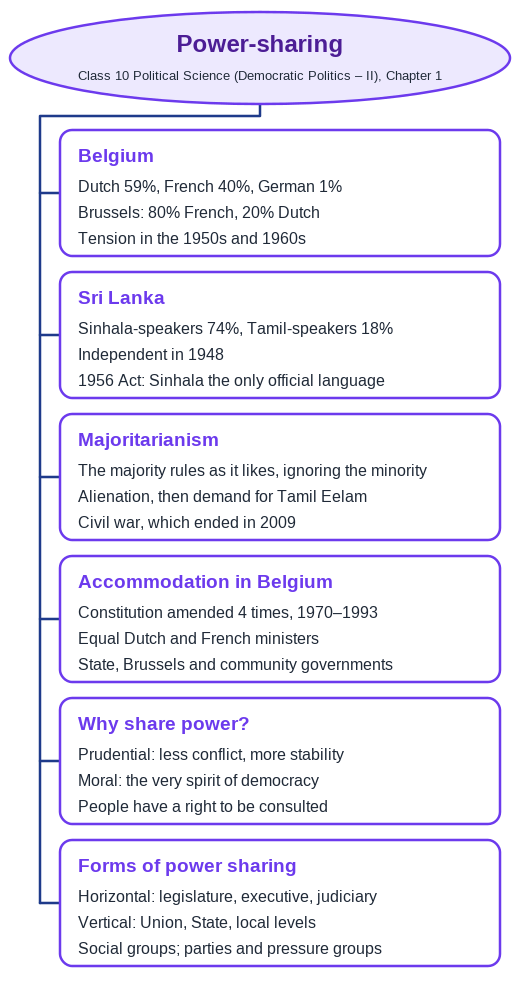
Thought bubble, page 2: a student thinks that sharing power means dividing it, and so weakening the country. Why does the chapter begin with this idea? Because many people believe it, the chapter tests this belief first. The two stories that follow point the other way. Belgium shared power among its communities and stayed united; Sri Lanka’s governments would not, and the country was torn by civil war. By the end, the chapter argues that sharing power reduces conflict and holds a country together, so it strengthens a country rather than weakening it.
Map question, page 2: where are the different communities concentrated on the maps of Belgium and Sri Lanka? Belgium: Dutch-speakers in the Flemish region in the north; French-speakers in Wallonia in the south; German-speakers in a small area in the east; and Brussels, mostly French-speaking, as a separate region inside the Flemish area. Sri Lanka: Sri Lankan Tamils in the north and east (around Jaffna, Trincomalee and Batticaloa, places named on the book’s map); Indian Tamils in pockets of the central hill country, near Kandy; Sinhala-speakers over most of the south, west and centre; and Muslims in small pockets in many parts of the island.
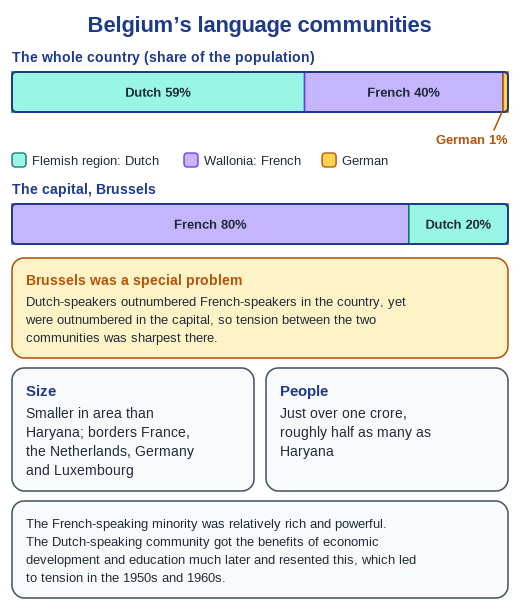
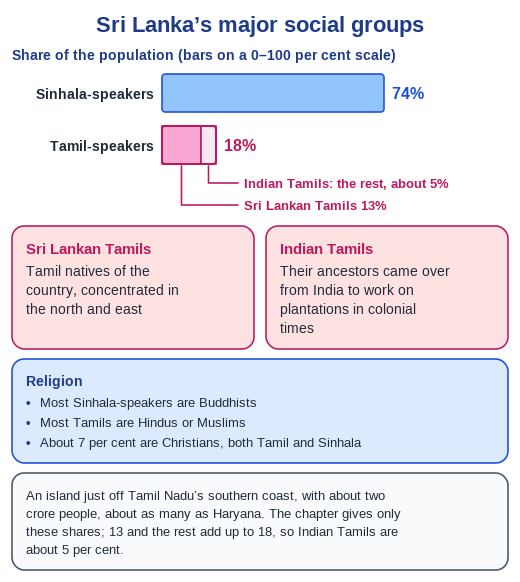
Thought bubble, page 4 (top): what is wrong if the majority community rules? And if not in Sri Lanka, where would the Sinhalas rule? In a democracy, the side with the most votes forms the government, and that is normal. The chapter’s worry is different: a majority community ruling in whatever way it wants and ignoring the minority, which it calls majoritarianism. In Sri Lanka, it says, this left Tamils feeling alienated, and distrust grew into a civil war that harmed both communities. A majority can govern and still share power: by respecting minority languages, giving regions a say, and treating every citizen equally in education and jobs. Then every community feels the country is its own.
Thought bubble, page 4 (bottom): what kind of solution is Belgium’s rule on ministers? A student is glad India’s Constitution does not say which minister comes from which community. Belgium’s rule, equal numbers of Dutch- and French-speaking ministers in the central government, is a safeguard: neither community can run the centre alone. It suits a country with two major language communities and a history of tension between them; the photograph of a street sign in French and Dutch on the same page shows the same respect for both languages. India’s Constitution does not fix ministers by community, but India shares power in other ways: between the Union, the States and local governments, through reserved constituencies, and through competition among many parties. Each country chooses the arrangements that fit its own history and society; there is no single model.
Let us read newspaper, page 5: for a week, collect news clippings about conflicts or wars; in groups of five, sort them by place, find their causes, and see which could be settled by sharing power. This is a group activity. How to do it: each member cuts out reports for a week; the group sorts them into three piles: your state, the rest of India, and outside India. A table to fill: the conflict; where it is; its cause; is it about sharing power?; could a power-sharing arrangement help? What to look for: disputes between groups over language, religion, jobs or representation, between regions and a central government, or between parties are often about power sharing, and arrangements such as more powers for regions, equal representation or a coalition can ease them. Wars between countries over territory, or quarrels between individuals, are usually not about power sharing inside a country. Record the facts as the newspapers give them, and keep your own opinions separate.
Thought bubble, page 5: so sharing power makes us more powerful? That sounds odd. It sounds odd only if power is like a cake that gets smaller when it is cut. When every group has a share, people trust the system, quarrels stay small, and the country stays united and stable. Belgium shared power and avoided both civic strife and a split, and Brussels was later chosen as the headquarters of the European Union. Sri Lanka did not, and its civil war set back life in the whole country: its society, culture and economy. A government that all its people see as their own is stronger, not weaker.
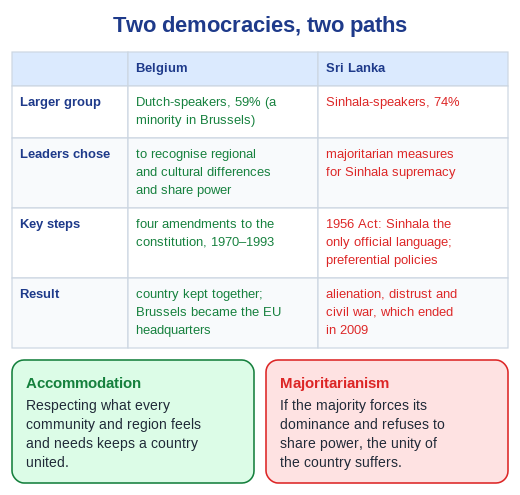
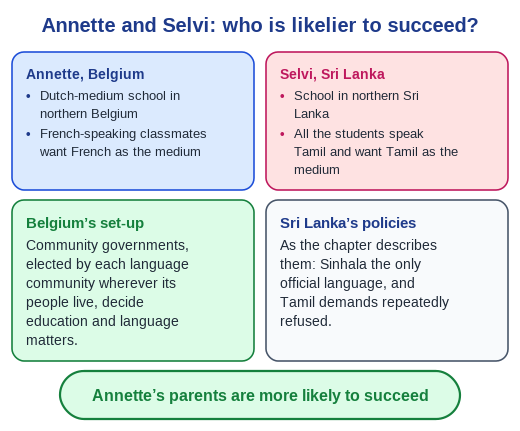
Let us revise, page 6: Annette, in a Dutch-medium school in northern Belgium, and Selvi, in a school in northern Sri Lanka, both want teaching in their own language. Whose parents are more likely to succeed with their government, and why? Annette’s. In Belgium, community governments, elected by each language community wherever its people live, have power over education and language matters, and the whole Belgian model is built to accommodate its language groups. So French-speaking families in Annette’s school have a government of their own community to turn to. Going by the chapter, Selvi’s parents would face governments that made Sinhala the only official language and repeatedly turned down Tamil demands for more autonomy, so they are less likely to succeed.
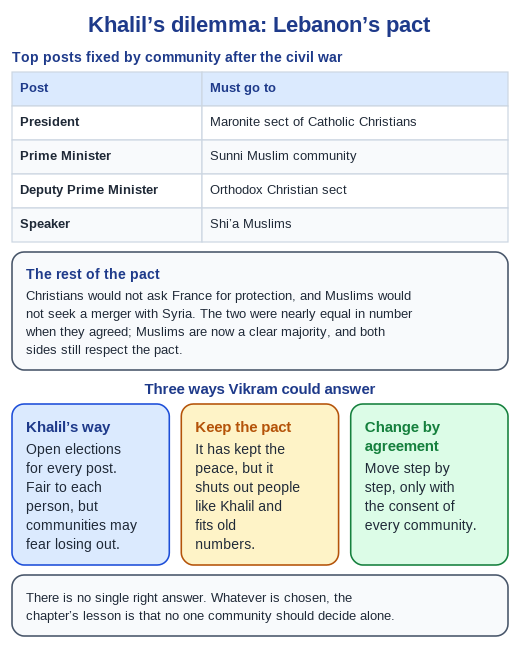
Khalil’s dilemma, page 7: Lebanon’s power-sharing rules reserve its top posts for particular communities. If Vikram could rewrite them, should he adopt open elections as Khalil wants, keep the old rules, or do something else? There is no single correct answer; what matters is weighing the choices. Khalil’s way, open elections for every post: every citizen, including people like Khalil who do not want to be known by any community, gets an equal chance. But communities that fought a bitter civil war may fear losing out, especially as their numbers have changed, and old conflicts could return. Keep the old rules: they ended the war and both sides still respect them. But they tie the top posts to religion for ever, shut out people like Khalil, and no longer match the population. Something else (one possible answer): change slowly and only by agreement. Keep the pact for now, let leaders of all communities agree on steps towards opening the posts, and protect each community in other ways, such as a fair share of seats in the legislature. The chapter’s lesson is that power-sharing rules last when every community accepts them, not when one side imposes them.
Cartoon, page 8: in 2005 new laws in Russia gave its president more powers. What does the cartoon say about democracy and the concentration of power, and what other examples make the same point? The cartoon shows a horse labelled “Democracy” pulling a cart, with Russia’s president and the visiting US president holding its reins very tight. Its message: when power is gathered in one person’s hands, democracy is held back and cannot move freely; it needs power to be spread out and checked. Other examples from your books: Napoleon, who gave France efficient laws but, as History Chapter 1 says, destroyed democracy there; the conservative governments of Europe after 1815, which censored newspapers and books; and absolute monarchs who ruled with no elected assembly. Even a school where one monitor alone decides everything shows the same problem on a small scale.
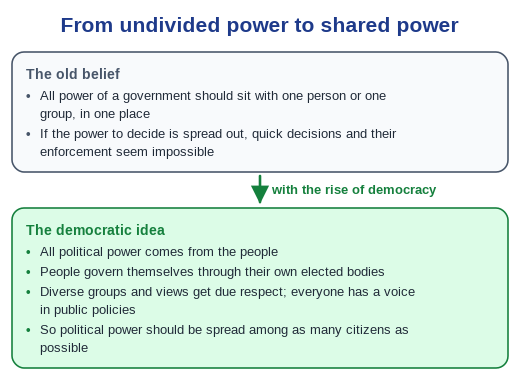
Thought bubble, page 9: a student’s class gets a new monitor each month; does that count as power sharing? Partly. Changing the monitor every month means power does not stay with one student, much as power passes among different parties over time in a democracy. But at any moment one student still holds all the monitor’s powers. It would be fuller power sharing if, for example, the class elected its monitors, the monitor shared duties with a small class committee, and the class teacher could check the monitor’s decisions: power shared among people, with checks and balances.
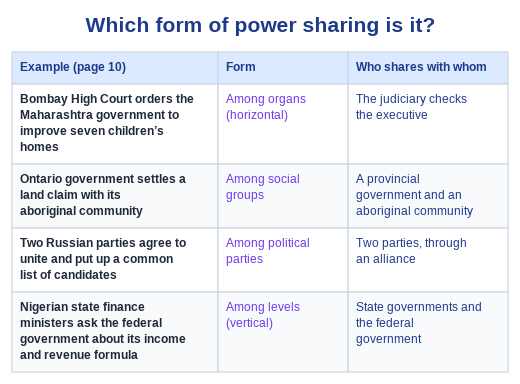
Let us revise, page 10: which of the four forms of power sharing do these four examples show, and who shares power with whom?
- The Bombay High Court orders the Maharashtra government to improve conditions in seven children’s homes in Mumbai: among organs of government (horizontal). The judiciary checks the executive.
- The Ontario government in Canada settles a land claim with the aboriginal community: among social groups. A provincial government shares power with the aboriginal community and promises to work with it in mutual respect.
- Two Russian parties, the Liberal Yabloko Movement and the Union of Right Forces, agree to unite and put up a common list of candidates: among political parties. Two parties share power through an alliance.
- Finance ministers of Nigeria’s states ask the federal government to declare its sources of income and how it shares revenue: among levels of government (vertical). The state governments and the federal government.
Exercises (pages 10–12)
1. “What are the different forms of power sharing in modern democracies? Give an example of each of these.”
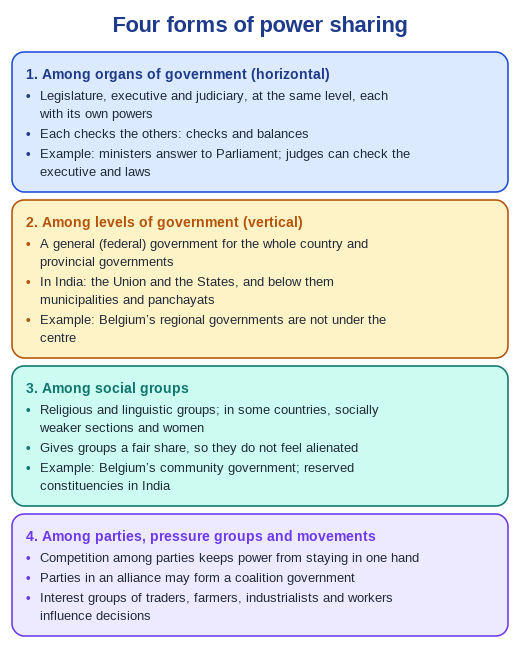
Answer: Modern democracies share power in four ways: among organs of government, among levels of government, among social groups, and among parties, pressure groups and movements.
- Among organs of government (horizontal distribution): the legislature, executive and judiciary work at the same level. Each has its own powers and checks the others (a system of checks and balances). Example: in India, ministers are answerable to Parliament or the State Assemblies. Judges are appointed by the executive, but they can check the executive and the laws.
- Among governments at different levels (vertical or federal division): one government for the whole country and governments for provinces or regions. The constitution lays down the powers of each, and this can reach down to local bodies. Example: India’s Union and State governments, with municipalities and panchayats below them. In Belgium, the State Governments are not subordinate to (not under) the Central Government.
- Among social groups: religious, language and other groups get a share of power. Example: Belgium’s community government for each language community; reserved constituencies in India’s assemblies and Parliament.
- Among political parties, pressure groups and movements: competition stops power staying in one hand. Parties may share power directly in a coalition, and interest groups influence decisions. Example: Germany’s two main rival parties ran a coalition government after the 2005 elections, as the chapter notes. Traders’ or farmers’ groups may sit on government committees.
2. “State one prudential reason and one moral reason for power sharing with an example from the Indian context.”
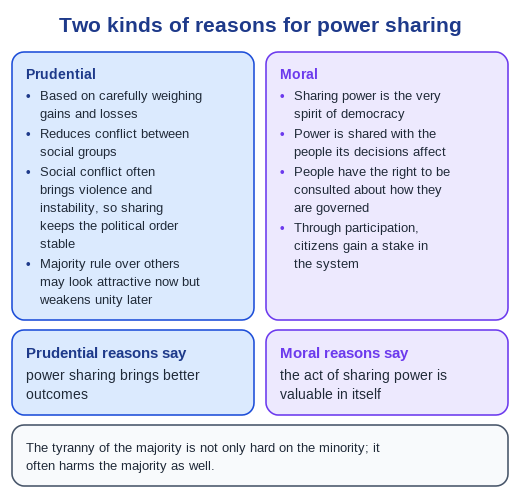
Answer: Prudential reason: power sharing reduces conflict between social groups. Moral reason: power sharing is the very spirit of democracy.
Prudential reason (prudential means based on careful thinking about gains and losses)
- Sharing power reduces the chance of conflict between social groups.
- Conflict often leads to violence and instability, so sharing power keeps the political order stable.
- Indian example: reserved constituencies in the assemblies and Parliament give socially weaker groups (Extra: the Scheduled Castes and Scheduled Tribes) a place in law-making. So they do not feel cut off from the government.
- Another example: as Chapter 2 of this book explains, States formed on the basis of language let different language groups run many of their own affairs.
Moral reason (moral means that sharing power is right in itself)
- Power sharing is the very spirit of democracy.
- People have a right to be consulted about how they are governed.
- Indian example: every adult citizen votes to elect the Union, State and local governments. Elected panchayats and municipalities let people take part in decisions about their own village or town.
3. “After reading this chapter, three students drew different conclusions. Which of these do you agree with and why? Give your reasons in about 50 words.”
Thomman - Power sharing is necessary only in societies which have religious, linguistic or ethnic divisions.
Mathayi – Power sharing is suitable only for big countries that have regional divisions.
Ouseph – Every society needs some form of power sharing even if it is small or does not have social divisions.
Answer: I agree with Ouseph.
- Power sharing is not only a way to calm religious, language or regional divisions. It is the very spirit of democracy.
- Every society, however small or united, has different views and interests.
- Its people have a right to be consulted.
- Even a small country needs organs that check one another and parties that compete, so that power never rests in one hand.
4. “The Mayor of Merchtem, a town near Brussels in Belgium, has defended a ban on speaking French in the town’s schools. He said that the ban would help all non-Dutch speakers integrate in this Flemish town. Do you think that this measure is in keeping with the spirit of Belgium’s power sharing arrangements? Give your reasons in about 50 words.”
Answer: No. The ban goes against the spirit of Belgium’s power sharing.
- Belgium’s arrangements rest on respect and equal treatment for both language communities.
- For example: equal numbers of Dutch- and French-speaking ministers at the centre, a Brussels government where both communities are equally represented, and community governments that look after each group’s education and language.
- Banning French in schools forces one community’s language on another. This is the kind of domination the chapter warns against.
- Integration should come through accommodation (making room for every group), not through a ban.
5. “Read the following passage and pick out any one of the prudential reasons for power sharing offered in this.”
“We need to give more power to the panchayats to realise the dream of Mahatma Gandhi and the hopes of the makers of our Constitution. Panchayati Raj establishes true democracy. It restores power to the only place where power belongs in a democracy – in the hands of the people. Giving power to Panchayats is also a way to reduce corruption and increase administrative efficiency. When people participate in the planning and implementation of developmental schemes, they would naturally exercise greater control over these schemes. This would eliminate the corrupt middlemen. Thus, Panchayati Raj will strengthen the foundations of our democracy.”
Answer: Giving power to panchayats reduces corruption and increases administrative efficiency.
- Why it is prudential: it points to better results: less corruption and a government that works better.
- Another prudential reason in the passage: when people take part in planning and carrying out development schemes, they control them better, and corrupt middlemen are cut out.
- Not prudential: the lines about true democracy and returning power to the people give moral reasons instead.
6. “Different arguments are usually put forth in favour of and against power sharing. Identify those which are in favour of power sharing and select the answer using the codes given below? Power sharing: A. reduces conflict among different communities B. decreases the possibility of arbitrariness C. delays decision making process D. accommodates diversities E. increases instability and divisiveness F. promotes people’s participation in government G. undermines the unity of a country (a) A B D F (b) A C E F (c) A B D G (d) B C D G”
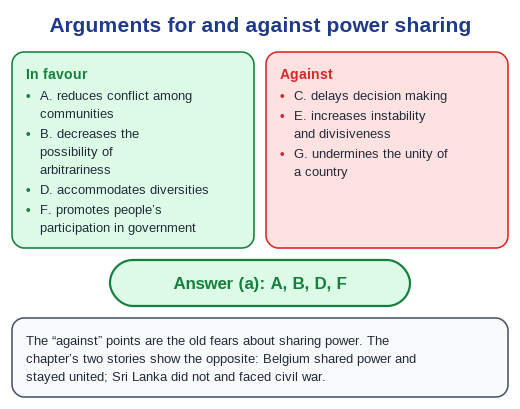
Answer: (a) A B D F.
- In favour: A, B, D and F are benefits: less conflict, less arbitrariness (rule by someone’s own wish, with no checks), room for different groups, and more people taking part in government.
- Against: C, E and G are arguments against power sharing.
- The chapter’s reply to them: Belgium shared power and stayed united, while refusing to share power brought Sri Lanka instability and civil war.
7. “Consider the following statements about power sharing arrangements in Belgium and Sri Lanka. A. In Belgium, the Dutch-speaking majority people tried to impose their domination on the minority French-speaking community. B. In Sri Lanka, the policies of the government sought to ensure the dominance of the Sinhala-speaking majority. C. The Tamils in Sri Lanka demanded a federal arrangement of power sharing to protect their culture, language and equality of opportunity in education and jobs. D. The transformation of Belgium from unitary government to a federal one prevented a possible division of the country on linguistic lines. Which of the statements given above are correct? (a) A, B, C and D (b) A, B and D (c) C and D (d) B, C and D”
Answer: (d) B, C and D.
- A is wrong: in Belgium the French-speaking minority was the relatively rich and powerful group. The Dutch-speaking majority could have used its numbers to force its will, but Belgium’s leaders chose to share power instead.
- B is right: Sri Lanka’s governments took majoritarian steps to establish Sinhala supremacy (dominance).
- C is right: the Tamils demanded regional autonomy (self-rule for their areas), Tamil as an official language and equal chances in education and jobs. The chapter notes that a federal division of power was refused in Sri Lanka.
- D is right: between 1970 and 1993 Belgium amended its constitution four times and gave its regions powers of their own. This helped avoid a possible split of the country on language lines.
8. “Match List I (forms of power sharing) with List II (forms of government) and select the correct answer using the codes given below in the lists:”
| List I | List II | |
|---|---|---|
| 1. | Power shared among different organs of government | A. Community government |
| 2. | Power shared among governments at different levels | B. Separation of powers |
| 3. | Power shared by different social groups | C. Coalition government |
| 4. | Power shared by two or more political parties | D. Federal government |
Codes (1, 2, 3, 4): (a) D A B C; (b) B C D A; (c) B D A C; (d) C D A B.
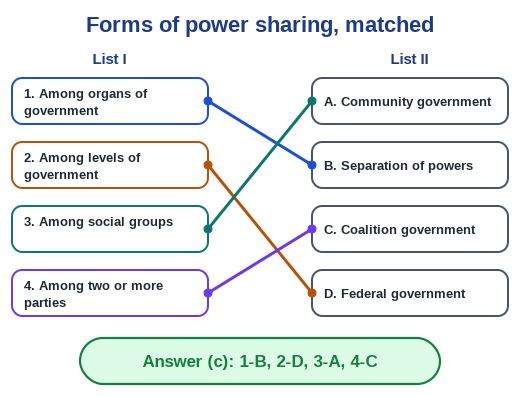
Answer: (c) B D A C.
- 1-B: organs of government share power through the separation of powers.
- 2-D: levels of government share power through a federal government.
- 3-A: social groups share power through a community government, as in Belgium.
- 4-C: parties share power through a coalition government.
9. “Consider the following two statements on power sharing and select the answer using the codes given below: A. Power sharing is good for democracy. B. It helps to reduce the possibility of conflict between social groups. Which of these statements are true and false? (a) A is true but B is false (b) Both A and B are true (c) Both A and B are false (d) A is false but B is true”
Answer: (b) Both A and B are true.
- A is true: this is the chapter’s main conclusion. Power sharing is the very spirit of democracy (the moral reason).
- B is true: this is the prudential reason. Sharing power lowers the chance of conflict between social groups and keeps the political order stable.
Practice
-
When many countries of Europe formed the European Union, which city was chosen as its headquarters?
Show answer
Answer: (b) Brussels
-
In Belgium, the State Governments of the regions are:
Show answer
Answer: (b) not subordinate to the Central Government
-
Whose forefathers came to Sri Lanka from India as plantation workers?
Show answer
Answer: (b) Indian Tamils
-
Under Lebanon’s pact, what did the Christians and the Muslims each agree not to do?
Show answer
Answer: The Christians promised not to ask France for protection, and the Muslims promised not to seek a merger with neighbouring Syria.
-
How does the separation of powers stop any one organ from misusing power?
Show answer
Answer: Each organ, the legislature, the executive and the judiciary, has its own powers and can check the others. For example, ministers answer to the legislature, and courts can check the executive and the laws, so none can use unlimited power.
Stuck on a question?
Take a photo and Lagnever AI explains it step by step. Try it for 7 days for ₹2.
Get it on Google Play Open in browser
For parents: after the trial, the plan renews monthly by UPI or card autopay. You can cancel anytime in the app.