
Class 10 History Chapter 1: The Rise of Nationalism in Europe Notes
This chapter in five lines
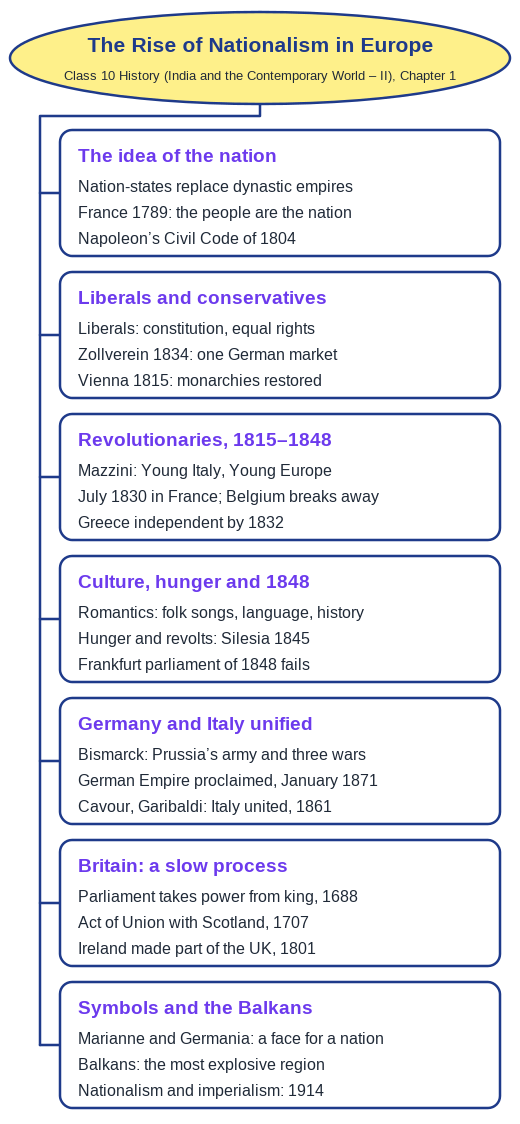
In the 19th century, nation-states replaced Europe’s multi-national dynastic empires. The French Revolution of 1789 first made the people, not the king, the nation. After 1815, liberals and revolutionaries fought a conservative order, and 1848 brought revolts across Europe. Germany and Italy were unified from above by 1871, Britain took a slower path, and nationalism joined to imperialism led to war in 1914.
What is this chapter about?
In 1848 the French artist Frédéric Sorrieu imagined a world of equal nations living in liberty: in his print, the peoples of Europe and America walk past a statue of Liberty, each group with its own flag and costume. This chapter asks how such nations came to exist. During the 19th century, nationalism changed Europe, and nation-states took the place of large empires in which one dynasty ruled over many peoples. A nation-state is more than a territory under one government: most of its citizens, not just its rulers, feel that they share an identity and a history. The chapter shows that this feeling did not exist from the start. People built it through struggles, through leaders and through ordinary men and women. It opens Section I, Events and Processes, of the Class 10 History book.
How did the French Revolution create the idea of the nation?
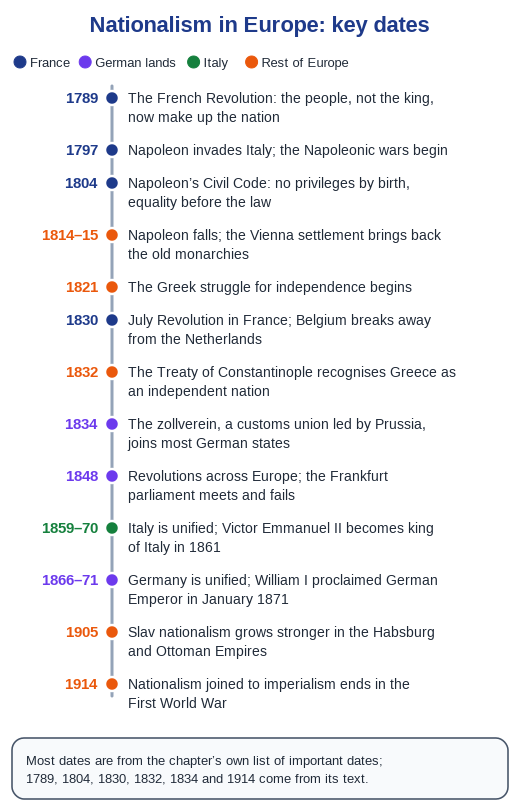
Nationalism first showed itself clearly in France in 1789. The Revolution took sovereignty away from the king and gave it to the body of French citizens: from now on, the people were the nation. The revolutionaries spread the ideas of la patrie (fatherland) and le citoyen (citizen), replaced the royal flag with the tricolour, renamed the Estates General the National Assembly, abolished internal customs duties, and brought in one system of weights and measures and one common language, French as spoken in Paris. Jacobin clubs sprang up in other cities, and in the 1790s French armies carried the idea of nationalism into Holland, Belgium, Switzerland and large parts of Italy. Read How did the French Revolution create the idea of the nation?
What did Napoleon change?
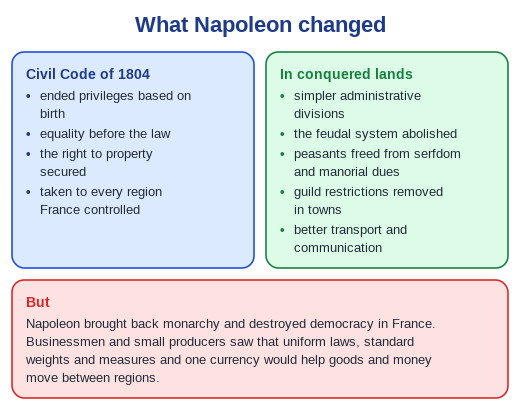
Napoleon brought back monarchy and so ended democracy in France, but he ran his lands on revolutionary principles. His Civil Code of 1804, the Napoleonic Code, ended privileges based on birth, made everyone equal before the law and protected property. In the Dutch Republic, Switzerland, Italy and Germany he simplified administration, abolished the feudal system, freed peasants from serfdom and removed guild restrictions. At first many people welcomed the French as bringers of liberty, but higher taxes, censorship and forced service in the French armies soon turned them hostile.
How was Europe divided before nation-states?
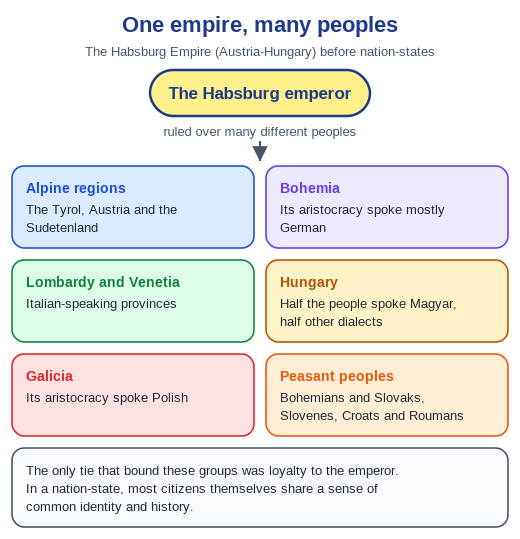
In the mid-18th century there were no nation-states. Germany, Italy and Switzerland were split into kingdoms, duchies and cantons. The Habsburg Empire held the Alpine lands, Bohemia, Italian-speaking Lombardy and Venetia, Hungary and Galicia, with peoples such as Magyars, Poles, Bohemians, Slovaks, Slovenes, Croats and Roumans; their only common bond was loyalty to the emperor. A small, French-speaking landed aristocracy stood above a large peasant population. As industry grew, first in England, new middle classes of industrialists, businessmen and professionals appeared, and it was among the educated liberals of these classes that the dream of national unity spread.
What did liberal nationalism stand for?
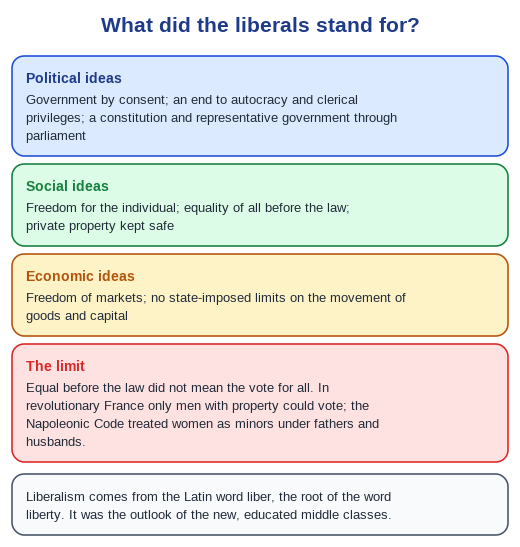
Liberalism comes from the Latin liber, the root of the word ‘liberty’. Liberals wanted individual freedom, equality before the law, government by consent, a constitution and a parliament. Equality before the law did not mean the vote for all, though: only men with property could vote, and the Napoleonic Code treated women as minors. In economics, liberals wanted markets without state restrictions. In the German lands, a merchant faced 11 customs barriers between Hamburg and Nuremberg in 1833, so in 1834 Prussia led a customs union, the zollverein. Read What happened in Europe between 1815 and 1848?
What was the conservative order of 1815?
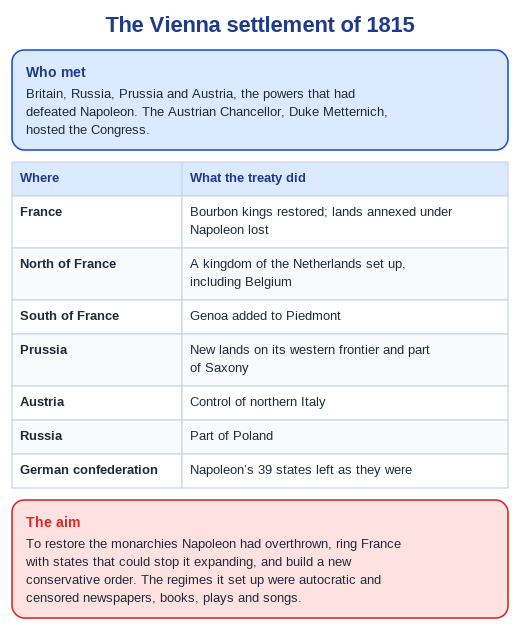
After Napoleon’s defeat, Britain, Russia, Prussia and Austria met at Vienna in 1815, with the Austrian Chancellor, Duke Metternich, as host. The Treaty of Vienna restored the Bourbon kings in France, placed buffer states around France, and gave Prussia, Austria and Russia new lands. The conservative regimes were autocratic and censored the press. Liberals went underground into secret societies. Giuseppe Mazzini, born in Genoa in 1805, founded Young Italy and Young Europe; Metternich saw him as the greatest danger to the social order.
What happened between 1830 and 1848?
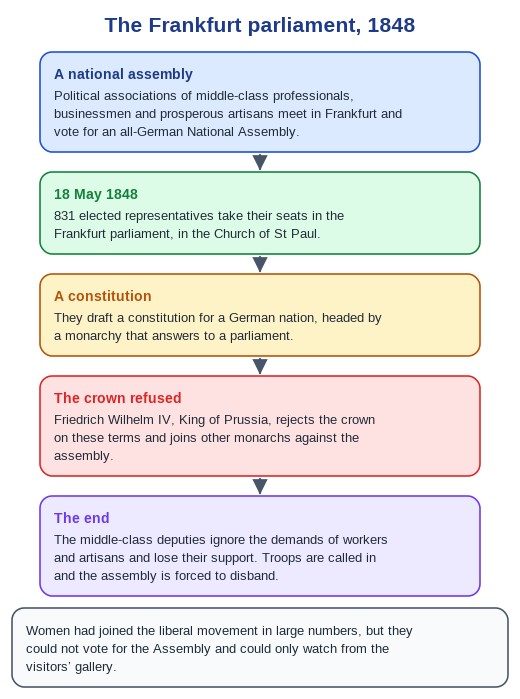
In July 1830 French liberals overthrew the Bourbons and set up a constitutional monarchy under Louis Philippe; Belgium then broke away from the Netherlands. The Greek war of independence against the Ottoman Empire, begun in 1821, won wide European support and ended in 1832. Romantic writers, collectors and musicians built national feeling through folk culture and language. Hunger and unemployment led to revolts, and in 1848 liberals tried to unite Germany through an elected parliament at Frankfurt. It failed, but rulers then began to grant reforms: serfdom was abolished in the Habsburg lands and Russia, and Hungary won more autonomy in 1867.
How were Germany and Italy unified?
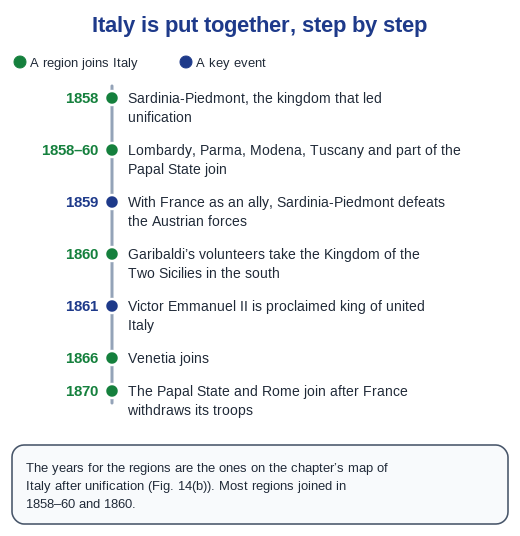
After 1848, conservatives took over the national cause. In Germany, Prussia’s chief minister Otto von Bismarck used the army and the bureaucracy; three wars against Denmark, Austria and France ended with King William I proclaimed German Emperor at Versailles on 18 January 1871. Italy, split into seven states, was united by Sardinia-Piedmont under King Victor Emmanuel II: Count Cavour’s alliance with France defeated Austria in 1859, Giuseppe Garibaldi’s volunteers took the south in 1860, and Victor Emmanuel II became king of united Italy in 1861. Read How were Germany and Italy unified?
Why was Britain different?
Britain became a nation-state slowly, not through a sudden revolution. The English parliament took power from the monarchy in 1688. The Act of Union of 1707 joined England and Scotland in the United Kingdom of Great Britain, and Ireland was forcibly added in 1801. England dominated: Scotland’s culture was suppressed, and the Union Jack, the national anthem and English were promoted.
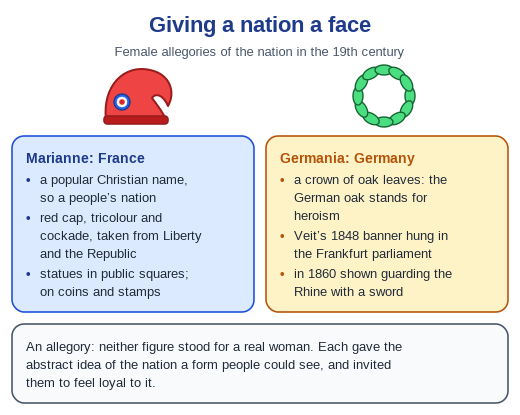
How did artists give a nation a face?
Artists showed nations as women. These figures were allegories: they gave a shape to an abstract idea. France became Marianne, with the red cap, the tricolour and the cockade, on statues, coins and stamps. Germany became Germania, crowned with oak leaves, because the German oak stood for heroism.
Why did the Balkans become explosive?
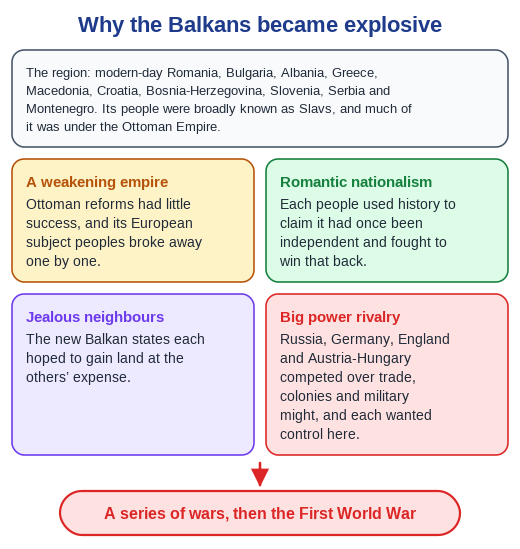
By the late 19th century nationalism had lost its liberal ideals and grown narrow and warlike. After 1871 the worst trouble was in the Balkans. As the Ottoman Empire weakened, Slav peoples broke away and their new states quarrelled over land, while Russia, Germany, England and Austria-Hungary competed for control. This led to a series of wars and, in 1914, the First World War.
Before we move on
Nationalism tied to imperialism led Europe into war, but colonised peoples also turned the idea of the nation against empire, each in their own way. Chapter 2 of the book, Nationalism in India, follows that story in India; for an earlier view, see Class 8’s India’s Long Road to Independence. Answers to every activity and question are in the NCERT solutions for Chapter 1.
Key terms
| Term | Meaning |
|---|---|
| Nation-state | A state in which most citizens, not only the rulers, share a sense of common identity, history or descent. |
| Absolutist | Rule by a monarch with no limits on his power; in history, a centralised, army-backed and harsh form of monarchy. |
| Utopian | An ideal picture of society, too perfect to be likely to exist. |
| Plebiscite | A vote in which all the people of a region say yes or no to a proposal. |
| Napoleonic Code | Napoleon’s Civil Code of 1804: it ended privileges based on birth and gave equality before the law and the right to property. |
| Liberalism | From the Latin liber, the root of ‘liberty’: freedom for the individual, equality before the law, government by consent, a constitution and a parliament. |
| Suffrage | The right to vote. |
| Zollverein | The customs union of 1834, formed at Prussia’s initiative, that removed tariff barriers among most German states. |
| Conservatism | The belief that traditional institutions such as the monarchy, the Church and the family should be kept, with slow change rather than sudden change. |
| Treaty of Vienna (1815) | The settlement made by Britain, Russia, Prussia and Austria after Napoleon’s defeat to restore the old monarchies. |
| Romanticism | A cultural movement that valued emotion, folk culture and a shared past, and used them to build national feeling. |
| Volksgeist | The spirit of the nation, which Herder said lived in the folk songs, poetry and dances of the common people (das volk). |
| Junkers | The large landowners of Prussia. |
| Allegory | Showing an abstract idea, such as liberty or a nation, as a person or an object; Marianne stands for France. |
| Ethnic | To do with a shared origin, by descent or culture, that a group claims, such as English, Welsh, Scot or Irish. |
Topics in this chapter
Practice
-
According to the chapter, when did nationalism first find clear expression?
Show answer
Answer: (b) in the French Revolution of 1789
-
The zollverein, formed in 1834, was a:
Show answer
Answer: (b) customs union
-
Who hosted the Congress of Vienna in 1815?
Show answer
Answer: (c) Duke Metternich
-
Who was proclaimed German Emperor at Versailles in January 1871?
Show answer
Answer: (b) William I
-
Which treaty recognised Greece as an independent nation in 1832?
Show answer
Answer: (c) Treaty of Constantinople
-
Germania wears a crown of oak leaves because the German oak stands for:
Show answer
Answer: (b) heroism
Questions students ask
What are the main topics of Class 10 History Chapter 1?
How the French Revolution created the idea of the nation, Napoleon’s reforms, liberal nationalism and the conservative order after 1815, the revolutionaries and the revolts of 1830–1848, the unification of Germany and Italy, the different case of Britain, how artists gave nations a face, and how nationalism joined imperialism in the Balkans.
Is The Rise of Nationalism in Europe in the 2026-27 NCERT book?
Yes. It is Chapter 1 of India and the Contemporary World – II, the Class 10 History textbook marked Reprint 2026-27, on pages 3 to 28. Chapter 2 of the same book, Nationalism in India, carries the story to India.
Who were the main figures in the unification of Italy?
Giuseppe Mazzini spread the idea of a united Italian republic; Count Cavour, chief minister of Sardinia-Piedmont, won an alliance with France; Giuseppe Garibaldi’s volunteers took the south in 1860; and Victor Emmanuel II became king of a united Italy in 1861.
Why is 1848 an important year in this chapter?
In 1848 hungry and jobless people rose up in many parts of Europe, and educated liberals led a revolution for constitutions and nation-states. France became a republic with votes for all adult men, and the Frankfurt parliament tried to unite Germany. The liberal attempts failed, but rulers afterwards began to grant reforms.
Stuck on a question?
Take a photo and Lagnever AI explains it step by step. Try it for 7 days for ₹2.
Get it on Google Play Open in browser
For parents: after the trial, the plan renews monthly by UPI or card autopay. You can cancel anytime in the app.