
How were Germany and Italy unified?
Answer in short
Both were unified from above, by kings, ministers and armies rather than by popular revolution. Prussia’s chief minister Otto von Bismarck won three wars, and William I was proclaimed German Emperor at Versailles on 18 January 1871. In Italy, Cavour’s diplomacy and Garibaldi’s volunteers made Victor Emmanuel II of Sardinia-Piedmont king of united Italy in 1861.
Stuck on a question? Take a photo and Lagnever AI explains it step by step. Try it for 7 days for ₹2. Get it on Google Play
Why did nationalism change after 1848?
Before 1848, nationalism was tied to liberals, democracy and revolution. After the failures of 1848, conservatives took it over. Kings, ministers and generals now used national feeling to make their states stronger and to gain power in Europe. Germany and Italy show this clearly: both were unified from above.
How did Prussia unify Germany?
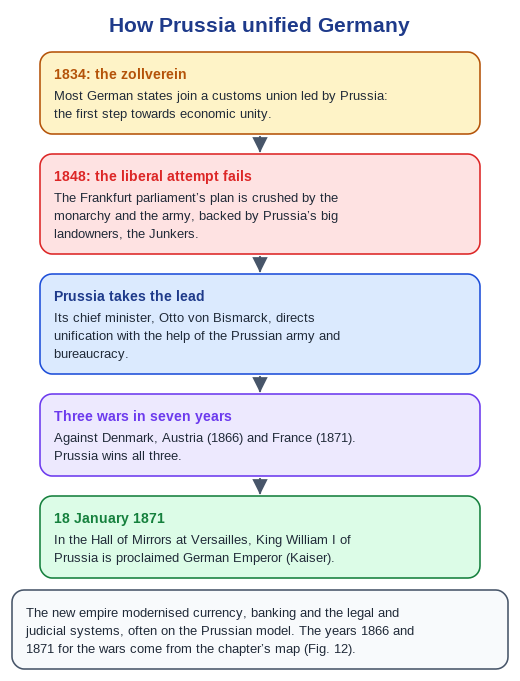
In 1848 middle-class Germans had tried to unite the German confederation under an elected parliament. The monarchy and the army, backed by Prussia’s big landowners, the Junkers, crushed that attempt. From then on Prussia led the movement. Otto von Bismarck, Prussia’s chief minister, planned and directed unification, relying on Prussia’s army and its officials. In seven years Prussia fought three wars, against Denmark, Austria and France, and won them all. The chapter’s map dates the war with Austria to 1866 and the war with France to 1871.
On 18 January 1871, German princes, army leaders and Prussian ministers, Bismarck among them, met in the Hall of Mirrors at the Palace of Versailles, in France, and King William I of Prussia was proclaimed German Emperor, the Kaiser. The new empire modernised the currency, banking and the legal and judicial systems, often taking Prussian practice as the model. A Viennese cartoon of 1870 even showed Bismarck with a whip, and the deputies of parliament cowering below him.
What was Italy like before unification?
Italy had a long history of division. In the middle of the 19th century it was split into seven states, and of these, Sardinia-Piedmont alone had an Italian royal family. Austria’s Habsburgs held the north, the Pope governed the centre, and Spain’s Bourbon kings dominated the south. Italian itself was spoken in many local forms.
Who unified Italy?
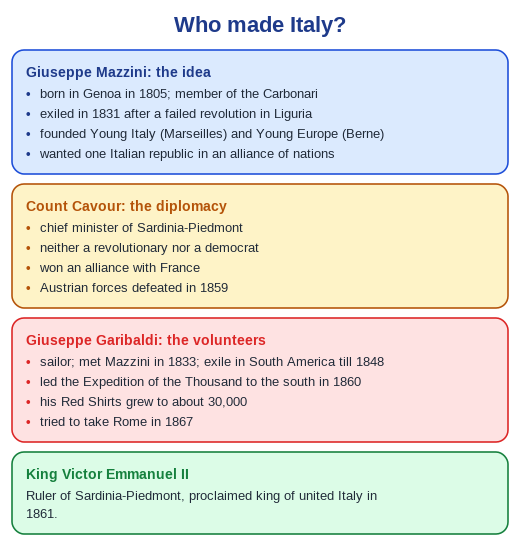
In the 1830s Giuseppe Mazzini had planned a single Italian republic and spread the idea through Young Italy. But the risings of 1831 and 1848 failed, so the task passed to Sardinia-Piedmont and its king, Victor Emmanuel II, who set out to unify Italy through war. For the ruling elite, a united Italy promised economic growth and political power.
Its chief minister, Count Cavour, was not a revolutionary, nor a democrat. Like many rich and educated Italians, he spoke French better than Italian. Through a careful alliance with France, Sardinia-Piedmont defeated the Austrian forces in 1859. Armed volunteers under Giuseppe Garibaldi joined the fight. In 1860 they entered the south, the Kingdom of the Two Sicilies, and with local peasants on their side drove out its Spanish Bourbon rulers. In 1861 Victor Emmanuel II became king of a united Italy.
Many Italians knew little about any of this. Illiteracy was high, and the chapter tells how peasants in the south who had backed Garibaldi had never heard of Italia and thought ‘La Talia’ was Victor Emmanuel’s wife.
When did each part join Italy?
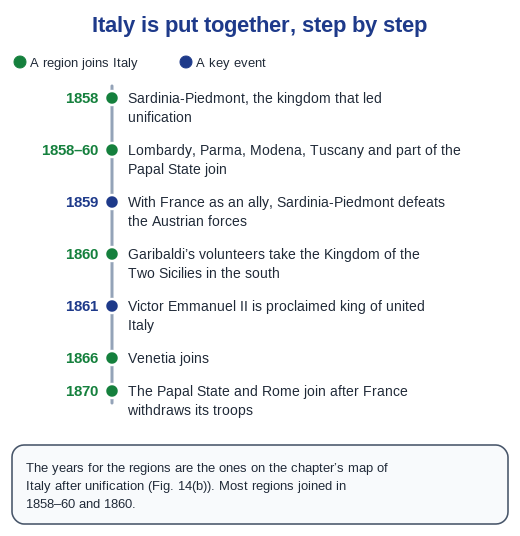
The chapter’s map of Italy after unification gives a year for each region. Sardinia-Piedmont is marked 1858; Lombardy, Parma, Modena, Tuscany and part of the Papal State joined in 1858–60; the Kingdom of the Two Sicilies in 1860; Venetia in 1866; and the Papal State with Rome in 1870, when France withdrew its troops during its war with Prussia. Garibaldi had tried to take Rome in 1867, but his Red Shirts were no match for the French and Papal troops.
How was Britain different?
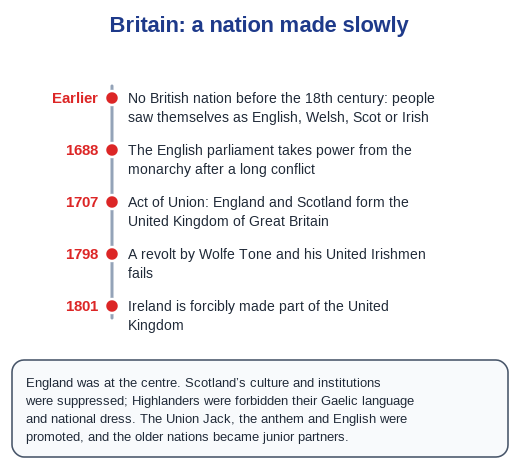
Some scholars call Britain the model nation-state, but it was formed in a very different way: slowly, not through revolution or a war of unification. There was no British nation before the 18th century; people saw themselves as English, Welsh, Scot or Irish. As England grew richer and stronger, it spread its influence over the other peoples of the British Isles. The English parliament took power from the monarchy in 1688. The Act of Union of 1707 joined England and Scotland in the United Kingdom of Great Britain, and Scotland’s culture was suppressed. After a failed revolt by Wolfe Tone’s United Irishmen in 1798, Ireland was forcibly incorporated in 1801.
Read on: How did the French Revolution create the idea of the nation?, What happened in Europe between 1815 and 1848?, the chapter notes and the NCERT solutions.
Practice
-
Who was the chief minister of Prussia who led German unification?
Show answer
Answer: (b) Otto von Bismarck
-
Garibaldi’s volunteers were popularly known as the:
Show answer
Answer: (c) Red Shirts
-
Which was the only Italian state ruled by an Italian princely house before unification?
Show answer
Answer: (d) Sardinia-Piedmont
-
Why does the chapter say the army was the architect of the German nation?
Show answer
Answer: Because Germany was unified by Prussia’s army and bureaucracy under Bismarck, through three wars, after the elected Frankfurt parliament had failed. The new empire was proclaimed by princes, generals and ministers, not by an elected assembly.
-
What did the southern Italian peasants think ‘La Talia’ meant?
Show answer
Answer: Many had never heard of Italia and thought ‘La Talia’ was Victor Emmanuel’s wife. It shows that, with high illiteracy, most ordinary Italians knew little of liberal-nationalist ideas.
Questions students ask
When was Germany unified?
The chapter dates the unification of Germany to 1866–1871. It was completed when King William I of Prussia was proclaimed German Emperor in the Hall of Mirrors at Versailles on 18 January 1871.
What was the Expedition of the Thousand?
It was Giuseppe Garibaldi’s campaign of 1860 into southern Italy. Volunteers kept joining until there were about 30,000, known as Red Shirts, and with local peasants’ support they drove out the Bourbon rulers of the Kingdom of the Two Sicilies.
Why is Britain called a strange case?
Because Britain did not become a nation-state through a revolution or a war of unification. It grew slowly, as England extended its power over Scotland, Wales and Ireland, through the parliament of 1688, the Act of Union of 1707 and Ireland’s incorporation in 1801.
Stuck on a question?
Take a photo and Lagnever AI explains it step by step. Try it for 7 days for ₹2.
Get it on Google Play Open in browser
For parents: after the trial, the plan renews monthly by UPI or card autopay. You can cancel anytime in the app.